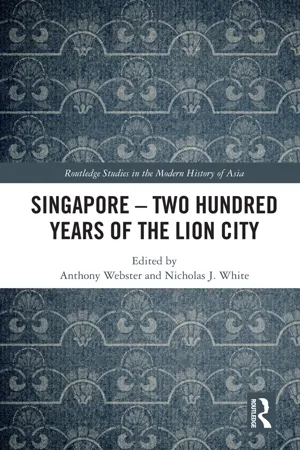
Two hundred years after Singapore's foundation by Stamford Raffles in 1819, this book reflects on the historical development of the city, putting forward much new research and new thinking. It discusses Singapore's emergence as a regional economic hub, explores its strategic importance and considers its place in the development of the British Empire. Subjects covered include the city's initial role as a strategic centre to limit the resurgence of Dutch power in Southeast Asia after the Napoleonic Wars, the impact of the Japanese occupation, and the reasons for Singapore's exit from the Malaysian Federation in 1965. The book concludes by examining how Singapore's history is commemorated at present, reinforcing the image of the city as prosperous, peaceful and forward looking, and draws out the lessons which history can provide concerning the city's likely future development.
eBook - ePub
Singapore – Two Hundred Years of the Lion City
- 254 pages
- English
- ePUB (mobile friendly)
- Available on iOS & Android
eBook - ePub
Singapore – Two Hundred Years of the Lion City
About this book
Trusted by 375,005 students
Access to over 1.5 million titles for a fair monthly price.
Study more efficiently using our study tools.
Information
Subtopic
Regional StudiesIndex
Social Sciences1 Introduction
Situating Singapore’s success
Looking to Asia for answers to domestic economic questions has been a recurring theme in British political and economic history. During the economic difficulties of the 1880s and 1890s, the potential of China as a market for British manufactures was regularly touted around the chambers of commerce of provincial Britain as a way out of depression. From the 1960s, commentators aggrieved at British economic decline, became fascinated by the Japanese economic ‘miracle’ as a potential model for the UK to follow. In the last decade or so, China has once again moved centre stage, arguably with much more justification, as a promising market for British manufactures. The fascination with Asia has been heightened by the proliferation of Asian companies setting up or acquiring manufacturing plants, prestigious property and even football clubs in the UK, including Nissan, Honda, Toyota, Tata, Sime Darby and Air Asia. The prospect of Brexit has sent cabinet ministers to the Pacific Rim in search not only of trading and investment partners but new economic models for Britain after its departure from its European harbour.
In this volume of essays, Tim Bunnell’s comparative analysis of the postcolonial reversal of fortunes affecting Liverpool and Singapore points to precisely why emulating Singapore has found favour in the UK: by the 1990s, residents of Liverpool, once one of the world’s leading port cities, were talking gloomily of being reduced to ‘Third World’ status while simultaneously Singaporean leaders, presiding over the world’s busiest port, boasted of joining the ‘First World’. For 2018, Singapore was ranked ninth in the world in the UN’s Human Development Index (HDI) compared to the United Kingdom at 14th.1 Singapore has been seen, especially by the more zealous supporters of a ‘free market’ Brexit, almost as a blueprint for post-2019 British political economy. Visiting Singapore in January 2019, Jeremy Hunt, Britain’s foreign secretary, ruled out copying the city-state’s structures in total, but he did see Singapore – an island nation of, but not entirely integrated with, its immediate region – as an exemplar from which much could be learned. Hunt cited specifically the ‘excellence of [Singapore’s] education system, the long-term investment in infrastructure and a strategic approach to how a nation sustains competitive advantage in the world.’2 The vacuum cleaner entrepreneur and vocal pro-Brexit supporter, James Dyson, went a stage further by announcing the relocation of his company’s headquarters to Singapore. The island’s low taxes, access to growing Asian markets and the recent trade agreement with the EU were cited by observers as possible reasons for Dyson’s move.3
It is ironic that exactly 200 years after Raffles claimed the island for the English East India Company interest in Singapore has been rekindled in the UK, highlighting this once iconic British colonial possession as a model for the future. The present volume therefore has an unexpected contemporary resonance in Britain, as well as being a timely reflection upon a major example of imperial ‘place-making’– of the creation (or revival, in view of the much earlier existence of Temasek-Singapura) of a major entrepôt within Britain’s Asian network of imperial city-ports, including Calcutta, Bombay, Madras, Colombo, Rangoon, Penang, Melaka and Hong Kong. Unlike so many former European-controlled cities, Singapore has enjoyed a glittering postcolonial career, rising to become perhaps the most impressive economic and social success story of Southeast Asia. In Singapore itself, this has produced some measure of ambivalence about the colonial origins of modern Singapore, as Donna Brunero emphasises in her chapter in this collection. While the ruling post-independence regime in Singapore is robustly critical of colonialism, Thomas Stamford Raffles, the primary imperial agent of 1819, remains a celebrated figure, not least for his commitment to free trade and enterprise, principles which remain firmly at the heart of modern Singaporean economic policy and national identity. This ambiguity is evident in commemoration or celebration of the bicentennial in Singapore itself. The website of the body organising the bicentennial celebrations refers to 1819 as a ‘milestone’ in Singapore’s development but not in fact the origins of the city, which are firmly placed 700 years ago, as Temasek.4 In this way, the potentially embarrassing identification of Singapore as a purely imperial creation, which might owe its success to the legacy of colonial rule, is averted. John Miksic’s chapter in the present volume certainly confirms that Raffles’s acquisition of Singapore was not an act of ‘pure’ creation but rather one of revival; of re-establishment of what had once been a major centre of trade and political authority. That said, the spectacular and rapid growth of Singapore’s population and trade in the two decades after 1819 was unprecedented and justifies the assumption encompassed in the present volume that the port’s bicentennial year marks a very significant milestone in the island’s development.5
Singapore’s success since independence is thus a matter of contemporary political attention, though its historical roots have attracted less interest or proper appreciation beyond academia. In part, this reflects that, as a former British possession, Singapore’s historical rise to prominence may reveal some uncomfortable truths about the contribution of colonial rule to that success, and this is certainly suggested in some of the chapters in this book. Bunnell’s study of Malay seafaring networks, for example, points to the commercial and cultural influence of Liverpool, the so-called ‘Second City of the Empire’, from the 1860s to the 1960s in the making of global Singapore. A controversial recent reinterpretation of the history of Hong Kong (ranked equal as seventh with Sweden in the UN’s HDI for 2018), meanwhile, has placed the offshore city-state alongside Singapore and the Gulf States in Britain’s ‘Asian city cluster’ in which the imperial power promoted free trade and provided institutional frameworks that encouraged private enterprise, while also empowering a cooperative Asian intermediary class. This benevolent colonial legacy left the post-British entrepôts as ‘engines of modernisation’ in their respective regions.6 As Stan Neal discusses in his essay in the present collection, educated and inquisitive Singaporeans recognise today how the English language and British-style institutions and law have contributed positively to the nature of the contemporary city-state. But, equally for Singapore as in Hong Kong, racial and class hierarchies, and the resulting income disparities and political upheavals, take the gilding off British colonialism.7 Moreover, irrespective of the rights, wrongs and wherefores of colonial rule vis-à-vis the postcolonial nation state, the history of Singapore’s growth should also give pause to those who seek to find in it a model which can be easily copied or transferred to other contexts. Indeed, it should become clear by reading the chapters in this volume that while Singapore has become seen as an exemplar which might be imitated elsewhere, its relative success was in many ways the interaction of a range of factors not easily replicated. It is worth spelling these out, not only to identify some of the unique reasons for Singapore’s spectacular growth (with the important caveat that this has been achieved at the expense of personal liberty) but also to bring out both elements of continuity which span the transition from imperial rule to independence and innovations post-independence which mark a break with the colonial past.
Perhaps the most striking aspect of modern Singapore from its very earliest days after 1819 was both the multi-ethnic composition of its population and its position as a gateway for the inward migration of social (and to a lesser extent financial) capital and people into the city itself and further ‘Up Country’ into the Malay peninsula. G. Roger Knight reminds us of the importance of the Scottish entrepreneurial diaspora which formed the backbone of the expatriate import-export firms – known as agency houses – which came to dominate the top echelons of Singapore’s commerce during the nineteenth century. But the European population was always tiny and itinerant, and the considerable wealth accumulation by the expatriate merchant princes was down to the lure of Singapore for more permanent Asian settlers. Singapore’s trade and population grew rapidly from the 1820s as a result of the revitalised port’s success in attracting traders from all over the Malay world eager to sell Southeast Asian produce in demand in the Chinese market (to which it was re-exported by both European and Chinese merchants) and to purchase imports from India and later from Britain, especially cotton goods.
Yet a crucial aspect of Chinese immigration into Singapore was its nature. The rapidity of the growth of the port’s Chinese population was facilitated by relocation of pre-existing Chinese communities from ports such as Melaka to Singapore, taking with them their own networks of finance and partnerships as well as their connections with China and across Southeast Asia. Recent work in regional studies demonstrates that immigration involving ‘Communities-on-the-Move’ frequently boosts economic growth most effectively when whole communities relocate, transferring with them business connections and social and familial bonds built up over time. This enables such communities to ‘hit the ground running’ in economic terms, providing a speedy and lasting boost to the local economy.8 This certainly seems to have been the case for Singapore, as Chinese merchants provided an invaluable link with traders across the region, rapidly opening markets and sources of Southeast Asian produce not only for the Chinese but for the European agency houses who came to depend on them (as stressed also in Knight’s chapter). Added to this, the later large inflow of Chinese labourers for the tin mines of the Malay states was not only facilitated by this Singaporean Chinese community, it also in doing so, furnished the imperial authorities with a means to fund government without resorting to higher taxes or trade tariffs, through the infamous system of opium farming and other exclusive retailing rights, which the Chinese kongsis (syndicates) purchased and ran. Even newcomers to Singapore from China such as Seah Eu Chin, who arrived in 1823, were able to quickly find a place within what was already a well-ordered Chinese community (as emphasised in Neal’s essay in this collection). This all amounted to the rapid installation in Singapore of a highly organised and effective Chinese community able to deliver well-established and unparalleled business services and regional linkages. Indeed, the relative openness of Singapore to inward migration remained both a feature of official policy into the post-independence period and a source of economic vibrancy. Anti-immigration British Brexiteers seeking to imitate Singapore should take note.
A second key feature of Singapore’s success was its embedded role in the commerce of Southeast Asia, and how this helped provide a platform for launching the port as a ‘global’ city. Singapore quickly became the focal point for intra-regional commerce by the late 1830s, notwithstanding efforts by the Dutch to curb its growth through protectionist tariffs. Knight shows how the Fraser brothers were ‘made in Singapore’ between the 1830s and the 1850s partly by trades that originated outside Southeast Asia – cotton textiles and opium – but simultaneously by tapping into and piggy-backing on wider intra-regional networks (notably in the rice trade). Tomotaka Kawamura’s chapter shows how this intra-Asian dimension was strengthened later in the century with the establishment of major branches for a range of Exchange Banks in Singapore and elsewhere in the region. The port’s pivotal role in facilitating mass Chinese immigration further boosted its regional centrality, and as Valeria Giacomin shows in her essay, the development of a highly effective cluster of interests linked with the rubber industry, early in the twentieth century, enabled Singapore to expand the range of its services into other nascent industries, including palm-oil production. From its earliest days, Singapore also developed commerce outside the region (as Knight’s discussion of opium reveals). Atsushi Kobayashi’s chapter examines how Singapore in the 1820s and 1830s became an important entrée to the Southeast Asia market for Indian cotton goods at a time when the subcontinent’s producers were under severe competitive pressure from British industrially produced textiles. In due course, British cottons also displaced Indian cloth from the Southeast Asian market, though local preference for South Asian textiles slowed this process. Singapore also provided the financial and labour provision services which enabled Southeast Asia to become a major supplier of raw materials to the global economy, including tin and later rubber from mainland Malaya, as well as rice and teak from Burma and Siam. It was Singapore’s integrated connections within the region which provided the platform for its global ‘career’ especially after 1900, a point emphatically made by Giacomin.
In their discussion of the Japanese Occupation of 1942–1945 in this collection, Gregg and Gillian Huff show that de-regionalisation through loss of food supplies and de-globalisation (through shutting off world markets for rubber and tin exports and imports of consumer and capital goods) led to severe economic dislocation. This commercial collapse during the Pacific War cannot have been helped by a lack of knowledge and severe repression of the overseas Chinese on the part of Japan’s administrators. As such, Huff & Huff view the post-1965 export-oriented industrialisation (EOI) of independent Singapore as a far more significant break point in the city’s economic development than the ill-fated era of Japanese rule. As Kah Seng Loh’s chapter reveals, however, the EOI strategy – targeted at both regional and wider world markets – had been anticipated as early as 1960–1961, and as Nicholas J. White’s essay suggests, this was reinforced by the negative experiences of incorporation into and separation from Malaysia between 1963 and 1965. Inter alia, White’s chapter shows how economic tensions between Singapore and Kuala Lumpur were engendered by the island’s embroilment in confrontation with Indonesia, which shut off long-established regional exchanges, and by disagreements over the formation of a common market in which Singapore’s globalised free-port status was threatened. In the post-independence era, as Loh’s chapter elucidates further, Singapore’s policy of rapid industrialisation was predicated on attracting foreign investment and selling to the global market rather than simply relying on regional interconnections. The key policy adviser, Albert Winsemius, was especially heeded in this policy, which very much aligned with the strong commercial lobby. Would-be exponents of a British ‘Singapore’ would do well to ponder the importance of regional interests for global projection in the history of Singapore’s rise. The early success of Singapore’s containerisation, for example, was linked to the technologically upgraded port’s role as a centre for regional transhipment.9 In similar vein, the coastal feeder services of, for example, the Straits Steamship Company played a key role during the colonial era in the rise of the Southeast Asian hub linked in turn to global ocean-going shipping (as addressed by both Bunnell and Giacomin).
A third factor in Singapore’s success, before and after independence, was its creation of a political and institutional framework and culture which privileged (and still privileges) commerce and international openness. The latter, as Loh stresses, was represented not just in economic exchanges but also in the willingness of successive Singapore governments (colonial and postcolonial) to take advice from overseas consultants on social and economic policy from the 1900s. That’s not to forget the important geo-strategic role which Singapore came to take on as the outer defence of Australasia as A. J. Stockwell’s chapter demonstrates. As noted in White’s essay, the British defence complex in Singapore was reckoned to account for 20–25 per cent of Singapore’s GDP in the 1960s: it was no surprise, therefore, that Lee Kuan Yew was distraught at Britain’s accelerated military withdrawal ‘east of Suez’ from 1968. But, as Stockwell shows, Singapore was late to the party of fortress colonies compared to Gibraltar, Bermuda and Malta, with the former’s naval base completed as late as 1938. Even then, Singapore continued to be valued in London primarily in economic terms as a regional commercial hub and in its facilitation of Malaya’s supplies of commodities to world markets (and the resultant dollar earnings from massive sales of rubber and tin to the US especially). This absence of a longer term ‘defence culture,’ and a lack of integration between civil and military administrations, explains the lack of preparedness for the Japanese onslaught (although Britain’s imperial overstretch in fighting a war on two fronts was necessarily a big factor in the fall of Singapore in February 1942).
Back in the early nineteenth century, Anthony Webster’s chapter shows, alienation from the East India Company’s rule and its priorities for the Straits Settlements mobilised merchants in defence of such policies as free trade and the use of the dollar, and ultimately to campaign for the Colonial Office to take over jurisdiction of...
Table of contents
- Cover
- Half Title
- Series
- Title
- Copyright
- Contents
- List of illustrations
- List of contributors
- Editors’ acknowledgements
- 1 Introduction: situating Singapore’s success
- Part I Singapore – growth, trade & economy
- Part II Singapore – politics, culture & identity
- Index
Frequently asked questions
Yes, you can cancel anytime from the Subscription tab in your account settings on the Perlego website. Your subscription will stay active until the end of your current billing period. Learn how to cancel your subscription
No, books cannot be downloaded as external files, such as PDFs, for use outside of Perlego. However, you can download books within the Perlego app for offline reading on mobile or tablet. Learn how to download books offline
Perlego offers two plans: Essential and Complete
- Essential is ideal for learners and professionals who enjoy exploring a wide range of subjects. Access the Essential Library with 800,000+ trusted titles and best-sellers across business, personal growth, and the humanities. Includes unlimited reading time and Standard Read Aloud voice.
- Complete: Perfect for advanced learners and researchers needing full, unrestricted access. Unlock 1.5M+ books across hundreds of subjects, including academic and specialized titles. The Complete Plan also includes advanced features like Premium Read Aloud and Research Assistant.
We are an online textbook subscription service, where you can get access to an entire online library for less than the price of a single book per month. With over 1.5 million books across 990+ topics, we’ve got you covered! Learn about our mission
Look out for the read-aloud symbol on your next book to see if you can listen to it. The read-aloud tool reads text aloud for you, highlighting the text as it is being read. You can pause it, speed it up and slow it down. Learn more about Read Aloud
Yes! You can use the Perlego app on both iOS and Android devices to read anytime, anywhere — even offline. Perfect for commutes or when you’re on the go.
Please note we cannot support devices running on iOS 13 and Android 7 or earlier. Learn more about using the app
Please note we cannot support devices running on iOS 13 and Android 7 or earlier. Learn more about using the app
Yes, you can access Singapore – Two Hundred Years of the Lion City by Anthony Webster, Nicholas White, Anthony Webster,Nicholas J. White,Nicholas White, Anthony Webster, Nicholas J. White in PDF and/or ePUB format, as well as other popular books in Social Sciences & Regional Studies. We have over 1.5 million books available in our catalogue for you to explore.