The French Revolution had a marked impact on the ways in which citizens saw the newly liberated spaces in which they now lived. Painting, gardening, cinematic displays of landscape, travel guides, public festivals, and tales of space flight and devilabduction each shaped citizens' understanding of space. Through an exploration of landscape painting over some 40 years, Steven Adams examines the work of artists, critics and contemporary observers who have largely escaped art historical attention to show the importance of landscape as a means of crystallising national identity in a period of unprecedented political and social change.
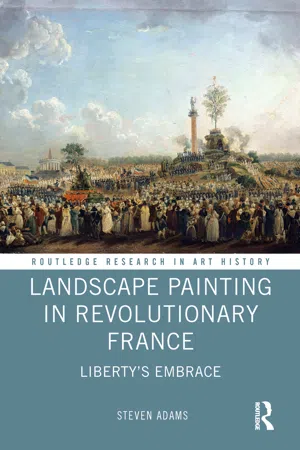
- 156 pages
- English
- ePUB (mobile friendly)
- Available on iOS & Android
eBook - ePub
About this book
Trusted by 375,005 students
Access to over 1.5 million titles for a fair monthly price.
Study more efficiently using our study tools.
Information
Topic
ArtSubtopic
Art General1 Landscape painting and the pastoral vision
Art and spatiality during the ancien régime
The Revolution of 1789 prompted a change in the way in which French subjects/citizens occupied, conceptualized and described real and imagined space. The result of this reconceptualization, as we will go on to see, is evident in revolutionary festivals, particularly those staged in the early 1790s, in direct political action – the sacking of the capital’s tax barriers and public buildings, the siege and destruction of the Bastille – in written descriptions of real and imagined spaces contained in press reports and pamphlets of the early 1790s, and not least in landscape painting. One of the ways of bringing some of these changes into sharper contextual focus is to step back and examine landscape painting and other forms of spatial expression found during the last decade or so of the ancien régime and to explore some of the characteristics of the shift from the spatialities of the old regime to those of the new.
We might think of the shift between one regime and another not as a definitive break – although some contemporaries clearly thought otherwise seeing the French Revolution as an event of biblical significance – but as a set of quite distinctly differentiated cultural strata that change at different rates, some at a breakneck speed, others at a much gentler pace.1 When in 1791, for example, Pierre-Charles Lévesque revised the late Claude-Henri Watelet’s Dictionnaire des beaux-arts following its publication three years earlier, he was aware that tastes had changed in the arts and made various ‘additions’ to its articles to account for them. But the additions curiously had little to say about the seismic political events that separated the first and second editions. For the most part, it seems that the Dictionnaire was as serviceable in 1791 as it was in 1788. Similarly, the volume of painters exhibiting at the Salon of 1791 shows a near four-fold increase over those seen two years earlier. The proportion of landscapes, portraits and the minor genres on show also increases but again – with a few notable exceptions – it is hard to identify much of a change in the appearance of the landscapes exhibited either side of the French Revolution, perhaps only their quality.2 For the most part, what changes immediately after 1789 is not the fabric of landscape painting, the specific repertoire of subjects available to painters, but rather the size and composition of the constituency who made, circulated, consumed, collected, patronized and wrote about them. During the ancien régime, those consuming, collecting and patronizing the arts in general and landscape in particular – the court, gentlemen-financiers and aristocrats of varying political persuasions, the Parisian crowd who flocked to the Salon and the various public fairs and expositions staged in the capital during the 1770s – may have been diverse, but they largely shared the same set of albeit differentiated positions within the one cultural field, the production, circulation, patronage or collection of art. Indeed, contemporary dictionaries, encyclopedias, trade directories and in some instances art criticism do much to help constitute this field, showing its limits, its strata and its social and professional composition. Trade directories of the period typically show the diversity of the profession with academicians at the top and artisans at the bottom, but it is evident that this is still one profession. It is in this context that dictionaries are often instructive. I want to begin with Watelet, author of the Dictionnaire des beaux-arts, a theorist and a practitioner of landscape, and an exceptionally well-connected amateur.
Watelet, paysage and the Dictionnaire des beaux arts
In the summer of 1785, Watelet resumed work on an ambitious project, the Dictionnaire des beaux arts, later published with Pierre-Charles Lévesque as the Dictionnaire des arts de peinture, sculpture et gravure, part of Charles-Joseph Panckoucke’s series of popular encyclopedias, and one of a number of publications prompted by the success of Denis Diderot and Jean Le Ronde d’Alembert’s famous Encylopédie.3 Watelet was well placed to undertake the task. Widely known among the artistic and literary circles of ancien régime Paris, a member of the Académie Royale de peinture et de sculpture (and academies in Rome, Florence, Cortona, Parma, Berlin, Cordoba, Madrid and Marseilles), Watelet was also an accomplished engraver said to rival Rembrandt, a prominent collector and the author of a didactic poem, L’Art de peindre that secured his membership of the Académie française. Watelet was particularly well placed to write about landscape and landscape painting, a subject examined in some detail in the lengthy article ‘Paysage’ in the Dictionnaire’s second volume published posthumously in 1791, and first put into practice some years earlier in one of the first picturesque gardens in France, Le Moulin Joli.
Back in the early 1750s, Watelet began work on the garden on an island estate a few miles upstream from Paris. Here, Watelet, his mistress Marguerite Le Comte and her husband received a succession of international luminaries who came to immerse themselves in nature, and set the cares of the modern world aside to recreate ancient bonds of friendship through art.4 Two early visitors to the garden, the landscape painter Jean-Baptiste Le Prince and the engraver Jean-Claude Richard de Saint-Non, depicted the island shortly after its acquisition by Jacques-Roger Le Comte in a series of seven engravings dedicated to the garden’s ‘gentle miller’, Watelet’s mistress Marguerite. The frontispiece to the series captures something of the tone of this new pastoral vision (Figure 1.1). In contrast to French formal gardens of the previous century, Saint-Non depicts an artfully dishevelled landscape in which men and women seemingly make only the slightest intervention into Nature. An impromptu fishing net hangs from a couple of branches, a pontoon and a broken fence crumble into the landscape framed by a vignette of reeds, a few trees and shrubs. Other engravings in the series show a similar world of pastoral tranquillity in which men and women are in such accord with Nature that the effort needed to sustain them is minimal: in one, doves flutter around a cote, a child and its nurse play beside a river shaded by trees, while cattle and sheep come to drink by a pool against the backdrop of the island mill; in another, a couple of fishermen slumber by the edge of a river while a third idly casts a line (Figure 1.2). In each instance, the image is artfully drawn but by no means laboured. The landscape and figures who occupy it are captured at apparent speed in a spirit of what Watelet later described as a moment of ‘jouissance’, the unexpected capture of a moment of joy.5 Here, there is a happy congruence between the absence of apparent labour in the pictures’ facture, and in the absence of alienated labour in the lives of those shown within the pictures, and, we might also assume, in the limited circle of friends who so enjoyed looking at them. The etchings are the work of souls sensitive to nature, made for the appreciation of others of a like-minded sensibility, who find happy incarnations of themselves within the picture of a world that has no place within the vulgar economy of labour and exchange that taints the world beyond the garden.

Figure 1.1 Saint-Non, Richard de, and Le Prince, Jean-Baptiste, Frontispiece to the Varie vedute del Gentile Mulino, 1755, etching, 14.5 × 20.3 cm (Courtesy the École Nationale supérieure des beaux-arts, the Institut national d’histoire de l’art and the Réunion des musées nationaux).

Figure 1.2 Saint-Non, Richard de, and Le Prince, Jean-Baptiste, View of a River Bank from Varie vedute del Gentile Mulino, 1755, etching, 17.7 × 26.2 cm (Courtesy the École nationale supérieure des beaux-arts, the Institut national d’histoire de l’art and the Réunion des musées nationaux).
Watelet described this pastoral vision and the social and economic conditions necessary to sustain it in some detail in a short but influential treatise on the history and principles of gardening, his Essai sur les jardins. 6 ‘Early parks’, the large, rectilinear formal gardens of the second half of the seventeenth century – Vaux-Le-Vicomte, Marly Le Roi and most conspicuously the royal palace at Versailles – were the products of ‘feudal pride’, he argued; the large enclosures were ‘uniform, dreary and boring’, economically unproductive and potentially damaging to the ‘common good’. In the same way that feudal lords maintained their dominance by fortifying their homes with towers, so their gardens were protected by walls to contain a ‘timid’ fauna for the barbaric act of hunting, a clear indication of feudalism’s alienation from the natural world.7 Gardens in the ‘poetic’ style’, those adorned with classical architecture and statuary, may, Watelet went on, ‘lead us to believe that we are for a moment transported to distant times and places’, but the gardens were socially exclusive and the use of heavy literary allusion made the poetic garden inaccessible to all but the educated.8 ‘Pleasure gardens’ fell similarly short of this pastoral ideal. They were made to offer excessive stimulation to a privileged class whose tastes were already jaded by their immense wealth. Such gardens were, he argued, a sign of voluptuous excess that was seen as an enemy of both virtue and good taste.9 ‘French gardens’ (Watelet was keen to distinguish his own project from an English tradition of informal gardening that, he argued, had its origins in ancient China) took on a more sustainable form. In ‘A letter to a friend’, the concluding chapter to the Essai, Watelet describes his first encounter with his island estate some 20 years earlier, one that sets out not only the key ingredients of ‘French’ gardens, but also something of the political and moral economy that sustains them.
The epistolary form sets the tone. The letter is not so much a programme for garden design in which a plan is imposed on nature but the record of a moment of revelation in which Nature and the ancient but now broken contract it once enjoyed with men and women imprint themselves on the psyche of the gentleman viewer sensible enough to receive its overtures. On a short ferry crossing on his return to Paris, Watelet described how his thoughts had momentarily turned from art and friendship – ‘two subjects so dear to him … that they dominate all others’ – to an idyllic vision of nature ‘a couple of a league in the distance’.10 There, he encountered several small islands divided by meandering streams, a working seventeenth-century mill, and a cottage so simple that it resembled a ‘parish priest’s vicarage’.11 Nestling in the shade of a linden wood set against a rural backdrop of productive fields and gardens, men and women lived modestly but happily, in perfect physical and emotional accord with the world around them. Watelet was so moved to share his impressions of the site with his friends that he eventually took up residence. An artist (either François Boucher or Xavier Le Prince) designed a home for Watelet’s ménage. Thereafter, the improvements made to the garden were reportedly few and those that were made instantly flourished, a sure sign, according to Watelet, of Nature’s affirmation of the attentions lavished on her.12
In practice, as Françoise Arquié-Bruley has shown, the improvements made to the garden were considerable and helped contribute to Watelet’s precarious financial position in the early 1780s.13 A charge levelled at him for financial irregularity in 1776 estimated that improvements to the garden accounted for some 300,000 livres (about 1 million Euros). The figure was p...
Table of contents
- Cover
- Half-Title
- Series
- Title
- Copyright
- Dedication
- Contents
- Figures
- Acknowledgements
- Foreword
- Introduction: Landscape and landscape painting in Revolutionary France
- 1 Landscape painting and the pastoral vision: Art and spatiality during the ancien régime
- 2 Making space for the Revolution
- 3 ‘The passive instrument of the First Consul’s will’: Painting landscapes for Napoléon Bonaparte
- 4 Blindness, amnesia and consumption: Painting landscapes in Restoration France
- 5 ‘Comment cela finira-t-il?’: A postscript
- Bibliography
- Index
Frequently asked questions
Yes, you can cancel anytime from the Subscription tab in your account settings on the Perlego website. Your subscription will stay active until the end of your current billing period. Learn how to cancel your subscription
No, books cannot be downloaded as external files, such as PDFs, for use outside of Perlego. However, you can download books within the Perlego app for offline reading on mobile or tablet. Learn how to download books offline
We are an online textbook subscription service, where you can get access to an entire online library for less than the price of a single book per month. With over 1.5 million books across 990+ topics, we’ve got you covered! Learn about our mission
Look out for the read-aloud symbol on your next book to see if you can listen to it. The read-aloud tool reads text aloud for you, highlighting the text as it is being read. You can pause it, speed it up and slow it down. Learn more about Read Aloud
Yes! You can use the Perlego app on both iOS and Android devices to read anytime, anywhere — even offline. Perfect for commutes or when you’re on the go.
Please note we cannot support devices running on iOS 13 and Android 7 or earlier. Learn more about using the app
Please note we cannot support devices running on iOS 13 and Android 7 or earlier. Learn more about using the app
Yes, you can access Landscape Painting in Revolutionary France by Steven Adams in PDF and/or ePUB format, as well as other popular books in Art & Art General. We have over 1.5 million books available in our catalogue for you to explore.