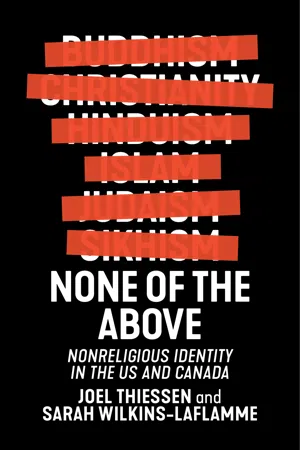
Compares secular attitudes characterizing "religious nones" in the United States and Canada Almost a quarter of American and Canadian adults are nonreligious, while teens and young adults are even less likely to identify religiously. None of the Above explores the growing phenomenon of "religious nones" in North America. Who are the religious nones? Why, and where, is this population growing? While there has been increased attention on secularism in both Europe and the United States, little work to date has focused on Canada. Joel Thiessen and Sarah Wilkins-Laflamme turn to survey and interview data to explore how a nonreligious identity impacts a variety of aspects of daily life in the US and Canada in sometimes similar and sometimes different ways, offering insights to illuminate societal and political trends. With numbers of nonreligious people even higher in Canada than in the US, some believe that secular currents to the north foreshadow what will happen in the US. None of the Above asserts that a growing divide between religious and nonreligious populations could engender a greater distance in moral and political values and behaviors. At once provocative and insightful, this book tackles questions of coexistence, religious tolerance, and spirituality, as American and Canadian society accelerate toward a more secular future.
eBook - ePub
None of the Above
Nonreligious Identity in the US and Canada
- English
- ePUB (mobile friendly)
- Available on iOS & Android
eBook - ePub
About this book
Trusted by 375,005 students
Access to over 1.5 million titles for a fair monthly price.
Study more efficiently using our study tools.
Information
Topic
Theology & ReligionSubtopic
Religion1
I’m Done … and I’m Not Going Back!
Patrick grew up in a small bilingual French-English village in Eastern Canada. Raised in the Catholic tradition where he was “forced” to attend mass most weeks, Patrick described his first communion as “an obligation to the grandparents.” He, his parents, and his siblings ceased attending weekly mass once the youngest in the family had their first communion, and he noted that many in the community gossiped about his family’s decision to stop attending regularly. Unlike Darlene’s experience described earlier, Patrick did not describe his family as particularly religious growing up. They did not pray or read scripture or talk about their faith in the home. Now in his early thirties, Patrick listed his grievances against the Catholic Church and religion overall. He cited the heavy emphasis on Jesus rather than God, religion’s negativity toward scientific advances, religious diversity and uncertainty of which religion is right, the oppression of women, and attempts by religious groups to control people’s attitudes and behaviors. Patrick still believes in God, though not as an active force in the world. He is unsure about the afterlife, saying, “I view our time on this world as a short-term thing … just enjoy yourself, rather than [worry] about what’s after … there’s joy in life so why not try to achieve as much joy as you can while you’re alive.” Regarding attending church, he adamantly claimed, “I don’t attend, and I never plan on attending again.” He carried on to reflect that religion can be both positive and negative in society. As for his level of confidence in his perspectives on religion and life? Patrick declared, “I might not believe that I’m right, but I know that if you came and tried to push religion on me, I would believe you are wrong.” Patrick’s confidence, like others we will encounter, alerts us to the stable “none” identity that many who say they have no religion seem to possess.
When looking at statistics that show that a growing segment of Americans and Canadians have done away with a religious identity, one of the first questions that often come to mind is why. How do individuals such as Patrick describe their own journey that led them not only to stop any regular religious practice or contact with a religious group but also to go one step further and break all identity ties from their family’s, potentially their region’s or their culture’s, and their own predominant religious tradition? This chapter explores some of these biographic pathways leading someone to say they have no religion—a group that sociologist Stephen Bullivant (2017) winsomely identifies as “nonverts”—and what such individuals often share in common.
As we will show, and confirming existing literature, a majority of religious nones in the United States and Canada fall into this nonvert category, meaning they were raised with a religion and later set it aside. Yet, not everyone who says they have no religion grew up in a religious tradition. Some are, again to borrow from Bullivant (2017), “cradle nones.” When they were children, these individuals had little to no contact with religion, experiencing irreligious socialization. For both “nonverts” and “cradle nones,” we show how their individual narratives must be understood in relation to their wider social environments, within a broader, notably generational, stages of decline process, and that there are also a series of macrolevel historical, cultural, political, and demographic factors affecting the overall size of the religious none population in a given area.
Reasons for Becoming a Religious None
As we saw in the introduction with the stages of decline framework, as organized religion plays a smaller and smaller role in other aspects of social life, such as in education, health and cultural identity, disaffiliation, or leaving one’s religion becomes a viable option for some individuals in society. In turn, this initial exit from one’s religion can generate a snowball effect: as irreligion grows, the stigma that was once attached to it gradually fades and it becomes increasingly socially acceptable to be unaffiliated. More individuals become willing to adopt this detached stance toward religion.
Then, when these individuals are ready to start families, their children are born into homes that are either indifferent toward religion or even sometimes actively against it. Fewer children receive any religious socialization during their formative years: fewer step foot in a place of worship, even for special occasions, and fewer receive any form of religious education at home, at school, or elsewhere. These individuals then have a good chance of remaining nonaffiliated as adults, for example, not even considering religion as a possible place to turn to for comfort in times of hardship later in life. And when they are ready to have children of their own, the pattern of raising nonaffiliates continues (Baker and Smith 2015; Bengtson, Putney, and Harris 2013; Clarke and Macdonald 2017; Dillon and Wink 2007; Manning 2013; Merino 2012; Zuckerman 2012). Although present among those of many different religious backgrounds, these processes leading to nonaffiliation have been most common in the United States and Canada among individuals and families from Christian backgrounds (Bibby 2011; Clarke and Macdonald 2017; Reimer and Hiemstra 2018; Sherkat 2014). In the United States, mainline Protestants have historically been the main feeders to the religious none category, followed by Catholics and Evangelical Protestants of late (Bengtson, Putney, and Harris 2013, 152; Drescher 2016, 16–17; Sherkat 2014, 71). In Canada, the same trends are present, along with those raised Buddhist who are disproportionately prone to identify as nones in their adult years (Clarke and Macdonald 2017; Reimer and Hiemstra 2018, 12).
While all people have their own unique biographic story of how their relationship, or lack thereof, with religion has developed over the course of their lifetime, among religious nones we often group their pathways into two broad categories: those who were exposed to religion during their childhood but who chose to leave it behind at some point later on in their lives (disaffiliation, which characterized twenty-four of our thirty interviewees) and those who grew up with no religion (irreligious socialization, found among six of our thirty interviewees; Baker and Smith 2015; Bullivant 2017; Merino 2012; Thiessen and Wilkins-Laflamme 2017; Zuckerman, Galen, and Pasquale 2016). We observe these two main pathways of disaffiliation and irreligious socialization when asking questions in surveys, and also when interviewing the unaffiliated in depth about how they became a religious none.
Nonverts and Religious Disaffiliation
As shown in figure 1.1, in the United States in 2008 56% of religious nones reported that their parents had a religious affiliation, and half conveyed they attended religious services at least once a month when growing up. In Canada, these percentages in 2005 are very similar at 55% and 50% respectively. Consequently, a (slim) majority of religious nones in the United States and Canada appear to be coming from religious backgrounds.

Figure 1.1. Disaffiliation indicators, USA (2008) and Canada (2005). Source: (1) US GSS 2008. N = 1,344. (2) Project Canada Survey 2005. N = 1,933. All estimates weighted to be representative of general populations.
Among the twenty-four religious nones interviewed who fall into the category of disaffiliates, what is first apparent is that twenty-three of them left their childhood religion during their teen or young adult years. In other words, we are not dealing with religious nones who maintained religious affiliation well into their adult years and then turned away from it. This is in line with what many researchers studying the nonreligious have found: late adolescence and young adulthood is a crucial time for becoming a religious none (Bruce 2011; LeDrew 2013; Pasquale 2010; Roozen 1980; Zuckerman, Galen, and Pasquale 2016). Moreover, in line with other excellent qualitative research in the United States (Drescher 2016; Zuckerman 2012), the disaffiliation process among interviewees is typically a gradual rather than a sudden development. Religious nones often do not leave their religion behind overnight (see also Bullivant 2008a; Jamieson 2002).
Sixteen of the interviewed unaffiliated experienced what researcher Phil Zuckerman (2012) calls a mild form of disaffiliation, meaning that these disaffiliates were not overly religious to begin with. American scholar Elizabeth Drescher (2016) indicates that this type of less or untroubled passage into disaffiliation seems to occur most often among those from liberal Protestant backgrounds in the United States, a finding that resonates with our Canadian interviewees too. The remaining eight unaffiliated individuals interviewed underwent a more transformative disaffiliation experience where they broke away from a stronger and typically more conservative (e.g., Catholic or Evangelical) religious background (also see Bengtson, Putney, and Harris 2013; Roof 1999).
So what contributed to these different trajectories for disaffiliation, and how are these processes at work in people’s lived experiences? Although we cannot identify with our data if any one factor plays a key role over others, here we do turn to four central reasons that help to account for the disaffiliation process among the twenty-four nonverts interviewed, as well as mentioning, when relevant, other important catalysts identified in the existing literature. For some interviewees, only one of the following variables was necessary for their religious exit; for others, a combination of these factors facilitated their disaffiliation.
Parents Give Choice to Children
The first factor is that parents gave their children in their preteen or teen years the choice of continued religious involvement, and many took this opportunity to step away from their religious group. Barbara is in her early fifties and has worked in retail her entire career. She stated, “Mom was Catholic. We were dragged to church every Sunday. Dad was Anglican. Didn’t go to church until later in his life when we moved back to Calgary.… Mother took us up until age sixteen. We had to go every Sunday. We did the midnight mass. We did Easter. We did it all. And then at sixteen, we were given the choice if we wanted to keep going. And of course, we’re all, ‘No! That’s it. I’m done!’”
Along with parents giving religious choice to their children, it was clear in the interviews that religion was not that salient for parents either. Many discuss that, aside from their family attending religious services, sometimes more to see friends and gossip than for explicit religious reasons, religion was rarely spoken of in the home and religious practices such as prayer or scripture reading were absent in the home so far as they could recall. Samantha, in her midtwenties and a recent university graduate with a bachelor of science degree, recalled, for example, that her family attended a conservative Protestant congregation when she grew up: “We did go to church sometimes, but it was never, like, a solid part of who we were as a family.” Identifying with a religion was often equated simply with being a good moral person.
Consequently, there is a fine and often fuzzy line between disaffiliation and irreligious socialization. On the one hand, parents valued religion enough to provide some religious exposure to their children. Their children had sufficient association with religion in order to make a conscious decision to disaffiliate. On the other hand, parents who gave children choice over religious affiliation and involvement, especially in homes where religion was not that important to parents to begin with, could be interpreted as evidence of irreligious socialization (or at the very least, the absence of intentional religious socialization). We lean toward the former interpretation because even weak religious socialization is still religious socialization; however, we think that weak religious socialization is indicative of the gradual secularization processes discussed in the previous chapter. It seems that parents do not value and pass on religious belief and practice in the same ways today than in previous generations where choice was rarely an option (see Crockett and Voas 2006; Manning 2015; Thiessen 2016). As such, we see a logical connection from disaffiliation due to choice during one’s teen years to weak religious socialization and irreligious socialization. Additionally, without a solid and long-standing religious base themselves, it is unlikely that religious nones would in turn attempt to pass on religious affiliation, belief, or involvement to their children—at least in any substantive way where religion would play an important role in their life or their children’s lives.
Intellectual Disagreements
Second, intellectual disagreements contributed to some interviewees setting their religious affiliation aside. These ranged from tensions between evidence-based science versus faith (see also Baker 2012) to personal experiences not aligning with religious or church teachings (e.g., God is loving yet pain and suffering exist in the world) and the many faith groups in existence that make it difficult for individuals to settle with any one religion in particular. The strong ties between political and Christian rhetoric in the United States, especially at the right end of the political spectrum, which researchers such as Hout and Fischer (2002) and Putnam and Campbell (2010) argue may drive some individuals to say they have no religion, would also fall into this category.
For interviewees in Alberta who disaffiliated, theirs was a gradual process as time, experience, and heightened awareness of different viewpoints culminated in officially adopting a religious none status. Many of these same realities come to the surface in an American context too, such as with Phil Zuckerman’s (2012, 33–39) interviews with apostates, and with a Pew Research Center survey (2016) of just under nine hundred disaffiliated Americans that shows 49% identifying disagreement with or lack of belief in religious teachings as a reason they disaffiliated, along with 20% saying they left because they disliked organized religion. We return to Patrick, whom we introduced at the beginning of this chapter. He identified science as a significant reason for his gradual disbelief:
All the wonderful things that we’re doing with science, kind of put in question … you need to believe in what I say and you can’t question the approach of the church, and then the big bang theory … what’s the science behind it? And then religion tells you, don’t worry about the science, just believe blindly … but explain to me the science, and it’s like, don’t believe in the science.… Focus on just believing and … do what I say … don’t follow your heart … just go with blind faith … and then you know your question goes unanswered … then … every time the community gets a dumbfounded question, it’s like, have faith, and then that’s the answer … give me a little bit more.… And then we’ve seen evolution, and especially in the 1900s, if you don’t believe in evolution then look around you … the evolution that we’ve gone through in the last hundred years … and I think that’s where … the church has a hard time … science versus the religion.… I saw the science … it’s more mathematical, science, than religion where … you don’t have proof other than the Bible, which was written how many years ago by people you don’t even trust.
Tracie is a manager in a marketing department, now in her late thirties. She attended Anglican services with her mom and siblings growing up. Her dad was not religious. After she was confirmed at around ten ...
Table of contents
- Cover
- Half Title
- Series Page
- Title Page
- Copyright
- Contents
- Introduction: Nonreligious Identity in the US and Canada
- 1. I’m Done … and I’m Not Going Back!
- 2. Nones of All Shapes and Sizes
- 3. We Are Just as Moral … If Not More!
- 4. I Want Everybody to Have the Same Chance to Find Happiness
- 5. It’s Too Bad Your Parents Aren’t Christian …
- Conclusion: Darlene, Patrick, Corrine, and Sandra
- Acknowledgments
- Appendix A: Interview Guide Used in Semistructured Interviews with Religious Nones
- Appendix B: Further Statistical Results from Chapter 2
- Appendix C: Further Statistical Results from Chapter 3
- Appendix D: Further Statistical Results from Chapter 4
- Notes
- Bibliography
- Index
- About the Authors
Frequently asked questions
Yes, you can cancel anytime from the Subscription tab in your account settings on the Perlego website. Your subscription will stay active until the end of your current billing period. Learn how to cancel your subscription
No, books cannot be downloaded as external files, such as PDFs, for use outside of Perlego. However, you can download books within the Perlego app for offline reading on mobile or tablet. Learn how to download books offline
Perlego offers two plans: Essential and Complete
- Essential is ideal for learners and professionals who enjoy exploring a wide range of subjects. Access the Essential Library with 800,000+ trusted titles and best-sellers across business, personal growth, and the humanities. Includes unlimited reading time and Standard Read Aloud voice.
- Complete: Perfect for advanced learners and researchers needing full, unrestricted access. Unlock 1.5M+ books across hundreds of subjects, including academic and specialized titles. The Complete Plan also includes advanced features like Premium Read Aloud and Research Assistant.
We are an online textbook subscription service, where you can get access to an entire online library for less than the price of a single book per month. With over 1.5 million books across 990+ topics, we’ve got you covered! Learn about our mission
Look out for the read-aloud symbol on your next book to see if you can listen to it. The read-aloud tool reads text aloud for you, highlighting the text as it is being read. You can pause it, speed it up and slow it down. Learn more about Read Aloud
Yes! You can use the Perlego app on both iOS and Android devices to read anytime, anywhere — even offline. Perfect for commutes or when you’re on the go.
Please note we cannot support devices running on iOS 13 and Android 7 or earlier. Learn more about using the app
Please note we cannot support devices running on iOS 13 and Android 7 or earlier. Learn more about using the app
Yes, you can access None of the Above by Joel Thiessen,Sarah Wilkins-Laflamme in PDF and/or ePUB format, as well as other popular books in Theology & Religion & Religion. We have over 1.5 million books available in our catalogue for you to explore.