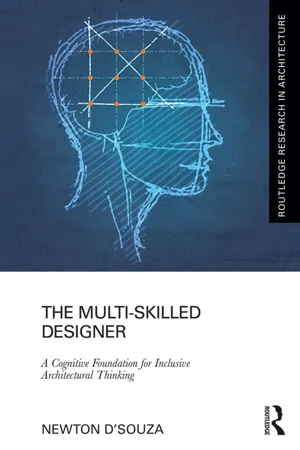
eBook - ePub
The Multi-Skilled Designer
A Cognitive Foundation for Inclusive Architectural Thinking
- 242 pages
- English
- ePUB (mobile friendly)
- Available on iOS & Android
eBook - ePub
The Multi-Skilled Designer
A Cognitive Foundation for Inclusive Architectural Thinking
About this book
The Multi-Skilled Designer presents and analyzes different approaches to contemporary architectural design and interprets them through the theory of multiple intelligences. The book establishes a systematic framework that uses the lens of cognitive psychology and developments in psychometric and brain research to analyze the unique cognitive thought processes of architectural designers and compiles design projects that could serve as a pedagogical companion for the reader. The book is aimed at design practitioners and students interested in examining their own thinking styles as well as those involved in design cognition research.
Tools to learn more effectively

Saving Books

Keyword Search

Annotating Text

Listen to it instead
Information
1
The multi-skilled designer
Introduction
Nearly 20 years ago, I left behind a position with a burgeoning architectural firm and returned to graduate school out of an earnest yearning to explore better ways of design. Dissatisfied with my own design process and quickly on my way to becoming a young burnout, I found myself seeking answers to essential questions of design. What do designers really do? What are the attributes of a good designer? How do designers achieve their highest creative potential? What began initially as a quest for better ways of designing, which sometimes lead beyond design, took me to the realization that I was missing the central question. This central question, one that seems deceptively simple as posed by one of my graduate school professors and yet is anything but, is: Ultimately, what is design?
Even as an undergraduate design student, I have been long interested in the intellectual epiphany that a designer experiences in design conceptualization. Figure 1.1 is a sketch of mine during those years for a design proposal for a Center for Oceanography, one that a jury member commented as being “sketchy” and not developed enough. It was true that I enjoyed conceptualizing design projects more than the grind of “well-developed” solutions. As designers, it is an experience none too familiar when confronted with a new design project that we encounter a feeling of “stuckness” (a mental block of feeling stuck in the middle of design process), whether due to lack of information, uncertainty of how to proceed, or simply feeling lost from information overload.1 If and when design ideas emerge, it is usually at the threat of an impending deadline, at which time we launch into a flurry of design ideations. During these initial stages, I often found myself venturing into new creative realms – which partly explains the “sketchy” forms during my jury reviews. I often wondered whether and how I could be more efficient and disciplined in my conceptual thinking. My pursuit of design thinking as graduate student was therefore, in part, motivated by my desire to investigate better ways of thinking about design and, ultimately, optimize my design process.
When I first began this quest, the extant literature on design process and psychological attributes of design were loosely compiled under the area of

Figure 1.1 Author’s thesis proposal for a Center for Oceanography (1993) that the reviewers found too “sketchy”
design cognition, which involves how designers think and solve problems. As my interest in design thinking endured, I decided not to return to my design practice as originally planned but instead continued in the pursuit of this research inquiry, which expanded to several other domains, including architectural theory, cognitive psychology, design computation, and environment-behavior, among others. This book is an attempt to synthesize these different strands of design thinking – drawing on an academic perspective but also reflecting on my own tacit experiences as both a practicing architect and interior designer.
Indeed, the world of design is changing dramatically due to advances in technology and the distributed nature of practice. For instance, speaking from personal experience, I was schooled in the modernist paradigm, practiced in the post-modernist paradigm, and currently teach in a parametric era. However, some of the questions raised by this book are fundamental to the way we learn, teach, and communicate design. In the current era of design described in terms of “blobs” and “force fields,” we might wonder whether past compositional sensitivities are becoming obsolete. Have design skills changed so radically that we need to rethink how design is taught and learned? In the face of ever-changing systems of paradigms, it is a daunting task to maintain a strong foothold on time-honored design principles, much less conceive of a set of design skills to apply or teach. However, it is a critical point of departure that only reinforces my belief that designers today need multiple skillsets to negotiate the complex design issues emerging in this 21st-century design context. Design problems of today vary far too greatly – in terms of their content, scale, and complexity and demand a repertoire of mental representations (e.g., spatial visualization, problem-solving, verbal skills, communication skills, interpersonal skills) – to be limited by notions of paradigm and associated skillsets.
In making a case for the multi-skilled designer, this book explores design skills, the processes by which design skills are implemented, and the extent to which these skills can be described within current design works. By “design skills,” I mean those skills that are most relevant to design. I first proposed a multiple skills framework in my doctoral dissertation entitled Design Intelligence: A Case for Multiple Intelligences in Design, which was based on ideas popularized by cognitive psychologist Howard Gardner. Gardner’s multiple intelligences framework consists of eight forms of intelligences: verbal/linguistic, logical/mathematical, spatial, bodily-kinesthetic, musical, interpersonal, intrapersonal, and naturalistic intelligences. The conclusion of my dissertation was that architectural designers were more likely than other disciplines to use all their design skills in some threshold capacity, although they excelled in specific disciplinary skills (such as spatial skills). However, I also concluded that merely possessing multiple skills in design is insufficient. Designers need to blend these skills meaningfully in order to successfully and consistently apply them to design problems. Ultimately, I found that both the conception and application of design skills must be conducted in a situated and dynamic manner, rather than universally applied.
This book is the culmination of the lessons learned during my studies of architectural pedagogy, through my 18 years of teaching experience as a design professor, and through vibrant discussions and interactions with my professional practice colleagues. The book is structured to benefit a variety of audiences at different levels. The primary audience are those involved in design cognition research, an area that overlaps with the psychology of design thinking, and includes practitioners of design, design theorists, computer scientists interested in design, and neuroscientists interested in how the design mind works. While the book is presented as a cognitive-historical project, it might also be used by design practitioners and students interested in examining their own thinking styles. Although the examples are mostly derived from architectural discourse, the book can be useful to a wide continuum of design disciplines, including architecture, interior, design, urban design, and industrial/product design.
The theoretical contributions of the book are: first, to provide a cognitive explanation for multiple approaches in architecture design thinking; second, to describe attributes of specific design skills; third, to outline how these skills function in a design process; and, fourth, to outline its practical and pedagogical implications. The goal of the book is not to debate how design ought to be performed but to understand how specific skills might make specific designs possible – hence, the book does not intend to make value judgments on specific paradigms, such as modernist versus parametric styles of thinking. Rather, the paradigms used here are intended to provide context as to why certain skills might be disposed to those ways of thinking. In a sense, this book could also be used as a self-diagnostic tool to examine one’s own skills. For example, a designer with a limited skillset might want to expand his/her repertoire of skills or sharpen the skills s/he does have. Furthermore, increasing self-awareness of our own skills not only helps us to better understand and move ourselves along in the design process but lends to our ability to empathize with other designs’ strengths and weaknesses. In this respect, it should be no surprise that the multiple intelligences framework is often used as a career-advising tool in educational circles and may have some utility for careers in design as well.2
Hence, the goals of the book are:
- To establish a systematic framework that uses the lens of cognitive psychology and developments in psychometric and brain research to analyze the unique cognitive thought processes of architectural designers;
- To highlight skills diversity demonstrated in unique design approaches using examples from iconic design work as well as alternative practices;
- To compile design projects that could serve as a pedagogical companion for design studio instructors, design reviewers, practitioners, and students;
- To synthesize literature from architectural theory, practice, and design cognition;
- To explain tacit design processes from an architectural practitioner’s point of view.
Using the multiple intelligences framework as a broad template, the book explores archival resources and documentation of practicing architects not typically captured in popular magazines or mainstream design discourse. Examples include iconic design works but also alternative design practices. The use of iconic design works familiar to the larger design community provide an anchor to start the conversation on multiple intelligences in design. On the other hand, alternative design practices, although less frequently discussed in the design literature, are essential to making the area of design cognition inclusive. Lauri Baker, for instance, designed spaces using local wisdom, cost-effective strategies, community stewardship, and local craftsman culture, among other elements.
In a way, the book is also a cathartic exercise. As I elaborate on multiple skills – some of which are not necessarily strengths of mine – they provide me with multiple vantage points from which to examine the design process, nevertheless. The intention is to identify, describe, and present a matrix of individual approaches so practitioners and educators can appreciate the validity of each in their own right.
In order to understand the scope of the book, it is also worth mentioning what the book is not. While the book identifies design styles, it is not about styles. Indeed, each designer featured operates under different design paradigms, and I deliberately highlight their individual biases to demonstrate certain tendencies of architects toward design. However, the intention is not to pigeonhole individual architects based on these biases nor to make an argument as to why we should favor some designers over the others. Instead, different styles are highlighted to make the case that the practice of architecture can be approached in a variety of ways.
The book is also more about the process of architecture and less about the products of design. Whether sound processes lead to sound products is certainly debatable, but one can identify a certain level of consistency and a dominant way of thinking in each designer’s body of work, which itself implies a certain successful method of doing design. Additionally, since the focus is on the conceptual design process, rather than the product itself, no illustrations of finished design products are presented in this book. The focus is instead on design representations manifested when a building is merely a seed in the designer’s mind.
This book is largely about how designers think – or, more importantly, it is a speculation into why they think the way they do. In recent years, considerable interest has been generated in design thinking, deriving from cognition, neuroscience, design computation, and Artificial Intelligence in design. Although domains outside of design have provided substantial insight into design thinking, these insights have often been fragmented and riddled with misperceptions about the domain of design. For instance, professional architects attending conferences on design computation have complained about how simplistically the architectural domain is presented and perceived at these conferences. Intrigued by this same issue, I attempt to highlight the complexity of the architect’s mind in hopes of opening up the possibilities for discussion and transfer between related domains. In essence, I propose a multiple intelligences view of architectural design – one that is inclusive of various modes of thinking.
Navigating the book
In making a case for the multi-skilled designer, the introductory chapter outlines the author’s journey in writing the book and lays a road map for navigating the chapters. It makes a case for valuing the practice of multiple skills among designers in order to nurture diversity in design thought, empathize with variations in individual strengths, and implement diagnostic tools for design thinking. The multiple intelligences framework from cognitive psychology is introduced as an explanatory framework for skill diversity in design.
The second chapter introduces the subject of design cognition and its relevance to archival and empirical studies conducted on design thinking. It contextualizes design thinking in terms of the unique nature of design problems, design creativity, design representations, digital technology, and collaborative design thinking.
The third chapter outlines the measurement and mapping of design skills using psychometric and neuroscience literature. The terminology of design skill is clarified in the context of cognitive-historical research in design. A rationale for multiple intelligences framework is presented along with a methodology to measure multiple skills in design.
The next eight chapters elaborate on specific skill categories in the context of architectural design (intrapersonal, interpersonal, suprapersonal, bodily-kinesthetic, naturalistic, spatial, linguistic, and logical-mathematical). Each chapter begins with a description of the specific design skill, followed by selective documentation demonstrating the practice of these skills in the works of iconic designers and alternative practitioners. The accompanying illustrations of work are not intended to represent a comprehensive catalog of the designer’s body of work but instea...
Table of contents
- Cover
- Half Title
- Series Page
- Title
- Copyright
- Dedication
- Contents
- List of illustrations
- Acknowledgements
- 1 The multi-skilled designer
- 2 Design cognition
- 3 Mapping design skills
- 4 Intrapersonal skills: Daniel Libeskind’s multivalent explorations and Peter Zumthor’s atmospheric poetics
- 5 Interpersonal skills: Alejandro Aravena’s social persuasion and university-based design center’s community engagement
- 6 Suprapersonal skills: Louis Kahn’s Treasure of Shadows and Zaha Hadid’s force fields
- 7 Bodily-kinesthetic skills: Holl’s Parallax and Hertzberger’s social activation
- 8 Naturalistic skills: Geoffery Bawa’s bio-climatic scenographies and Chris Corenlius’ landscape narratives
- 9 Spatial skills: Frank Lloyd Wright’s destruction of the box and Tadao Ando’s spatial nothingness
- 10 Verbal/linguistic skills: Bernard Tschumi’s narrative deconstruction and Maya Lin’s prose poetry
- 11 Logical-mathematical skills: Le Corbusier’s Cartesian order and Greg Lynn’s non-linear dynamics
- 12 The metaphor of an ensemble: theoretical, practical, and pedagogical implications of multiple skills
- Index
Frequently asked questions
Yes, you can cancel anytime from the Subscription tab in your account settings on the Perlego website. Your subscription will stay active until the end of your current billing period. Learn how to cancel your subscription
No, books cannot be downloaded as external files, such as PDFs, for use outside of Perlego. However, you can download books within the Perlego app for offline reading on mobile or tablet. Learn how to download books offline
Perlego offers two plans: Essential and Complete
- Essential is ideal for learners and professionals who enjoy exploring a wide range of subjects. Access the Essential Library with 800,000+ trusted titles and best-sellers across business, personal growth, and the humanities. Includes unlimited reading time and Standard Read Aloud voice.
- Complete: Perfect for advanced learners and researchers needing full, unrestricted access. Unlock 1.4M+ books across hundreds of subjects, including academic and specialized titles. The Complete Plan also includes advanced features like Premium Read Aloud and Research Assistant.
We are an online textbook subscription service, where you can get access to an entire online library for less than the price of a single book per month. With over 1 million books across 990+ topics, we’ve got you covered! Learn about our mission
Look out for the read-aloud symbol on your next book to see if you can listen to it. The read-aloud tool reads text aloud for you, highlighting the text as it is being read. You can pause it, speed it up and slow it down. Learn more about Read Aloud
Yes! You can use the Perlego app on both iOS and Android devices to read anytime, anywhere — even offline. Perfect for commutes or when you’re on the go.
Please note we cannot support devices running on iOS 13 and Android 7 or earlier. Learn more about using the app
Please note we cannot support devices running on iOS 13 and Android 7 or earlier. Learn more about using the app
Yes, you can access The Multi-Skilled Designer by Newton D'souza in PDF and/or ePUB format, as well as other popular books in Arquitectura & Arquitectura general. We have over one million books available in our catalogue for you to explore.