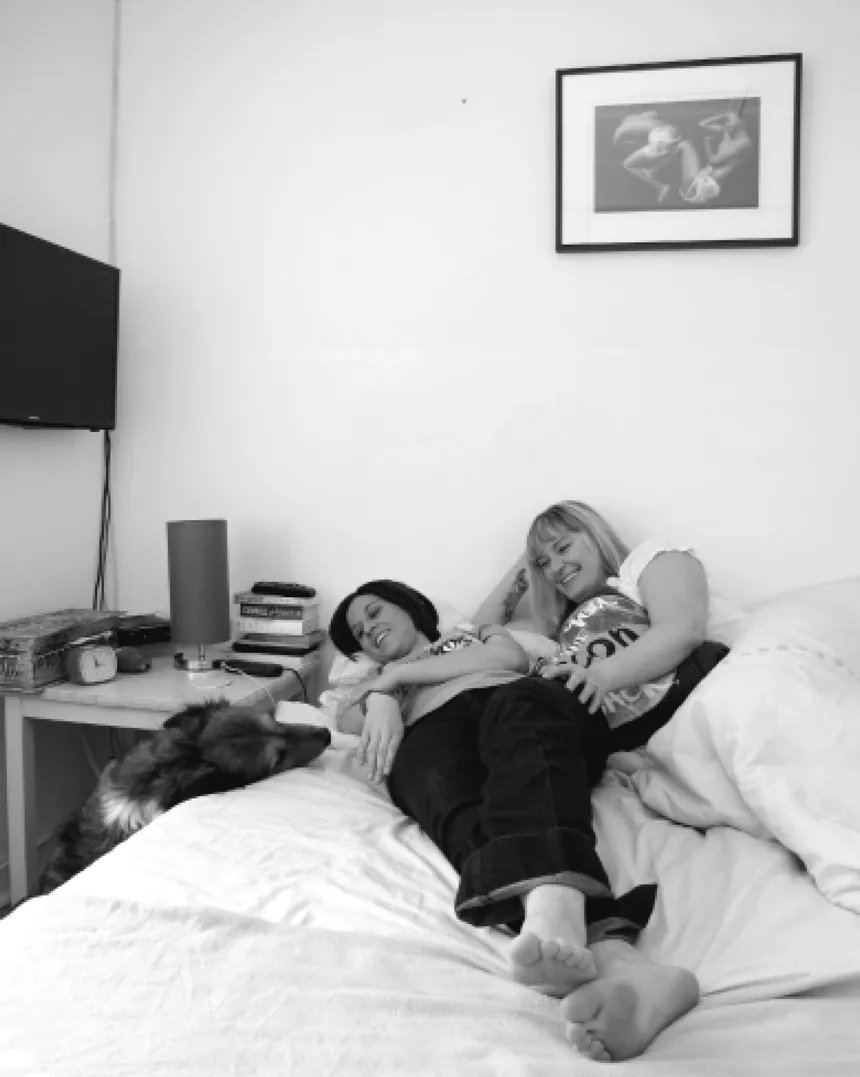
This section is book-ended by two chapters that creatively explore notions of family and belonging, primarily through visual media. Both series of images expand the conditions for kinship beyond bio-genetic connection, to include human-animal bonds, genderqueer identities, families formed through reproductive technologies, adoption, friendships, and bonds of marriage.
Chapter 1 is a photographic essay by artist/activist Germaine de Larch whose work is ‘an artistic exploration of making the private public’ (see http://www.germainedelarch.co.za/home for further details). De Larch’s photographs are inspired by a deliberate attempt to eschew ‘the demand that everything must make a spectacular political statement’ (Ndebele 2001:56) in favour of showcasing the ordinary and ‘the way people actually live’ (Ndebele 2001:57). Staying true to the aim of capturing ‘humanity in its unmediated, ordinary and thus extraordinary form’, De Larch’s essay simply seeks to acknowledge, document, and celebrate eight families as they choose to define themselves, using their images and their own words. Entitled ‘Chosen family’, De Larch’s essay begins our exploration of ‘family’ and belonging by foregrounding Weston’s (1991:xv) proposition in the classic Families we choose that ‘biological connection might not be enough to make kinship, or to make it last’.
Likewise, in Chapter 5, Zethu Matebeni questions the assumption that non-biological relations ‘are more likely to be ephemeral or superficial’ (Lewin 1993:974) than blood kin. Instead, Matebeni asserts that her photo essay is ‘premised on affective bonds between people whose relations extend the normative notion of ‘family and kinship’ Through prose, poetry and photography, this essay seeks to attend creatively to the commonly dismissed intimate bonds of non-biological kin, exploring friendships and shared intimacies of ‘families we choose’, and interwoven with Matebeni’s personal reflections on experiences of queer relations and affective bonds.
The remaining chapters in this part of the book tackle questions of inclusion and exclusion, assimilation and transgression in relation to ‘family’ as a central space for recognition, citizenship, and belonging. Chapter 3 deals with the formal aspect of belonging, focusing on how the state defines and recognises ‘family’ Catriona Macleod, Tracy Morison, and Ingrid Lynch concentrate on the ways that the notion of ‘family’ is constructed in South African policy (viz. the White Paper on Families). They outline some of the ways that queer family forms are rendered invisible, despite the stated policy aim of being inclusive of diverse family forms, and suggest some ways that ‘family diversity’ can be meaningfully incorporated into policy.
Chapter 3 presents a critical discussion of `familyhood’ and queer belonging. Interrogating the meanings of ‘family’ and ‘family life’, Desiree Lewis argues that assimilationist strategies in queer politics risk erasing the creative potential of what can be seen as more transgressive notions of belonging. Lewis shines light on alternative modes and spaces for belonging and togetherness (’bonds of affect’) in queer community-building that occurs in selected leisure and pleasure events in Cape Town, South Africa.
Similarly questioning received notions of belonging, in chapter 4 Jaco Barnard-Naude centres on legal recognition of ‘family’ in South African jurisprudence. Drawing on rich interdisciplinary conceptual perspectives, Barnard-Naude presents the argument that it is no coincidence that the path of same-sex relationship recognition runs through the field of heteronormative censure. He juxtaposes Edelman’s (2004) radical critique of the political with the Constitutional Court’s pronouncements on ‘family’ and reproduction in the context of same-sex relationships. In doing so, Barnard-Naude argues, recovers a radical reading of constitutional protection against discrimination on the basis of sexual orientation.