Queer Kinship
eBook - ePub

Queer Kinship

South African Perspectives on the Sexual politics of Family-making and Belonging

  1. 210 pages
  2. English
  3. ePUB (mobile friendly)
  4. Available on iOS & Android
eBook - ePub

Queer Kinship

South African Perspectives on the Sexual politics of Family-making and Belonging

About this book

What makes kinship queer? This collection from leading and emerging thinkers in gender and sexualities interrogates the politics of belonging, shining a light on the outcasts, rebels, and pioneers. Queer Kinship brings together an array of thought-provoking perspectives on what it means to love and be loved, to 'do family' and to belong in the South African context.

The collection includes a number of different topic areas, disciplinary approaches, and theoretical lenses on familial relations, reproduction, and citizenship. The text amplifies the voices of those who are bending, breaking, and remaking the rules of being and belonging. Photo-essays and artworks offer moving glimpses into the new life worlds being created in and among the 'normal' and the mundane.

Taken as a whole, this text offers a critical and intersectional perspective that addresses some important gaps in the scholarship on kinship and families. Queer Kinship makes an innovative contribution to international studies in kinship, gender, and sexualities. It will be a valuable resource to scholars, students, and activists working in these areas.

Frequently asked questions

Yes, you can cancel anytime from the Subscription tab in your account settings on the Perlego website. Your subscription will stay active until the end of your current billing period. Learn how to cancel your subscription.
No, books cannot be downloaded as external files, such as PDFs, for use outside of Perlego. However, you can download books within the Perlego app for offline reading on mobile or tablet. Learn more here.
Perlego offers two plans: Essential and Complete
  • Essential is ideal for learners and professionals who enjoy exploring a wide range of subjects. Access the Essential Library with 800,000+ trusted titles and best-sellers across business, personal growth, and the humanities. Includes unlimited reading time and Standard Read Aloud voice.
  • Complete: Perfect for advanced learners and researchers needing full, unrestricted access. Unlock 1.4M+ books across hundreds of subjects, including academic and specialized titles. The Complete Plan also includes advanced features like Premium Read Aloud and Research Assistant.
Both plans are available with monthly, semester, or annual billing cycles.
We are an online textbook subscription service, where you can get access to an entire online library for less than the price of a single book per month. With over 1 million books across 1000+ topics, we’ve got you covered! Learn more here.
Look out for the read-aloud symbol on your next book to see if you can listen to it. The read-aloud tool reads text aloud for you, highlighting the text as it is being read. You can pause it, speed it up and slow it down. Learn more here.
Yes! You can use the Perlego app on both iOS or Android devices to read anytime, anywhere — even offline. Perfect for commutes or when you’re on the go.
Please note we cannot support devices running on iOS 13 and Android 7 or earlier. Learn more about using the app.
Yes, you can access Queer Kinship by Tracy Morison,Ingrid Lynch,Vasu Reddy in PDF and/or ePUB format, as well as other popular books in Social Sciences & LGBT Studies. We have over one million books available in our catalogue for you to explore.

Information

Publisher
Routledge
Year
2019
Print ISBN
9780367188023
eBook ISBN
9780429582196

PART I

The politics of belonging – questioning queer kinship and belonging

This section is book-ended by two chapters that creatively explore notions of family and belonging, primarily through visual media. Both series of images expand the conditions for kinship beyond bio-genetic connection, to include human-animal bonds, genderqueer identities, families formed through reproductive technologies, adoption, friendships, and bonds of marriage.
Chapter 1 is a photographic essay by artist/activist Germaine de Larch whose work is ā€˜an artistic exploration of making the private public’ (see httĀ­p://www.gerĀ­mainedelarĀ­ch.co.za/hoĀ­me for further details). De Larch’s photographs are inspired by a deliberate attempt to eschew ā€˜the demand that everything must make a spectacular political statement’ (Ndebele 2001:56) in favour of showcasing the ordinary and ā€˜the way people actually live’ (Ndebele 2001:57). Staying true to the aim of capturing ā€˜humanity in its unmediated, ordinary and thus extraordinary form’, De Larch’s essay simply seeks to acknowledge, document, and celebrate eight families as they choose to define themselves, using their images and their own words. Entitled ā€˜Chosen family’, De Larch’s essay begins our exploration of ā€˜family’ and belonging by foregrounding Weston’s (1991:xv) proposition in the classic Families we choose that ā€˜biological connection might not be enough to make kinship, or to make it last’.
Likewise, in Chapter 5, Zethu Matebeni questions the assumption that non-biological relations ā€˜are more likely to be ephemeral or superficial’ (Lewin 1993:974) than blood kin. Instead, Matebeni asserts that her photo essay is ā€˜premised on affective bonds between people whose relations extend the normative notion of ā€˜family and kinship’ Through prose, poetry and photography, this essay seeks to attend creatively to the commonly dismissed intimate bonds of non-biological kin, exploring friendships and shared intimacies of ā€˜families we choose’, and interwoven with Matebeni’s personal reflections on experiences of queer relations and affective bonds.
The remaining chapters in this part of the book tackle questions of inclusion and exclusion, assimilation and transgression in relation to ā€˜family’ as a central space for recognition, citizenship, and belonging. Chapter 3 deals with the formal aspect of belonging, focusing on how the state defines and recognises ā€˜family’ Catriona Macleod, Tracy Morison, and Ingrid Lynch concentrate on the ways that the notion of ā€˜family’ is constructed in South African policy (viz. the White Paper on Families). They outline some of the ways that queer family forms are rendered invisible, despite the stated policy aim of being inclusive of diverse family forms, and suggest some ways that ā€˜family diversity’ can be meaningfully incorporated into policy.
Chapter 3 presents a critical discussion of `familyhood’ and queer belonging. Interrogating the meanings of ā€˜family’ and ā€˜family life’, Desiree Lewis argues that assimilationist strategies in queer politics risk erasing the creative potential of what can be seen as more transgressive notions of belonging. Lewis shines light on alternative modes and spaces for belonging and togetherness (’bonds of affect’) in queer community-building that occurs in selected leisure and pleasure events in Cape Town, South Africa.
Similarly questioning received notions of belonging, in chapter 4 Jaco Barnard-Naude centres on legal recognition of ā€˜family’ in South African jurisprudence. Drawing on rich interdisciplinary conceptual perspectives, Barnard-Naude presents the argument that it is no coincidence that the path of same-sex relationship recognition runs through the field of heteronormative censure. He juxtaposes Edelman’s (2004) radical critique of the political with the Constitutional Court’s pronouncements on ā€˜family’ and reproduction in the context of same-sex relationships. In doing so, Barnard-Naude argues, recovers a radical reading of constitutional protection against discrimination on the basis of sexual orientation.
CHAPTER 1

Chosen family: A photographic essay

Germaine de Larch
We live in a world where nuclear, hetero-patriarchal ā€˜Happy Families’ are no longer the default. Their structure no longer serves our need for connection, generosity of spirit or individual expression. Today, there are as many ways to be a family as there are ways to express love. It is time that families deliberately formed through choice and creative re-definition are documented, acknowledged and celebrated. This chapter is dedicated to that deliberateness, choice, creativity and redefinition, that freedom, and to that love.!

CHOSEN FAMILIES

A postmodern family

fig2_1_B.webp
Fig. 2.1 This is our normal: Richardt & Steven with Ms Jones
I would say our attitude to family is informed by our practice as artists and academic researchers. Describing what makes our family alternative is difficult though, because this is our normal. One thing that I guess makes our household different is that it is based on consensus rather than heteronormative gender-hierarchy. But this is also true of many of our friends in heterosexual unions—what used to be referred to as a postmodern family.

Our rainbow family

fig2_2_B.webp
Fig. 2.2 We are bound by love, not by genes: Lynn & lain with Demi & Riley
We are a mixed rainbow family of four who have come together not by genetics but by love. Mom – Lynn, Dad – lain, Demi – 13 and Riley –6. As an infertile South African couple, interracial adoption was an absolute non-issue for us. We celebrate our different shades and are open, honest and comfortable in our skins. A sense of humour, lots of hugs and cuddles and a close, open relationship has many a time been the envy of some genetically created families. We are bound by love, not by genes. There is a powerful force in love alone that no gene pool could ever fulfil.
We are bound by love, not by genes.

Team Carley

fig2_3_B.webp
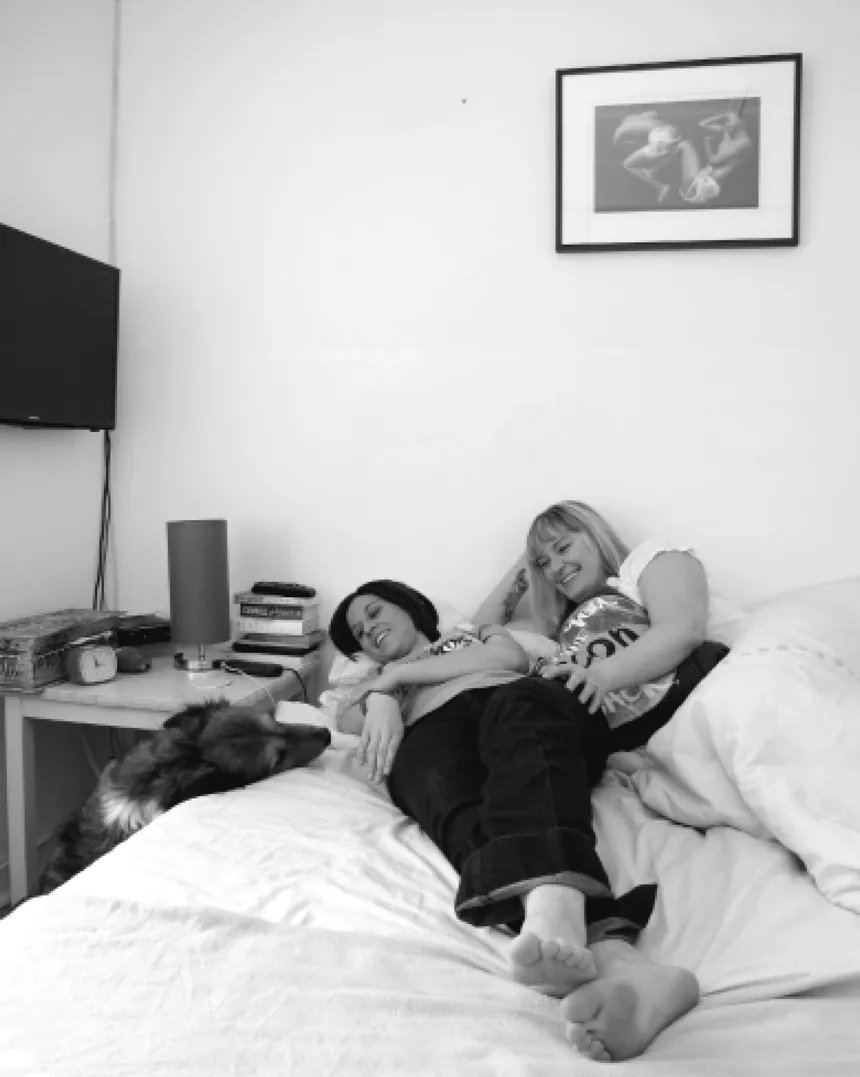
Fig. 2.3 Our common intention…makes us work as a couple: Carmen & Lesley with Rosie
Although we’re completely different in most ways, our common intention to put ā€˜Team CarLey’ first makes us work as a couple. We’ve been married for eight months now, and our lovely home is ruled by three cats and the Border Collie, Rosie. Children are next on our ā€˜gay agenda’, and we’re excited about raising them according to gender-neutral principles.

We are home

fig2_4_B.webp
Fig. 2.4 Together we are ā€˜home’: Natasje with Nina, Pinkie, Leonardo, Starsky & Hutch
Our family comprises seven dogs, a cat and me. We are a family in every sense of the word; we all love each other fiercely. We would all protect one another with our lives. In fact, living in a country with high crime, my only fear is the safety of my fur-kids. That is why they sleep inside. When I leave the house and they are on their own, they are all in their bedrooms—three to a room—so if someone decides to burgle us, they can take what they want without harming the kids. They sleep inside, on my bed, with me.
I sometimes wonder if we are a pack or a family, and I think we are a little bit of both. There is hierarchy in the home—though I don’t encourage it! The young ones have their ā€˜moments’: three teenage boys is not a joke. And just because they are dogs does not mean they don’t act out. They do! Charlie is feisty and he has a real will of his own.
We fight. Charlie, Leo and Max fought and they are currently separated and undergoing behaviour modification with the help of a behaviourist once a week. I fight with them…over the usual: not listening, manners, stealing food, and naughtiness. I have to learn to not fight about the behaviours I don’t want, but to gently love my kids to alternate behaviours.
I spend quality one-on-one time with every dog and the cat every day, doing their favourite activity, and I spend time devising fun group activities for them: they are spaniels and need intellectual stimulation so we hide and sniff or put treats in a bottle with a small opening, etc.
We are a family. We love, fight, learn and grow together. Together we are ā€˜home’.

A trans-race, proudly gay family

fig2_5_B.webp
Fig. 2.5 We continue to challenge, surprise, confront and love each other: Gerard & Richard with NƩka & Lindelani
We have been together for 20 years. Ten years into our relationship we embarked on the extraordinary journey of adopting our two beautiful children. As a trans-race, proudly gay family, we continue to challenge, surprise, confront and love each other deeply.

A close, loving family

fig2_6_B.webp
Fig. 2.6 We are a close, loving family: Cathleen & Rachelle with Leo & Mouche
Married for five years, the only reason we could be viewed as an alternative family is because the make-up of our family unit is alternate to what society views as the nuclear or ā€˜normal’ family. We are a close, loving family.

An ā€˜alternative’ family?

fig2_7_B.webp
Fig. 2.7 We don’t feel like an ā€˜alternative’ family: Debbie & Denise with Cailyn & Dylan
As a trans-race, proudly gay family, we continue to challenge, surprise, confront and love each other deeply.
We married in 2009, and were blessed with our twins in December 2014. Although we may look like an alternative family, we don’t feel like one.

CHAPTER 2

Focus on ā€˜the family’? How South African family policy fails queer families

Catriona Ida Macleod, Tracy Morison and Ingrid Lynch

INTRODUCTION

In the past decade, South African policy-makers have increasingly focused on the family as a site of state intervention. To date, several family-related policies have been developed to support societal well-being and cohesion. The most recent policy document is the White Paper on Families (Department of Social Development 2012), which aims to facilitate the mainstreaming of a family perspective into all government policy-making from the national to the municipal level and across multiple departments. The White Paper stresses that ā€˜its implementation’ will be dependent on a sound inter-sectoral and interdepartmental system and mechanism, an active political administration and technical expertise’ (Department of Social Development 2012:44). This is an ambitious and broad-based implementation plan that potentially has significant implications for social life. A thorough inspection of the assumptions made in the policy, particularly concerning queer families that have historically been marginalised, is thus important.
Family policies are, in general, intended to provide support, enhance family members’ wellbeing, strengthen family relationships, and help families address social challenges, like economic instability. Their ultimate aim is to ensure a safe and socially cohesive society (Robila 2014). A core concern, therefore, is with promoting stable, healthy families. Indeed, the White Paper outlines its main objective as Toster[ing] positive family well-being and overall socio-economic development in the country’ (Department of Social Development 2012:8). This concern is valid in our country where many families experienced a profound lack of stability under apartheid and today instability is brought about by various socio-economic changes, especially the HIV/AIDS epidemic (Department of Social Development 2012).
In this chapter, we argue, however, that, despite good intentions, the White Paper fails queer families1 in three ways. In the first, slim mention is made of families that do not fit the cisgender2 heteronorm, thereby rendering these families all but invisible in family policy formulation. In the second, where family diversity is referred to, there is little engagement with the challenges and possibilities facing queer families, except to promote ā€˜tolerance’ by presumed heterosexual cisgender service providers. In the third, the policy favours family structure over family functioning, with the policy discussion dominated by the aim of preserving a certain type of family rather than facilitating relations that support members in their diversity (including sexual and gendered diversity). We argue that the invisibilisation of queer family forms (while at the same time paying lip service to diversity) and the emphasis on maintaining (cisgender heterosexual) family structures in social policy contributes to the marginalisation of queer people, and in particular those who are already in socially marginal and vulnerable positions based on race, location, or socio-economic class. In this chapter, we address each of the three pitfalls of the White Paper in turn before discussing the implications of these and offering some ideas about how they could be remedied in order to promote meaningful inclusion of family diversity that does not simply privilege heteronormative structures.

PITFALL I: A CONCENTRATION ON HETERONORMATIVE FAMILY STRUCTURES

The family form preferred in policy is the nuclear family, which comprises of a cisgender mother and a cisgender father living with their biological offspring; often called the ā€˜traditional’ or nuclear family
The taken-for-granted assumption that the White Paper seems to start from is that certain kinds of families are better than others simply due to their structure. The family form preferred in policy is the nuclear family, which comprises of a cisgender mother and a cisgender father living with their biological offspring; often called the ā€˜traditional’ or nuclear family. The White Paper ā€˜s implicit endorsement of heteronormative family structures is evident in three ways: (1) family diversity is only paid lip service; (2) families that diverge from the cisgender heterosexual two-parent family are either problematised or absent from the policy; and (3) the problematisation of some family forms lays the foundation for problematising others that are absent from ...

Table of contents

  1. Cover
  2. Half Title
  3. Title Page
  4. Copyright Page
  5. Table of Contents
  6. Acknowledgements
  7. Preface
  8. About the editors
  9. About the authors
  10. Introduction Queer kinship in South Africa
  11. Part I The politics of belonging – questioning queer kinship and belonging
  12. Part II Domestic and parenthood desires – the voices of queer youth
  13. Part III Lesbian women’s marriage and family-making
  14. Part IV Queer men’s production and performance of family
  15. Index