eBook - ePub
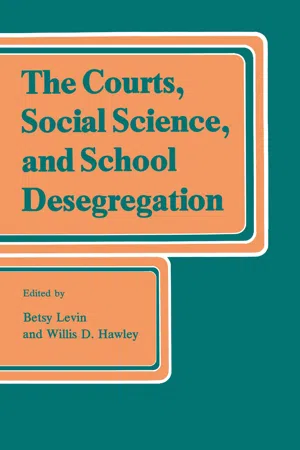
The Courts, Social Science, and School Desegregation
- 432 pages
- English
- ePUB (mobile friendly)
- Available on iOS & Android
eBook - ePub
The Courts, Social Science, and School Desegregation
About this book
This book surveys the legal issues confronting courts as they decide school desegregation cases, and the extent to which social science research has been brought to bear on those issues. It examines the relationship between school segregation and residential segregation.
The Legal Backdrop
Judicial Evolution of The Law of School Integration Since Brown V. Board Of Education*
Frank T. Read†
Introduction
The frenetic pace and extent of change in race relations in the past twenty years has dimmed the memory of what it was to be a Negro citizen in the South in 1954. All public schools were segregated; public accommodations were segregated; only a minute percentage of registered voters were black; and black public office holders were virtually non-existent. Black families had less than one-half the median incomes of white families, and illiteracy rates were appallingly high. The black American in the South was a second class citizen. Furthermore, it appeared that he was destined to remain locked in that status by a myriad of state-imposed Jim Crow laws deliberately designed to perpetuate the segregation of the races and thus the disparity between black and white citizens.
Then, on May 17, 1954—”Black Monday” to segregationists—the United States Supreme Court decided Brown v. Board of Education (Brown I),1 unanimously holding that segregation of white and black children in state public schools, solely on the basis of race and pursuant to statutes permitting or requiring such segregation, denied to black children the equal protection of the laws guaranteed by the fourteenth amendment.2 The Brown decision rocked the South, secured the fame (or infamy, in the opinion of some) of the Warren Court, and propelled the nation into the modern era of its on-going revolution in race relations.
This article will survey the evolution of public school desegregation law in the federal courts since Brown I. While the article is in many respects not only incomplete but also oversimplified, it should provide the reader with at least the minimally sufficient legal backdrop necessary for an appreciation of the more substantive works that follow in this symposium issue.
I
The Two Brown Decisions: A Clarion Call
The decision in Brown I had been foreshadowed by several Supreme Court decisions involving institutions of higher education. These cases were bound by the dictates of Plessy v. Ferguson3 the 1896 case which declared constitutional a Louisiana statute requiring “separate but equal” public facilities for blacks and whites. However, these higher education cases established the principle that in determining whether the facilities were equal, a court could also consider whether intangible educational benefits were equally provided to both races. The litany of doom played for segregation at the college and professional school level by such cases as Missouri ex rel. Gaines v. Canada,4 Sipuel v. Board of Regents of the University of Oklahoma,5 and Sweatt v. Painter6 should have been a warning that the apartheid structure of public school education in the South, so carefully nurtured since the Civil War, could not long survive further legal scrutiny.
A. Brown I: What Did the Supreme Court Actually Hold?
Four separate cases from the states of Kansas, South Carolina, Virginia, and Delaware were consolidated for argument in Brown I. In each of the four cases the plaintiff black children sought the aid of the federal courts in obtaining admission to the public schools of their community on a non-segregated basis. In each case, except the Delaware case, a three-judge district court had refused their requests on the basis of the “separate but equal” doctrine of Plessy v. Ferguson. On direct appeal to the Supreme Court, Chief Justice Warren, speaking for a unanimous Court, phrased the legal issue to be decided: “Does segregation of children in public schools solely on the basis of race, even though the physical facilities and other ‘tangible’ factors may be equal, deprive the children of the minority group of equal educational opportunities?”7 The Court answered that question in the affirmative. In a much quoted paragraph, the Supreme Court interpreted the equal protection clause of the fourteenth amendment as flatly prohibiting state-imposed segregation of the races in the public schools: “We conclude that in the field of public education the doctrine of ‘separate but equal’ has no place. Separate educational facilities are inherently unequal.”8
In holding that the equal protection clause prohibited state-imposed segregation of the races in public schools, the Supreme Court took judicial notice of the fact that separation of Negro children, solely because of their race, “generates a feeling of inferiority as to their status in the community that may affect their hearts and minds in a way unlikely ever to be undone.”9 In its now-famous footnote eleven, the Brown I opinion cited the findings of several prominent social scientists, including Kenneth B. Clark and Gunnar Myrdal, as “modern authority” which “amply supported” the finding that segregation was damaging to black children.10 That footnote constituted a source of irritation for many jurists and fueled the segregationists’ fires ignited by the Supreme Court’s new ruling; they erroneously read footnote eleven as an essential underpinning to the Court’s holding. In fact, the opinion in Brown I is, at its essence, a straight-forward legal interpretation of the equal protection clause, recognizing that state-required segregation by race is an invidious classification, and for that reason unconstitutional. Brown I is supportable without citation to the works of the footnote eleven social scientists.11
Having decided that the states must provide educational opportunities to all on equal terms, the Supreme Court then faced the immense problem of implementing its decision. Proceeding cautiously, the Court ordered the parties to prepare for a reargument of the case at the next term, and, at that reargument, to focus their attention on the problem of implementation.
B. Brown II
On May 31, 1955 (one full year after Brown I), Brown II, the implementation decision, was handed down—again by a unanimous Court.12 Sensing the enormous impact of their decision in Brown I, the Supreme Court Justices proceeded gingerly in Brown II. Put simply, in Brown II the Court remanded the combined cases of Brown I to the federal district courts wherein the cases had originated to take steps consistent with the opinion in Brown L The Supreme Court made several noteworthy points, however, to guide its lower federal courts:
- Local school authorities have the primary responsibility for implementation.13
- The function of the federal court is to decide whether a local school board’s response constitutes good faith implementation.14
- The district court is to be guided by equitable principles “characterized by practical flexibility” in shaping remedies, with the pointed reminder that the principle of equal educational opportunity espoused in Brown I is not to yield simply because of disagreement with that principle.15
- Although the district court should take into account the practical problems of implementation, the local school authorities must make a “prompt and reasonable start,” and thereafter the court should insure that desegregation proceeds “with all deliberate speed.”16
In retrospect the Supreme Court’s heavy reliance on local school authorities and federal district court judges seems to have been misplaced; and this misplaced confidence exerted enormous influence on the course of desegregation, especially in the early years following Brown II.
II
Implementation of the Brown I Mandate
A discussion of the implementation of the Brown I mandate by the federal courts in the twenty years that have passed since that landmark holding can perhaps best be divided into four historical periods. The first period covers the time frame between Brown II in 1955 and the James Meredith affair in 1963. It is characterized by a series of pitched judicial battles over token desegregation. The second period, covering the years between 1963 and 1967, is typified by the struggles of the lower federal courts, without Supreme Court guidance, to evolve desegregation standards and to break down entrenched local resistance. The third period, from 1968 through 1972, is the period of judicial revolution in the Deep South; federal courts, stung by Supreme Court impatience, issued decrees mandating massive integration. The fourth period, from the Supreme Court’s holding in Swann v. Charlotte-Mecklenburg Board of Education17 in 1971 to date, is characterized by confusion over the future of integration, attempts to move integration activity from the South to the ghettos and barrios of the East and West, and litigation over a host of second-generation integration problems. Each of the four great integration periods will be discussed in order.
A. The Muted Response to Brown I: 1955-1963
1. The Public
While there was an intense, immediate reaction to Brown I among white southerners and America’s black population, the rest of the nation looked on from the sidelines, more concerned about other matters. America was emerging from the aftermath of the police action in Korea; the Army-McCarthy hearings were getting under way; and the disastrous French experience in Indochina was grinding to an end in the ruins of Dien Bien Phu.
To black Americans, Brown v. Board of Education signaled the start of a rising tide of hope. It fueled the spirit of a civil rights movement that was to reach its zenith in the early and mid-sixties. To white southerners the decision on Black Monday was received by most with deep resentment or bitter anger, by some with quiet resignation, and by very few with rejoicing. Most southern editorial writers vowed an eternal fight to preserve the southern way of life and prevent the mongrelization of the races. Segregationist organizations flourished: moribund Ku Klux Klan Klaverns gained new life and White Citiz...
Table of contents
- Cover Page
- Half title Page
- Title Page
- Copyright Page
- Contents
- Foreword
- The Legal Backdrop
- Neighborhood Schools and Busing
- Effects of School Desegregation: What Social Science Research Does and Doesnt Tell Us
- Some Practical Problems in Desegregation and Some Alternatives
- Reflection
Trusted by 375,005 students
Access to over 1.5 million titles for a fair monthly price.
Study more efficiently using our study tools.
Frequently asked questions
Yes, you can cancel anytime from the Subscription tab in your account settings on the Perlego website. Your subscription will stay active until the end of your current billing period. Learn how to cancel your subscription
No, books cannot be downloaded as external files, such as PDFs, for use outside of Perlego. However, you can download books within the Perlego app for offline reading on mobile or tablet. Learn how to download books offline
Perlego offers two plans: Essential and Complete
- Essential is ideal for learners and professionals who enjoy exploring a wide range of subjects. Access the Essential Library with 800,000+ trusted titles and best-sellers across business, personal growth, and the humanities. Includes unlimited reading time and Standard Read Aloud voice.
- Complete: Perfect for advanced learners and researchers needing full, unrestricted access. Unlock 1.5M+ books across hundreds of subjects, including academic and specialized titles. The Complete Plan also includes advanced features like Premium Read Aloud and Research Assistant.
We are an online textbook subscription service, where you can get access to an entire online library for less than the price of a single book per month. With over 1.5 million books across 990+ topics, we’ve got you covered! Learn about our mission
Look out for the read-aloud symbol on your next book to see if you can listen to it. The read-aloud tool reads text aloud for you, highlighting the text as it is being read. You can pause it, speed it up and slow it down. Learn more about Read Aloud
Yes! You can use the Perlego app on both iOS and Android devices to read anytime, anywhere — even offline. Perfect for commutes or when you’re on the go.
Please note we cannot support devices running on iOS 13 and Android 7 or earlier. Learn more about using the app
Please note we cannot support devices running on iOS 13 and Android 7 or earlier. Learn more about using the app
Yes, you can access The Courts, Social Science, and School Desegregation by Betsy Levin, Betsy Levin,Daniel Elazar in PDF and/or ePUB format, as well as other popular books in Law & Public Law. We have over 1.5 million books available in our catalogue for you to explore.