Everyone wants to be a contrarian investor.From the hedge funds who bet against the US housing market in the run up to 2008, to George Soros's billion-dollar bet against the Bank of England in 1992, some of the most famous and most profitable trades in history have been contrarian calls.And with the relentless growth of passive investing - investors blindly following the market - the opportunities for a smart investor to profit by betting against the crowd should be greater than ever.Yet being a contrarian is hard work.It takes patience, the conviction to stand by an unpopular viewpoint, and the mental toughness to endure being 'wrong' for prolonged periods of time. Standing out from the crowd goes against our every natural instinct.Which is, of course, why it works.So how do you go about it? There is no single, mechanical investment approach that marks an investor out as a contrarian. Instead, you need to adopt a sceptical mindset: a flexible mode of thinking that allows you to stand back and spot when the market's view of the world is badly out of touch with reality - and the best way to profit when reality eventually reasserts itself.In The Sceptical Investor, John Stepek, executive editor of MoneyWeek, pulls together the latest research on behavioural finance, and examples from well-known contrarian investors, to offer practical techniques to help you to spot opportunities in common investment situations, from turnaround plays to bubbles and busts, that others in the market miss.It won't make you popular and it won't make you famous. But it will make you money.
eBook - ePub
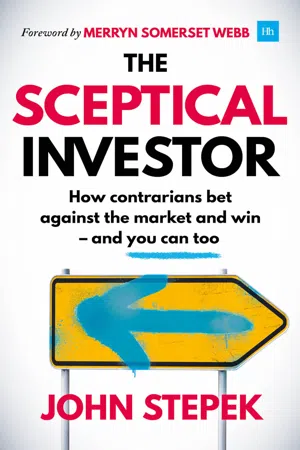
The Sceptical Investor
How contrarians bet against the market and win - and you can too
- English
- ePUB (mobile friendly)
- Available on iOS & Android
eBook - ePub
About this book
Trusted by 375,005 students
Access to over 1.5 million titles for a fair monthly price.
Study more efficiently using our study tools.
Information
1. What is Contrarian Investing?
Why every fund manager says they are a contrarian
I’ve been writing about investment for 15 years. In that time, I’ve never met a fund manager who wasn’t a contrarian.
No wonder. Successful contrarians are the closest things that financial markets get to heroes. A contrarian trade that pays off won’t just make you a profit – it could make your reputation. Jesse Livermore, the subject of investment classic Reminiscences of a Stock Operator, became history’s most famous trader because he made his (second) multi-million dollar fortune by shorting the market ahead of the 1929 stock market crash. One of the trades that made Sir John Templeton’s name was his decision to bet big on beaten-down US stocks just as the second world war was getting underway, quadrupling his original stake in just four years. More recently, the hedge fund managers who made millions by betting against the US subprime mortgage market ahead of the 2008 financial crisis, had a bestselling book – The Big Short by Michael Lewis – written about them, which was then turned into a Hollywood film.
Big bold bets. Getting it right when everyone else gets it wrong. Getting rich while also being able to say ‘I told you so’. It’s very appealing.
So obviously, if a journalist asks you, as a professional investor, ‘Are you a contrarian?’, the only answer you’re ever going to give is ‘Yes’. Nobody wants to invest with someone who claims to blindly follow the crowd (even though that, in fact, is what a great many fund managers do, for reasons we’ll explore later).
What do contrarian investors actually do?
Everyone knows a contrarian trade when they see one. Yet pinning contrarianism down to specifics is surprisingly hard. Most other investing styles are well defined. Value investors buy cheap stocks. Momentum investors buy stuff that has already gone up. Growth investors buy pricey-looking stocks that are growing quickly. Small-cap funds buy, well, small caps. You can buy funds with these descriptions in the title and you’ll have a good idea of what strategy they plan to follow.
But what do ‘contrarian’ investors do? There’s a vague understanding that contrarian investors bet against the market. They “buy when there’s blood on the streets”. They “zig when the market is zagging”. They “buy what everyone else hates”. These old clichés are right in certain ways – contrarians do all of these things. But the clichés are wrong in a very specific and harmful way. Putting the focus on what ‘the market’ is doing, suggests that the most important factor in contrarian thinking is to spend most of your time second-guessing the market.
This is profoundly wrong – and this misconception goes a long way to explaining why many would-be contrarians lose money.
Why I prefer scepticism to contrarianism
The basic problem with doing the opposite of what the market is doing, is that sometimes – often, even – the market gets things right. And even when it’s wrong, it can stay wrong for longer than you can stay solvent (to paraphrase the great economist John Maynard Keynes, who learned this lesson the hard way). Some indicators of market sentiment can certainly highlight potentially profitable hunting grounds (we’ll look at those later on) but spotting moments of ‘irrational exuberance’ or points of ‘maximum pessimism’ is only a small part of what a successful contrarian does.
And not all contrarians use the same methods. Some buy value stocks and hang on patiently for the share price to recover. Others make big, timely bets against investment bubbles, or simply avoid getting sucked into them. Others look for reliably cyclical sectors – buying on the downturns and selling when the good times roll around again. And contrarians understand that things change. The market arbitrages success away – the strategies that worked yesterday may not work tomorrow. In short, contrarian investing is a mindset rather than a specific strategy, which is why it’s so hard to pin down.
This is why I prefer to think of contrarianism as sceptical investing. In fact, that’s the term I’m going to use for the rest of this book. Sceptical investors do not define themselves in opposition to the crowd. Yes, they understand that markets make mistakes – a market is made up of human beings, and human beings tend to overreact in predictable ways. However, what matters is the scale of the mistake – the size of the gap between the underlying ‘reality’ and the market’s perception of that reality.
The importance of perception versus reality
Investment author and strategist Michael Mauboussin draws a good analogy. Imagine a horse race. As a punter, you can look at the horse’s diet, the form, the jockey – the ‘fundamentals’. Those can give you a good idea of what the horse is ‘worth’ – what its chances of winning the race are. But if you want to make money consistently, this isn’t all you need to know. You need to know what odds the bookies are placing on the horse actually winning. You won’t get anywhere fast by betting on the favourite every time, even if it is the best horse in the race – the odds on offer for a winning bet won’t compensate for your inevitable losses.
Sceptical investors make their money when the bookie is mis-pricing the horse’s chances. In other words, where the market gets the odds wrong. So as Mauboussin puts it, it’s not just about sentiment – it’s about “how that sentiment can lead to disconnects between fundamentals and expectations.”
So sceptical investors are always questioning assumptions – both the market’s and their own. They don’t take anything for granted. They do the work required to have as clear an understanding of reality as possible, rather than just working off a hunch or a nebulous sentiment indicator of some sort. This enables them to identify when markets are overreacting to the point where the reward on offer for betting on the gap closing between market perception and reality more than justifies the risk of being wrong.
If this was easy, everybody would be doing it
That sounds simple. In practice, of course, it’s very difficult. If it wasn’t, everybody would be doing it. But it’s not impossible. And with the right tool kit and mindset – which I hope to show you in this book – you can learn how to be a more sceptical investor.
It is partly about doing your research. If a company’s share price falls by 50% after a profit warning, you can’t just assume the market is overreacting – you need to build a solid case for investing, which means looking at accounts and thinking deeply about which scenarios may unfold. But at a more conceptual level, it’s also about approaching the market with the correct mental models (in other words, having a sound grasp of what really drives the market, rather than what drives it in theory), and having enough self-knowledge and humility to avoid being hamstrung by your own behavioural flaws.
That’s what this book is about. In the chapters that follow, we’ll look at how the market really works, and why the sceptical approach is a better way to look at investing, regardless of how active or passive you want to be. Then we’ll move on to the psychology of markets, and how to think critically in order to take advantage of their tendency to overreact, while developing techniques aimed at restraining your own self-destructive instincts. Finally, we’ll look at some of the most successful methods used by contrarians and sceptical investors today.
Let’s get started.
2. Why Sceptical Investing Works
The prevailing view of markets – the dominant ‘mental model’ – is that they are efficient. There is a very long and technical explanation of the efficient market hypothesis (EMH) – indeed, I could write a whole book about it and barely scratch the surface or cover all the arguments and different interpretations – but, put very simply, the EMH argues that markets ‘price in’ all available data promptly, as a result of a mass of investors responding to new information as it arrives. That doesn’t mean that prices are necessarily always ‘right’ as such (no one can predict the future), but in effect they might as well be. Beating an efficient market consistently over time should be impossible, because there is no way to secure a lasting edge over the long run. It also suggests that it should be hard or impossible for apparently obvious or predictable anomalies – such as massive, irrational valuation bubbles – to exist, or to survive for long if they do.
Confessions of an
inefficient investor
inefficient investor
Now, most of us would argue that this clearly isn’t true, and to be fair, few but the most fundamentalist academics would argue that the market is perfectly efficient. There are plenty of examples in history of markets getting it badly wrong (look at the fallout from any bubble and bust of your choice), even when all of the relevant information is seemingly widely available. For example, during the tech bubble of the late 1990s, a CEO could put a rocket under the share price of their company simply by appending ‘.com’ to the company name – no change of strategy or connection to the tech industry required.
And if you’re anything like me, then I’m sure you’re more than aware that individual investors are often anything but efficient. I first started investing as a young finance writer in my early 20s, when I was assigned a feature on online share dealing. I felt that I should go through the process myself, and trade a few stocks too, if I was to explain the ins and outs accurately to my readers. So I opened an account with one of the discount dealers, and invested in three companies. I bought an ATM operator (because it almost literally had a licence...
Table of contents
- Contents
- About the Author
- Foreword by Merryn Somerset Webb
- 1. What is Contrarian Investing?
- 2. Why Sceptical Investing Works
- 3. Why Should I be a Sceptical Investor?
- 4. Your Big Advantage Over the Professionals
- 5. You Versus the Crowd
- 6. Beating Your Brain – Process Versus Outcome
- 7. How to Use the Media
- 8. The Incredible Power of Incentives
- 9. The Importance of Intellectual Humility
- 10. How to Spot Bubbles and What to Do About Them
- 11. Finding the World’s Cheapest Markets
- 12. The Dangerous Temptation of Making Better Forecasts
- 13. Buying Companies for Less Than They’re Worth
- 14. Turnaround Situations, Falling Knives and Profit Warnings
- 15. Finding a Contrarian Fund Manager
- Conclusion
- Acknowledgements
- Further Reading
- Publishing details
Frequently asked questions
Yes, you can cancel anytime from the Subscription tab in your account settings on the Perlego website. Your subscription will stay active until the end of your current billing period. Learn how to cancel your subscription
No, books cannot be downloaded as external files, such as PDFs, for use outside of Perlego. However, you can download books within the Perlego app for offline reading on mobile or tablet. Learn how to download books offline
Perlego offers two plans: Essential and Complete
- Essential is ideal for learners and professionals who enjoy exploring a wide range of subjects. Access the Essential Library with 800,000+ trusted titles and best-sellers across business, personal growth, and the humanities. Includes unlimited reading time and Standard Read Aloud voice.
- Complete: Perfect for advanced learners and researchers needing full, unrestricted access. Unlock 1.5M+ books across hundreds of subjects, including academic and specialized titles. The Complete Plan also includes advanced features like Premium Read Aloud and Research Assistant.
We are an online textbook subscription service, where you can get access to an entire online library for less than the price of a single book per month. With over 1.5 million books across 990+ topics, we’ve got you covered! Learn about our mission
Look out for the read-aloud symbol on your next book to see if you can listen to it. The read-aloud tool reads text aloud for you, highlighting the text as it is being read. You can pause it, speed it up and slow it down. Learn more about Read Aloud
Yes! You can use the Perlego app on both iOS and Android devices to read anytime, anywhere — even offline. Perfect for commutes or when you’re on the go.
Please note we cannot support devices running on iOS 13 and Android 7 or earlier. Learn more about using the app
Please note we cannot support devices running on iOS 13 and Android 7 or earlier. Learn more about using the app
Yes, you can access The Sceptical Investor by John Stepek in PDF and/or ePUB format, as well as other popular books in Business & International Business. We have over 1.5 million books available in our catalogue for you to explore.