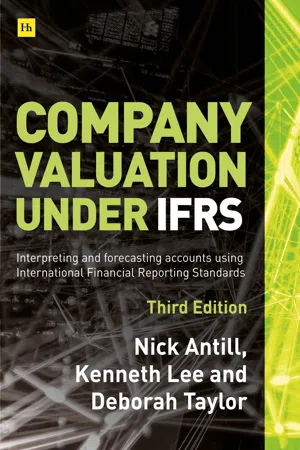
Revised and updated.The influence of International Financial Reporting Standards (IFRS) on accounting across the world is stronger than ever. Most importantly, this stems from the mandatory adoption of IFRSs in many parts of the world, including Europe, Canada, Australia, Brazil and, with some relatively small exceptions, China. Additionally, foreign registrants in the US are also permitted to use IFRS by the SEC. The impact of IFRSs also extends to accounting developments as the IASB and the FASB work closely together to formulate new standards such as those recently issued on leasing and revenue recognition. It is clear that investors, analysts and valuers need to understand financial statements produced under IFRS to feed in to their valuations and broader investment decisions.Written by practitioners for practitioners, the book addresses valuation from the viewpoint of the analyst, the investor and the corporate acquirer. It starts with valuation theory: what is to be discounted and at what discount rate? It explains the connection between standard methodologies based on free cash flow and on return on capital. And it emphasizes that, whichever method is used, accurate interpretation of accounting information is critical to the production of sensible valuations. The authors argue that forecasts of cash flows imply views on profits and balance sheets, and that non-cash items contain useful information about future cash flows - so profits matter.The book addresses the implications for analysis, modelling and valuation of key aspects of IFRS, all updated for recent developments, including:- Pensions- Stock options- Derivatives- Provisions- Leases- Revenue recognition- Foreign currencyThe text also sets out the key differences between IFRS and US GAAP treatments of these issues, in addition to their implications for analysis.A detailed case study is used to provide a step-by-step valuation of an industrial company using both free cash flow and economic profit methodologies. The authors then address a range of common valuation problems, including cyclical or immature companies, as well as the specialist accounting and modelling knowledge required for regulated utilities, resource extraction companies, banks, insurance companies, real estate companies and technology companies. Accounting for mergers and disposals is first explained and then illustrated with a detailed potential acquisition.
eBook - ePub
Company valuation under IFRS - 3rd edition
Interpreting and forecasting accounts using International Financial Reporting Standards
- English
- ePUB (mobile friendly)
- Available on iOS & Android
eBook - ePub
Company valuation under IFRS - 3rd edition
Interpreting and forecasting accounts using International Financial Reporting Standards
About this book
Trusted by 375,005 students
Access to over 1.5 million titles for a fair monthly price.
Study more efficiently using our study tools.
Chapter One: It’s Not Just Cash; Accounts Matter
1. Introduction – Valuation refresher
The key valuation technology that underpins the views expressed in this text is based around the importance of financial statements as a foundation for sensible and accurate valuations. Before exploring this further let us refresh some core ideas about equity valuation.
Valuation language is based around financial ratios
Open any financial website or the financial section of a newspaper, and somewhere you will be confronted by tables of share prices, accompanied by at least two ratios: Price/Earnings (P/E) and dividend yield. P/E is a measure of the share price divided by the last year’s earnings. Dividend yield is the dividend paid by the company during the past twelve months, divided by the share price. The first is a measure of payback period: how many years is it before I earn my money back? The second is a measure of income yield: what am I going to receive in income on a pound or euro invested?
There is a third ratio in the triumvirate which is rarely shown, though, ironically, academic testing shows that it has the highest explanatory value in predicting future share price movements. This is the ratio of Price/Book (P/B) which is the ratio of the share price divided by the per share value of shareholders’ equity in the balance sheet. This tells me what premium I am paying over the amount that has been invested in the business in subscriptions to equity capital and in retained earnings.
The three ratios are clearly related. To the extent that companies retain earnings, rather than paying them out, they increase the book value of their equity. Moreover, the same considerations will determine whether I am prepared to buy a share on a high P/E ratio, a low dividend yield or a high P/B ratio. In each case I should be happier to pay more for a company that looks safe, is highly profitable, or grows faster than others.
True returns: the IRR and NPV rule
When companies make investment decisions, they go beyond simple calculations of payback. More sophisticated approaches include calculating the I...
Table of contents
- Contents
- About the Authors
- Preface to the Third Edition
- Chapter One: It’s Not Just Cash; Accounts Matter
- Chapter Two: WACC – Sixty Years On
- Chapter 3: What Do We Mean By ‘Return’?
- Chapter 4: Key Issues in Accounting and Their Treatment Under IFRS
- Chapter 5: Valuing a Company
- Chapter Six: Special Cases
- Chapter Seven: Modelling Mergers and Acquisitions
- Chapter 8: Conclusions and Continuations
- Further Reading
- Appendices
- Analysis Formulae
- Publishing details
Frequently asked questions
Yes, you can cancel anytime from the Subscription tab in your account settings on the Perlego website. Your subscription will stay active until the end of your current billing period. Learn how to cancel your subscription
No, books cannot be downloaded as external files, such as PDFs, for use outside of Perlego. However, you can download books within the Perlego app for offline reading on mobile or tablet. Learn how to download books offline
Perlego offers two plans: Essential and Complete
- Essential is ideal for learners and professionals who enjoy exploring a wide range of subjects. Access the Essential Library with 800,000+ trusted titles and best-sellers across business, personal growth, and the humanities. Includes unlimited reading time and Standard Read Aloud voice.
- Complete: Perfect for advanced learners and researchers needing full, unrestricted access. Unlock 1.5M+ books across hundreds of subjects, including academic and specialized titles. The Complete Plan also includes advanced features like Premium Read Aloud and Research Assistant.
We are an online textbook subscription service, where you can get access to an entire online library for less than the price of a single book per month. With over 1.5 million books across 990+ topics, we’ve got you covered! Learn about our mission
Look out for the read-aloud symbol on your next book to see if you can listen to it. The read-aloud tool reads text aloud for you, highlighting the text as it is being read. You can pause it, speed it up and slow it down. Learn more about Read Aloud
Yes! You can use the Perlego app on both iOS and Android devices to read anytime, anywhere — even offline. Perfect for commutes or when you’re on the go.
Please note we cannot support devices running on iOS 13 and Android 7 or earlier. Learn more about using the app
Please note we cannot support devices running on iOS 13 and Android 7 or earlier. Learn more about using the app
Yes, you can access Company valuation under IFRS - 3rd edition by Nick Antill, Kenneth Lee in PDF and/or ePUB format, as well as other popular books in Business & Finance. We have over 1.5 million books available in our catalogue for you to explore.