eBook - ePub
Available until 23 Dec |Learn more
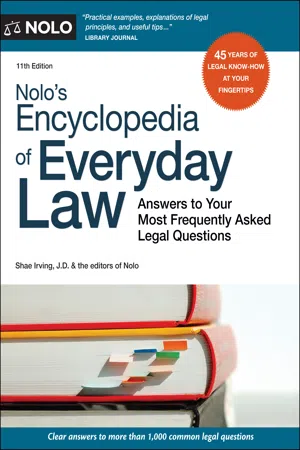
Nolo's Encyclopedia of Everyday Law
Answers to Your Most Frequently Asked Legal Questions
- 512 pages
- English
- ePUB (mobile friendly)
- Available on iOS & Android
eBook - ePub
Available until 23 Dec |Learn more
Nolo's Encyclopedia of Everyday Law
Answers to Your Most Frequently Asked Legal Questions
About this book
Everything you ever wanted to know about the law, but couldn't afford to ask
The law affects practically every aspect of our lives, and legal questions come up daily. When they do, turn to Nolo's Encyclopedia of Everyday Law, a handy, information-packed desk reference.
Written by Nolo's expert team of attorneys, this book answers more than 1, 000 of the most frequently asked questions about everyday legal issues, including:
- Credit & debt
- Workplace rights
- Wills & trusts
- Buying a house
- Divorce
- Small claims court
- Domestic violence
- Adoption
- Traffic accidents
- Inventions
- Privacy rights
- Child custody & support
- Elder care
- Bankruptcy
- Noisy neighbors
- Home businesses
- Name changes
- Searches & seizures
- Tenant rights
- Criminal law
The 11th edition is completely updated to reflect the latest laws, government agency contacts, and resources. There's also a helpful glossary of legal terms and an appendix on how to do your own legal research.
Frequently asked questions
Yes, you can cancel anytime from the Subscription tab in your account settings on the Perlego website. Your subscription will stay active until the end of your current billing period. Learn how to cancel your subscription.
At the moment all of our mobile-responsive ePub books are available to download via the app. Most of our PDFs are also available to download and we're working on making the final remaining ones downloadable now. Learn more here.
Perlego offers two plans: Essential and Complete
- Essential is ideal for learners and professionals who enjoy exploring a wide range of subjects. Access the Essential Library with 800,000+ trusted titles and best-sellers across business, personal growth, and the humanities. Includes unlimited reading time and Standard Read Aloud voice.
- Complete: Perfect for advanced learners and researchers needing full, unrestricted access. Unlock 1.4M+ books across hundreds of subjects, including academic and specialized titles. The Complete Plan also includes advanced features like Premium Read Aloud and Research Assistant.
We are an online textbook subscription service, where you can get access to an entire online library for less than the price of a single book per month. With over 1 million books across 1000+ topics, we’ve got you covered! Learn more here.
Look out for the read-aloud symbol on your next book to see if you can listen to it. The read-aloud tool reads text aloud for you, highlighting the text as it is being read. You can pause it, speed it up and slow it down. Learn more here.
Yes! You can use the Perlego app on both iOS or Android devices to read anytime, anywhere — even offline. Perfect for commutes or when you’re on the go.
Please note we cannot support devices running on iOS 13 and Android 7 or earlier. Learn more about using the app.
Please note we cannot support devices running on iOS 13 and Android 7 or earlier. Learn more about using the app.
Yes, you can access Nolo's Encyclopedia of Everyday Law by Shae Irving,Nolo Editors in PDF and/or ePUB format, as well as other popular books in Law & Law Theory & Practice. We have over one million books available in our catalogue for you to explore.
Information
CHAPTER
1
Houses
Buying a House
Selling Your House
Deeds
Home is heaven for beginners.
—Charles H. Parkhurst
Buying or selling a house is both exciting and demanding. To do either successfully, you need to understand how houses are priced, financed, and inspected; how to find and work with a real estate agent; how to protect your interests when negotiating a contract; and how legal transfer of ownership takes place. This chapter covers many of the basics for buyers, sellers, and owners.
Buying a House
Before you fall in love with a house, it’s essential to determine how much you can afford to pay and what your financing options are. You’ll also need to choose a good real estate agent or broker, decide whether to buy an existing, pre-owned house or a newly built house; perhaps consider alternative forms of ownership (such as a condo or townhouse); and finally, even if you think you’ve found your dream home, understand house inspections, and insure your new home against unforeseen problems.
How do I determine how much house I can afford?
Don’t rely on abstract formulas. Instead, take a close look at how much of your monthly income you can realistically set aside after you stop paying rent. Then, when considering a particular house, total up the estimated monthly loan payments (including principal and interest) plus one-twelfth of your yearly bill for property and homeowners’ insurance and other house-related costs like utilities and maintenance. Now compare that to your monthly income.
Lenders normally expect you to keep your overall debt (including for your house) below 43% of your gross monthly income (before taxes).
It’s best to run the numbers yourself before you talk to a bank or lender. Various online mortgage calculators, such as those at www.nolo.com/legal-calculators, will help you get a realistic picture of your budget.
Next, ask a lender or loan broker for a preapproval letter saying that you will (subject to later review) be approved for a loan of a specified amount based on your income and credit history.
Having lender preapproval makes you more financially attractive to sellers than simple loan “prequalification” (which involves less scrutiny by the lender). It’s crucial in competitive markets or where sellers are wary of accepting any offer that might not close successfully.
How important is my credit history in getting loan approval?
Your credit history plays a vital role in determining the type and amount of loan you can qualify for. Expect prospective lenders to request your credit score from the credit bureaus. This score is a statistical summary of the information in your credit report, such as:
•your history of paying bills on time
•the level of your outstanding debts
•how long you’ve had credit
•your credit limit, and
•the types of credit you have.
The higher your credit score, the easier it will be to get a loan. If your score is low, a lender may either reject your loan application altogether or insist on a very large down payment or high interest rate to lower the lender’s risk.
To avoid problems, always check your credit report and clean up your file if necessary—before, not after, you apply for a mortgage. For information on how to order and clean up your credit report, see Chapter 9.
How can I find the best home loan or mortgage?
Banks, credit unions, savings and loans, insurance companies, mortgage bankers, and others make home loans. Lenders and terms change frequently as new companies appear, old ones merge, and market conditions fluctuate. To get the best deal, compare loans and fees from at least a half-dozen lenders. This information is widely available online.
Mortgage rate websites can be a great place to examine mortgage programs, and crunch numbers. Many mortgage websites also offer direct access to loans from one or more lenders. However, many customers prefer to complete their transaction with a “live” lender or broker.
To avoid all the legwork involved in shopping for mortgages on your own, you can also work with a loan broker who specializes in matching house buyers with an appropriate mortgage lender. (Check the broker’s qualifications carefully—not all are licensed.) Loan brokers usually collect their fee from the lender, not from you.
What are alternative options for home loans?
You might also be eligible for a government-guaranteed loan, offered by:
•the Federal Housing Administration (FHA), an agency of the Department of Housing and Urban Development (HUD) (see www.hud.gov)
•the U.S. Department of Veterans Affairs (see www.benefits.va.gov/%20homeloans), or
•a state or local housing agency.
Government loans usually have low down-payment requirements and sometimes offer better-than-market interest rates as well.
Also, ask banks and other private lenders about any “first-time buyer programs” that offer low down-payment plans and flexible qualifying guidelines to low- and moderate-income buyers with good credit.
Finally, don’t forget private sources of mortgage money—parents, other relatives, friends, or even the seller of the house you want to buy. Borrowing money privately is usually the most cost-efficient method of all, and can benefit everyone by keeping money within the family.
What’s the difference between a fixed and an adjustable rate mortgage?
With a fixed rate mortgage, the interest rate and the amount you pay each month remain the same over the entire mortgage term, traditionally 15 or 30 years.
With an adjustable rate mortgage (ARM), the interest rate will fluctuate in step with the interest rates in the economy. Initial ARM interest rates are usually offered at a discounted (“teaser”) rate, which is lower than those for fixed rate mortgages. Over time, however, initial discounts are filtered out. To avoid constant and drastic changes, ARMs typically regulate (cap) how much and how often the interest rate and/or payments can change in a year and over the life of the loan.
How do I decide between a fixed and an adjustable rate mortgage?
Because interest rates and mortgage options change often, your choice of a fixed or an adjustable rate mortgage should depend on their respective interest rates, how much you can afford in the short term, your view of the future (high inflation tends to drive ARM rates up and vice versa), and how willing you are to take a risk.
Risk-averse people usually choose the certainty of a fixed rate mortgage, even if an ARM might be cheaper in the long run. However, some people can’t afford the relatively higher interest rates at which fixed rate mortgages usually begin.
Keep in mind that if you take out a loan now, and several years from now interest rates have dropped but your home has retained its value, refinancing might be an option. But if the only way you can afford your home over the long term given your expected income is to count on a refinance, don’t take the risk—many others have done so and lost.
What’s the best way to find and work with a real estate agent or broker?
Get recommendations from people who have bought or sold a house in the past few years and whose judgment you trust. Don’t work with an agent you meet at an open house or see advertised unless and until you call references and thoroughly check the person out. (In fact, it’s best to line up an agent before visiting open houses, because if you visit an open house unaccompanied and wish to make an offer, some listing agents have been known to claim that they found you first, and are therefore owed the full commission.)
The agent or broker you choose should be in the full-time business of selling real estate and should have the following five traits: integrity, business sophistication, experience with the type of services you need, knowledge of the area where you want to live, and sensitivity to your tastes and needs.
All states regulate and license real estate agents and brokers. Many states also require the agent to be upfront with you about the exact nature of the relationship into which you’re entering. You’re best off hiring an agent who represents you and only you, as opposed to also representing the seller as a so-called “dual agent,” with mixed loyalties.
Typically, the seller pays the commission of his or her listing agent, who splits it with the real estate salesperson who represents the buyer. The total commission is a percentage (usually 5%–6%) of the sales price of the house (so 2.5%–3% per agent). What this means is that your agent or broker has a built-in conflict of interest: Unless you’ve agreed to pay the agent separately (which few buyers do), there’s no payday until you buy a home, and the more you pay for a house, the bigger the agent’s cut.
To offset this conflict, you need to become knowledgeable about the house-buying process, your ideal affordable house and neighborhood, your financing needs and options, your legal rights, and how to evaluate comparable prices.
What’s the best way to get information on homes for sale and details about the neighborhood?
Most people begin their search online, scanning listings to see which homes are worth a visit, how much they cost, and what amenities they offer. Virtual tours often include floor plans and room-by-room photographs.
Once you see a house you like, contact your agent, the listing agent, or the owner (if it’s a listing by a FSBO—for sale by owner) to obtain additional information or to set up an appointment to see the home.
Your state or regional realty association or multiple listing service (MLS) should have a website listing homes for sale. Major real estate companies, such as RE/MAX, Coldwell Banker, Sotheby’s, Prudential, and others offer home listings on their websites.
Advice on relocation decisions and details about your new community are also readily available online.
There’s no substitute for your own legwork, however. Ask questions of friends and colleagues, walk and drive around neighborhoods, talk to local residents, read local newspapers, and do whatever it takes to help you get a better sense of a neighborhood or city.
I want to buy a newly built house. Is there anything special I need to know?
The most important factor in buying a newly built house is not what you buy (that is, the particular model and customized finishes), but rather from which builder you buy. New is not always better, especially if the house is slapped together in a hurry—or months late. And as the first person to live in the house, you could be in for unpleasant surprises, such as water pipes that aren’t connected to the sewer or light switches that don’t work.
Shop for an excellent builder—one who builds quality houses, delivers on time, has adequate cash reserves to finish the job (your home plus any promised community amenities, such as a clubhouse or pool), and stands behind the work. To check out a part...
Table of contents
- Cover
- Title
- Copyright
- Table of Contents
- About Nolo’s Encyclopedia of Everyday Law
- 1 Houses
- 2 Neighbors
- 3 Landlords and Tenants
- 4 Workplace Rights
- 5 Small Businesses
- 6 Patents
- 7 Copyrights
- 8 Trademarks
- 9 Your Money
- 10 Cars and Driving
- 11 Wills and Estate Planning
- 12 Health Care Directives and Powers of Attorney
- 13 Older Americans
- 14 Spouses and Partners
- 15 Parents and Children
- 16 Courts and Mediation
- 17 Criminal Law and Procedure
- Glossary
- Appendix Legal Research
- Index