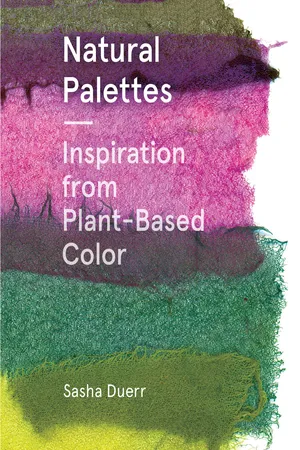
Natural Palettes
eBook - ePub

Natural Palettes

Inspirational Plant-Based Color Systems

  1. English
  2. ePUB (mobile friendly)
  3. Available on iOS & Android
eBook - ePub

Natural Palettes

Inspirational Plant-Based Color Systems

About this book

"The plant-lover's alternative to the Pantone color guide."—Julia Sherman, creator of Salad for President Renowned natural dyer, artist, and educator Sasha Duerr envisions a new age of fresh, modern color palettes, drawing from our original source of inspiration and ingredients—the natural world around us. This innovative plant-based color guide includes twenty-five palettes with five hundred natural color swatches, providing a bounty of ideas for sustainable fashion, textiles, fine art, floral design, food, medicine, gardening, interior design, and other creative disciplines. Bring the healing power of forest bathing into your home with a palette of spruce cones, pine needles, and balsam branches. Move past Pantone and embrace the natural balance of a pollinator palette with Hopi sunflower, red poppy, echinacea, and scabiosa.Duerr complements her palettes with illuminating reflections on connections between color and landscape, the healing properties of medicinal plants, the ways food and floral waste can be regenerated to enhance lifestyle experiences, the ecological benefits of using natural colors, and more. You may never view color—or the plants that surround us—the same way again.

Tools to learn more effectively

Saving Books

Saving Books

Keyword Search

Keyword Search

Annotating Text

Annotating Text

Listen to it instead

Listen to it instead

Information

Compost Colors

Although both food and natural fiber and dyes used in clothing and textiles are so biodegradable that they often have left no traces as artifacts, the two have been linked in practical and creative collaborations throughout human history, as creating natural color was once fully in sync with cooking and the making of medicine. Many natural dye ingredients are also medicinal or the by-products of edible plants.
Honoring plants for their multiple purposes can help us to redirect what could otherwise become waste, transforming leftover raw materials into something beautiful, stylish, and meaningful. Everyday waste products from our kitchens, restaurants, and grocery stores—such as onion skins and pomegranate rinds—can be upcycled to extend and expand their value into the realm of color. Making natural color from the by-products of fruits and vegetables can be a very powerful sensory and creative act—much like knowing where your food comes from, or, better yet, learning to grow food and cook it yourself.
What we consider valuable is always changing. Carrot tops can provide gorgeous gold and green colors. At one point, they were grown specifically for the tops rather than the root, as they are very medicinal and flavorful, yet today we tend to just toss them out (if they have not already been removed by the grocer).
Waste from our food supply is one of the single largest problems in US municipal waste. By understanding the plants we eat, we learn how to reduce that waste and use resources more wisely in our homes and communities. At the same time, more opportunities arise for versatility in our uses for those plants—whether they be culinary, medicinal, cultural, or ecological. Working with plant color can be an easy and accessible way of becoming in sync with the cycles of our ecologies and applying that knowledge directly to art and design practices. Natural color created by the seeds, tops, and peels of local fruits and vegetables can connect us to healthier places, restore our own health, and renew our purpose.
image

18 COMPOST COLORS

Natural color can be abundantly hidden within everyday produce, as the by-products of common fruits and vegetables hold a rainbow array of hues. Compost colors can be made from discarded carrot tops, citrus peels, and pomegranate rinds. Have your color and eat it, too!
image

Avocado Pits

—
Persea americana
The avocado tree is thought to have originated in south-central Mexico. The oldest pit ever found dates back ten thousand years. In ...

Table of contents

  1. Cover
  2. Title
  3. Dedication
  4. Contents
  5. Introduction
  6. Living Color
  7. Deepening Our Color Senses
  8. Landscape Alchemy
  9. Weeds to Wonder
  10. Cultivating Color
  11. Compost Colors
  12. Color Therapy
  13. Afterword
  14. Acknowledgments
  15. Further Reading
  16. Index of Plants
  17. Copyright
  18. About the Author