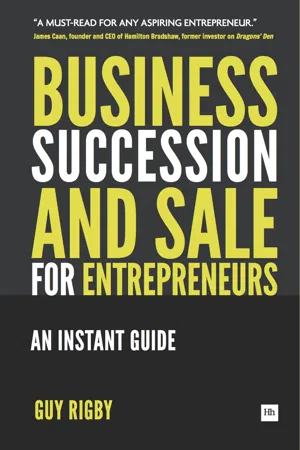
This eBook is a guide to business succession and sale for entrepreneurs.The author of this instant guide from Harriman House, Guy Rigby, has also written From Vision to Exit, which is a complete entrepreneurs' guide to setting up, running and passing on or selling a business.
- 20 pages
- English
- ePUB (mobile friendly)
- Available on iOS & Android
eBook - ePub
About this book
Trusted by 375,005 students
Access to over 1.5 million titles for a fair monthly price.
Study more efficiently using our study tools.
Information
Topic
Negocios y empresaSubtopic
Negocios en generalBusiness Succession and Sale For Entrepreneurs
“Every exit is an entrance somewhere else.”
— Tom Stoppard, British playwright
Planning for succession
It’s hard to build a successful business, so the idea of leaving or handing over the reins is likely to engender a mixture of fear, grief and other conflicting emotions. But nothing lasts forever, so, whether you’re selling your business, passing it on to the next generation or simply retiring, you’ll need to plan for your succession.
Great businesses are generally run by leaders who spend the majority of their time working on their business, as opposed to in their business. By definition, businesses run by these types of leaders can survive, and even thrive, without them. Apart from their valuable strategic input, their management roles will be capable of being filled through normal recruitment channels, meaning that their businesses are not owner-dependent.
If you’ve achieved this enviable status, your succession will be far easier than for peers who are still up to their necks in the day-to-day muck and bullets. If not, then there’s still some work to do.
Owner-dependency has many negative connotations, the most important of which are that the business cannot be successfully run without the owner’s involvement and that the business is unlikely to have any meaningful value.
If you accept this prognosis, it’s important to start your succession planning early. Leaving it too late is a common mistake. In addition, succession should not only be considered when you’re selling your business or planning for your retirement. After all, what would happen to your business if you were hit by that proverbial bus?
Your succession plan will depend on whether you are selling, retiring or considering other ‘what if’ scenarios. You might simply be trying to free yourself up to carry out a more strategic role, or it might just be part of your plan to ensure that your business can survive and succeed without you.
Unless you are selling the business and departing, succession will be focused on two key aspects – the appointment and development of the right successor and the change in your own role.
Appointing and developing your successor
Barring wholesale changes of management, perhaps as a result of a sale or an MBI, most businesses favour the appointment of internal rather than external candidates to succeed their outgoing CEOs. Methods of recruitment may vary, depending on whether there’s an obvious internal candidate, the potential for both internal or external candidates, or just an external candidate.
Views on this can vary. I was once a director of a company that wanted to consider both internal and external candidates for the CEO role. In that instance, the outgoing CEO chose to run two processes – one to get the views (in fact, votes) of the staff to elect the best internal candidate, and one to identify external candidates. The process was run by an external headhunting firm, who interviewed the resulting shortlist and presented back to the board. Eventually, an internal candidate was chosen.
It was an interesting, if not unusual, approach. What it definitely succeeded in doing was to create uncertainty and take everyone’s eye off the ball, as the process took some months to complete.
At the end of the day, it will probably depend on your culture. If there’s an obvious internal candidate in a smallish business, I would probably just go ahead with the appointment. In a bigger business, more formality may be required. “Even if you end up recruiting somebody internally you should still have gone through a robust recruitment process where you get the best professional help that you can afford,” says David Molian.
Another approach may be to create development plans for one or more ‘candidates in waiting’. Nick Jenkins, the chairman of Moonpig, took this approach by appointing a commercial director and then handing over more and more of the daily work to him until he was happy that he could take the CEO role on. “You really need to understand whether they can do it,” says Nick. “So I brought Iain in and didn’t tell him that I wanted him to take over my job, because if I’d realised he was the wrong person for the job I’d have needed to bring in somebody else above him.”
Whatever you decide to do, you should define the scope of the role and the qualities required to fill it. You should also discuss it openly with your senior team. In addition, if you know that one or more team members have designs on the role but that you would not consider their appointment, take time out to meet them. Help them understand why the role wouldn’t suit them and why they’re important to you where they are.
Once the candidate has been selected, decisions will have to be made on timing and implementation. Will the new role take effect immediately or, as with Moonpig’s commercial director, will there be a staged transfer of responsibilities? This may differ between internal and external appointments.
Don’t let go of the reins until you’re ready. Some friends of mine, who had years of experience in their industry, ran a brilliant business making £2–£3m per annum of profit. Notwithstanding this, they managed to convince themselves that a ‘professional’ CEO could do a much better job. Through their headhunters,...
Table of contents
- Cover
- Publishing details
- Praise for From Vision to Exit
- About the Author
- Preface
- Business Succession and Sale For Entrepreneurs
- From Vision to Exit
- Other Business eBooks From Harriman House
Frequently asked questions
Yes, you can cancel anytime from the Subscription tab in your account settings on the Perlego website. Your subscription will stay active until the end of your current billing period. Learn how to cancel your subscription
No, books cannot be downloaded as external files, such as PDFs, for use outside of Perlego. However, you can download books within the Perlego app for offline reading on mobile or tablet. Learn how to download books offline
Perlego offers two plans: Essential and Complete
- Essential is ideal for learners and professionals who enjoy exploring a wide range of subjects. Access the Essential Library with 800,000+ trusted titles and best-sellers across business, personal growth, and the humanities. Includes unlimited reading time and Standard Read Aloud voice.
- Complete: Perfect for advanced learners and researchers needing full, unrestricted access. Unlock 1.5M+ books across hundreds of subjects, including academic and specialized titles. The Complete Plan also includes advanced features like Premium Read Aloud and Research Assistant.
We are an online textbook subscription service, where you can get access to an entire online library for less than the price of a single book per month. With over 1.5 million books across 990+ topics, we’ve got you covered! Learn about our mission
Look out for the read-aloud symbol on your next book to see if you can listen to it. The read-aloud tool reads text aloud for you, highlighting the text as it is being read. You can pause it, speed it up and slow it down. Learn more about Read Aloud
Yes! You can use the Perlego app on both iOS and Android devices to read anytime, anywhere — even offline. Perfect for commutes or when you’re on the go.
Please note we cannot support devices running on iOS 13 and Android 7 or earlier. Learn more about using the app
Please note we cannot support devices running on iOS 13 and Android 7 or earlier. Learn more about using the app
Yes, you can access Business Succession & Sale for Entrepreneurs by Guy Rigby in PDF and/or ePUB format, as well as other popular books in Negocios y empresa & Negocios en general. We have over 1.5 million books available in our catalogue for you to explore.