- 432 pages
- English
- ePUB (mobile friendly)
- Available on iOS & Android
eBook - ePub
Valley Forge
About this book
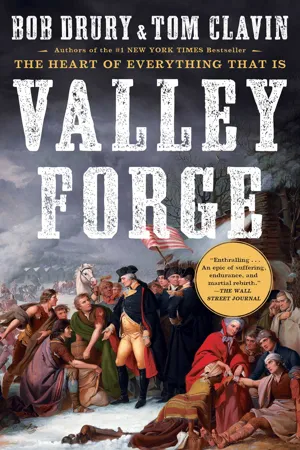
The #1 New York Times bestselling authors of The Heart of Everything That Is return with “a thorough, nuanced, and enthralling account” (The Wall Street Journal) about one of the most inspiring—and underappreciated—chapters in American history: the Continental Army’s six-month transformation in Valley Forge.
In December 1777, some 12,000 members of America’s Continental Army stagger into a small Pennsylvania encampment near British-occupied Philadelphia. Their commander in chief, George Washington, is at the lowest ebb of his military career. Yet, somehow, Washington, with a dedicated coterie of advisers, sets out to breathe new life into his military force. Against all odds, they manage to turn a bobtail army of citizen soldiers into a professional fighting force that will change the world forever.
Valley Forge is the story of how that metamorphosis occurred. Bestselling authors Bob Drury and Tom Clavin show us how this miracle was accomplished despite thousands of American soldiers succumbing to disease, starvation, and the elements. At the center of it all is George Washington as he fends off pernicious political conspiracies. The Valley Forge winter is his—and the revolution’s—last chance at redemption. And after six months in the camp, Washington fulfills his destiny, leading the Continental Army to a stunning victory in the Battle of Monmouth Court House.
Valley Forge is the riveting true story of a nascent United States toppling an empire. Using new and rarely seen contemporaneous documents—and drawing on a cast of iconic characters and remarkable moments that capture the innovation and energy that led to the birth of our nation—Drury and Clavin provide a “gripping, panoramic account” (Publishers Weekly, starred review) of the definitive account of this seminal and previously undervalued moment in the battle for American independence.
In December 1777, some 12,000 members of America’s Continental Army stagger into a small Pennsylvania encampment near British-occupied Philadelphia. Their commander in chief, George Washington, is at the lowest ebb of his military career. Yet, somehow, Washington, with a dedicated coterie of advisers, sets out to breathe new life into his military force. Against all odds, they manage to turn a bobtail army of citizen soldiers into a professional fighting force that will change the world forever.
Valley Forge is the story of how that metamorphosis occurred. Bestselling authors Bob Drury and Tom Clavin show us how this miracle was accomplished despite thousands of American soldiers succumbing to disease, starvation, and the elements. At the center of it all is George Washington as he fends off pernicious political conspiracies. The Valley Forge winter is his—and the revolution’s—last chance at redemption. And after six months in the camp, Washington fulfills his destiny, leading the Continental Army to a stunning victory in the Battle of Monmouth Court House.
Valley Forge is the riveting true story of a nascent United States toppling an empire. Using new and rarely seen contemporaneous documents—and drawing on a cast of iconic characters and remarkable moments that capture the innovation and energy that led to the birth of our nation—Drury and Clavin provide a “gripping, panoramic account” (Publishers Weekly, starred review) of the definitive account of this seminal and previously undervalued moment in the battle for American independence.
Tools to learn more effectively

Saving Books

Keyword Search

Annotating Text

Listen to it instead
Information
PART I
The Enemy were routed in the greatest Confusion several Miles, we pass’d thro their Encampments & took some pieces of Cannon, in short we were flatter’d with every appearance of a most glorious & decisive Action when to my great surprize Our Men began to give way, which when the Line was once broke became pretty General & could not with our utmost Exertions be prevented & the only thing left was to draw them off in the best manner we could.
—GEORGE WASHINGTON TO GEN. ISRAEL PUTNAM, OCTOBER 8, 1777

George Washington’s experiences—both good and bad—as a young officer in the Virginia militia fighting alongside British forces in the French and Indian War served him well as commander of the American forces.
ONE

A SPRIG OF GREEN
They marched in parade formation through the heart of Philadelphia, 12,000 strong. Down Front Street and up Chestnut Street they came, the heroes of Trenton and Princeton, the survivors of Long Island and Harlem Heights and White Plains, and they constituted a panoply foreshadowing the diversity that would define a future nation. The Grand Army, they were called: Irishmen, Germans, and Poles; French and disaffected Brits and Scots; a company of African American freemen, all now newly minted Americans. A “multiplicity of interests,” as James Madison would call them, forging a distinct national identity. Every man wore a sprig of greenery affixed to his hat or woven through his hair. It was a symbol of hope and victory.
At their head, astride his white Arabian standing 16 hands high, rode the 45-year-old George Washington, his russet hair liberally powdered to look like a wig, pulled back into a queue and held in place by a black silk ribbon. In his elegant blue-and-buff uniform, the strapping Washington was a majestic and commanding figure, graceful to the point where contemporaries commented on his fluid dancing skills. But mounted, with his polished silver spurs girding knee-high black riding boots, he projected the powerful impression of martial virility itself. Six feet two inches tall, he had strong, narrow shoulders set atop a broad chest that flared out to a lifelong horseman’s wide hips and muscled thighs. But it was his hands that caught one’s attention—large and sinewy planter’s hands strong enough to crack hickory nuts.
Washington was the centripetal force to which the soldiers parading through Philadelphia had each been drawn. Despite his imposing carriage, however, it was the general’s melancholy blue eyes with their flecks of gray that hinted at the merest trace of self-doubt. Those eyes, set deep in his craggy, sunburned face, flashed the tale of a man who, to paraphrase one historian, had constructed his own fierce stoicism to mask his combustible emotions and insecurities.
The 19-year-old Marquis de Lafayette was given the honor of riding beside Washington. He was famously soigné in his signature blue cocked hat and matching greatcoat with red facing, and his gold-braided epaulets bounced to the rise and fall of his cantering sorrel over the river cobblestones. Hard on the duo’s heels in their own long officers’ coats, boots shined to a luster and spurs jangling, came the indispensable polymath Alexander Hamilton—who at 22 had already proved his mettle on battlefields from White Plains to Princeton—and the leonine John Laurens, also 22, the son of the South Carolina delegate Henry Laurens, soon to succeed John Hancock as president of the Continental Congress. These three adoring aides constituted what the childless Washington deemed a veritable troika of surrogate sons. They each returned his affection.
It was a feverish Sunday, August 24, 1777, almost 26 months since Washington had been culled from the Virginia delegation to the First Continental Congress and commissioned general and commander in chief of the army of the united colonies: a wealthy southern plantation owner tabbed to lead a revolution. Now, this morning, the flood tide of troops stepping smartly through Philadelphia’s city center to the beat of fife and drum had been transformed from the “lower class” militiamen whom Washington once described as exhibiting “an unaccountable kind of stupidity” into a force for freedom. Most of the soldiers remained shabbily clad in motley vestments. Washington, never a man for spontaneity, had ordered the green sprigs in order to provide some uniformity to the Continentals’ discrepant apparel. Despite their dishabille, they nonetheless awed the 40,000 inhabitants of the new nation’s capital as they made for the floating bridge spanning the Schuylkill River that would carry them to their new camp across the water in Darby, Pennsylvania.
By 1777, Philadelphia stretched six blocks deep for two miles along the larger Delaware River, and for two solid hours the city’s residents gaped from windows, verandas, and rooftops or crowded out of doorways to line the muddy wooden curbs to view the passing troops. The spectators included members of the Continental Congress, whose delegates packed the redbrick bell tower of the statehouse Lafayette would one day dub Independence Hall. With each passing regiment rose a great huzzah for the men from Delaware and New Jersey and New York, from Connecticut and Massachusetts and New Hampshire, from Maryland and North Carolina and Virginia. The crowd saved their loudest cheers for their fellow Pennsylvanians and, of course, for the commander in chief himself.
Washington had ordered the army’s wagons and excess horses kept out of view during the promenade. The baggage train, which suggested the true nature of his ill-provisioned force, was to take a roundabout route to the new encampment. Given the hundreds of local soldiers under his command, Washington also warned of a punishment of 39 lashes to anyone who abandoned the parade route prematurely to visit with family and friends. Despite his efforts, he could not prevent the army’s camp followers, perhaps 400 women and children, from pouring into the city behind the troops, “chattering and yelling in sluttish shrills as they went, and spitting in the gutters” below the rented rooms on Market Street where Thomas Jefferson had written the Declaration of Independence.
Still, the procession went off almost precisely as Washington had choreographed it, a splendid demonstration designed to plant seeds of doubt in the minds of the city’s large Loyalist community. Although the commander in chief was not an overly religious man, even he may have felt the hand of divine intervention when the previous night’s downpour had ceased abruptly at dawn and left the city’s streets washed clean. Only his inner circle was aware that today’s spic-and-span pageantry was mostly a bluff. For the British were coming. Soon. With a battle-tested force far greater than the number of Continental Army regulars. And they intended to take this city.
♦ ♦ ♦
Since losing a series of battles and being driven from New York the previous summer, Washington and his closest advisers had been uncharacteristically flummoxed by General Sir William Howe, who led the 30,000-strong British expeditionary force in North America. Throughout the spring and summer of 1777, Howe had orchestrated a series of feints that forced Washington into exaggerated countermeasures. He had dispatched companies of his exhausted Continentals from their camp in Morristown, New Jersey, through rainstorms and searing heat as far north as the Hudson Highlands and as far south as the lower Delaware River. Each expedition was for naught, as Howe always pulled his troops back to New York before the Americans arrived. This was all a part of the British commander’s scheme; he was in no hurry to crush the rebels just yet. His superiors in Britain, particularly his friend King George III, hoped that the massive show of British force would bring the colonies to their senses and, subsequently, to the bargaining table.
In period paintings the 48-year-old Gen. Howe bore an eerie likeness to Washington, most notably in his erect bearing, high forehead, and aristocratic gaze, which was somewhat offset by a set of uneven and probably false teeth that struck observers as similar to the perforations on a stamp. Contemporary descriptions of the general were less kind than his portrait artists, with one young American who met him describing “a large portly man, of coarse features [who] appeared to have lost his teeth, as his mouth had fallen in.” At least his similarity to the denture-wearing American commander in chief rings true.
Howe and his older brother Adm. Lord Richard “Black Dick” Howe, commander of the British fleet in America, were scions of an aristocratic family that had attained its peerage a century earlier under the Dutch-born “King Billy” III. Both had attended Eton. The admiral’s taciturn demeanor and dusky complexion had earned him his nickname, and the general’s skin tone was also of a darker hue than that of most contemporary Englishmen. The younger Howe was fond of both gambling and whoring—he compensated his American mistress’s husband with a job as a prison commissioner. He had nonetheless earned his stars by showing valor on the front lines during the Seven Year’s War—what the American colonists called the French and Indian War—and, later, during his costly victory at Bunker Hill. His energy and courage continued to endear him to his troops, who were the most highly trained in North America. Yet close observers also noted that the general “lacked the confidence, the sense of responsibility, and the professional dedication that distinguished” his older brother the admiral.
After the British general John Burgoyne’s staggering recapture of upstate New York’s Fort Ticonderoga in early July, Washington was nearly certain that Howe would move north to join Burgoyne to control the Hudson River and effectively cut off the more rebellious New England colonies from the rest of the country.I Since then, however, the Continental spy network in New York had increasingly reported that the Howe brothers were secretly mustering pilots familiar with the Delaware River. If these communiqués proved true, common sense dictated only one target—the British were aiming for Philadelphia, the largest city in North America and home to the Continental Congress. The morale-breaking display of the American delegates fleeing before a conquering enemy army was what Washington had come to prevent.
♦ ♦ ♦
In late July Gen. Howe had teased Washington and his intelligence officers yet again when he loaded 17,000 of his British regulars and German mercenaries onto his brother’s fleet of 228 ships—the largest flotilla to ever ply American waters—and sailed from Sandy Hook, New Jersey.II Their destination was unclear. It was not lost on the Americans that Adm. Howe, so attuned to the world’s tides that he was known as “the human sea chantey,” had pioneered Britain’s naval expertise in amphibious landings, and rumors abounded. One report had the Howes tacking toward occupied Rhode Island in an attempt to retake Boston, the city they had been driven from 17 months earlier. Another had them sailing south to open up a new front below Virginia. General George Weedon, Washington’s fellow Virginian and longtime lieutenant, fretted that the Continentals were “in the dark with regard to [the enemy’s] designs.”
As a defense against the Royal Navy vessels advancing up the Delaware, Washington’s volunteer French military engineers had constructed a series of underwater obstructions known as chevaux-de-frise, or “Frisian Horses,” at various points along the river. These stockade-like rows of thick, iron-tipped wooden spears—employed during European wars since medieval times to impede cavalry charges—were weighted to the river bottom by heavy crates filled with rocks and designed to pierce the hulls of enemy craft. Washington did not have much faith in the contraptions. He wrote to a subordinate that “the idea of preventing ships from passing up & down rivers . . . has proved wrong . . . unless the water is narrow.” He was more confident in the string of riverside forts the Continentals occupied, including two strong redoubts on opposite banks south of Philadelphia at just such a “narrow” point in the river. The Continentals hoped that taken together, all these obstacles would prove to be an impassable choke point.
Howe appeared to agree, and on August 23—the day before the Continental Army’s grand show of force in Philadelphia—reports reached Washington that the entire enemy squadron had reappeared and anchored off the capes of a northern inlet of Chesapeake Bay at the head of Maryland’s Elk River. Within days, Gen. Howe’s army had disembarked. This struck the Americans as an odd location from which to begin a march to capture a city over 50 miles away. But that is not what the Britisher had in mind. A week earlier a message had reached Howe, who was aboard his brother’s command ship, from Lord George Germain, secretary of state for the Americas. In it, Germain suggested that after capturing Philadelphia and subduing the other Middle Atlantic colonies, Howe was to leave the conquered territories to be maintained by Loyalist militias while he drove north to join Burgoyne in upstate New York. Germain, a dour misanthrope with no patience for rebels of any stripe, strongly hinted that the Crown expected Gen. Howe to crush this bothersome uprising before 1777 was out. Thus Gen. Howe’s primary intention was to lure Washington and his entire force into a major, war-ending confrontation. As it happened, this was what Washington also looked forward to—“One bold stroke [to] free the land from rapine, devastations, and burnings,” he wrote to Gen. Benedict Arnold.
Meanwhile, the commander in chief was privately encountering a different kind of enemy, threefold, bureaucratic in nature, and wielding paper instead of guns: the Continental Congress, the civil government of Pennsylvania, and the Board of War. The third of these, officially titled the Board of War and Ordnance, had been established in June 1776 as a temporary liaison between the civil authorities and the military. Staffed by five congressional delegates and a skeleton crew of clerks, the board was charged with overseeing various functions of military administration from enlistments to promotions while remaining an arm’s length from the physical army. But by April 1777 the original board members, burdened by mountains of organizational duties, reported to Congress that they could not keep pace with the workload. They suggested their own replacement by a permanent body of professional soldiers. Congress was deliberating just such a move, which Washington correctly viewed as a threat to his authority, even as he prepared to meet Gen. Howe’s army.
Moreover, there were those in Congress, particularly among the New England contingent, whose confidence in Washington’s leadership was eroding. Memories of the Continental Army’s surprise Christmas victories of 1776 at Trenton and Princeton were fading, replaced by ennui over the lack of movement across the spring and summer of 1777. The fiery John Adams, one of the most influential members of the Continental Congress, feared handing Washington untrammeled power, and worried aloud that the country’s growing devotion to the commander in chief was producing the very type of regal figure whose yoke America was fighting to throw off. More to the point: who was Washington to deserve this veneration if he remained unable to use the momentum of his victories in New Jersey to further the rebellion?
Finally, what was perhaps of most pressing, and distressing, importance to Washington was the Pennsylvania state government’s apparent laissez-faire approach to the impending military clash. This attitude was most evident in the state’s request that a portion of its militiamen be temporarily released from his command in order to return to their farms to plant winter corn. There was a precedent for this seeming indifference. The Continental Congress had always been wary of a standing national army, and the Pennsylvania state politicians followed suit. They were even, incredibly, under the impression that Washington’s mixed force of regulars and militiamen was already “far too numerous.” The absence of a few units, they reasoned, would not much be missed.
Washington knew better, no matter how far his host of raw recruits may have evolved since Bunker Hill. He understood perfectly that what seemed a formidable force to the throngs of cheering Philadelphians was in fact about to meet the most disciplined and confident armed force in the world. He had seen with his own eyes what could result.
Over two decades earlier, while fighting for the British during the French and Indian War as a 22-year-old lieutenant colonel, Washington had been charged with leading a ragtag unit of Virginia militiamen into the uncharted territory then called the Ohio Country—a vast area west of the Blue Ridge Mountains and south of the Great Lakes. His orders: to backstop a company of British regulars dispatched to drive the French from what is now western Pennsylvania. When the Redcoats and their colonial attendants found the French and their Indian allies, a murderous fight ensued. Though Washington’s backwoodsmen had never seen action against trained soldiers, he was confident that their frontier wiles and experience would stand them well. Yet his green recruits withered under concerted and coordinated enemy fire, retreating and falling on their own rum supply in fright and despair. Washington had kept his composure and comported himself wi...
Table of contents
- Cover
- Dedication
- A Note to Readers
- Prologue
- Part I
- Part II
- Part III
- Epilogue
- Afterword
- Photographs
- Acknowledgments
- About the Authors
- Bibliography
- Notes
- Index
- Illustration Credits
- Copyright
Frequently asked questions
Yes, you can cancel anytime from the Subscription tab in your account settings on the Perlego website. Your subscription will stay active until the end of your current billing period. Learn how to cancel your subscription
No, books cannot be downloaded as external files, such as PDFs, for use outside of Perlego. However, you can download books within the Perlego app for offline reading on mobile or tablet. Learn how to download books offline
Perlego offers two plans: Essential and Complete
- Essential is ideal for learners and professionals who enjoy exploring a wide range of subjects. Access the Essential Library with 800,000+ trusted titles and best-sellers across business, personal growth, and the humanities. Includes unlimited reading time and Standard Read Aloud voice.
- Complete: Perfect for advanced learners and researchers needing full, unrestricted access. Unlock 1.4M+ books across hundreds of subjects, including academic and specialized titles. The Complete Plan also includes advanced features like Premium Read Aloud and Research Assistant.
We are an online textbook subscription service, where you can get access to an entire online library for less than the price of a single book per month. With over 1 million books across 990+ topics, we’ve got you covered! Learn about our mission
Look out for the read-aloud symbol on your next book to see if you can listen to it. The read-aloud tool reads text aloud for you, highlighting the text as it is being read. You can pause it, speed it up and slow it down. Learn more about Read Aloud
Yes! You can use the Perlego app on both iOS and Android devices to read anytime, anywhere — even offline. Perfect for commutes or when you’re on the go.
Please note we cannot support devices running on iOS 13 and Android 7 or earlier. Learn more about using the app
Please note we cannot support devices running on iOS 13 and Android 7 or earlier. Learn more about using the app
Yes, you can access Valley Forge by Bob Drury,Tom Clavin in PDF and/or ePUB format, as well as other popular books in History & Early American History. We have over one million books available in our catalogue for you to explore.