- 216 pages
- English
- ePUB (mobile friendly)
- Available on iOS & Android
eBook - ePub
Available until 23 Dec |Learn more
The Invisible Church
About this book
This ground-breaking book offers hope,insight, reflection and paractical ideas
Frequently asked questions
Yes, you can cancel anytime from the Subscription tab in your account settings on the Perlego website. Your subscription will stay active until the end of your current billing period. Learn how to cancel your subscription.
At the moment all of our mobile-responsive ePub books are available to download via the app. Most of our PDFs are also available to download and we're working on making the final remaining ones downloadable now. Learn more here.
Perlego offers two plans: Essential and Complete
- Essential is ideal for learners and professionals who enjoy exploring a wide range of subjects. Access the Essential Library with 800,000+ trusted titles and best-sellers across business, personal growth, and the humanities. Includes unlimited reading time and Standard Read Aloud voice.
- Complete: Perfect for advanced learners and researchers needing full, unrestricted access. Unlock 1.4M+ books across hundreds of subjects, including academic and specialized titles. The Complete Plan also includes advanced features like Premium Read Aloud and Research Assistant.
We are an online textbook subscription service, where you can get access to an entire online library for less than the price of a single book per month. With over 1 million books across 1000+ topics, we’ve got you covered! Learn more here.
Look out for the read-aloud symbol on your next book to see if you can listen to it. The read-aloud tool reads text aloud for you, highlighting the text as it is being read. You can pause it, speed it up and slow it down. Learn more here.
Yes! You can use the Perlego app on both iOS or Android devices to read anytime, anywhere — even offline. Perfect for commutes or when you’re on the go.
Please note we cannot support devices running on iOS 13 and Android 7 or earlier. Learn more about using the app.
Please note we cannot support devices running on iOS 13 and Android 7 or earlier. Learn more about using the app.
Yes, you can access The Invisible Church by Steve Aisthorpe in PDF and/or ePUB format, as well as other popular books in Theology & Religion & Christian Ministry. We have over one million books available in our catalogue for you to explore.
Information
Chapter 1 Forgotten but not gone
In this chapter, we follow Jesus’ call to ‘open our eyes’ and see what is going on right under our noses. Churchless faith is a feature of the dramatic and momentous change going on in Western society. Here, new research provides a window into the world behind the statistics of so-called decline and enables us to understand what is really going on – why this is an exciting time and why declining church attendance may not be all that it seems.
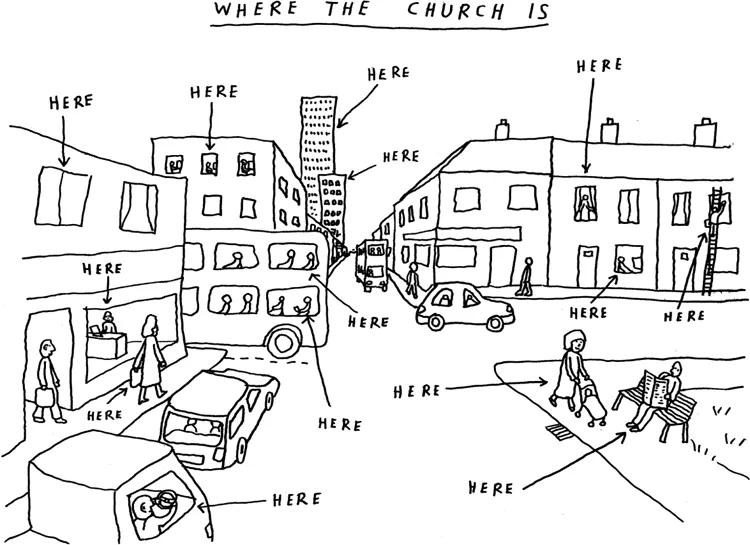
Jesus said . . . As you look around right now, wouldn’t you say that in about four months it will be time to harvest? Well, I’m telling you to open your eyes and take a good look at what’s right in front of you. These Samaritan fields are ripe. It’s harvest time!
John 4:34–35 (msg)
Open your eyes
The Palestinian countryside is challenging terrain from an agricultural point of view. The soil is rocky. The ground is parched for much of the year. Cultivation is a battle requiring both toil and tenacity. So, the sight of a sea of golden corn waving in the breeze, ‘ripe and ready to be harvested’, was unusual. However, Jesus and his disciples were close to Sychar in Samaria (John 4:5), a region of unusual fertility, renowned for its abundant harvests.1
The thought of travelling through Samaria would have been abhorrent to the disciples. The feud between Jews and Samaritans had been festering for centuries. Racial rivalry, religious dispute and ethnic cleansing had contributed to a toxic state of affairs. Rabbis said that to eat the bread of a Samaritan was tantamount to eating the flesh of a pig, the most detestable and repugnant act imaginable to a Jew.
To travel through Samaria was bad enough, but then to find Jesus speaking not just with a Samaritan, but a Samaritan woman, had been shocking. Surely no good could come from this? And yet, as they were still trying to process the significance of such radical behaviour, they began to see astounding signs of the impact of Jesus’ presence and work: ‘Many of the Samaritans from that town believed in him because of the woman’s testimony . . .’ (John 4:39). ‘Open your eyes’, Jesus says. ‘See that God is at work here. See the signs of the Kingdom.’
No doubt there was an attractive vista laid out before them, but Jesus was drawing their attention to something more profound and important than the fields of corn. He was instructing them to use more than their physical sense of sight. He wanted them to use their capacity to discern what was going on; to understand the meaning and significance of what they were witnessing, as on another occasion when he rebuked them, ‘You know how to interpret the appearance of the sky, but you cannot interpret the signs of the times’ (Matthew 16:3). In telling them to ‘open their eyes’, he wanted them to wake up to a deeper reality, to engage all their God-given faculties, and recognise what was going on behind the physically obvious.
Boiling frogs
This directive to ‘open your eyes and take a good look at what’s right in front of you’ is one that has had a major impact on my own thinking and priorities in recent years. You have probably heard the one about the frog and the boiling water. Folk wisdom has it (but please don’t try this at home!) that a frog dropped into boiling water will jump out, but if placed in cold water that is then heated gradually, it will fail to register the change and remain until cooked to death. Whether or not this is factually accurate, the meaning is clear. Like frogs and other sentient creatures, we easily perceive changes that are stark and sudden. Gradual changes, on the other hand, often go unnoticed or disregarded. In 2007, I returned to the UK after working overseas for twelve years. It took me a while to realise that some of the changes that were obvious to me, as I came back after a long spell away, were often unnoticed or overlooked by many.
This book has come into existence not because I enjoy spending weeks in front of a computer monitor, but rather because I am convinced that we are living through a period of exceptional change and that, as Christians, we need to take seriously Jesus’ commandment to open our eyes, to discern and understand the significance of what is going on right under our noses. Even twenty years ago, when information technology was still in its infancy, Peter Drucker, the well-known writer and educator in the world of business, proposed that we were entering the kind of dramatic transformation that seems to occur every few hundred years in Western history. He suggested that in fifty years’ time (or thirty from now) society will have so thoroughly rearranged itself that people who are born then will be unable to imagine the world in which their grandparents lived.2
Of course, the gradual and not-so-gradual changes in society are countless and diverse, but of particular interest to me, from the perspective of a Christian who had been out of the UK for more than a decade, were changes within the Church. By ‘Church’ (capital ‘C’) I mean the Christian community, ‘the body of Christ’ (1 Corinthians 12:27), rather than any particular organisation, institution or denomination. Some changes, which were sufficiently gradual as to go largely unnoticed by many, looked like an abrupt upheaval to me. I am talking about what one researcher has described as ‘a haemorrhage akin to a burst artery’,3 the exodus from church congregations of hundreds of thousands of people.
Across different parts of the UK, the picture is mixed. In England there are some areas of significant growth within the church, which almost compensate for widespread decline. The result is that, after a lengthy period of decline, church attendance in England has levelled out. One example of growth is the dramatic development of some ethnic minority churches as a consequence of immigration to London and some other large cities. In fact, church attendance in London grew from just over 620,000 in 2005 to just over 720,000 in the seven years to 2012, an enormous 16 per cent increase.4 Attendance at cathedrals has also increased in recent years.
Perhaps most encouraging for the long term, the strategy of planting new, culturally specific congregations, known as ‘Fresh Expressions’, is bearing considerable fruit. The Fresh Expressions movement describes itself as a ‘form of church for our changing culture, established primarily for the benefit of people who are not yet members of any church [which] will come into being through principles of listening, service, incarnational mission and making disciples’.5 Over 3,000 of these new forms of church now exist, spanning most church traditions in the UK.
However, despite these encouraging signs, the fact remains that there is widespread decline in attendance and membership beyond these areas of growth. In the five years between 2008 and 2013, the overall decline in church membership in the UK was about 5 per cent. Even this figure masks what was for some of the largest denominations a period of extraordinary decline. For example, membership of the Church of Scotland plummeted from 607,714 in 2000 to 415,705 in 2013. In 2007, the Christian charity, Tearfund, found that 33 per cent of people in the UK were ‘dechurched’.6 In Scotland, despite higher rates of church attendance than the UK as a whole, 39 per cent were dechurched. The situation in Wales was more shocking still, with a staggering 51 per cent dechurched.
Throughout the Western world the pattern is repeated. Reports from the Pew Research Center7 in the USA and the Christian Research Association in Australia8 both highlight similar trends of tumbling church attendance. The 2013 census in New Zealand showed that fewer than 1.9 million people were affiliated with a church, compared with more than 2 million in 2006.9
Burning questions
So, the church is declining. Or is it? Clearly, overall attendance at Sunday morning services is decreasing. But what is happening to these people? Is the declining membership of many church denominations and institutions necessarily synonymous with a decline in Christian faith? What does this upsurge, of people who used to go to church but no longer do, actually mean? In books with dramatic and despondent titles such as The death of Christian Britain10 and God is dead,11 some academics have enthusiastically interpreted diminishing church attendance as clear indication of a rapid and irrevocable process of secularisation. But what if we take a look behind the statistics? What if, rather than focusing on the relatively easy task of counting bottoms on pews on Sunday mornings, we were to find out what ‘dechurched’ actually means for the individual people concerned?
Behind every statistic is a person with a unique story. The word dechurched tells us what they are not doing (i.e. attending church), but not what they are doing. It tells us what they are no longer part of, but not what they are part of. So who are these people? Have the hundreds of thousands of people who have disengaged from their local church congregation in recent years also turned away from God? Or are many of the so-called dechurched practising a churchless, but nonetheless genuine Christian faith? If, rather than wholesale decline, we are witnessing a trend away from the traditional institutional forms of church towards something different, what then are we to make of that? Is it something to fight against? Could it even be that one day we might look back on this time as a time when God was acting to bring about the kind of historic transformation that we seem to see every few centuries?
The journey towards answering these questions began for me a few years ago. It was Easter. What a stirring scene! Gathered in a natural amphitheatre with a stunning panorama of the still snow-covered Cairngorms before us and the sparkling waters of the loch below, the final rousing chorus of ‘Thine be the glory’ brought another Easter celebration to a joyful and expectant climax. ‘Christ is risen’, called out a booming voice from the midst of the loose semicircle of eighty or ninety people. Young and old, men and women, local residents and tourists, all replied in one voice, ‘He is risen indeed!’
After twelve years away, working in South Asia, it was good to be back in this Highland village, the scene of my formative years as a Christian. As people gathered around the embers of the campfire and shared a simple breakfast of fish and bread, I had a sense of homecoming. It was good to be among friends; and not just friends, but brothers and sisters in Christ. However, scanning the crowd, I began to realise that a few faces were missing. People I was certain would want to be here, friends who I knew were deeply committed to the Christian faith and to this local church, seemed to be absent.
In the weeks that followed,...
Table of contents
- The Invisible Church
- Contents
- Acknowledgements
- Bible quotations
- Introduction Read This First!
- Chapter 1 Forgotten but not gone
- Chapter 2 Myths which masquerade as facts
- Chapter 3 Stereotypes, generalisations and prejudice
- Chapter 4 Exit routes
- Chapter 5 A longing for belonging
- Chapter 6 Our never-changing God – and his ever-changing church?
- Chapter 7 Life really is a journey
- Chapter 8 Learning to love
- Chapter 9 Co-missioned
- Chapter 10 Glimpses of the way ahead?
- Bible References Index
- Name and Subject Index