This book is available to read until 23rd December, 2025
- 288 pages
- English
- ePUB (mobile friendly)
- Available on iOS & Android
eBook - ePub
Available until 23 Dec |Learn more
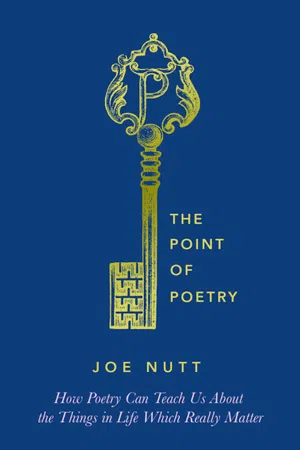
The Point of Poetry
About this book
What's the point of poetry? It's a question asked in classrooms all over the world, but it rarely receives a satisfactory answer. Which is why so many people, who read all kinds of books, never read poetry after leaving school.
Exploring twenty-two works from poets as varied as William Blake, Seamus Heaney, Rita Dove and Hollie McNish, this book makes the case for what poetry has to offer us, what it can tell us about the things that matter in life. Each poem is discussed with humour and refreshing clarity, using a mixture of anecdote and literary criticism that has been honed over a lifetime of teaching.
Poetry can enrich our lives, if we'll let it. The Point of Poetry is the perfect companion for anyone looking to discover how.
Frequently asked questions
Yes, you can cancel anytime from the Subscription tab in your account settings on the Perlego website. Your subscription will stay active until the end of your current billing period. Learn how to cancel your subscription.
At the moment all of our mobile-responsive ePub books are available to download via the app. Most of our PDFs are also available to download and we're working on making the final remaining ones downloadable now. Learn more here.
Perlego offers two plans: Essential and Complete
- Essential is ideal for learners and professionals who enjoy exploring a wide range of subjects. Access the Essential Library with 800,000+ trusted titles and best-sellers across business, personal growth, and the humanities. Includes unlimited reading time and Standard Read Aloud voice.
- Complete: Perfect for advanced learners and researchers needing full, unrestricted access. Unlock 1.4M+ books across hundreds of subjects, including academic and specialized titles. The Complete Plan also includes advanced features like Premium Read Aloud and Research Assistant.
We are an online textbook subscription service, where you can get access to an entire online library for less than the price of a single book per month. With over 1 million books across 1000+ topics, we’ve got you covered! Learn more here.
Look out for the read-aloud symbol on your next book to see if you can listen to it. The read-aloud tool reads text aloud for you, highlighting the text as it is being read. You can pause it, speed it up and slow it down. Learn more here.
Yes! You can use the Perlego app on both iOS or Android devices to read anytime, anywhere — even offline. Perfect for commutes or when you’re on the go.
Please note we cannot support devices running on iOS 13 and Android 7 or earlier. Learn more about using the app.
Please note we cannot support devices running on iOS 13 and Android 7 or earlier. Learn more about using the app.
Yes, you can access The Point of Poetry by Joe Nutt in PDF and/or ePUB format, as well as other popular books in Literature & Literary Criticism & Nature. We have over one million books available in our catalogue for you to explore.
Information
Twenty-One
The Prelude
(1805)
William Wordsworth (1770–1850)
William Wordsworth (1770–1850)
It’s time to bring out the big guns. The kind that jut skywards outside the Imperial War Museum like postmodern sculptures, or the one Rudyard Kipling’s Kim sat on at the start of his epic journey.
Contestants on Pointless, a quiz show currently popular on British TV, are always hoping to find an answer to a question that no one, out of a hundred people asked, could produce. If asked to name any English poet, most competitors would avoid William Wordsworth like the plague because they know he would probably be one of the most common answers. His alliterative, lexical name is synonymous with poetry. Ask a child clutching a crayon to draw a picture of a poet and it will be William Wordsworth standing on those stick-thin legs smiling at you under spiky hair. We’ve mentioned him already when exploring Coleridge, and especially their joint enterprise, Lyrical Ballads, but besides a dalliance with a host of daffodils, his fame rests to a large extent on one lengthy, autobiographical poem, The Prelude. It’s that poem which I’m going to invite you to read and enjoy. It comes, like almost everything good for you today, with a health warning. To read all thirteen books1 of blank verse will probably take you about seven to eight hours of non-stop reading, about two or three days if you’re holidaying close to a pool and a sun lounger.
It’s essentially an autobiographical epic, years on an imaginary psychiatrist’s couch compressed into one huge poem, so the obvious route in would be to tell you something about Wordsworth’s life and background as I’ve done with earlier poets. But the whole purpose of this book has been to offer a better, personal, richer route to enjoying poetry than more downtrodden approaches. How poorly some of those approaches work became all too clear on National Poetry Day recently in an exchange in a national educational publication I write a column for, when another author suggested that perhaps schools weren’t doing a great job of teaching poetry. He argued that ‘learning how to write poetry seriously is not a subject suitable for a school curriculum’.2 Outraged responses, worryingly from people actually being employed to teach poetry in schools, mostly shared a view that poetry is in some unique way free from any of the conventional constraints we rely on for language to be intelligible. One commentator made this child-friendly statement: ‘Poetry affords people (not just students) the opportunity to express and communicate in all the colours of the rainbow.’2
In contrast, I’ve aimed throughout to treat all readers as adults and gradually ease you into having the confidence to take any poem at face value, to bring yourself, your own experiences, thoughts and ideas to the poem so that it can set off that firework display that makes poetry a unique reading pleasure. For that reason I’m going to give you the opening section of the poem to read and respond to for yourself, without any upfront guidance or interference from me. This is how The Prelude opens.
Oh, there is blessing in this gentle breeze,
That blows from the green fields and from the clouds
And from the sky; it beats against my cheek,
And seems half conscious of the joy it gives.
O welcome messenger! O welcome friend! 5
A captive greets thee, coming from a house
Of bondage, from yon city’s walls set free,
A prison where he hath been long immured.
Now I am free, enfranchised and at large,
May fix my habitation where I will. 10
What dwelling shall receive me, in what vale
Shall be my harbour, underneath what grove
Shall I take up my home, and what sweet stream
Shall with its murmurs lull me to my rest?
The earth is all before me—with a heart 15
Joyous, nor scared at its own liberty,
I look about, and should the guide I chuse
Be nothing better than a wandering cloud
I cannot miss my way. I breathe again—
Trances of thought and mountings of the mind 20
Come fast upon me. It is shaken off,
As by miraculous gift ’tis shaken off,
That burthen of my own unnatural self,
The heavy weight of many a weary day
Not mine, and such as were not made for me. 25
Long months of peace—if such bold word accord
With any promises of human life—
Long months of ease and undisturbed delight
Are mine in prospect. Whither shall I turn,
By road or pathway, or through open field, 30
Or shall a twig or any floating thing
Upon the river point me out my course?
Enough that I am free, for months to come
May dedicate myself to chosen tasks,
May quit the tiresome sea and dwell on shore— 35
If not a settler on the soil, at least
To drink wild water, and to pluck green herbs,
And gather fruits fresh from their native bough.
Nay more, if I may trust myself, this hour
Hath brought a gift that consecrates my joy; 40
For I, methought, while the sweet breath of heaven
Was blowing on my body, felt within
A corresponding mild creative breeze,
A vital breeze which travelled gently on
O’er things which it had made, and is become 45
A tempest, a redundant energy,
Vexing its own creation. ’Tis a power
That does not come unrecognised, a storm
Which, breaking up a long-continued frost,
Brings with it vernal promises, the hope 50
Of active days, of dignity and thought,
Of prowess in an honourable field,
Pure passions, virtue, knowledge, and delight,
The holy life of music and of verse.
Thus far, O friend, did I, not used to make 55
A present joy the matter of my song,
Pour out that day my soul in measured strains,
Even in the very words which I have here
Recorded. To the open fields I told
A prophesy; poetic numbers came 60
Spontaneously, and clothed in priestly robe
My spirit, thus singled out, as it might seem,
For holy services. Great hopes were mine:
My own voice cheared me, and, far more, the mind’s
Internal echo of the imperfect sound— 65
To both I listened, drawing from them ...
Table of contents
- Cover
- Title
- Dedication
- Contents
- Foreword
- One Sonnet 18
- Two The Hawk
- Three The Tyger
- Four The Things That Matter
- Five Adlestrop
- Six Break of Day in the Trenches
- Seven When I am Dead, My Dearest
- Eight Mrs Midas
- Nine Tractor
- Ten My Last Duchess
- Eleven To his Coy Mistress
- Twelve Famous for What?
- Thirteen The Gun
- Fourteen Twickenham Garden
- Fifteen Blackberry-Picking
- Sixteen The Darkling Thrush
- Seventeen The Rime of the Ancient Mariner
- Eighteen The Eve of St Agnes
- Nineteen The Bistro Styx
- Twenty The Sea and the Skylark
- Twenty-One The Prelude
- Twenty-Two Paradise Lost
- Where to Now?
- Credits
- Acknowledgements
- A Note on the Author
- Supporters
- Copyright