- 72 pages
- English
- ePUB (mobile friendly)
- Available on iOS & Android
eBook - ePub
Scorched: Extreme Heat and Real Estate
About this book
This publication explores how extreme heat is emerging as a growing risk factor and planning consideration across the United States, and how the real estate industry is responding with design approaches, technologies and new policies to mitigate the impacts and help protect human health. Real estate development and land use policy case studies explore how U.S. real estate developers, designers, and policymakers are implementing solutions to make spaces more adaptable to environmental conditions and comfortable for occupants.
Trusted by 375,005 students
Access to over 1.5 million titles for a fair monthly price.
Study more efficiently using our study tools.
Information
PART I
THE SCIENCE AND IMPACTS
The Science of Extreme Heat
The Impacts of Extreme Heat

Like many historically temperate cities, New York City faces increasingly frequent and hotter extreme heat events. High temperatures are made worse in urban areas like New York City that experience the urban heat island effect.
Three distinct but related phenomena—climate change, heat waves, and urban heat islands—contribute to extreme heat and are changing the lived experience of people across the United States.
The year 2018 was the fourth hottest on record globally; the next three warmest were 2016, 2015, and 2017, respectively.1 Summer 2018 was an especially brutal one for the United States. In June, dozens died across the Northeast and Midwest during a string of 100°F days.2 In July, 41 heat records were set across the nation.3 Many schools across the Northeast did not open as planned in September because classroom temperatures were dangerous.
The 2018 heat wave was not without precedent, domestically or internationally. A five-day heat wave in July 1995 killed more than 700 people in Chicago and remains the single deadliest heat wave in the United States. That summer, 55 million residents across the Northeast experienced the largest power outage in American history, caused in part by extreme heat. In 2002, after several years of heat-exacerbated drought, New Mexico’s Santa Fe Building Council considered halting all new building permits.4 Internationally, the 2003 European heat wave and associated power outages claimed the lives of 70,000 citizens of 12 countries, making it the highest death toll associated “with any other natural disaster to have ever struck a region of the developed world.”5
THE SCIENCE OF EXTREME HEAT
Climate change has caused an increase in temperature across the United States and makes extreme heat events hotter and more likely to occur.6 In addition, climate change is not the only cause of extreme heat—and in cities, not even the main cause of these more intense, frequent, and long-lasting extreme heat events. Several distinct but related climate-and weather-related phenomena contribute to extreme heat:
- Rising global temperatures (a long-term increase caused by human-induced climate change);
- Heat waves (relatively short-term periods of abnormally hot and humid weather); and
- Urban heat islands (areas of hotter temperatures created by local, urban conditions).
The relative change in temperature causes more damage—to people and infrastructure—in cooler places and where fewer adaptation strategies (such as air conditioning or shade trees) are in place.
URBAN HEAT ISLANDS—NOT GLOBAL WARMING—CAUSE THE MAJORITY OF THE TEMPERATURE RISE IN U.S. CITIES. CITIES ARE 2° TO 6°F WARMER ON AVERAGE THAN THEIR SURROUNDINGS AND ARE WARMING UP TO 50 PERCENT FASTER THAN THE REST OF THE COUNTRY.7
The UHI-induced temperature increase above the “baseline normal” and the faster rate of warming are in addition to the “background” 1° to 2°F rise in global temperatures that has already occurred in the United States because of climate change.
While we are in a northern climate, we still have significant heat issues during the summer.
BROKEN TEMPERATURE RECORDS
SUMMER 2018
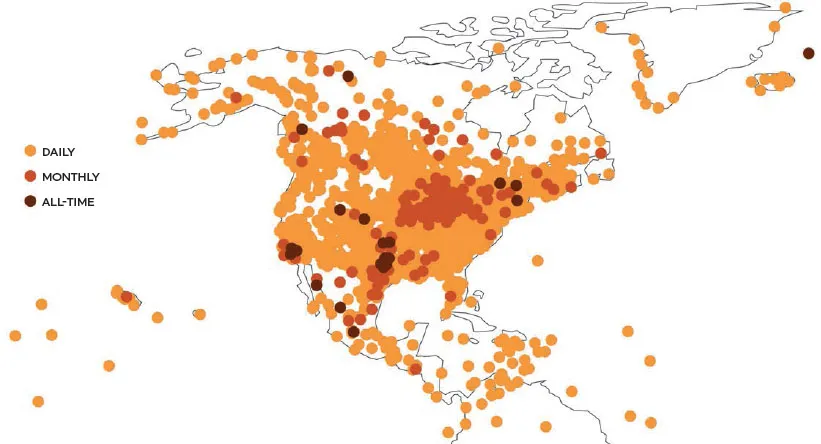
This map displays the daily, monthly, and all-time-high temperature records broken between May 1 and July 31, 2018, during an uncommonly warm summer. (ULI, adapted from Axios with data from Berkeley Earth)
HEAT WAVE SURFACE TEMPERATURES
SAN FRANCISCO, SEPTEMBER 1, 2017
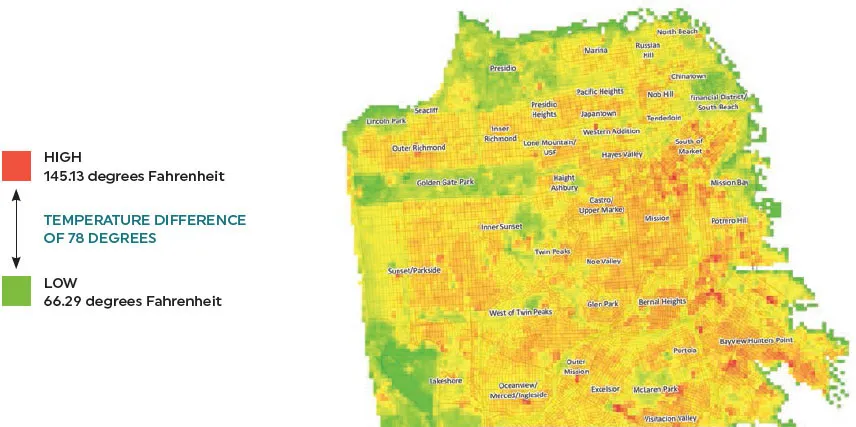
The temperature difference across San Francisco during this September 2017 heat event was 78.84°F, demonstrating the significant influence of land use and topography on temperature. (San Francisco Office of Neighborhood Resilience)
Elements of Extreme Heat
Although these three extreme heat factors (climate change, heat waves, and urban heat islands) are each distinct phenomena, many of their causes and consequences are the same.
CLIMATE CHANGE
Climate change has caused a 1.3° to 1.9°F temperature increase in the United States since record keeping began; within several decades, U.S. average temperatures are projected to be 2° to 4°F higher with even larger temperature increases expected in some regions.8 What the U.S. climate will be by the end of the century depends in large part upon the rates of GHG emissions that drive climate change. “There’s nowhere in the U.S. right now where temperature and humidity levels are so high that a healthy individual cannot stay outside for long without becoming ill or dying, but in 20 years, it’s possible,” says Brian Stone, renowned heat expert and program director at Georgia Tech’s School of City and Regional Planning.
HEAT WAVES
In addition to the background increase in temperature, climate change is altering the characteristics of extreme heat events. “It’s not just excessive heat,” explains Rives Taylor, principal and codirector of resilience at Gensler; “it’s the extreme swing in temperature from one day to the next. That sudden difference in temperature wreaks havoc on mechanical systems and facade materiality….Our buildings have to face a totally different world.”
The frequency of heat waves, their duration, and the temperatures during them are all becoming more extreme. Cities today have on average 10 more extreme heat events per year than they did in the mid-1950s.9 Heat waves also manifest differently indoors than they do outdoors.10 Early research results indicate that, when a heat wave occurs, indoor temperatures spike later than outdoor temperatures and last longer, likely because it takes time for heat to transfer indoors, and once there, it is trapped inside.11
URBAN HEAT ISLANDS
Cities are at elevated risk from extreme temperatures because they absorb more of the sun’s energy (i.e., heat) and can be up to 22°F hotter in comparison to their surroundings.12 This difference in temperature between urban areas and their rural surroundings is called an urban heat island or the urban heat island effect (UHIE). UHIs are not uniform across cities; developments without significan...
Table of contents
- Cover
- Title Page
- Copyright
- About the Urban Land Institute
- Contents
- Executive Summary
- Part I. The Science and Impacts
- Part II. Implications and Opportunities for the Real Estate Sector
- Part III. The Extreme Heat Policy Landscape
- Conclusion: Building for a Warmer Future
- Acknowledgments
- Notes
Frequently asked questions
Yes, you can cancel anytime from the Subscription tab in your account settings on the Perlego website. Your subscription will stay active until the end of your current billing period. Learn how to cancel your subscription
No, books cannot be downloaded as external files, such as PDFs, for use outside of Perlego. However, you can download books within the Perlego app for offline reading on mobile or tablet. Learn how to download books offline
Perlego offers two plans: Essential and Complete
- Essential is ideal for learners and professionals who enjoy exploring a wide range of subjects. Access the Essential Library with 800,000+ trusted titles and best-sellers across business, personal growth, and the humanities. Includes unlimited reading time and Standard Read Aloud voice.
- Complete: Perfect for advanced learners and researchers needing full, unrestricted access. Unlock 1.5M+ books across hundreds of subjects, including academic and specialized titles. The Complete Plan also includes advanced features like Premium Read Aloud and Research Assistant.
We are an online textbook subscription service, where you can get access to an entire online library for less than the price of a single book per month. With over 1.5 million books across 990+ topics, we’ve got you covered! Learn about our mission
Look out for the read-aloud symbol on your next book to see if you can listen to it. The read-aloud tool reads text aloud for you, highlighting the text as it is being read. You can pause it, speed it up and slow it down. Learn more about Read Aloud
Yes! You can use the Perlego app on both iOS and Android devices to read anytime, anywhere — even offline. Perfect for commutes or when you’re on the go.
Please note we cannot support devices running on iOS 13 and Android 7 or earlier. Learn more about using the app
Please note we cannot support devices running on iOS 13 and Android 7 or earlier. Learn more about using the app
Yes, you can access Scorched: Extreme Heat and Real Estate by Katharine Burgess,Elizabeth Foster in PDF and/or ePUB format, as well as other popular books in Architecture & Urban Planning & Landscaping. We have over 1.5 million books available in our catalogue for you to explore.