- English
- ePUB (mobile friendly)
- Available on iOS & Android
eBook - ePub
ArchiMate® 3.1 - A Pocket Guide
About this book
ArchiMate®, an Open Group Standard, is an open and independent modeling language for Enterprise Architecture that is supported by different tool vendors and consulting firms. The ArchiMate language enables Enterprise Architects to describe, analyze, and visualize the relationships among architecture domains in an unambiguous way.
This Pocket Guide is based on the ArchiMate® 3.1 Specification. It gives a concise introduction to the ArchiMate language. What's more, it's authoritative with material derived from the official ArchiMate documentation.
Topics covered include:
• A high-level introduction to the ArchiMate Specification and its relationship to Enterprise Architecture
• The high-level structure of the ArchiMate language, including an introduction to layering, and the ArchiMate Framework
• The Generic Metamodel for the language
• The relationships that the ArchiMate language includes to model the links between elements
• The Motivation Elements, which includes concepts such as goal, principle, and requirement
• The Strategy Elements, which includes concepts such as resource, capability, and course of action
• The Business Layer, which includes the modeling concepts relevant in the business domain
• The Application Layer, which includes modeling concepts relevant for software applications
• The Technology Layer, which includes modeling concepts relevant for system software applications and infrastructure
• The Physical Elements, which include concepts relevant for the modeling of physical concepts like machines and physical installations
• The relationships between different layers of the language
• The Implementation and Migration Elements, which include concepts to support modeling Enterprise Architecture-enabled transformation
• A summary of the changes from ArchiMate 2.1 to ArchiMate 3.1
• A Glossary of terms
Trusted by 375,005 students
Access to over 1 million titles for a fair monthly price.
Study more efficiently using our study tools.
Information
Topic
EducationSubtopic
Business DevelopmentChapter 1
Introduction
This chapter provides an introduction to the ArchiMate Specification, a standard of The Open Group.
Topics addressed in this chapter include:
• An introduction to the ArchiMate Specification
• A brief overview of the ArchiMate Specification
• The ArchiMate language and its relationship to Enterprise Architecture and the TOGAF Standard
1.1 Introduction to the ArchiMate Specification
The ArchiMate Specification, a standard of The Open Group, is an open and independent modeling language for Enterprise Architecture that is supported by different tool vendors and consulting firms. The ArchiMate language enables Enterprise Architects to describe, analyze, and visualize the relationships among architecture domains in an unambiguous way.
Just as an architectural drawing in classical building architecture describes the various aspects of the construction and use of a building, the ArchiMate Specification offers a common language for describing the construction and operation of business processes, organizational structures, information flows, IT systems, and technical and physical infrastructure. This insight helps stakeholders to design, assess, and communicate the consequences of decisions and changes within and between these architecture domains.
This document is the Pocket Guide to the ArchiMate 3.1 Specification, referred to simply as the “ArchiMate Specification” within this document. The ArchiMate 3.1 Specification is a maintenance update to the ArchiMate Specification.
 |
Development of the ArchiMate Language The ArchiMate language was created in the period 2002-2004 in the Netherlands by a project team from the Telematica Instituut in co-operation with several partners from government, industry, and academia, including Ordina, Radboud Universiteit Nijmegen, the Leiden Institute for Advanced Computer Science (LIACS), and the Centrum Wiskunde & Informatica (CWI). The development included tests in organizations such as ABN AMRO, the Dutch Tax and Customs Administration, and the Stichting Pensioenfonds ABP.In 2008, the ownership and stewardship of the ArchiMate language was transferred from the ArchiMate Foundation to The Open Group. Since 2009, The Open Group ArchiMate Forum has developed successive versions and published them on The Open Group public website. |
1.2 ArchiMate Specification Overview
The ArchiMate Specification is The Open Group Standard for the ArchiMate Enterprise Architecture modeling language. It contains the formal definition of the visual design language.
The contents of the specification include the following:
• The introduction, including the objectives, overview, conformance requirements, and terminology
• Definitions of the general terms used in the specification
• The structure of the modeling language
• The generic metamodel of the language
• The relationships in the language
• A detailed breakdown of the modeling framework covering the motivation elements, strategy elements, and the three core layers (Business/Application/Technology)
• Relationships between core layers
• Implementation and migration elements for expressing the implementation and migration aspects of an architecture
• The concepts of stakeholders, architecture viewpoints, and views, and also the ArchiMate viewpoint mechanism
• Mechanisms for customizing the language for specialized or domain-specific purposes
• Notation overviews and summaries
• Informative descriptions of the relationship of the ArchiMate language to other standards, specifications, and guidance documents, including the TOGAF framework, Business Process Modeling Notation (BPMN), Unified Modeling Language (UML), the BIZBOK® Guide,2 and Business Motivation Model (BMM)
The ArchiMate 3.1 Specification is the latest version of the specification and is an evolution from the ArchiMate 2.1 and earlier.
1.3 The ArchiMate Language and Enterprise Architecture
The role of the ArchiMate Specification is to provide a graphical language for the representation of Enterprise Architectures over time (i.e., including strategic, transformation, and migration planning), as well as the motivation and rationale for the architecture. The ArchiMate modeling language provides a uniform representation for diagrams that describe Enterprise Architectures, and offers an integrated approach to describe and visualize the different architecture domains together with their underlying relations and dependencies.
The design of the ArchiMate language started from a set of relatively generic concepts (objects and relations), which have been specialized for application at the different architectural layers for an Enterprise Architecture. The most important design restriction on the ArchiMate language is that it has been explicitly designed to be as compact as possible, yet still usable for most Enterprise Architecture modeling tasks. In the interest of simplicity of learning and use, the language has been limited to the concepts that suffice for modeling the proverbial 80% of practical cases.
1.3.1 The ArchiMate Language and the TOGAF ADM
The ArchiMate language consists of the ArchiMate core language, that includes the Business, Application, and Technology layers, and elements to model the Strategy and Motivation for an architecture, as well as its Implementation and Migration. Figure 1 shows a simplified mapping of how the ArchiMate language can be used in relation to the phases of the TOGAF ADM.
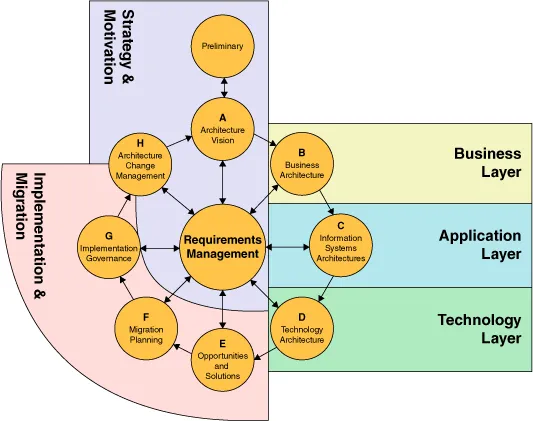
Figure 1: The Relationship between the ArchiMate Language and the TOGAF ADM
The Business, Application, and Technology layers support the description of the architecture domains defined by the TOGAF framework (business, information systems, and technology, as well as their inter-relationships).
The strategy and motivation elements in the ArchiMate language can be used to support the Requirements Management, Preliminary Phase, and Architecture Vision phases of the TOGAF ADM, which establish the high-level business goals, architecture principles, and initial business requirements. They are also relevant to the Architecture Change Management phase of the TOGAF ADM, since the phase deals with changing requirements. Although not shown in the figure, it should be noted that these elements could also be used in other ADM phases, such as Phases B, C, and D.
The implementation and migration elements of the ArchiMate language support the implementation and migration of architectures through the Opportunities and Solutions, Migration Planning, and Implementation Governance phases of the TOGAF ADM.
2 Business Architecture Guild. A Guide to the Business Architecture Body of Knowledge® (BIZBOK® Guide), Version 7.0, 2018; refer to: www.businessarchitectureguild.org.
Chapter 2
Language Structure
This chapter describes the construction of the ArchiMate language.
Topics addressed in this chapter include:
• The top-level language structure
• Layering
• The ArchiMate Framework
2....
Table of contents
- Cover
- Title
- Copyright
- Contents
- Chapter 1 Introduction
- Chapter 2 Language Structure
- Chapter 3 Generic Metamodel
- Chapter 4 Relationships
- Chapter 5 Motivation Elements
- Chapter 6 Strategy Elements
- Chapter 7 Business Layer
- Chapter 8 Application Layer
- Chapter 9 Technology Layer
- Chapter 10 Physical Elements
- Chapter 11 Relationships between Core Layers
- Chapter 12 Implementation and Migration Elements
- Chapter 13 ArchiMate Viewpoints
- Appendix A
- Glossary
- Index
Frequently asked questions
Yes, you can cancel anytime from the Subscription tab in your account settings on the Perlego website. Your subscription will stay active until the end of your current billing period. Learn how to cancel your subscription
No, books cannot be downloaded as external files, such as PDFs, for use outside of Perlego. However, you can download books within the Perlego app for offline reading on mobile or tablet. Learn how to download books offline
Perlego offers two plans: Essential and Complete
- Essential is ideal for learners and professionals who enjoy exploring a wide range of subjects. Access the Essential Library with 800,000+ trusted titles and best-sellers across business, personal growth, and the humanities. Includes unlimited reading time and Standard Read Aloud voice.
- Complete: Perfect for advanced learners and researchers needing full, unrestricted access. Unlock 1.4M+ books across hundreds of subjects, including academic and specialized titles. The Complete Plan also includes advanced features like Premium Read Aloud and Research Assistant.
We are an online textbook subscription service, where you can get access to an entire online library for less than the price of a single book per month. With over 1 million books across 990+ topics, we’ve got you covered! Learn about our mission
Look out for the read-aloud symbol on your next book to see if you can listen to it. The read-aloud tool reads text aloud for you, highlighting the text as it is being read. You can pause it, speed it up and slow it down. Learn more about Read Aloud
Yes! You can use the Perlego app on both iOS and Android devices to read anytime, anywhere — even offline. Perfect for commutes or when you’re on the go.
Please note we cannot support devices running on iOS 13 and Android 7 or earlier. Learn more about using the app
Please note we cannot support devices running on iOS 13 and Android 7 or earlier. Learn more about using the app
Yes, you can access ArchiMate® 3.1 - A Pocket Guide by Andrew Josey,The Open Group in PDF and/or ePUB format, as well as other popular books in Education & Business Development. We have over one million books available in our catalogue for you to explore.