
- 80 pages
- English
- ePUB (mobile friendly)
- Available on iOS & Android
eBook - ePub
The Prisons / Le Carceri
About this book
The timeless Carceri etchings of Piranesi (1720–1778) represent not only spectacular artistic accomplishments but also unforgettable expressions of psychological truths. Combining the influences of Tiepolo, Bibiena, and Rembrandt, these works of architectural fantasy challenge the boundaries of perception, creating a vast system of visual provocation. Innumerable staircases, immense vaults, and other ambiguous structures are compounded with projecting beams, pulleys, rickety catwalks and gangways, dangling ropes and chains, and the occasional shadowy human figure.
This full reproduction in book form of The Prisons, made directly from mint copies of original prints, presents both editions of Piranesi's work, with prints on facing pages for convenient comparison. The first edition (circa 1745) ranks among the most rare and valuable print collections in existence and abounds in a multiplicity of perspectives—an innovation that predates Cubism by two centuries. For the second (1761) edition, Piranesi reworked the plates, adding elaborate details that alter some of them almost beyond recognition. It is in the second, more emotionally challenging renditions that his masterful management of light and shadow is most evident. This edition features an informative Introduction by Philip Hofer, in addition to a Preface by John Howe, a conceptual designer on Peter Jackson's Lord of the Rings film trilogy.
Frequently asked questions
Yes, you can cancel anytime from the Subscription tab in your account settings on the Perlego website. Your subscription will stay active until the end of your current billing period. Learn how to cancel your subscription.
At the moment all of our mobile-responsive ePub books are available to download via the app. Most of our PDFs are also available to download and we're working on making the final remaining ones downloadable now. Learn more here.
Perlego offers two plans: Essential and Complete
- Essential is ideal for learners and professionals who enjoy exploring a wide range of subjects. Access the Essential Library with 800,000+ trusted titles and best-sellers across business, personal growth, and the humanities. Includes unlimited reading time and Standard Read Aloud voice.
- Complete: Perfect for advanced learners and researchers needing full, unrestricted access. Unlock 1.4M+ books across hundreds of subjects, including academic and specialized titles. The Complete Plan also includes advanced features like Premium Read Aloud and Research Assistant.
We are an online textbook subscription service, where you can get access to an entire online library for less than the price of a single book per month. With over 1 million books across 1000+ topics, weâve got you covered! Learn more here.
Look out for the read-aloud symbol on your next book to see if you can listen to it. The read-aloud tool reads text aloud for you, highlighting the text as it is being read. You can pause it, speed it up and slow it down. Learn more here.
Yes! You can use the Perlego app on both iOS or Android devices to read anytime, anywhere â even offline. Perfect for commutes or when youâre on the go.
Please note we cannot support devices running on iOS 13 and Android 7 or earlier. Learn more about using the app.
Yes, you can access The Prisons / Le Carceri by Giovanni Battista Piranesi in PDF and/or ePUB format, as well as other popular books in Art & Monographies d'artistes. We have over one million books available in our catalogue for you to explore.
Information
INTRODUCTION
After a truly significant artist dies, although he is often temporarily âforgotten,â it is only a question of time before he is rediscovered. Meanwhile, whether adequately appreciated in his own lifetime or not, there is normally a tendency for him to be superseded in the public eye, at least, by some newer figure. Only a few artists in all history have been at once, and continually, recognized. And not even the greatest are internationally acknowledged until they have become established in the general consciousness as great innovators, or as outstanding figures in their national environment.
Giovanni Battista Piranesi (1720â1778) did enjoy a considerable reputation in his lifetime, butâan unusual circumstanceâit was mainly outside of his native land, Italy! His dramatic personality and technical ability should have inspired nearly as wide attention as did Goyaâs. But unlike the slightly later Spanish master, who became preeminent in a number of artistic media, with a wide range of arresting, attractive subject matter, Piranesi excelled only in drawing and in the making of architectural prints, which often appeared in very large, expensive books. His most longed-for careerâto be employed as an architectâwholly eluded him except during two years in the mid-1760âs. This was his great personal tragedy, for it seems clear that he might have become as outstanding in this profession as he desired to be. Precocious, where Goya was late in reaching maturity, Piranesi might be said to have worn himself out prematurely, for he died at 58. Nevertheless, his production of prints was enormousâwell over a thousand etchings, mainly large in scaleâand his resourcefulness in getting them published, together with his quite controversial archaeological theories, was amazing considering his continual poverty and his unfortunate lack of powerful Italian patrons.
The series of prints which is the subject of this essay was first given the rather formidable, and poorly spelled, Italian title âInvenzioni Capric di Carceri all Acqua Forte Datte in Luce da Giovani Buzard [somewhat later spelled correctly Bouchard] in Roma Mercant(e) al Corsoâ by their publisher, who was a Frenchman. When Piranesi himself expanded the series to sixteen etchings, and took over the publication some years later, it was not a great deal clearer. One cannot be quite certain that âCarceriâ is preceded by the article âLe,â and then follows âDâInvenzione de G Battista Piranesi Archit Vene,â rather pathetically pointing to his Venetian origin and his aspiration to be regarded primarily as an architect. In neither case, be it noted, is there a date, but we feel rather certain now that the first fourteen prints were conceived and executed between about 1743 and 1745, while Piranesi was in his early twenties. In some respects their authorâs genius never surpassed this early tour de force, which of course is the reason one can say he was decidedly precocious. Time, and a great need for simplification, has reduced most references to the series to Le Carceri (in Italian) and The Prisons (in English).
Piranesiâs sources of inspiration are not hard to discover. Moreover, as so often in the case of a needy and sensitive artist, they were chosen because they related to a very deep spiritual conflict. Young as he was, Giovanni Battista had already begun to realize his architectural talents were not wanted. So, like Goya, whose first important print series Los Caprichos reflects another kind of inner crisis, Piranesi was not able to hide the fact that his prints are not mere âcaprices,â but a personal identification with the profounder implications of the subject matter. He had no solid career as a court painter behind him as Goya did. Indeed, because of his intransigent nature and constant quarrels, Piranesi was destined to continual disappointment, which was only lifted for a short time (in 1764-65) when two great ecclesiastical patrons gave him a minor architectural commission. Goyaâs later career was quite different, for he eventually had his fill of patronage and praise. But toward the end of his life, he abandoned it all and went to live in self-imposed exile. Had Piranesi been given a proper invitation to go to England, he might have prospered there, for a number of traveling English art connoisseurs on the Grand Tour came to admire him. And the contemporary Scots artist and architect Robert Adam became his close friend. A later generation of British notables, including William Beckford and J. M. W. Turner, actually made him famous. So in England, Piranesi was never completely forgotten. In America, his reputation has come much laterâmainly, one might say, in the last thirty years.
Although Arthur Samuelâs Piranesi (London, 1910) was the first critical recognition of this century, Albert Giesecke published a more important work, the first sound biography, at Leipzig one year later. These are the two books that really initiated the rediscovery of Piranesiâs genius, which had been largely forgotten during the second half of the nineteenth century. They were soon followed by Henri Focillonâs excellent and reliable catalogue (Paris, 1918), and then by Arthur M. Hindâs more detailed one which appeared in London in 1922.
From 1922 until after World War II there was a âgeneration gapâ so far as important contributions to the study of Piranesi are concerned. Then came the Pierpont Morgan Libraryâs sensational exhibition of drawings early in 1949. For this an excellent catalogue ...
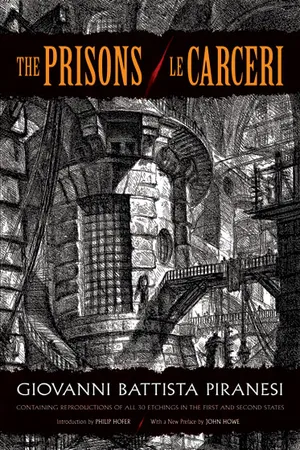
Table of contents
- DOVER BOOKS ON FINE ART
- Title Page
- PUBLISHERâS NOTE
- Copyright Page
- Table of Contents
- PREFACE
- INTRODUCTION
- I - Title page to âInvenzioni Capric di Carceri.â
- II - Carcere, with a Large Number of Human and Sculptured Figures.
- III - Carcere, with a Circular Tower.
- IV - Carcere, with a View Through an Arch Toward a Bridge with a Sculptured Frieze. Below, a Colonnade Reminiscent of St. Peterâs Square in Rome.
- V - Carcere, like Plate II, with Similar Elaborate Paraphernalia.
- VI - Carcere, with Arches and Pulleys and a Smoking Fire in the Center.
- VII - Carcere, with Numerous Wooden Galleries and a Drawbridge.
- VIII - Carcere, with a Staircase Flanked by Military Trophies.
- IX - Carcere, with a Doorway Surmounted by a Colossal Wheel-shaped Opening.
- - Carcere, with a Group of Captives Chained to Posts.
- XI - Carcere, with a Central Hanging Lantern.
- XII - Carcere, with a Platform Approached by Steps.
- XIII - Carcere, with Several Straight, Broad Central Staircases.
- XIV - Carcere, with a Staircase Ascending to the Left.
- XV - Carcere, with Vaults Springing from a Monumental Pier.
- XVI - Carcere, with a High Gallery Beyond a Low, Timbered Anteroom.