The Gift brilliantly argues for the importance of creativity in our increasingly money-driven society. Reaching deep into literature, anthropology and psychology for striking examples, the heart of Lewis Hyde's modern masterpiece is the simple and important idea that a 'gift' can inspire and change our lives, art and culture.
Lewis Hyde has been championed by some of the greatest artists of our time. He addresses the questions we face every day in our public and private lives.
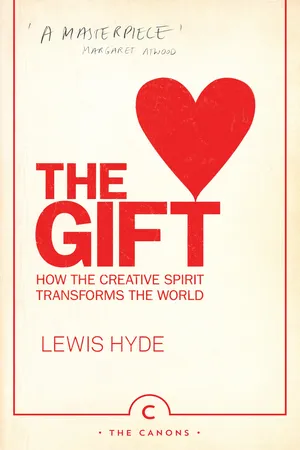
- 368 pages
- English
- ePUB (mobile friendly)
- Available on iOS & Android
eBook - ePub
About this book
Information
PART I
A THEORY OF GIFTS
CHAPTER ONE
SOME FOOD WE COULD NOT EAT
I • The Motion
When the Puritans first landed in Massachusetts, they discovered a thing so curious about the Indians’ feelings for property that they felt called upon to give it a name. In 1764, when Thomas Hutchinson wrote his history of the colony, the term was already an old saying: ‘An Indian gift,’ he told his readers, ‘is a proverbial expression signifying a present for which an equivalent return is expected.’ We still use this, of course, and in an even broader sense, calling that friend an Indian giver who is so uncivilized as to ask us to return a gift he has given.
Imagine a scene. An Englishman comes into an Indian lodge, and his hosts, wishing to make their guest feel welcome, ask him to share a pipe of tobacco. Carved from a soft red stone, the pipe itself is a peace offering that has traditionally circulated among the local tribes, staying in each lodge for a time but always given away again sooner or later. And so the Indians, as is only polite among their people, give the pipe to their guest when he leaves. The Englishman is tickled pink. What a nice thing to send back to the British Museum! He takes it home and sets it on the mantelpiece. A time passes and the leaders of a neighboring tribe come to visit the colonist’s home. To his surprise he finds his guests have some expectation in regard to his pipe, and his translator finally explains to him that if he wishes to show his goodwill he should offer them a smoke and give them the pipe. In consternation the Englishman invents a phrase to describe these people with such a limited sense of private property. The opposite of ‘Indian giver’ would be something like ‘white man keeper’ (or maybe ‘capitalist’), that is, a person whose instinct is to remove property from circulation, to put it in a warehouse or museum (or, more to the point for capitalism, to lay it aside to be used for production).
The Indian giver (or the original one, at any rate) understood a cardinal property of the gift: whatever we have been given is supposed to be given away again, not kept. Or, if it is kept, something of similar value should move on in its stead, the way a billiard ball may stop when it sends another scurrying across the felt, its momentum transferred. You may keep your Christmas present, but it ceases to be a gift in the true sense unless you have given something else away. As it is passed along, the gift may be given back to the original donor, but this is not essential. In fact, it is better if the gift is not returned but is given instead to some new, third party. The only essential is this: the gift must always move. There are other forms of property that stand still, that mark a boundary or resist momentum, but the gift keeps going.
Tribal peoples usually distinguish between gifts and capital. Commonly they have a law that repeats the sensibility implicit in the idea of an Indian gift. ‘One man’s gift,’ they say, ‘must not be another man’s capital.’ Wendy James, a British social anthropologist, tells us that among the Uduk in northeast Africa, ‘any wealth transferred from one subclan to another, whether animals, grain or money, is in the nature of a gift, and should be consumed, and not invested for growth. If such transferred wealth is added to the subclan’s capital [cattle in this case] and kept for growth and investment, the subclan is regarded as being in an immoral relation of debt to the donors of the original gift.’ If a pair of goats received as a gift from another subclan is kept to breed or to buy cattle, ‘there will be general complaint that the so-and-so’s are getting rich at someone else’s expense, behaving immorally by hoarding and investing gifts, and therefore being in a state of severe debt. It will be expected that they will soon suffer storm damage …’
The goats in this example move from one clan to another just as the stone pipe moved from person to person in my imaginary scene. And what happens then? If the object is a gift, it keeps moving, which in this case means that the man who received the goats throws a big party and everyone gets fed. The goats needn’t be given back, but they surely can’t be set aside to produce milk or more goats. And a new note has been added: the feeling that if a gift is not treated as such, if one form of property is converted into another, something horrible will happen. In folk tales the person who tries to hold on to a gift usually dies; in this anecdote the risk is ‘storm damage.’ (What happens in fact to most tribal groups is worse than storm damage. Where someone manages to commercialize a tribe’s gift relationships the social fabric of the group is invariably destroyed.)
If we turn now to a folk tale, we will be able to see all of this from a different angle. Folk tales are like collective dreams; they are told in the kind of voice we hear at the edge of sleep, mingling the facts of our lives with their images in the psyche. The first tale I have chosen was collected from a Scottish woman in the middle of the nineteenth century.
The Girl and the Dead Man
Once upon a time there was an old woman and she had a leash of daughters. One day the eldest daughter said to her mother, ‘It is time for me to go out into the world and seek my fortune.’ ‘I shall bake a loaf of bread for you to carry with you,’ said the mother. When the bread came from the oven the mother asked her daughter, ‘Would you rather have a small piece and my blessing or a large piece and my curse?’ ‘I would rather have the large piece and your curse,’ replied the daughter.
Off she went down the road and when the night came wreathing around her she sat at the foot of a wall to eat her bread. A ground quail and her twelve puppies gathered near, and the little birds of the air. ‘Wilt thou give us a part of thy bread,’ they asked. ‘I won’t, you ugly brutes,’ she replied. ‘I haven’t enough for myself.’ ‘My curse on thee,’ said the quail, ‘and the curse of my twelve birds, and thy mother’s curse which is the worst of all.’ The girl arose and went on her way, and the piece of bread had not been half enough.
She had not travelled far before she saw a little house, and though it seemed a long way off she soon found herself before its door. She knocked and heard a voice cry out, ‘Who is there?’ ‘A good maid seeking a master.’ ‘We need that,’ said the voice, and the door swung open.
The girl’s task was to stay awake every night and watch over a dead man, the brother of the housewife, whose corpse was restless. As her reward she was to receive a peck of gold and a peck of silver. And while she stayed she was to have as many nuts as she broke, as many needles as she lost, as many thimbles as she pierced, as much thread as she used, as many candles as she burned, a bed of green silk over her and a bed of green silk under her, sleeping by day and watching by night.
On the very first night, however, she fell asleep in her chair. The housewife came in, struck her with a magic club, killed her dead, and threw her out back on the pile of kitchen garbage.
Soon thereafter the middle daughter said to her mother, ‘It is time for me to follow my sister and seek my fortune.’ Her mother baked her a loaf of bread and she too chose the larger piece and her mother’s curse. And what had happened to her sister happened to her.
Soon thereafter the youngest daughter said to her mother, ‘It is time for me to follow my sisters and seek my fortune.’ ‘I had better bake you a loaf of bread,’ said her mother, ‘and which would you rather have, a small piece and my blessing or a large piece and my curse?’ ‘I would rather,’ said the daughter, ‘have the smaller piece and your blessing.’
And so she set off down the road and when the night came wreathing around her she sat at the foot of a wall to eat her bread. The ground quail and her twelve puppies and the little birds of the air gathered about. ‘Wilt thou give us some of that?’ they asked. ‘I will, you pretty creatures, if you will keep me company.’ She shared her bread, all of them ate their fill, and the birds clapped their wings about her ’til she was snug with the warmth.
The next morning she saw a house a long way off … [here the task and the wages are repeated].
She sat up at night to watch the corpse, sewing to pass the time. About midnight the dead man sat up and screwed up a grin. ‘If you do not lie down properly I will give you one good leathering with a stick,’ she cried. He lay down. After a while he rose up on one elbow and screwed up a grin; and a third time he sat and screwed up a grin.
When he rose the third time she walloped him with the stick. The stick stuck to the dead man and her hand stuck to the stick and off they went! He dragged her through the woods, and when it was high for him it was low for her, and when it was low for him it was high for her. The nuts were knocking at their eyes and the wild plums beat at their ears until they both got through the wood. Then they returned home.
The girl was given the peck of gold, the peck of silver, and a vessel of cordial. She found her two sisters and rubbed them with the cordial and brought them back to life. And they left me sitting here, and if they were well,’ tis well; if they were not, let them be.
There are at least four gifts in this story. The first, of course, is the bread, which the mother gives to her daughters as a going-away present. This becomes the second gift when the youngest daughter shares her bread with the birds. She keeps the gift in motion – the moral point of the tale. Several benefits, in addition to her survival, come to her as a result of treating the gift correctly. These are the fruits of the gift. First, she and the birds are relieved of their hunger; second, the birds befriend her; and third, she’s able to stay awake all night and accomplish her task. (As we shall see, these results are not accidental, they are typical fruits of the gift.)
In the morning the third gift, the vessel of cordial, appears. ‘Cordial’ used to mean a liqueur taken to stimulate the heart. In the original Gaelic of this tale the phrase is ballen íocshlaint, which translates more literally as ‘teat of ichor’ or ‘teat of health’ (‘ichor’ being the fluid that flows instead of blood in the veins of the gods). So what the girl is given is a vial of healing liquid, not unlike the ‘water of life,’ which appears in folk tales from all over the world. It has power: with it she is able to revive her sisters.
This liquid is thrown in as a reward for the successful completion of her task. It’s a gift, mentioned nowhere in the wonderful litany of wages offered to each daughter. We will leave for later the question of where it comes from; for now, we are looking at what happens to the gift after it is given, and again we find that this girl is no dummy – she moves it right along, giving it to her sisters to bring them back to life. That is the fourth and final gift in the tale.*
This story also gives us a chance to see what happens if the gift is not allowed to move on. A gift that cannot move loses its gift properties. Traditional belief in Wales holds that when the fairies give bread to the poor, the loaves must be eaten on the day they are given or they will turn to toadstools. If we think of the gift as a constantly flowing river, we may say that the girl in the tale who treats it correctly does so by allowing herself to become a channel for its current. When someone tries to dam up the river, one of two things will happen: either it will stagnate or it will fill the person up until he bursts. In this folk tale it is not just the mother’s curse that gets the first two girls. The night birds give them a second chance, and one imagines the mother bird would not have repeated the curse had she met with generosity. But instead the girls try to dam the flow, thinking that what counts is ownership and size. The effect is clear: by keeping the gift they get no more. They are no longer channels for the stream and they no longer enjoy its fruits, one of which seems to be their own lives. Their mother’s bread has turned to toadstools inside them.
Another way to describe the motion of the gift is to say that a gift must always be used up, consumed, eaten. The gift is property that perishes. It is no accident that the gifts in two of our stories so far have been food. Food is one of the most common images for the gift because it is so obviously consumed. Even when the gift is not food, when it is something we would think of as a durable good, it is often referred to as a thing to be eaten. Shell necklaces and armbands are the ritual gifts in the Trobriand Islands, and when they are passed from one group to the next, protocol demands that the man who gives them away toss them on the ground and say, ‘Here, some food we could not eat.’ Or, again, a man in another tribe that Wendy James has studied says, in speaking of the money he was given at the marriage of his daughter, that he will pass it on rather than spend it on himself. Only, he puts it this way: ‘If I receive money for the children God has given me, I cannot eat it. I must give it to others.’
Many of the most famous of the gift systems we know about center on food and treat durable goods as if they were food. The potlatch of the American Indians along the North Pacific coast was originally a ‘big feed.’ At its simplest a potlatch was a feast lasting several days given by a member of a tribe who wanted his rank in the group to be publicly recognized. Marcel Mauss translates the verb ‘potlatch’ as ‘to nourish’ or ‘to consume.’ Used as a noun, a ‘potlatch’ is a ‘feeder’ or ‘place to be satiated.’ Potlatches included durable goods, but the point of the festival was to have these perish as if they were food. Houses were burned; ceremonial objects were broken and thrown into the sea. One of the potlatch tribes, the Haida, called their feasting ‘killing wealth.’
To say that the gift is used up, consumed and eaten sometimes means that it is truly destroyed as in these last examples, but more simply and accurately it means that the gift perishes for the person who gives it away. In gift exchange the transaction itself consumes the object. Now, it is true that something often comes back when a gift is given, but if this were made an explicit condition of the exchange, it wouldn’t be a gift. If the girl in our story had offered to sell the bread to the birds, the whole tone would have been different. But instead she sacrifices it: her mother’s gift is dead and gone when it leaves her hand. She no longer controls it, nor has she any contract about repayment. For her, the gift has perished. This, then, is how I use ‘consume’ to speak of a gift – a gift is consumed when it moves from one hand to another with no assurance of anything in return. There is little difference, therefore, between its consumption and its movement. A market exchange has an equilibrium or stasis: you pay to balance the scale. But when you give a gift there is momentum, and the weight shifts from body to body.
I must add one more word on what it is to consume, because the Western industrial world is famous for its ‘consumer goods’ and they are not at all what I mean. Again, the difference is in the form of the exchange, a thing we can feel most concretely in the form of the goods themselves. I remember the time I went to my first rare-book fair and saw how the first editions of Thoreau and Whitman and Crane had been carefully packaged in heat-shrunk plastic with the price tags on the inside. Somehow the simple addition of air-tight plastic bags had transformed the books from vehicles of liveliness into commodities, like bread made with chemicals to keep it from perishing. In commodity exchange it’s as if the buyer and the seller were both in plastic bags; there’s none of the contact of a gift exchange. There is neither motion nor emotion because the whole point is to keep the balance, to make sure the exchange itself doesn’t consume anything or involve one person with another. Consumer goods are consumed by their owners, not by their exchange.
The desire to consume is a kind of lust. We long to have the world flow through us like air or food. We are thirsty and hungry for something that can only be carried inside bodies. But consumer goods merely bait this lust, they do not satisfy it. The consumer of commodities is invited to a meal without passion, a consumption that leads to neither satiation nor fire. He is a stranger seduced into feeding on the drippings of someone else’s capital without benefit of its inner nourishment, and he is hungry at the end of the meal, depressed and weary as we all feel when lust has dragged us from the house and led us to nothing.
Gift exchange has many fruits, as we shall see, and to the degree that the fruits of the gift can satisfy our needs there will always be pressure for property to be treated as a gift. This pressure, in a sense, is what keeps the gift in motion. When the Uduk warn that a storm will ruin the crops if someone tries to stop the gift from moving, it is really their desire for the gift that will bring the storm. A restless hunger springs up when the gift is not being eaten. The brothers Grimm found a folk tale they called ‘The Ungrateful Son’:
Once a man and his wife were sitting outside the front door with a roast chicken before them which they were going to eat between them. Then the man saw his old father coming along and quickly...
Table of contents
- Cover
- About the Author
- Copyright Page
- Title Page
- Dedication
- Contents
- Foreword
- Introduction
- I. A Theory of Gifts
- II. Two Experiments in Gift Aesthetics
- Conclusion
- Afterword
- Bibliography
- Notes
- Acknowledgments
- Index
Trusted by 375,005 students
Access to over 1.5 million titles for a fair monthly price.
Study more efficiently using our study tools.
Frequently asked questions
Yes, you can cancel anytime from the Subscription tab in your account settings on the Perlego website. Your subscription will stay active until the end of your current billing period. Learn how to cancel your subscription
No, books cannot be downloaded as external files, such as PDFs, for use outside of Perlego. However, you can download books within the Perlego app for offline reading on mobile or tablet. Learn how to download books offline
Perlego offers two plans: Essential and Complete
- Essential is ideal for learners and professionals who enjoy exploring a wide range of subjects. Access the Essential Library with 800,000+ trusted titles and best-sellers across business, personal growth, and the humanities. Includes unlimited reading time and Standard Read Aloud voice.
- Complete: Perfect for advanced learners and researchers needing full, unrestricted access. Unlock 1.5M+ books across hundreds of subjects, including academic and specialized titles. The Complete Plan also includes advanced features like Premium Read Aloud and Research Assistant.
We are an online textbook subscription service, where you can get access to an entire online library for less than the price of a single book per month. With over 1.5 million books across 990+ topics, we’ve got you covered! Learn about our mission
Look out for the read-aloud symbol on your next book to see if you can listen to it. The read-aloud tool reads text aloud for you, highlighting the text as it is being read. You can pause it, speed it up and slow it down. Learn more about Read Aloud
Yes! You can use the Perlego app on both iOS and Android devices to read anytime, anywhere — even offline. Perfect for commutes or when you’re on the go.
Please note we cannot support devices running on iOS 13 and Android 7 or earlier. Learn more about using the app
Please note we cannot support devices running on iOS 13 and Android 7 or earlier. Learn more about using the app
Yes, you can access The Gift by Lewis Hyde in PDF and/or ePUB format, as well as other popular books in Social Sciences & Cultural & Social Anthropology. We have over 1.5 million books available in our catalogue for you to explore.