The Central Asia Regional Economic Cooperation (CAREC) Transport Strategy 2030 builds on progress made and lessons learned from the CAREC Transport and Trade Facilitation Strategy 2020. It separates trade facilitation from transport and links to the overall CAREC 2030 program in the areas of enhanced connectivity and sustainability. This strategy underscores increasing sustainability and network quality alongside continued construction and rehabilitation of transport corridors, and places more emphasis on multimodal connectivity, road asset management, road safety, and performance-based maintenance goals. The CAREC Transport Strategy 2030 will be implemented in conjunction with the CAREC Integrated Trade Agenda 2030.
- 46 pages
- English
- ePUB (mobile friendly)
- Available on iOS & Android
eBook - ePub
About this book
Trusted by 375,005 students
Access to over 1 million titles for a fair monthly price.
Study more efficiently using our study tools.
Information
CHAPTER V
Strategic Pillar—Roads and Road Asset Management
32. CAREC and Roads and Road Asset Management (RAM). Over the last decade, investments in the road sector focused on the construction and rehabilitation of priority road networks in CAREC countries to increase the standard and condition of these roads to meet current and future transport needs. To ensure the long-term sustainability of these road improvements, the TTFS 2020 envisaged the development of Road Asset Management Systems (RAMS) and the implementation of performance-based maintenance (PBM) contracts in several CAREC DMCs. To support this objective, a regional Road Asset Management Workshop was held in April 2015, followed by the preparation and dissemination of three road asset management publications. DMCs designed and used CAREC self-assessment tools to assess their status and capacity to implement robust RAMS. Throughout the TTFS 2020 implementation period, the CAREC DMCs and development partners continued working on the modality of PBM contracts and arrangements for development financing of the PBM-related projects.
33. Key issues. Despite improvements of the CAREC road network infrastructure and road maintenance practices, budgets prioritize construction and rehabilitation and the existing funding allocation for maintenance only covers a fraction of the estimated need. Furthermore, the limited maintenance funding is not necessarily needs- and demand-driven, but tends to be targeted at older roads in poor condition. As a result, proper maintenance of recently completed road networks is lacking in most CAREC DMCs. This led to accelerated deterioration of these roads which reduced the actualization of travel time savings expected from the investments.11 Moreover, a lack of investment in upfront, routine, and preventive maintenance reduces the life span of the assets, as the roads will get to a point where they are no longer maintainable, requiring costly rehabilitation or reconstruction. As a result, countries have been unconsciously increasing life cycle costs of the road assets.
34. Actions. The objective of this strategic pillar of the CAREC program is to strengthen road asset management in the CAREC countries to respond to these issues. Road asset management is a strategic approach that seeks the optimal allocation of resources for the management, operation, preservation, and enhancement of road infrastructure to meet the needs of current and future road users. Road asset management looks at the optimization of available funding and determines the optimal allocation of this funding to different roads and investment types, with the aim of maximizing the benefits of improved road conditions and reduced road user costs over time. By collecting and analyzing data regarding the road network and its users, governments can make more informed choices regarding the allocation of funding to either develop, rehabilitate, or maintain an ever-expanding network of roads. This may also consider any expected climate change impacts. This approach introduces a shift in focus from short-term targets regarding the upgrading of road standards, to the long-term benefits of road maintenance for asset sustainability and future road sector funding requirements.
35. Although CAREC supports the ongoing general development of six CAREC road corridors, the emphasis of future investment and technical assistance will increasingly be on routine and periodic maintenance12 of completed roads through to 2030. This will be combined with the introduction and further development of RAMS that optimize and categorize the allocation of maintenance funding in relation to long-term road conditions and costs.
36. The RAMS approach focuses on optimizing the efficiency and effectiveness of funding allocations in the road sector. The RAMS allows governments to predict future conditions of the road network and determine the impact that different funding levels and allocation will have on the road network in the long term. Optimization of funding levels and allocation generally results in a shift in focus from capital investment toward preservation of roads in good or fair condition, giving priority to roads with higher traffic volumes. By 2019, Pakistan was the only CAREC country with a fully mainstreamed and integrated RAMS for its national highway network, although several other member countries also progressed in this direction. In Pakistan, the RAMS resulted in a shift in funding allocation from rehabilitation to periodic maintenance, and a significant reduction in the average roughness of its highway network.
Box: Road Asset Management System Analysis at Different Budget Levels
The example below shows a road asset management system analysis depicting the expected highway conditions over time for Yunnan Province in the People’s Republic of China based on different budget levels and allocation strategies. The first graph is based on current budget levels where allocations focus on the rehabilitation of a limited number of roads in poor condition, leading to the gradual deterioration of the rest of the road network which does not receive funding. In the second graph, the allocation is optimized for the same budget, focusing on roads with high traffic volumes and prioritizing preventive maintenance of roads in good or fair condition. This allows a greater portion of the network to be maintained and results in overall better road conditions, especially for high volume roads (T4). The third graph shows how an increase in the budget allows a greater portion of the road network to be rehabilitated and maintained, with further improvement of the road conditions over time (again focusing on roads with higher traffic volumes).

T1≤1000ADT, 1000ADT<T2≤2000ADT, 2000ADT<T3≤4000ADT, T4>4000ADT, ADT = average daily traffic, IRI = International Roughness Index.
Source: ADB. 2011. Technical Assistance for Yunnan Sustainable Road Maintenance Project. Manila.
Table 2: Components of Road Asset Management
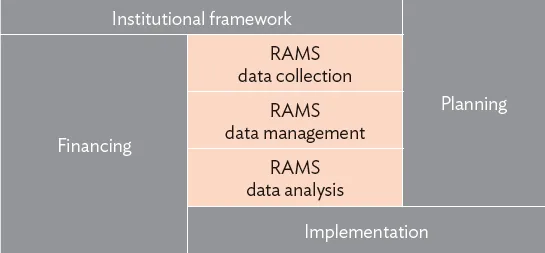
RAMS = Road Asset Management System.
Source: CAREC Secretariat.
37. However, a RAMS is only a tool and to function properly, it must be integrated within the wider road asset management context, including financing mechanisms, planning procedures, implementation modalities, and the institutional framework (Table 2). This integration tends to be the main barrier for countries to achieve the full benefit of a RAMS. Therefore, the CAREC program will pay significant attention to working with member countries to ensure their RAMS link up properly with existing road management procedures, or assist in the adjustment of these procedures, where necessary and desirable.
38. This will involve looking at possible financing mechanisms and different funding levels for road maintenance, developing strategies to ensure adequate funding for maintenance operations and predicting the impact on future road conditions and road user costs. Special attention will be given to the introduction and development of road user charges as a source of maintenance funding. The CAREC program will furthermore determine how RAMS may support existing planning procedures in CAREC countries, strengthening decision making based on objective data analysis. The need for institutional reforms will be assessed, ensuring the required institutional capacities exist to run the RAMS and to implement the resulting plans. Alternative implementation modalities will be reviewed to identify options that provide suitable incentives for the timely execution of road maintenance in line with plans.
Different financing mechanisms are used in the CAREC member countries. For road network development, general budget allocations and donor funding are commonly used. Although general budget allocations are also common for financing road maintenance, there is a growing tendency to introduce earmarked road user charges. Common road user charges include fuel taxes, vehicle registration fees, heavy vehicle surcharges, and tolls.
39. In support of road asset management, the CAREC program will also assist the further introduction of performance-based maintenance contracts (PBM).13 PBM facilitate the management of road maintenance and improve predictability of the resulting road conditions, while also increasing interest from contractors and providing incentives to invest in maintenance equipment and carry out repairs in a timely manner. As such, they complement RAMS very well. Mature experiences with PBM have resulted in cost savings of 15%–30% compared to traditional approaches (Table 3). The 14th Transport Sector Coordinating Committee (TSCC) Meeting in April 2015 confirmed region-wide interest in implementing PBM, and since then, several coun...
Table of contents
- Front Cover
- Title Page
- Copyright Page
- Contents
- Tables, Figures, Box, and Maps
- Abbreviations
- Executive Summary
- I. Introduction
- II. Lessons Learned
- III. CAREC Transport Sector Strategic Framework
- IV. Strategic Pillar—Cross-Border Transport and Logistics Facilitation
- V. Strategic Pillar—Roads and Road Asset Management
- VI. Strategic Pillar—Road Safety
- VII. Strategic Pillar—Railways
- VIII. Strategic Pillar—Aviation
- IX. Implementation Arrangements and Action Plan
- Appendixes
- Footnotes
- Back Cover
Frequently asked questions
Yes, you can cancel anytime from the Subscription tab in your account settings on the Perlego website. Your subscription will stay active until the end of your current billing period. Learn how to cancel your subscription
No, books cannot be downloaded as external files, such as PDFs, for use outside of Perlego. However, you can download books within the Perlego app for offline reading on mobile or tablet. Learn how to download books offline
Perlego offers two plans: Essential and Complete
- Essential is ideal for learners and professionals who enjoy exploring a wide range of subjects. Access the Essential Library with 800,000+ trusted titles and best-sellers across business, personal growth, and the humanities. Includes unlimited reading time and Standard Read Aloud voice.
- Complete: Perfect for advanced learners and researchers needing full, unrestricted access. Unlock 1.4M+ books across hundreds of subjects, including academic and specialized titles. The Complete Plan also includes advanced features like Premium Read Aloud and Research Assistant.
We are an online textbook subscription service, where you can get access to an entire online library for less than the price of a single book per month. With over 1 million books across 990+ topics, we’ve got you covered! Learn about our mission
Look out for the read-aloud symbol on your next book to see if you can listen to it. The read-aloud tool reads text aloud for you, highlighting the text as it is being read. You can pause it, speed it up and slow it down. Learn more about Read Aloud
Yes! You can use the Perlego app on both iOS and Android devices to read anytime, anywhere — even offline. Perfect for commutes or when you’re on the go.
Please note we cannot support devices running on iOS 13 and Android 7 or earlier. Learn more about using the app
Please note we cannot support devices running on iOS 13 and Android 7 or earlier. Learn more about using the app
Yes, you can access CAREC Transport Strategy 2030 by in PDF and/or ePUB format, as well as other popular books in Business & Transportation Industry. We have over one million books available in our catalogue for you to explore.