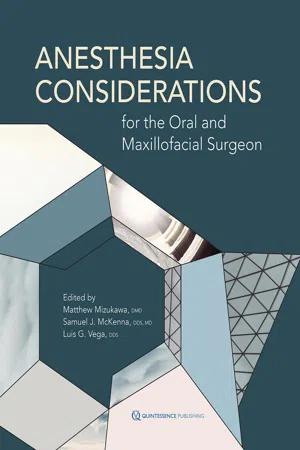
Although office-based anesthesia administration has been essential in the evolution of outpatient surgery, it is becoming more complex as people live longer and with more comorbid diseases. The purpose of this book is to strengthen the margin of safety of office-based anesthesia administration by helping practitioners determine whether the patients they treat are good candidates for office-based anesthesia. This book is organized into three sections. The first section provides a review of the principles of anesthesia, including the pharmacology of anesthetic agents, local anesthesia, patient monitoring, preoperative evaluation, the airway, and management of emergencies and complications. The major organ systems of the body are reviewed in section two, and the most common comorbid conditions that affect these systems are described in terms of their pathophysiology, diagnosis, management, and anesthesia-related considerations. Section three reviews patient groups that warrant special consideration in the administration of office-based anesthesia, such as geriatric, pediatric, pregnant, and obese patients. Spiral-bound and featuring tabs for quick and easy reference, this important book belongs on the shelf of every clinician who provides anesthesia in the office setting.
eBook - ePub
Anesthesia Considerations for the Oral and Maxillofacial Surgeon
- 482 pages
- English
- ePUB (mobile friendly)
- Available on iOS & Android
eBook - ePub
Anesthesia Considerations for the Oral and Maxillofacial Surgeon
About this book
Trusted by 375,005 students
Access to over 1 million titles for a fair monthly price.
Study more efficiently using our study tools.
Information


CHAPTER 14
The Central Nervous System
Normal Anatomy and Physiology
Metabolic Disorders
Neurodegenerative/Demyelinating Disorders
Cerebrovascular Accident
Structural
Psychiatric Disorders
The concepts of normal central nervous system (CNS) anatomy and physiology are integral to understanding the neuropharmacologic effects of anesthetic agents in patients with CNS conditions. This chapter focuses on the relevant pathophysiology, diagnosis, management, and anesthetic considerations of metabolic, neurodegenerative, cerebrovascular, structural, and psychiatric diseases of the CNS.
Normal Anatomy and Physiology
Anatomically, the CNS consists of the brain and the spinal cord. The brain is divided into the cerebrum, the brainstem, and the cerebellum. The cerebral cortex is the largest portion of the human brain and comprises two separate symmetric hemispheres joined caudally at their base by the corpus callosum. The cerebral cortex is responsible for higher functions of memory, motor function, sensory perception, and cognitive thought. Each hemisphere is divided by distinct fissures into four lobes (frontal, temporal, parietal, and occipital), each with a specific purpose and function. The hypothalamus and the thalamus lie beneath the cerebral cortex. The thalamus acts as a sensory relay station, connecting the peripheral nervous system to the cerebral hemispheres. It also participates in functions of wakefulness and consciousness. The hypothalamus is involved primarily in primitive perceptions and functions, such as hunger, thirst, sexual behavior, and sleep. It also contributes to the regulation of hormone secretion from the pituitary gland. The brainstem consists of the medulla, the pons, and the midbrain and is responsible for many primitive functions essential for survival. The medulla primarily regulates homeostatic functions, such as blood pressure, cardiac rhythm, and breathing. The pons is involved with coordinating eye and facial movements, facial sensation, hearing, and balance. The midbrain is an important locale for automatic ocular motion and other specific functions of the visual and auditory systems. The cerebellum maintains posture, balance, and muscular tone. It also is involved in the fine-tuning of motor activity and the ability to perform rapid, repetitive, and coordinated motor functions.1
The spinal cord is an ovoid bundle of nervous tissue connecting the brain to the peripheral nervous system. It is approximately 43 to 45 cm in length in adults and extends from the caudal medulla at the level of the foramen magnum to the level of the L1-2 intervertebral space. Its primary functions are efferent motor transmission, afferent sensory conduction, and spinal reflex control.1
The brain is contained within the bony cranium, whereas the spinal cord is protected by the vertebrae of the spinal column. Both the brain and the spinal cord are further protected by three layers of meninges, which, from the outermost to the innermost layer, are the dura mater, arachnoid mater, and pia mater. Between these layers are several clinically important anatomical spaces, including the epidural, subdural, and subarachnoid spaces. In particular, the subarachnoid space is notable because it contains cerebrospinal fluid (CSF), which is produced in the ventricular system of the brain and provides a cushion and basic immunologic protection to the brain and spinal cord. CSF is also important in the autoregulation of cerebral blood flow.1
Anesthetic agents may have important effects on cerebral blood flow, metabolism, the properties of CSF, and intracranial pressure (ICP).
Cerebral blood flow
The adult human brain accounts for approximately 2% of total body weight but approximately 20% of total body oxygen utilization. Accordingly, the brain receives 12% to 15% of total cardiac output (750 mL/min in adults). Cerebral blood flow (CBF) varies from 10 to 300 mL/100 g per minute, depending on metabolic activity. The cerebral metabolic rate (CMR), a measure of cerebral oxygen consumption, increases with increased cerebral electrical activity. In the absence of substantial oxygen reserves and because of the high oxygen demands of the brain, unconsciousness occurs in seconds with any interruption in cerebral blood flow. If blood flow is not established within 3 to 8 minutes, irreversible cellular damage will occur.2 Different regions of the brain are more or less sensitive to hypoxia.
An important concept in the discussion of CBF is cerebral perfusion pressure (CPP), which is defined as the difference between mean arterial pressure (MAP) and ICP. The association between CPP and ICP...
Table of contents
- Cover
- Halftitle Page
- Title Page
- Copyright Page
- Contents
- Dedications
- Preface
- Contributors
- Section I: Principles of Anesthesia Administration
- Section II: Anesthesia and Comorbid Disease
- Section III: Anesthesia in Special Patient Groups
- Appendices
- Index
Frequently asked questions
Yes, you can cancel anytime from the Subscription tab in your account settings on the Perlego website. Your subscription will stay active until the end of your current billing period. Learn how to cancel your subscription
No, books cannot be downloaded as external files, such as PDFs, for use outside of Perlego. However, you can download books within the Perlego app for offline reading on mobile or tablet. Learn how to download books offline
Perlego offers two plans: Essential and Complete
- Essential is ideal for learners and professionals who enjoy exploring a wide range of subjects. Access the Essential Library with 800,000+ trusted titles and best-sellers across business, personal growth, and the humanities. Includes unlimited reading time and Standard Read Aloud voice.
- Complete: Perfect for advanced learners and researchers needing full, unrestricted access. Unlock 1.4M+ books across hundreds of subjects, including academic and specialized titles. The Complete Plan also includes advanced features like Premium Read Aloud and Research Assistant.
We are an online textbook subscription service, where you can get access to an entire online library for less than the price of a single book per month. With over 1 million books across 990+ topics, we’ve got you covered! Learn about our mission
Look out for the read-aloud symbol on your next book to see if you can listen to it. The read-aloud tool reads text aloud for you, highlighting the text as it is being read. You can pause it, speed it up and slow it down. Learn more about Read Aloud
Yes! You can use the Perlego app on both iOS and Android devices to read anytime, anywhere — even offline. Perfect for commutes or when you’re on the go.
Please note we cannot support devices running on iOS 13 and Android 7 or earlier. Learn more about using the app
Please note we cannot support devices running on iOS 13 and Android 7 or earlier. Learn more about using the app
Yes, you can access Anesthesia Considerations for the Oral and Maxillofacial Surgeon by Matthew Mizukawa,Samuel J. McKenna,Luis G. Vega in PDF and/or ePUB format, as well as other popular books in Medicine & Dentistry. We have over one million books available in our catalogue for you to explore.