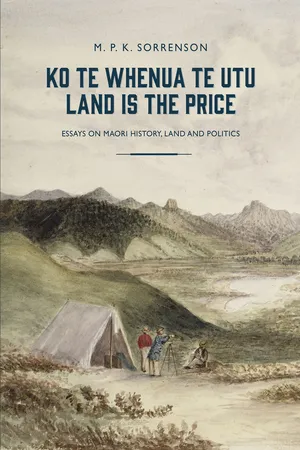
For more than half a century, Keith Sorrenson—one of New Zealand's leading historians and himself of mixed Maori and Pakeha descent—has dived deeper than anyone into the story of two peoples in New Zealand. In this new book, Sorrenson brings together his major writing from the last 56 years into a powerful whole—covering topics from the origins of Maori (and Pakeha ideas about those origins), through land purchases and the King Movement of the 19th century, and on to 20th-century politics and the new history of the Waitangi Tribunal. Throughout his career, Sorrenson has been concerned with the international context for New Zealand history while also attempting to understand and explain Maori conceptions and Pakeha ideas from the inside. And he has been determined to tell the real story of Maori losses of land and their political responses as, in the face of Pakeha colonization, they became a minority in their own country. Ko te Whenua te Utu / Land Is the Price is a powerful history of Maori and Pakeha in New Zealand.
eBook - ePub
Ko te Whenua te Utu / Land Is the Price
Essays on Maori History, Land and Politics
- 344 pages
- English
- ePUB (mobile friendly)
- Available on iOS & Android
eBook - ePub
Ko te Whenua te Utu / Land Is the Price
Essays on Maori History, Land and Politics
About this book
Trusted by 375,005 students
Access to over 1.5 million titles for a fair monthly price.
Study more efficiently using our study tools.
Information
1
The Whence of the Maori: Some Nineteenth-century Exercises in Scientific Method*

This essay does not attempt a final solution of that consuming passion of New Zealand scholars, the whence of the Maori. Rather, it is an examination of the quest itself, and an assessment of the influence of ideas on the origin of Maori on contemporary attitudes to Maori and their supposed capacity for civilisation. Some theories on the origin of Maori were patently absurd, yet these cannot be scathingly dismissed, for even the wrong ideas tend to have a currency that outlasts their exposure before the plain light of scientific reason.
It is well known that the voyages of Pacific discovery in the late eighteenth century provided a new testing ground for science and stimulated thought on man and his place in nature.1 In the nineteenth century there was a shift in focus from the oceans to the continents, and particularly to tropical Africa where the discovery by European explorers of apparently primitive African societies emphasised the great disparity between races and seemed to validate the social Darwinist theories of the period. In the Antipodes similar theories were to gain currency, though for slightly different reasons. Here the progress of commerce, Christianity and European colonisation were to reveal differences between Europeans and aborigines that also seemed to validate an assumption of the innate superiority of the white or Caucasian race. Developments in anthropology, linguistics, folklore and archaeology were used by historians — who were themselves beginning to regard their subject as a science — to extend their quest back in time beyond the range of written documents. Eighteenth-century reason and doctrines of nature were to leave Maori in a somewhat ambiguous position; the nineteenth century was to give them a more assured place, and not merely because scientific inquiry placed them higher in the hierarchy than other races. Christian dogma which eschewed the progressive theory also ranked Maori highly.
Eighteenth-century Voyages of Discovery
The quest for the origin of Maori began in the eighteenth century, if not the seventeenth. Tasman, having lost four men on the New Zealand coast in 1642, did not land or speculate on the origin of the people who had treated him so savagely. But Cook, on first making contact with Maori of the East Coast in 1769, realised that they were related to other Pacific peoples. Cook had previously visited Tahiti where he had taken on board an interpreter, Tupaia, who had little difficulty in conversing with Maori. This happy fact was noted at the time2 but it was not until they were preparing to leave New Zealand that Cook and his naturalist companion, Joseph Banks, paused in their journals to sum up on the Maori and speculate on their origins:
Having now given the best account in my power of the customs and opinions of the inhabitants of New Zealand, with their boats, nets, furniture, and dress, I shall only remark, that the similitude between these particulars here and in the South Sea islands is a very strong proof that the inhabitants have the same origin; and that the common ancestors of both, were the natives of the same country. They have both a tradition that their ancestors, at a very remote period of time, came from another country; and, according to the tradition of both, the name of that country was HEAWIJE; but the similitude of the language seems to put the matter altogether out of doubt.3
To emphasise the point a vocabulary of over 40 words in Maori and Tahitian was added.
Here Cook and Banks had initiated three methods of inquiry that were to be used with increasing confidence in later years: a comparison of customs and material culture, philology, and oral traditions. Yet they retained a caution that was not to be so evident in later estimates: ‘But supposing these islands, and those in the South Seas, to be peopled originally from the same country, it will perhaps for ever remain in doubt what country that is . . . .’4 They did not believe that the country was America or even the Southern Continent — for they were now very doubtful whether this existed at all — so they simply concluded that the ultimate source of both peoples was somewhere in the west. Neither Cook nor Banks speculated on how Maori might have reached New Zealand, but it is notable that Sydney Parkinson, the artist on the Endeavour, held that the canoes they had seen were unsuitable for oceanic navigating. He went on to propose the unlikely theory that Tahiti had been colonised from New Zealand.5
Cook’s second voyage was to add further speculation on the problem. This time the main source of speculation was John Reinhold Forster who had replaced Banks as naturalist. Forster had with him his son George who wrote up and published the father’s diary of the voyage.6 Having come to New Zealand from Tonga, the Forsters noted that the New Zealanders’ dialect was much the same as that of the Tongans. But J. R. Forster was interested in far more than simple linguistic comparisons. He had spent most of his life in Europe and was well acquainted with Continental philosophy and anthropology, particularly the work of J. F. Blumenbach, often described as the father of anthropology. A year after George had published the diary of the voyage, J. R. Forster brought out a rather more ambitious work, Observations made during a Voyage round the World, on Physical Geography, Natural History, and Ethic Philosophy. . . . ‘My object,’ Forster wrote, ‘was nature in its greatest extent; the Earth, the Sea, the Air, the Organic and Animated Creation, and more particularly that class of Beings to which we ourselves belong.’7 He did not quite achieve this soaring ambition; his comments on peoples were confined largely to those he had observed on the voyage. Forster’s views on race were orthodox. He accepted the ruling Christian doctrine of monogenesis, ‘that all mankind, though ever so much varied, are, however, but one species . . . . descended from one couple’.8 He accepted Blumenbach’s classification of races and his view that racial differences had been caused largely by environmental factors. Though Forster accepted the philosophical notion that nations progressed from animality to savagery to barbarism and eventually to civilisation, he did believe that climatic factors could bring about degeneration. In a theory, which he appears to have confined to the Southern Hemisphere, Forster held that the natives inhabiting the frozen extremities appeared to be ‘degenerated and debased from that original happiness, which the tropical nations more or less enjoy. I was first persuaded into this belief, from the state in which we found the inhabitants of Tierra del Fuego and New Zealand, and by comparing their situation, with that of their neighbours.’9 Forster thought that even within New Zealand there were considerable differences between the apparently primitive Maori that Cook’s expedition had come across in Dusky Sound at the south of the South Island and the more advanced Maori in the North Island. This division of the peoples of the Pacific into hard and soft primitives had some support in eighteenth-century thought, but it was not to endure. Nineteenth-century theorists were more inclined to reverse the climatic factor and favourably to compare the energetic Maori of temperate New Zealand with their ‘slothful’ cousins of tropical Polynesia.
Some of Forster’s other theories were to have rather more lasting significance. He anticipated the division of the peoples of the South Pacific into Melanesians and Polynesians; the former a dark-skinned, small-framed people confined mainly to the western Pacific; the latter a handsome, lighter-coloured, large-limbed people inhabiting the eastern Pacific. The theory did not rely only on physical features since it was also supported by linguistic evidence. Forster assumed that the Polynesians had come into the Pacific by a process of island-hopping from Malaya. He went on to apply the two-race theory to New Zealand. In a passage that was confused by an infusion of his environmental theory, Forster spoke of Malay immigrants who had absorbed an earlier aboriginal people and formed ‘a coalition of customs, wherein many points of civilization were totally lost, though the language was taken from the newcomers, and preserved blended with some words of the aboriginal tribe’.10 The idea of an aboriginal, pre-Maori race, perhaps Melanesian in origin and certainly inferior to Maori, was to linger in the ethnological record.
Nevertheless it was not so much the Forsters as Joseph Banks who was to put the Polynesians into the mainstream of European anthropology. Like Forster, Banks was acquainted with the great Blumenbach whose treatise On the Natural Variety of Mankind (1775) had maintained that mankind was one species which was divided into four races — Caucasian, Asiatic, American and Ethiopian. Then, after meeting Banks, Blumenbach added a fifth race to his second edition of 1781: the Malays (who included the Pacific Islanders).11 The work was further modified for its third edition of 1795 which was dedicated to Banks. Now the races were graded as well as classified. Blumenbach allotted the ‘first place’ to the Caucasian, the primeval race. This had diverged in two directions — the Ethiopian and the Mongolian. He regarded the Ethiopians who inhabited most of Africa as the most removed from the Caucasians, though he strenuously denied assertions that the Ethiopians were a separate species. The Americans occupied an intermediate position between the Caucasians and the Ethiopians. Finally, it can be noted that Blumenbach, like Forster, was aware of differences among the Pacific Islanders who varied from the ‘tawny colour of the Otaheitans . . . to the tawny-black of the New Hollanders’.12 Subsequent authorities were sometimes to vary the number and names of races, but this basic classification and ranking of the races was to be accepted throughout the nineteenth century; indeed fragments of it still remain in popular usage. The Maori, as members of the Malay race, were quite well placed, since they were not far removed from the ‘superior’ Caucasians. Later, scholars were to devote much intellectual energy to formulating a more direct connection.
In contrast to the lavish productions which followed from Cook’s visits to New Zealand and the Pacific, very little was to be published on the voyages of his French contemporaries. Only a brief summary of de Surville’s journal was published — twelve years after his visit to New Zealand. Marion du Fresne’s journals were not published, though Lieutenant Crozet’s was in 1783, after considerable editorial amendment by Abbé Rochon, as Nouveau Voyage à la mer du Sud. Crozet had taken command of the expedition following the death of Marion and 26 of his men at the Bay of Islands in 1772, and his journal is studded with ex post facto wisdom. Nevertheless it does contain much useful ethno-graphic information. Though the French had no interpreter with them, they did have a Tahitian vocabulary and were able to use this to converse with Maori. It is notable that Crozet thought that the New Zealanders were composed of more than one race; indeed in his view there were three: ‘true aborigines’ with a yellowish-white skin, tall stature and straight black hair; a swarthy, shorter variety with curled hair; and ‘true negroes’, short and broad in physique and with woolly hair.13 In a later passage he referred to the ‘whites, blacks and yellows’, the yellows being a mixture of the whites and the blacks.14 Some of the whites, he added, were no darker than the French sailors. The assumption that the New Zealanders were composed of two if not three races was to persist. In publishing an English translation of Crozet’s journal in 1891, H. Ling Roth said that Crozet was ‘very correct’, there were two races in the make-up of the New Zealanders, the black or Papuan, and the yellow or Malayo-Polynesian.15 By the late nineteenth century this was accepted dogma.
During the years between the explorers of the 1770s and the introduction of missionaries into New Zealand by Samuel Marsden in 1814, the published record on New Zealand is slim indeed. There was a good deal of commercial contact, most of it arising from the convict settlements at Sydney and Hobart, and including an intermittent trade in spars, sealing on the shores of the South Island, and a beginning of whaling. But the men who visited New Zealand were not of the kind who would make patient scientific observation of Maori, let alone speculations on their origin. Only one book directly relating to New Zealand was published in the period: Dr John Savage’s Some Account of New Zealand (1807) and this does not speculate on the origin or racial characteristics of the Maori. This Account probably helped to dispel the Maori reputation for savagery that had stuck to them following the massacre of Marion and his crew; but within a year of the publication of the Account, most of the crew of the Boyd were massacred at Whangaroa, and it seemed that the Maori reputation was deserved after all. Commercial contacts were reduced and Marsden had to postpone plans for the establishment of a Christian mission.
Missionary Ethnology
Marsden achieved his ambition in 1814 when he proceeded to the Bay of Islands with a ‘perfect resemblance to Noah’s ark’,16 preached the first sermon on Christmas Day, and left behind three missionaries — Thomas Kendall, John King and William Hall — and their families. The foundation and early history of the mission have been frequently described; here it is sufficient to note the contribution of Marsden and his missionaries to discussion on the origin and racial characteristics of Maori. Needless to say, the missionaries did not approach this task in the spirit of cool and detached scientific inquiry characteristic of the eighteenth-century voyagers. The missionaries came to civilise and convert the savage heathen, not to preserve what they regarded as degraded, inhuman and often obscene customs. Missionaries learnt the Maori language, inquired into their religion, their myths and legends, their systems of tapu and their social customs largely as a matter of expediency — so that they could replace them with the ‘truths’ of Christianity and the moral habits of civilisation. But even this form of inquiry had its dangers: too close an acquaintance with the ‘obscenities’ of Maori beliefs and behaviour was likely to bring about the fall of the missionary. Such was the fate of Thomas Kendall, who tried earnestly to understand Maori religion but who also had an affair with a Maori girl and traded in muskets.17 Marsden dismissed him for his sins. However, there were several missionaries who wrote useful accounts of Maori culture: William Yate, William Colenso and Richard Taylor, among the Anglicans; the Wesleyan, Thomas Buddle; and the Catholic, Catherin Servant. Nevertheless the missionary journals, or at least those portions of them t...
Table of contents
- Cover Page
- Title Page
- Contents
- Acknowledgements
- Introduction
- 1 The Whence of the Maori: Some Nineteenth-century Exercises in Scientific Method
- 2 Treaties in British Colonial Policy: Precedents for Waitangi
- 3 How to Civilise Savages: Some ‘Answers’ from Nineteenth-century New Zealand
- 4 Folkland to Bookland: F. D. Fenton and the Enclosure of the Maori ‘Commons’
- 5 Land Purchase Methods and their Effect on Maori Population, 1865–1901
- 6 The Maori King Movement, 1858–1885
- 7 Polynesian Corpuscles and Pacific Anthropology: The Home-made Anthropology of Sir Apirana Ngata and Sir Peter Buck
- 8 Colonial Rule and Local Response: Maori Responses to European Domination in New Zealand since 1860
- 9 Maori Representation in Parliament
- 10 Towards a Radical Reinterpretation of New Zealand History: The Role of the Waitangi Tribunal
- 11 Giving Better Effect to the Treaty: Some Thoughts for 1990
- 12 The Waitangi Tribunal and the Resolution of Maori Grievances
- 13 Waitangi: Ka Whawhai Tonu Matou
- Epilogue
- Notes
- Index
- Copyright Page
- Footnotes
- Backcover
Frequently asked questions
Yes, you can cancel anytime from the Subscription tab in your account settings on the Perlego website. Your subscription will stay active until the end of your current billing period. Learn how to cancel your subscription
No, books cannot be downloaded as external files, such as PDFs, for use outside of Perlego. However, you can download books within the Perlego app for offline reading on mobile or tablet. Learn how to download books offline
Perlego offers two plans: Essential and Complete
- Essential is ideal for learners and professionals who enjoy exploring a wide range of subjects. Access the Essential Library with 800,000+ trusted titles and best-sellers across business, personal growth, and the humanities. Includes unlimited reading time and Standard Read Aloud voice.
- Complete: Perfect for advanced learners and researchers needing full, unrestricted access. Unlock 1.5M+ books across hundreds of subjects, including academic and specialized titles. The Complete Plan also includes advanced features like Premium Read Aloud and Research Assistant.
We are an online textbook subscription service, where you can get access to an entire online library for less than the price of a single book per month. With over 1.5 million books across 990+ topics, we’ve got you covered! Learn about our mission
Look out for the read-aloud symbol on your next book to see if you can listen to it. The read-aloud tool reads text aloud for you, highlighting the text as it is being read. You can pause it, speed it up and slow it down. Learn more about Read Aloud
Yes! You can use the Perlego app on both iOS and Android devices to read anytime, anywhere — even offline. Perfect for commutes or when you’re on the go.
Please note we cannot support devices running on iOS 13 and Android 7 or earlier. Learn more about using the app
Please note we cannot support devices running on iOS 13 and Android 7 or earlier. Learn more about using the app
Yes, you can access Ko te Whenua te Utu / Land Is the Price by M. P. K. Sorrenson in PDF and/or ePUB format, as well as other popular books in History & Australian & Oceanian History. We have over 1.5 million books available in our catalogue for you to explore.