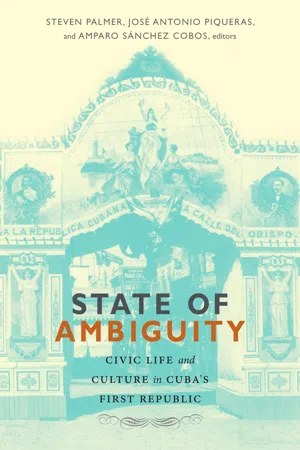
Cuba's first republican era (1902–1959) is principally understood in terms of its failures and discontinuities, typically depicted as an illegitimate period in the nation's history, its first three decades and the overthrow of Machado at best a prologue to the "real" revolution of 1959. State of Ambiguity brings together scholars from North America, Cuba, and Spain to challenge this narrative, presenting republican Cuba instead as a time of meaningful engagement—socially, politically, and symbolically. Addressing a wide range of topics—civic clubs and folkloric societies, science, public health and agrarian policies, popular culture, national memory, and the intersection of race and labor—the contributors explore how a broad spectrum of Cubans embraced a political and civic culture of national self-realization. Together, the essays in State of Ambiguity recast the first republic as a time of deep continuity in processes of liberal state- and nation-building that were periodically disrupted—but also reinvigorated—by foreign intervention and profound uncertainty.
Contributors. Imilcy Balboa Navarro, Alejandra Bronfman, Maikel Fariñas Borrego, Reinaldo Funes Monzote, Marial Iglesias Utset, Steven Palmer, José Antonio Piqueras Arenas, Ricardo Quiza Moreno, Amparo Sánchez Cobos, Rebecca J. Scott, Robert Whitney