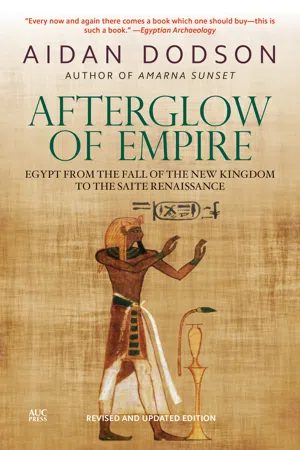
During the half-millennium from the eleventh through the sixth centuries BC, the power and the glory of the imperial pharaohs of the New Kingdom crumbled in the face of internal crises and external pressures, ultimately reversed by invaders from Nubia and consolidated by natives of the Nile Delta following a series of Assyrian invasions.Much of this era remains obscure, with little consensus among Egyptologists. Against this background, Aidan Dodson reconsiders the evidence and proposes a number of new solutions to the problems of the period. He also considers the art, architecture, and archaeology of the period, including the royal tombs of Tanis, one of which yielded the intact burials of no fewer than five pharaohs. The book is extensively illustrated with images of this material, much of which is little known to non-specialists of the period.By the author of the bestselling Amarna Sunset and Poisoned Legacy.
eBook - ePub
Afterglow of Empire
Egypt from the Fall of the New Kingdom to the Saite Renaissance
- English
- ePUB (mobile friendly)
- Available on iOS & Android
eBook - ePub
About this book
Trusted by 375,005 students
Access to over 1.5 million titles for a fair monthly price.
Study more efficiently using our study tools.
Information
Topic
HistoriaSubtopic
Historia africanaINTRODUCTION:
IMPERIAL EGYPT
IMPERIAL EGYPT
During the second half of the second millennium bc, Egypt had transformed from an entity primarily focused on the Nile valley to an imperial power. At her empire’s height she exercised direct or indirect control over a vast swath of territory that stretched from northern Syria into the heart of Upper Nubia. This expansion seems to have been a direct reaction to the humiliation of the Second Intermediate Period, during which much of Egypt had been under the sway of the Palestinian Hyksos rulers,1 while Nubia, long a tributary of Egypt, had become an independent and hostile state.2 The wars of liberation conducted by the last rulers of the Theban Seventeenth Dynasty had at length driven out the Hyksos, with the mopping-up operations of the first Eighteenth Dynasty kings transformed by Thutmose I and III into a ‘forward policy’ that pushed up to, and beyond, the Euphrates. An empire was thus created in Syria-Palestine that would endure, apparently with little challenge, for over a century.3 At the same time, Nubia was once again brought under Egyptian control, with a formal viceregal regime established at least as far south as the Fifth Cataract, which replaced the looser approach that seems to have been applied during previous periods of Egyptian control in the south.4
However, Egypt’s northern hegemony had come under pressure from the Hittites of Anatolia late in the Eighteenth Dynasty, leading to a series of campaigns into northern Syria that focused on the city of Qadesh in the Orontes valley.5 Ultimately, an accommodation had been reached between the Egyptians and Hittites, leading to a peace treaty in Year 21 of Rameses II, and what appears to have remained a mutually supportive relationship6 until the extinction of the Hittite empire in the first part of the twelfth century. The same upheavals that had contributed to the fall of the Hittites clearly had an impact on Egypt’s position in the broader Levant, culminating in Rameses III’s defensive wars against the ‘Sea Peoples’ in his Year 8.7
Another invasion, this time from Libya in Year 11, saw another successful Egyptian defense, with over two thousand of the enemy being killed and their captured leaders executed. However—and very significantly for the later course of Egyptian history—the Libyan population of the western Delta continued to increase by peaceful infiltration.8
In parallel with these issues of foreign relations, the core of the Egyptian state had been undermined by the conflicts within the ruling elite that had arisen within a decade of the death of Rameses II, culminating with Sethnakhte’s seizure of power from the female king Tawosret, and the foundation of the new Twentieth Dynasty.9 Furthermore, by the late twenties of the reign of Rameses III, economic problems were becoming manifest, made most visible in failures to pay the Deir el-Medina workmen, which led to a sit-down strike by them in Year 29.10 Against this background was hatched a plot against the king’s life. Apparently motivated by a dispute as to which of the king’s sons should be hi s heir, this seemingly resulted in the death of Rameses III in his thirty-second regnal year.11
In the wake of these unhappy events, the reigns that followed that of Rameses III saw a slow but steady national decline. On more than one occasion the conventional father-son succession of the kingship was frustrated by skulduggery, accident, or disease, leading to no fewer than three sons of Rameses III eventually occupying the throne.12 Rameses IV13 was succeeded by his son, Rameses V Amenhirkopeshef I, but when he died young, possibly of smallpox,14 his own successor was his uncle, Rameses VI Amenhirkopeshef II.15 A similar situation is seen after the death of Rameses VI, whose son, Rameses VII Itamun, was not followed on the throne by one of his own known offspring, but by another son of Rameses III, Rameses VIII Sethhirkopeshef. The regime of the eighth Rameses was short-lived, but may have ended peacefully, as none of his—admittedly scarce—memorials seem to have been mutilated. He was then followed on the throne by a ninth Rameses, whose reign was to mark a watershed in the history of Egypt.
1 | THE FALL OF THE HOUSE OF RAMESES |
In contrast to Rameses III through VIII, whose mutual relationships are clear,1 the background of Neferkare-setepenre Rameses IX Khaemwaset I is obscure. Based on the fact that Rameses IX had a son named (Rameses-)Montjuhirkopeshef (C),2 it has been proposed that Rameses IX might have been the offspring of the son of Rameses III named Montjuhirkopeshef.3 On the other hand the existence of a further son of Rameses IX named Nebmaatre4 (the prenomen of Rameses VI) could also point to Rameses IX being a son of the sixth Rameses.
Montjuhirkopeshef C is known only from his tomb in the Valley of the Kings (KV19), which had originally been begun for a Prince Sethhirkopeshef, almost certainly the future Rameses VIII. Here, Montjuhirkopeshef appears with the titles of First King’s Son of His Body, Eldest King’s Son of his Body, First Generalissimo, and Noble at the Head of the Two Lands; the inscription of Rameses IX’s name on a belt buckle guarantees his status as the original heir. Nebmaatre served as high priest at Heliopolis, named with his father on three reinscribed gateways and a column in a temple at Arab el-Hisn within the Heliopolis complex.
Of the administrators of Egypt during the reign of Rameses IX, three viziers are known: (Rameses-)Montjuerhatef, who died in Year 8,5 a Nebmaatrenakhte who was active in Year 14,6 and Khaemwaset (F), who was in office from at least Year 16 and survived into the reign of Rameses X (see pp. 5, 7, 10, 12). However, no other national officials are known, although a number of individuals of the viceregal administration of Nubia are attested. Two viceroys seem to have served during the reign, Wentawat and his son Ramesesnakhte (C),7 although this is based on the internal relative chronology of the viceregal succession, rather than any explicitly dated material.8 Among more junior office holders in Nubia, Ranefer, high priest at Quban, and Bakenwernel, Treasurer of the Lord of the Two Lands in Kush, are explicitly dated to Rameses IX’s reign.9 Indeed, a statuette of the latter came from Gebel Barkal,10 indicating that Egyptian authority still reached into Upper Nubia.
The reign of Rameses IX saw a significant amount of work carried out at Karnak—certainly the most since the time of Rameses III (fig. 1).11 While the Theban higher clergy of the period will be discussed below (pp. 14–16), little survives relating to their subordinates, apart from Imiseba, chief of the temple archives, attested by a text at Karnak and his impressive (albeit usurped) tomb (TT65) at Thebes-West.12 Although high priests of the Fayyum god Sobek-shedty and of Nekhbet at el-Kab are clearly datable to the reign,13 no information exists on the situation at Memphis, where only a handful of broadly ‘late New Kingdom’ high-priestly names are known.14
However, by far the best-known individuals of the reign are the various denizens of the Theban west bank who are mentioned in an extensive dossier of papyrus documents relating the apparent epidemic of tomb robbery that scarred the teens of Rameses IX’s reign. Apart from their intrinsic interest, they also include some material that is potentially crucial to the correct reconstruction of the last years of the Twentieth Dynasty (see pp. 9ff).

Fig. 1. Relief of Rameses IX offering to the Theban triad in the Cour de cachette at Karnak.
Although there is one reference back to an investigation carried out by the vizier Nebmaatrenakhte in Year 14,15 the dossier opens on III ꜣḫt 18 of Year 16, when a commission was sent by the vizier Khaemwaset F to inspect ancient tombs at Thebes-West. Of ten kings’ tombs inspected, one (of Sobekemsaf I of the Seventeenth Dynasty at Dra Abu’l-Naga) was found to have been robbed, as had two out of four sepulchers of priestesses, while another royal pyramid had been in the process of being tunneled into. Paweraa, mayor of Thebes-West, produced a list of thieves, who were arrested and induced to confess.16 The following day, the vizier himself led a delegation to the Valley of the Queens where all tombs were declared to be intact—even though an alleged thief taken with them had confessed17 to having robbed the tomb of queen Iset D, wife of Rameses III (QV51).18 In addition, following their torture an...
Table of contents
- Cover
- Halftitle Page
- Title Page
- Copyright
- Dedication
- Contents
- Preface
- Abbreviations and Conventions Used in Text
- Maps
- Introduction: Imperial Egypt
- Appendices
- Sources of Images
- Notes
- Bibliography
- Index
Frequently asked questions
Yes, you can cancel anytime from the Subscription tab in your account settings on the Perlego website. Your subscription will stay active until the end of your current billing period. Learn how to cancel your subscription
No, books cannot be downloaded as external files, such as PDFs, for use outside of Perlego. However, you can download books within the Perlego app for offline reading on mobile or tablet. Learn how to download books offline
Perlego offers two plans: Essential and Complete
- Essential is ideal for learners and professionals who enjoy exploring a wide range of subjects. Access the Essential Library with 800,000+ trusted titles and best-sellers across business, personal growth, and the humanities. Includes unlimited reading time and Standard Read Aloud voice.
- Complete: Perfect for advanced learners and researchers needing full, unrestricted access. Unlock 1.5M+ books across hundreds of subjects, including academic and specialized titles. The Complete Plan also includes advanced features like Premium Read Aloud and Research Assistant.
We are an online textbook subscription service, where you can get access to an entire online library for less than the price of a single book per month. With over 1.5 million books across 990+ topics, we’ve got you covered! Learn about our mission
Look out for the read-aloud symbol on your next book to see if you can listen to it. The read-aloud tool reads text aloud for you, highlighting the text as it is being read. You can pause it, speed it up and slow it down. Learn more about Read Aloud
Yes! You can use the Perlego app on both iOS and Android devices to read anytime, anywhere — even offline. Perfect for commutes or when you’re on the go.
Please note we cannot support devices running on iOS 13 and Android 7 or earlier. Learn more about using the app
Please note we cannot support devices running on iOS 13 and Android 7 or earlier. Learn more about using the app
Yes, you can access Afterglow of Empire by Aidan Dodson in PDF and/or ePUB format, as well as other popular books in Historia & Historia africana. We have over 1.5 million books available in our catalogue for you to explore.