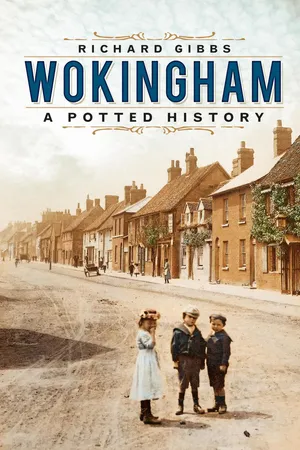
Wokingham sits on the edge of Windsor Great Forest. Originally settled by the Wocingas, an Anglo-Saxon tribe, the town grew steadily – but its early prosperity was cut short when half of the houses were destroyed during the English Civil War. Wokingham has hosted bull-baiting, highwaymen and a multitude of beer houses. The town's people have played their part in both world wars. Its rich history is interwoven with the history of England: a story of good times and bad, from the Beaker people to the Victorians to the present day. Wokingham is the quintessential English county town.
- 160 pages
- English
- ePUB (mobile friendly)
- Available on iOS & Android
eBook - ePub
About this book
Trusted by 375,005 students
Access to over 1.5 million titles for a fair monthly price.
Study more efficiently using our study tools.
Information
1
FROM EARLIEST TIMES
From earliest times a forest has existed in the south-eastern part of Berkshire, with vast stretches of heather, bracken and gorse-covered hills and moors, a wild and unfrequented region wherein deer and wolves and wild boars roamed, and British tribes dwelt, making their earthworks on the hills, a refuge for themselves and their cattle from the ravages of enemies and wild animals.
Arthur Heelas, 1928
In the far reaches of time, warm shallow waters covered much of the area surrounding present-day Wokingham. Over aeons, the gradual accumulation of the shells of tiny sea creatures laid down a bedrock of chalk. Around 50 million years ago, sharks and turtles were swimming around the mangrove swamps of a primeval ocean that deposited on its departure a thick layer of bluish clay. Millennia passed, and the area became an estuary with extensive mudflats and sandbanks formed by the ebb and flow of its tidal waters. Today these geological features are recognised by the sandy clay known as Bagshot Sands. They are a boon to some gardeners, while others are left in the proverbial mud of London clay.
And then, in the more recent geological past, the Quaternary period, from around 2 million years to 12,000 years ago, the region saw intermittent occurrences of a warm climate and ice ages. Glacial ice pushed the proto-Thames southward, and the river would erode the underlying clay, scouring the landscape. The ice would retreat, and the river would change course again and, in the process, leave behind residual deposits of gravel.
It is on one of these residual outcrops of gravel, a river terrace, that the settlement of Wokingham was established.
The town of Wokingham sits on ground that is slightly higher than the surrounding area. Market Place rises to about 70m above sea level. A pedestrian walking up the hill from where the Emm Brook crosses the Finchampstead Road, at around 45m above sea level, to the town hall, will climb 25m in less than a kilometre.
Topographically, the area around Wokingham is mainly London clay, which is overlain by the sandy Bagshot Formation. The town itself can be thought of as an island, one that is not only higher than its surroundings but also drier given its planting on a gravel outcrop.
It would be pleasing to imagine Neanderthals or early hominids strutting across this landscape chasing woolly mammoths or fleeing from sabre-toothed tigers; however, this is unlikely to have been a regular occurrence as there are only traces and hints of very early inhabitants as a result of a limited number of Palaeolithic and Neolithic finds in the area.
Around 2500 BC, the Neolithic farmers who had inhabited the British Isles for three to four millennia gave way to the new arrivals from Europe known as the Beaker people. They brought with them from Europe the understanding and technology of combining copper and tin in the right measures to make them more durable bronze instruments and tools. The Bronze Age had arrived in the UK, albeit around five centuries later than it did in ancient Greece.
In the vicinity of Wokingham, there appears to have been a small but well-established population at this time. In Barkham there are clear indications of settlements, including a curious burnt mound, reminiscent of a sauna, whose purpose is unclear.
The Beaker people also brought with them a unique culture, one feature of which literally stood out of the landscape. Their ceremonial barrows typically included luxury grave items that demonstrated the sophistication of their craftsmanship. There are notable examples of Bronze Age barrows surrounding Wokingham in Bill Hill, Bracknell and Finchampstead.
The Bronze Age eventually gave way around 800 BC to the Iron Age. The landscape that had earlier seen the construction of barrows now saw the development of hill forts such as the one nearby in Swinley Forest. The Iron Age hill fort known incorrectly as Caesar’s Camp was probably established between 500 and 300 BC, and so pre-dated any Roman influence. The only tenuous justification for the misnaming of the site by local antiquaries is that at some time it is likely to have fallen under the rule of King Cunobeline of the Catuvellauni; Cymbeline, the hero of the eponymous Shakespeare play, had been raised in Rome and was a loyal ally to the Romans.
Three Iron Age furnaces have been discovered close to the town, at what was Folly Court on the Barkham Road. At Matthewsgreen archaeologists have found a late Iron Age farmstead dating from around 40 BC. In this period, Wokingham, along with much of Berkshire, was to all intents and purposes ‘the land of the Atrebates’. This Celtic tribe had fled the Roman advance in Gaul around 50 BC.
Julius Caesar invaded Britain in the winter of 55/54 BC. It was not until 43 BC that the country, or part of it, was effectively governed by the Romans and would remain under their control for the next 500 years or so, until their departure in AD 410.
The Devil’s Highway, the Roman road that passes through Finchampstead on its way to Silchester or Calleva Atrebatum, is also a testament to the Roman presence. Silchester was itself a former Iron Age fort of the Atrebates tribe. Perhaps more prosaically, as further evidence of Roman occupation, there is a hoard of coins that were found at Matthewsgreen and date from the Emperor Constantine AD 306–337. The coins had been hidden, possibly by some farmer fearing assault or robbery but whom tragedy or accident overtook, thus preventing his return.
Nevertheless, despite all the indications of activity around the embryonic town, there is no tangible evidence of any permanent settlement until the fifth or sixth centuries, and even for that, it is necessary to rely on the etymology of the name Wokingham.
Numerous tribes from northern Europe filled the ‘political vacuum’ that was created by the departure of the Romans. The Germanic Angles and Saxons controlled, within the next 100 years after the Romans departure, much of the territory that had been under the rule of Rome; the Jutes, from Denmark, occupied some smaller areas in the south. This latest wave of invaders, and would-be settlers, imposed their language and customs on the local inhabitants, in much the same way that the Romans had. The Germanic language spoken by the Angles would eventually develop into English.
The placement of Wokingham on the gravel rise, within a heavily wooded countryside and a freshwater stream nearby, can be thought of as a deliberate act by a local Anglo-Saxon tribe called Woccingas, headed by Wocca. The Woccingas lived around the Woking area, and growth in the population could have been the impetus to encourage some members to leave the homestead to establish a new hamlet or settlement for the tribe, hence Woking – ham. Other members of the tribe decided to move further west in search of better agricultural land and settled in Woke-field.
These were turbulent times; Aidan, an Irish monk, established a monastery on Lindisfarne, and it was here in 793 that the Viking invasion began. The whole country was subjected to frequent raids and attacks. In 871, Bagsecg and Halfdan Ragnarsson camped near Reading to take on the Saxon army of Æthelwulf, the Ealdorman of the shire, in an attempt to gain control of Wessex, which included most of Berkshire. The Danes beat the Saxons back, only to be themselves beaten by Æthelwulf, who had joined forces with King Æthelred and his brother, Alfred the Great. The Danes retreated. Except for this battle, there are no other notable instances of the Viking presence in and around Wokingham; for the next 500 years or so, the small Anglo-Saxon village, most likely no more than a collection of huts in the middle of the heavily wooded forest, was undisturbed.
And then, along came the Normans and their conquest of 1066.
A group of Vikings that had settled in northern France became known as the Normans, and, by the early eleventh century, ruled a great and powerful region, sanctioned by the French Crown.
Following the death of the ‘English’ King, Edward the Confessor, the Normans of France, led by William (the Conqueror), sailed across the Channel and claimed the throne of England, defeating the only other contender, Harold Godwinson, at the Battle of Hastings in 1066.
When William dismissed his mercenaries in 1070, nearly all returned to France. The number who settled and remained in England was relatively few. Richard the Lionheart, King of England, Duke of Normandy, spent less than six months in England after he ascended the throne. The Norman conquerors ruled predominantly from France; England simply acquired a new ruling class.
William was pragmatic and, having conquered the country, needed to get to grips with running it as well as sharing bits out to his trusty followers.
The Anglo-Saxon Chronicle, dating from the late ninth century, states that:
… at the midwinter [1085], was the king in Gloucester with his council … After this had the king a large meeting, and very deep consultation with his council, about this land; how it was occupied, and by what sort of men. Then sent he his men over all England into each shire; commissioning them to find out ‘How many hundreds of hides were in the shire, what land the king himself had, and what stock upon the land; or, what dues he ought to have by the year from the shire’.
The Domesday Book does not mention Wokingham. To put this anomaly into context, the smaller villages of Barkham, Swallowfield, Easthampstead, Finchampstead and Shinfield were all included in the survey. One explanation put forward for the omission is that, at this time, the area was included in the account of the Manor of Sonning. Roger the Priest was the Lord of the Manor as well as being the Bishop of Salisbury, and the Domesday entry for Sonning lists forty villagers, sixteen smallholders and one church. As these represented households the population is likely to have been five times larger. Having said that, by way of comparison, both Finchampstead and Swallowfield had thirty households and Barkham had ten. The listing for Sonning seems strangely deficient, or perhaps suggests that the hamlet of Wokingham was literally a couple of huts in the middle of the woods and not worth the reckoning.
Whatever the understanding or reasoning for the absence of the town from the Domesday Book, a century later, around 1190, All Saints Church was founded and dedicated by Hubert le Poore, Bishop of Salisbury.
Notwithstanding the significance of this documented event, there is some evidence that an older Chapel of Ease existed on the site.
Glebe lands are lands that the church can rent out and thus generate an income for the rectory. The Wokingham glebe lands lay to the north-west of All Saints Church. In the thirteenth century there was an ongoing dispute over the land that the church claimed, but which was being farmed by a certain Ralph the Red – Radulfus Ruffus. The church was paying rent to the Bishop of Salisbury, but received no income from it, hence their displeasure.
An enquiry was set up in 1217 by Dean Adam of Salisbury. The case was laid before Henry III’s itinerant justices. The chief justice was Richard le Poore, who was ably assisted by six justices as well as the attorney Bartholomew de Kernes. Needless to say, against such opposition, in 1219, Radulfus lost the case and surrendered the land but he was allowed the use of the land for his lifetime at the rent of five shillings per annum.

John Norden’s map of 1607 shows Wokingham, spelt Ockmgham, as a cluster of houses and streets around the market place. Roads or tracks lead out to Arborfield, Lodden Bridge and Easthampstead Park.
As part of the court case, it was pointed out that Stephen, who was the priest at Wokingham, had inherited the chaplaincy:
For the whole of his life, Alfred (Alerud) the priest held, together with the Chapel of Wokingham, the land which Ralph the Red now unjustly occupies; after Alfred, his son Robert held the chapel and the land for the whole of his life, and cleared of trees a great part of that land; then came Godfrey (Godefidus) the Deacon, Alfred’s son and Robert’s brother; after Godfrey married, his son John in whose time the chapel was dedicated by Hubert Bishop of Salisbury (c.1190); after John came Godfrey’s youngest son Stephen, who paid 40 shillings to Dean Jordan (c.1195). And so, from the time of Alfred until the time of Stephen, the land has always belonged to the chapel of Wokingham.
This convoluted family tree takes the dating of the chapel back as far as Alfred in roughly 1140, a few years before the chapel is mentioned in the Sarum Rolls of 1146. It is also clear that the priests of this chapel were not celibate, which adds weight to the argument that it is unlikely to have been established in the post-Conquest era – no self-respecting Norman overlord would establish a church and allow such carry-ons by the incumbent and obviously not celibate priest.
This provides a sound argument that the chapel most likely pre-dates the 1066 invasion. It is probable that the chapel was also associated with the monastery of Abbot Hedda in Woccingas’ territory, as mentioned in a papal bull of 708 by Pope Constantine.
When Hubert le Poore died, his brother Richard, formerly the Dean of Salisbury, became Bishop and decided around 1218 to abandon the Old Sarum Cathedral for a new one in his manor of Milford by the River Avon.
One way of making money in this period was the establishment of ‘new towns’. Such an initiative enabled the landowner to effectively provide the equivalent of a ‘tax break’ to the people (burgesses) who rented the plots of land (burgage). In this instance, ‘the tax breaks’ amounted to not being liable for feudal duties.
Richard decided to pay for the new cathedral by creating a ‘new town’ in his Manor of Sonning with the purchase of a market charter for Wokingham from the Crown in 1219. It is pure speculation that during the Radulfus Ruffus court case Richard had pondered what he could do with this quiet backwater. The charter was confirmed as permanent in 1227. The market was to be held ‘peaceably’ every Tuesday.
In subsequent years the market would be held in Market Place, but it is likely that originally it was located in the enclosed Rose Street.
Wokingha...
Table of contents
- Cover
- Title
- Copyright
- Contents
- Foreword
- Introduction
- 1 From Earliest Times
- 2 Stagecoaches and Steam Trains
- 3 The Grander Houses of Wokingham
- 4 Crime and Punishment
- 5 Welfare and Education
- 6 Food, but Mainly Drink!
- 7 Wokingham at Play
- 8 Wokingham at Work
- 9 Wokingham at War
- 10 Wokingham at Prayer
- 11 In Living Memory
- Appendices
- Listed Buildings and Monuments
- Pubs and Inns of Wokingham
- Ministers of All Saints Church
- The Streets of Wokingham
- Acknowledgements
Frequently asked questions
Yes, you can cancel anytime from the Subscription tab in your account settings on the Perlego website. Your subscription will stay active until the end of your current billing period. Learn how to cancel your subscription
No, books cannot be downloaded as external files, such as PDFs, for use outside of Perlego. However, you can download books within the Perlego app for offline reading on mobile or tablet. Learn how to download books offline
Perlego offers two plans: Essential and Complete
- Essential is ideal for learners and professionals who enjoy exploring a wide range of subjects. Access the Essential Library with 800,000+ trusted titles and best-sellers across business, personal growth, and the humanities. Includes unlimited reading time and Standard Read Aloud voice.
- Complete: Perfect for advanced learners and researchers needing full, unrestricted access. Unlock 1.5M+ books across hundreds of subjects, including academic and specialized titles. The Complete Plan also includes advanced features like Premium Read Aloud and Research Assistant.
We are an online textbook subscription service, where you can get access to an entire online library for less than the price of a single book per month. With over 1.5 million books across 990+ topics, we’ve got you covered! Learn about our mission
Look out for the read-aloud symbol on your next book to see if you can listen to it. The read-aloud tool reads text aloud for you, highlighting the text as it is being read. You can pause it, speed it up and slow it down. Learn more about Read Aloud
Yes! You can use the Perlego app on both iOS and Android devices to read anytime, anywhere — even offline. Perfect for commutes or when you’re on the go.
Please note we cannot support devices running on iOS 13 and Android 7 or earlier. Learn more about using the app
Please note we cannot support devices running on iOS 13 and Android 7 or earlier. Learn more about using the app
Yes, you can access Wokingham by Richard Gibbs in PDF and/or ePUB format, as well as other popular books in History & British History. We have over 1.5 million books available in our catalogue for you to explore.