![]() Species profiles
Species profiles![]()
Osprey
Pandion haliaetus
Osprey
Pandion haliaetus
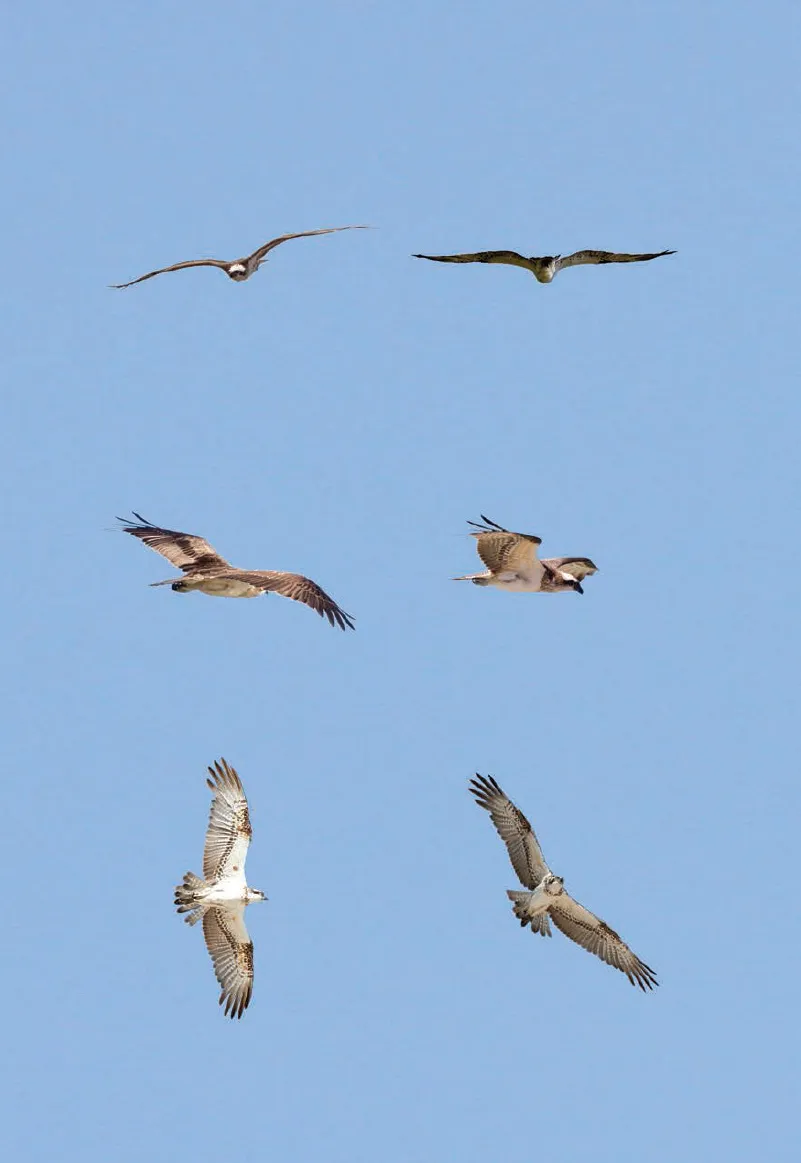
Overview: Large, bicoloured, big-footed aquatic hawk that flies buoyantly with slow, gentle, somewhat stiff wing beats; soars and glides on long, angular, M-shaped bowed wings; hovers; dramatically plunges head-first into water with feet thrown forwards; submerges (rather than snatching fish off the surface). Gives a distinctive ‘shiver’ to shed water when resuming flight after emerging from water.
Confusion species: Easily confused with immature White-bellied Sea-Eagle, and potentially confused with juvenile Brahminy Kite, pale-bellied Whistling Kites.
Key identification points
• Primary distinguishing features: Distinctive bowed M-shaped wing in profile when gliding. Stiff wing beats. Hovers. Appears somewhat long necked and short tailed in flight.
• Size: 56–66 cm body, 149–168 cm wingspan. Larger and more heavily built than Brahminy Kite and Whistling Kite, approaching White-bellied Sea-Eagle in size though more slender and narrow winged.
• Shape: Distinctive M-shaped wing in profile when gliding. Angular, slightly to moderately fingered wings when viewed from behind or obliquely; somewhat curved trailing edge to wing, approximately parallel to leading edge when wings flexed; primaries fingered when fully spread, but tapered to a long, moderately pointed wing-tip when partly closed; tail square when furled, but rounded when fanned.
• Proportions: Wrists are set well back from the front of the head when soaring, but level with the head when fully flexed in a fast glide. Tail length somewhat less than body (including head), making it look long necked and short tailed in flight. Head (including bill) rather long and prominent; flat crown; deep bill.
• Plumage: Overall white head and underbody and brown dorsal surface; pale underside, dark upperparts evident when circling at a distance; dark eye-stripe and mottled breast-band (if present) not obvious at a distance; barred underwings and tail, and dark carpal patch on underwing, evident at closer range.
• Close-up: During close-up overhead views the eye-stripe, breast-band (if present) and large grey feet and talons are very prominent.
Identifying age and sex: When seen together, the female is slightly larger than the male, and in adult plumage the male has little to no mottled breast-band. Adults have plain upperparts and (at close range) pale yellow to orange-yellow eyes that are very prominent and somewhat glaring; juveniles are overall rustier with more streaked crown and nape, cream-spotted upperparts (lost with wear), broader and heavier breast-band, and (at close range) have orange-yellow to orange eyes.
![]()
Black-shouldered Kite
Elanus axillaris
Black-shouldered Kite
Elanus axillaris
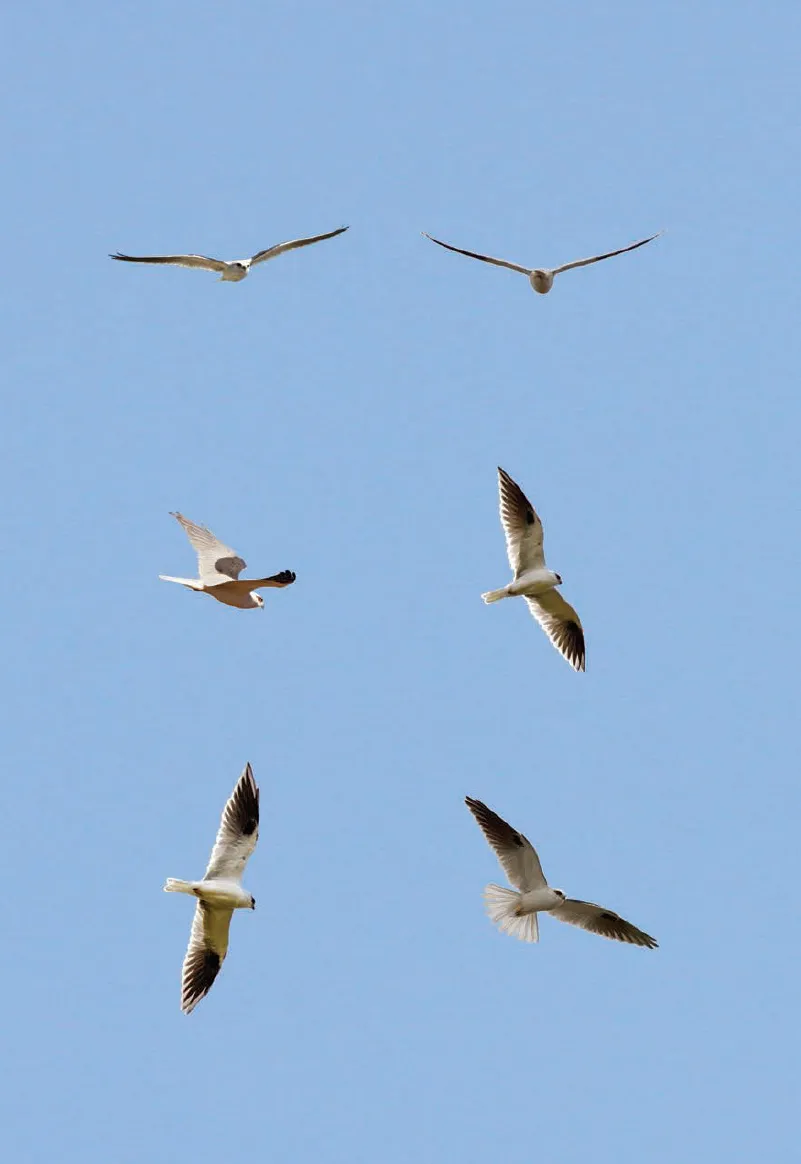
Overview: Small, lithe, delicate, mostly white hawk that flies with winnowing beats, soars/ glides on raised tern-like V-shaped wings; hovers in semi-upright posture with tail depressed and legs lowered; drops feet-first with wings raised high. Black carpal spot on underwing not obvious at a distance. Diurnal.
Confusion species: Easily confused with Letter-winged Kite. Also potentially confused with Nankeen Kestrel, Grey Falcon.
Key identification points
• Primary distinguishing features: Sharp winged; white bodied; wings held in strong V-shape when gliding. Hovers with body hanging down. Primarily differs from the very similar Letter-winged Kite (which is normally restricted to arid environs) in being diurnal, and by having a small black carpal spot on the underwing (as opposed to a thick black line).
• Size: 33–37 cm body, 82–94 cm wingspan. Similar in size to Nankeen Kestrel but more robust, broader winged and shorter tailed; smaller than Grey Falcon.
• Shape: Pointed, raised V-shaped wings when viewed from behind or obliquely; wing-tips gently pointed and not fingered when fully spread, but tapered to a long point when partly closed; tail square to slightly notched when furled, but rounded when fanned.
• Proportions: Wrists are set well back from the front of the head when soaring, but almost level with the head when fully flexed in a fast glide. Tail length less than body (including head), making it look somewhat short tailed in flight. Head rather short and broad, slightly domed; bill small and not prominent.
• Plumage: Overall white with grey wings and black ‘shoulders’ (inner forewings); pale body and raised wings evident when circling at a distance; black carpal spot and dark primaries on underwings and white unmarked tail only obvious at closer range.
• Close-up: During close-up overhead views the red eyes, black eyebrow and yellow feet are conspicuous.
Identifying age and sex: The male and female are similar, only distinguishable by behaviour, such as courtship, copulation and food provision by the male, when seen together and interacting. Juveniles are washed or streaked rusty on the foreparts, the dorsal feathers are fringed white, and (at close range) the eyes are brown.
![]()
Letter-winged Kite
Elanus scriptus
Letter-winged Kite
Elanus scriptus
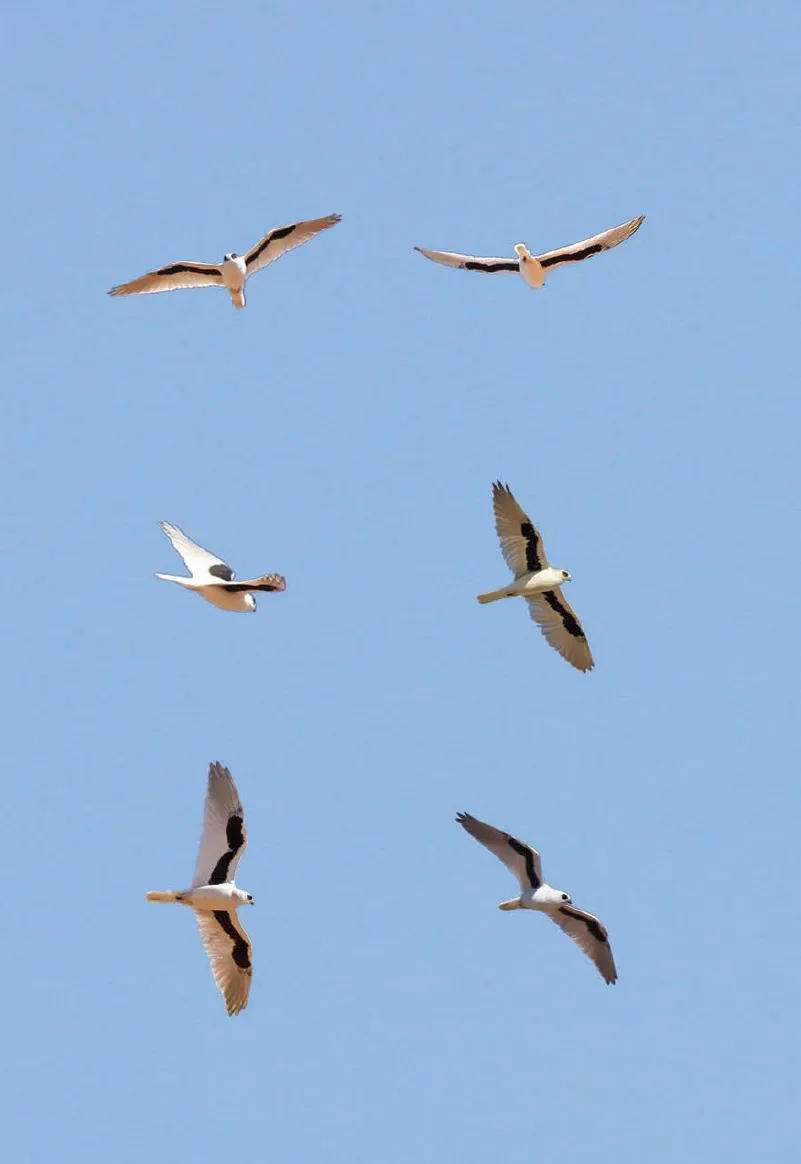
Overview: Small, delicate, mostly white hawk that flies with slow gull-like or tern-like beats; hovers; soars/glides on raised V-shaped wings; mostly nocturnal so unlikely to be seen flying by day unless out of normal arid-zone range (during drought), or disturbed at roost or breeding site.
Confusion species: Easily confused with Black-shouldered Kite, and potentially confused with Barn Owl when flying at night.
Key identification po...