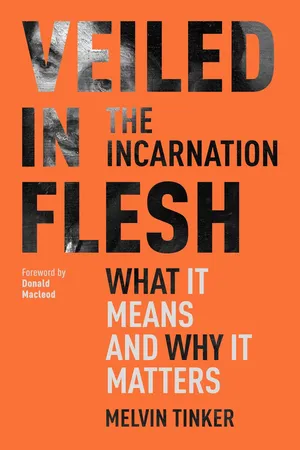
'Veiled in flesh the Godhead see, Hail the incarnate deity... Jesus, our Emmanuel.' Great words, from one of the most popular Christmas carols - but what do they actually mean and do they really matter?Melvin Tinker introduces the doctrine of the incarnation of God the Son in Jesus Christ, in two parts.Part One approaches the incarnation by way of an exposition of chapter 1 of the New Testament letter to the Hebrews. This grounds the doctrine in Scripture, working through some of the theological and pastoral implications.Part Two goes deeper, drawing on systematic and historical theology (especially the creeds) to tease out what the doctrine means and why it is vital to the life and health of the church and Christian devotion. While the treatment is clearly theological (dealing with biblical truth), it is also doxological (leading to praise) and pastoral (practical in its outworking) The doctrine is set alongside and related to two other key Christian beliefs - the Trinity and the atonement.
- English
- ePUB (mobile friendly)
- Available on iOS & Android
eBook - ePub
About this book
Trusted by 375,005 students
Access to over 1.5 million titles for a fair monthly price.
Study more efficiently using our study tools.
Information
Part 1
‘. . . THE GODHEAD SEE’: A BIBLICAL FOUNDATION
1
God’s final word (Heb. 1:1–4)
One of the most popular Christmas carols of all time, written by Charles Wesley and modified by George Whitefield, is ‘Hark, the Herald Angels Sing’. It contains the immortal lines: ‘Veiled in flesh the Godhead see / Hail, the incarnate deity / Pleased as man with man to dwell, / Jesus, our Emmanuel.’ Great words, but what do they actually mean, and do they really matter?
What they mean (as strange and seemingly implausible as it may initially sound) is that the Creator became a creature without ceasing to be Creator. Why they matter is because upon them rest our eternal destiny and the future of the whole universe. This is the way C. S. Lewis summarized the situation in his day, which was not all that dissimilar from ours:
Is not the popular idea of Christianity simply this: that Jesus was a great moral teacher and that if only we took his advice we might be able to establish a better social order and avoid another war? . . . It is quite true that if we took Christ’s advice we should soon be living in a happier world. You need not even go as far as Christ. If we all did what Plato or Aristotle or Confucius told us, we should get on a great deal better. And so what? We never have followed the advice of great teachers. Why are we more likely to start now? . . . But as soon as you look at any real Christian writings, you find that they are talking about something quite different from this popular religion. They say that Christ is the Son of God . . . they say that those who give Him their confidence can also become sons of God . . . They say that His death saved us from our sins.1
Putting it bluntly, if Jesus is not God who became man, then Christians are guilty of idolatry by worshipping a man, in which case the charge of blasphemy by Muslims is upheld. If Jesus is no more than a man, but simply to be placed on the same level as Socrates or Buddha, we needn’t give his words any more weight than those of any other man. But if he is God, this is a game changer, for then we can say with a fair degree of certainty that we know what God is like, what he wants from us and how we can be related to him.
In the first chapter of the letter to the Hebrews the writer expresses in the most sublime way imaginable that which defies the human imagination and which is meant to lead us into grateful devotion and genuine discipleship: that God became a man without ceasing to be God.
Although we don’t know who the writer of this letter was, we do know what he was, namely, a pastor-preacher. All the evidence is that this is one long sermon,2 although, according to Hebrews 13:22, it is a rather brief sermon! Hebrews 1:1–4 is one long sentence in the original packed with theological dynamite.3 The author’s writing style is not like that of any other writer in the New Testament – it is highly polished; some would say he is the ‘Shakespeare’ of the New Testament writers. Harold W. Attridge describes Hebrews as ‘a masterpiece of early Christian homiletics, weaving creative scriptural exegesis with effective exhortation’.4 But it is not so much how he writes that is particularly impressive, but what he writes.
Let’s begin with the first two verses: ‘Long ago, at many times and in many ways, God spoke to our fathers by the prophets, but in these last days he has spoken to us by his Son.’
Communication problems
As any marriage counsellor will tell you, most problems in relationships come down to a failure to communicate: ‘He never listens to me’; ‘She doesn’t understand me’; ‘It’s as if we are from different planets: I’m from Mars, she is from Venus, and my mother-in-law is from Pluto!’ Effective communication is vital to fostering good relationships between people. If that is the case at the human level, how much more so at the divine–human level, between God and people?
This immediately raises some big questions: ‘If there is a God, how are we to know? If there is a God, how can we know him?’ For both questions to be answered positively, some sort of communication has to take place, and the initiative has to come from God’s side. If God is there, then he must make himself known, he must tell us what he is like, for he is infinite and we are finite, and a great gulf is fixed between us. There is what Søren Kierkegaard called an ‘infinite qualitative distinction’ between God and us.
The word used to describe the activity of God ‘making himself known’ is ‘revelation’ (from the Latin revelatio), a word which, in the biblical languages, means ‘a pulling back of the curtains’ so that we can know what or who lies behind them:
It is knowledge that someone else discloses to us. In Christianity the term is important for it means that God has taken the initiative in disclosing himself to man. That knowledge of God is thought of then not as the end product of diligent human search, but the manifestation of God’s grace and of his will to be known.5
Here our writer to the Hebrews tells us that God has done just that in very special ways.
In the rather funny film Love and Death, the character played by the American comedian Woody Allen at one point says in exasperation,
If God would only speak to me – just once. If he would only cough. If I could just see a miracle. If I could see a burning bush or the seas part. Or my Uncle Sasha pick up the bill.
What you have in this plea is a mixture of universal human longing and entrenched modern cynicism. People want some assurance there is a God. But then there follow certain conditions: Allen wants God the conversationalist – ‘If God would only speak’; but he has spoken, maybe not in the way some people would want, but he has spoken nonetheless. God has spoken through the cross, but Allen would prefer a cough. Allen wants God the conjurer – ‘If I could just see a miracle’ – but dismisses a book full of miracles: the Bible. We receive the impression that no matter what conditions are laid down for God to meet, more conditions will be waiting further down the line. In every case it is God who is expected to jump through the hoops of our making and to do so at our bidding.
Not so the real God. However, that is not to say that he is not exceedingly gracious in the way he stoops down to speak to us. He takes into account our frailties and so speaks in ways we can understand, using human language. The French theologian John Calvin speaks of God ‘lisping’ to us. God also makes allowance for our rebellion, whereby more often than not we don’t want to understand what he is saying; we are more like Uncle Sasha turning a deaf ear so that someone else picks up the bill at the restaurant!
He is there and he has spoken
Our writer begins with the affirmation that God, having spoken ‘in’ the prophets in former times, has spoken in these last days ‘in’ his Son (literal translation). As Jonathan Griffiths rightly concludes,
Thus his [God’s] speech ‘in’ the Son is personal – even ontological – in its character. Although the terms in which Hebrews expresses this theology of personal revelation through the Son differ from the terms of John’s prologue, there is here in Hebrews a similar idea: the Son is himself God’s revelatory Word, his speech in personal form.6
Here we are told that God has always been the speaking God: ‘Long ago, at many times and in many ways, God spoke.’ Perhaps a better rendering would be ‘God speaking in the past’ is now ‘speaking through his Son’ – it is one long continuous event. It is not that God has been silent; it is that sin shrouds our planet in silence and makes us deaf to God and blind to his works. From the very beginning God made us uniquely to know him (Gen. 1 and 2), and since the initial rebellion in Eden he has steadily been unfolding a plan of rescue that would save the world that is lost and bring it back to him. This passage at the very beginning of the book of Hebrews is setting us up for the fact that God began the conversation that is Jesus Christ long before the actual incarnation itself.
This is special revelation we are talking about – that is, revelation which is given to specific people at specific times with specific content. The Bible makes it plain that the primary way God has chosen to relate to us is the same way in which we relate to each other: by words. Just consider for a moment how the first book in the Bible begins, which establishes the pattern for the way God deals with us in the rest of the Bible: ‘In the beginning, God created the heavens and the earth . . . the Spirit of God was hovering over the face of the waters. And God said, “Let there be . . .”, and...
Table of contents
- Foreword
- Preface
- Part 1
- 1
- 2
- 3
- 4
- 5
- Part 2
- 6
- 7
- 8
- 9
- 10
- 11
- For further reading
- Search items for Scripture references
- Notes
Frequently asked questions
Yes, you can cancel anytime from the Subscription tab in your account settings on the Perlego website. Your subscription will stay active until the end of your current billing period. Learn how to cancel your subscription
No, books cannot be downloaded as external files, such as PDFs, for use outside of Perlego. However, you can download books within the Perlego app for offline reading on mobile or tablet. Learn how to download books offline
Perlego offers two plans: Essential and Complete
- Essential is ideal for learners and professionals who enjoy exploring a wide range of subjects. Access the Essential Library with 800,000+ trusted titles and best-sellers across business, personal growth, and the humanities. Includes unlimited reading time and Standard Read Aloud voice.
- Complete: Perfect for advanced learners and researchers needing full, unrestricted access. Unlock 1.5M+ books across hundreds of subjects, including academic and specialized titles. The Complete Plan also includes advanced features like Premium Read Aloud and Research Assistant.
We are an online textbook subscription service, where you can get access to an entire online library for less than the price of a single book per month. With over 1.5 million books across 990+ topics, we’ve got you covered! Learn about our mission
Look out for the read-aloud symbol on your next book to see if you can listen to it. The read-aloud tool reads text aloud for you, highlighting the text as it is being read. You can pause it, speed it up and slow it down. Learn more about Read Aloud
Yes! You can use the Perlego app on both iOS and Android devices to read anytime, anywhere — even offline. Perfect for commutes or when you’re on the go.
Please note we cannot support devices running on iOS 13 and Android 7 or earlier. Learn more about using the app
Please note we cannot support devices running on iOS 13 and Android 7 or earlier. Learn more about using the app
Yes, you can access Veiled in Flesh by Melvin Tinker in PDF and/or ePUB format, as well as other popular books in Theology & Religion & Systematic Theology & Ethics. We have over 1.5 million books available in our catalogue for you to explore.