Exodus, Cole says, is 'the centre of the Old Testament'. It recounts the supreme Old Testament example of the saving acts of God, narrates the instituting of Passover and enshrines the giving of God's law. It portrays Moses, the prototype of all Israel's prophets, and Aaron, the first high priest.
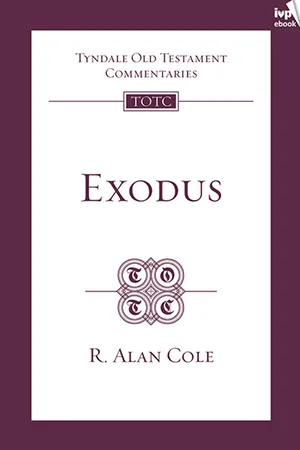
- English
- ePUB (mobile friendly)
- Available on iOS & Android
eBook - ePub
About this book
Information
Topic
Theology & ReligionSubtopic
ChristianityCommentary
1. Israel in Egypt (1:1–11:10)
a. Israel before Moses (1:1–22)
1:1–7. Background. 1. And these are the names … The initial ‘and’ found in the Hebrew makes clear that Exodus is not a new book, but simply the continuation of the Genesis story, and the fulfilment of the promises made to the patriarchs. But this is an appropriate place for a break: it is the last time in the Pentateuch that ‘sons of Israel’ is used to describe Jacob’s immediate family. From now on, the phrase will be a collective patronymic, describing the whole people of God, formed like any Arabic tribal name.
2–4. There is a sonorous roll in the names of the twelve phylarchs, like the list of the twelve apostles in the New Testament. A new work of God is about to begin.
5. Seventy may be used as a round number, or as a sacred figure. It may however be obtained exactly by excluding Jacob’s daughter Dinah from the total. The Greek text of Genesis 46 adds the five children of Ephraim and Manasseh, thus making the ‘seventy-five’ of Acts 7:14 1 The theological point is the difference between the small number who entered Egypt and the large numbers who left.
7. The Hebrew deliberately repeats three verbs used in Genesis 1:21, 22 which may be translated ‘were fruitful … swarmed … became numerous’. This increase was interpreted as God’s promised blessing on his creation. A considerable time had passed since Joseph’s death: at the very shortest reckoning, Moses was the fourth generation after Levi (Num. 26:58) and he may have been many hundred years later (Exod. 12:40). The land was filled is either the land of Goshen (probably the Wadi Tumilat, stretching from the Nile to the line of the present Suez Canal) or else, by a natural exaggeration, the whole territory of Egypt. This last interpretation, although statistically incorrect, expresses well the feelings of the native Egyptians, perhaps outnumbered in some parts by the unwelcome immigrants.
1:8–14. Pharaoh’s labour camps. 8. A new king need not necessarily mean the next pharaoh. Indeed, if Israel’s stay in Egypt was a matter of centuries (Exod. 12:40), then it may have been a new dynasty. The XVIIth Dynasty had been Hyksos (Semitic and foreign); the XVIIIth was a native dynasty (1570–1310) and at once expelled the foreign overlords. On independent grounds, it is usually considered nowadays that the exodus took place in the early years of the XIXth Dynasty (1310–1200), i.e. the 13th century BC. In either case, this is the simple language of popular folk history, expressing a truth, but not concerned with exact dates.
10, 11. Forced labour was an old principle in highly centralized Egypt, as in all the ancient world: neither pyramids nor Nile canals would have been possible without it. Taskmasters is a technical term, and would describe the hated Egyptian officials, under whom there were minor Israelite officials (Exod. 5:14); mas (translated ‘task’) was a technical term in Israel for ‘forced labour’ (usually Canaanite and therefore foreign, 1 Kgs 9:21). How such taskmasters were hated can be seen from the stoning of Adoram later (1 Kgs 12:18). Pithom and Raamses. This is a vivid touch of great value for dating the event, since the building of both cities is associated with Rameses II (c. 1290–1225 BC), probably in connection with his Asiatic campaigns. Pithom is probably Tell er-Retabe (‘Broomhill’) in the Wadi Tumilat. Raamses may be modern Qantîr (‘Bridge’), on the eastern arm of the Nile delta, but the exact location of both cities is disputed.
12. The more they multiplied and … spread abroad. Such attempts to control the growth of the people of God are vain. Again, two Genesis verbs (Gen. 1:22 and 30:30) are used to describe their triumphant growth. But it was a life of bitter, unrelieved drudgery (14) and the rude animal health of this biologically superior people ‘disgusted’ the sophisticated Egyptians (cf. NEB). Others prefer the translation ‘sick with worry’, comparing Genesis 27:46.
1:15–22. Pharaoh’s second plan: genocide. 15. The Hebrew midwives. ‘Hebrew’ seems to be a term of wide application in the early Old Testament, referring to all the semi-settled West Semitic peoples, in a cultural not genetic sense, and usually on the lips of a foreigner (as in verse 22). Here the term is appropriate, in the mouth of the pharaoh. In Exodus 5:3 it is again properly used, as describing the God of Israel to Egyptian pharaoh. In the legal code ‘Hebrew slave’ (Exod. 21:2) has a much wider meaning than ‘Israelite slave’. The word probably has a connotation something like modern ‘gipsy’, in a derogatory sense, combining the ideas of wandering and animal-trading. The ‘Apiru, or unskilled labourers, of the Egyptian texts, and the Habiru of the Tell el-Amarna tablets are probably the same cultural group.2 Shiphrah and Puah are two good Semitic names, of an archaic type (compare Gideon’s servant Purah in Judg. 7:10), meaning something like ‘beauty’ and ‘splendour’ respectively. For the first, compare the form Sapphira (Acts 5:1). Like the names Pithom and Raamses, these detailed memories assure us that we are dealing with genuine historical tradition. But why only two midwives? Either these were the only two, or they were the only two who disobeyed, or they were the only two whose names were remembered. The first alternative would, however, mean that the total number of Israelites was only a few thousand at most. Perhaps the third suggestion is the best, most congenial to folk history and to Semitic languages. In Hebrew ‘the midwives’ means ‘those particularized by the following circumstances’ (see Exod. 2:1).
16. The birthstool: literally ‘the two stones’ upon which the Israelite woman crouched while giving birth: there are other Semitic parallels. A less likely suggestion is that it is a reference to the distinguishing organs of the male children, who were alone to be killed.
19. They are vigorous and are delivered before the midwife comes to them. We are not told whether the midwives were lying, or whether the quick delivery of ‘Hebrew’ babies was a biological fact. Arabian parallels are quoted by Driver, but Rachel certainly had a hard delivery (Gen. 35:16). Even if they lied, it is not for their deceit that they are commended, but for their refusal to take infant lives, God’s gift. Their reverence for life sprang from reverence for God, the life-giver (Exod. 20:12, 13), and for this they were rewarded with families. The relevance of this to modern controversy about abortion should be carefully pondered.
22. The Hebrew for river (AV, RV) here is a loanword from Egyptian, and means ‘the river’ par excellence, that is, the Nile (RSV, NEB). (Other possible loan-words from Egyptian are ‘reed’ and ‘frog’; and numerous Egyptian proper names occur, in the tribe of Levi especially.) To execute by drowning was an obvious method in a country such as Egypt and Babylonia, just as death by stoning was obvious in rocky Israel (Josh. 7:25). Whether Israel in general obeyed pharaoh’s edict, we do not know: certainly the parents of Moses braved pharaoh’s anger (Heb. 11:23). Every daughter. These presumably would become slave wives, and so could be absorbed by the Egyptians in a generation. The whole vain attempt to wipe out the people of God finds its parallel in the New Testament attempt by Herod to destroy a generation of babies at Bethlehem (Matt. 2:16). But, as in the New Testament, God’s chosen agent is protected: neither pharaoh nor Herod can stand in the way of God’s plan. Jewish expositors have seen parallels to pharaoh’s action in the attempted genocide of Israel by Hitler and others: Christian expositors have sought such parallels in the bitter persecutions suffered by the church throughout her history.
b. Early life of Moses (2:1–25)
2:1–10. Birth and adoption. 1. The house of Levi. Amram (whose name is given in 6:20) was grandson of Levi, if the genealogies are complete, so that ‘house’ is quite literal, meaning ‘family’. Levi had no priestly associations in the early days, as can be seen from Genesis 49:5–7 where, with Simeon, he comes under his father’s curse for a bloodthirsty attack on Shechem (Gen. 34). The curse will be fulfilled: but in the case of Levi it will be turned into blessing, for Levi will be ‘scattered’ as the priestly tribe (Num. 35:7, 8). In view of the meaning of the root lāwā ‘to adhere’, and the use of lawi in southern Arabic to mean ‘a priest’, some have suggested that the name Levi denoted an occupation, not a tribe. The Bible, however, while quite conscious of this meaning of the name, associates it not with priestly status, but with circumstances of birth (Gen. 29:34). For the choice of Levi as the priestly tribe, in reward for faithfulness, see Exodus 32. A daughter of Levi. The Hebrew text should probably be translated the daughter, as in Numbers 26:59. If Jochebed was Kohath’s sister, then she would be literally ‘the daughter of Levi’ (6:20). However, it is idiomatic in Hebrew to use the definite article to describe her as the particular descendant of Levi about whom the following anecdote will be told.
2. Bore a son. The story does not say that Moses was her first-born son. His sister, obviously several years older, appears in verse 4, and Aaron is three years older than Moses (Exod. 7:7). It is quite unnecessary to assume that they were Amram’s children by another wife, although such plural marriages were common. Miriam is, however, usually described as ‘Aaron’s sister’ (Exod. 15:20), never as Moses’ sister: this has been used to support the above theory. But Old Testament narrative as a rule introduces facts only when relevant to the story: we cannot argue from silence.
3. She could hide him no longer. A healthy child cries too loudly to be hidden at three months old. His cries may later have attracted the attention of pharaoh’s daughter (5). A basket made of bulrushes. The Hebrew would be better translated by ‘papyrus basket’; the word is used elsewhere only of Noah’s ark (Gen. 6) and may possibly be connected with Egyptian tebet, ‘chest’. Any market in Asia is loaded with baskets of this sort, holding everything from pigs to fruit. It was coated with ‘bitumen’ (Gen. 11:3; 14:10) to make it watertight, and possibly to provide extra insulation against the hot sun. Isaiah 18:2 refers to papyrus skiffs as plying on the Nile, so that the ‘basket’ was a miniature Nile boat. And placed it among the reeds. These would be in shallow water, where the current could not carry the basket away, with less danger of crocodiles than on an open sandbank or beach. There would also be some protection from the heat of the sun, in the reeds. The sûp, ‘reeds’, whatever water plant it was, gave its name to the ‘Reed Sea’ or ‘Reed Marsh’ of 13:18. The writer remembers seeing a very thick growth of reeds (though not of any great height) roughly where the Sweet Water Canal joined the Suez Canal.
Jochebed’s act, like Abram’s claim to be the brother of Sarai in Genesis 12, is just within the law. She had indeed thrown her son into the river as ordered, but in a wicker basket. Some scholars have seen the story as parabolic or ideal, however, on the grounds of similar stories told of Sargon of Accad and others. But the existence of so many stories only shows that this was a favourite way of abandoning babies in the ancient world. It was in fact the ancient equivalent of leaving them on the steps of a hospital or orphanage today. The shallows of a river near any Asian village would be the ideal place today to expose a baby and ensure its being found by the women who came to wash clothes or prepare food. Discovery would be certain; there was a good wicker basket which could be salvaged, clearly visible.
5. The daughter of Pharaoh. The Apocrypha calls her Tharmuth (Jubilees 47:5); see Hyatt (p. 64) for ‘Merris’ and ‘Bithiah’ as other names for her. It is hard to see why the names should be invented, so that we may well have a fragment of reliable extra-biblical tradition here. Compare Jannes and Jambres, as the names of the magicians who opposed Moses (2 Tim. 3:8). If the pharaoh in question was Rameses II, he had close on sixty daughters. He also had numerous ‘hunting-lodges’ scattered over the delta area, where duck and other game were plentiful, so there is no need to assume that Moses’ parents lived near the royal capital Zoan.
6. She took pity on him. No eastern mother could bring herself to abandon a sturdy boy-baby like this. We may suspect that a girl-baby might not have fared so well, but they did not come under the pharaoh’s decree of execution. In all this, God’s providence was at work.
9. Your wages. It probably appealed to the robust Israelite sense of humour that Jochebed was ‘spoiling the Egyptians’ by receiving pay for nursing her own son: but there was also a deeper purpose in it. No doubt it was in these early years that Moses learnt of the ‘God of the fathers’ (Exod. 3:15) and realized that the Hebrews were his fellow countrymen (Exod. 2:11). Psychologists rightly stress the importance of impressions received during the earliest years. Without this ancestral background, God’s later revelation to Moses would have been rootless, and the Sinaitic Covenant could not have been seen as a sequel to, and consequence of, the Abrahamic Covenant (Exod. 3:6).
10. Moses, mōšeh, would be the active participle of the Hebrew verb māšâ, ‘pulling out’. A different vocalization could give the passive meaning ‘pulled out’, but there is no need to press this. As often in the Old Testament, this is not intended as a piece of exact philology, but a pun, based on assonance. Possibly pharaoh’s daughter chose the Egyptian name which appears as the second half of Thuthmose, Ahmose, and many other similar forms. Whether the name ‘Moses’ was itself considered as a shortening of some such longer form, it is impossible to say, nor indeed is it important to know. The Bible also seems to mean not only that the name Moses is capable of supporting a pun of this sort (which to the Hebrew was rich in spiritual meaning), but that it was deliberately chosen because of this capacity. There is nothing impossible here: West Semitic dialects were widely understood, and even spoken, in the delta area. An Egyptian mistress might well understand and use the tongue of her domestic servants to give orders, like many a ‘memsahib’ in later days.
2:11–15. The rejection and flight of Moses. 11. Grown up. Acts 7:23 says he was forty years old at the time. Exodus merely says that he was eighty years old when he spoke to pharaoh (Exod. 7:7) and that he had spent many days in Midian (Exod. 2:23). It is possible that forty years is symbolic for a generation, which the Western world usually reckons at thirty years. When Acts 7:22 says that he had been ‘instructed in all the wisdom of the Egyptians’, this is doubtless correct, if he was reared with other princelings. All this was the other side of God’s preparation. With the possible exceptions of Solomon, Daniel and Nehemiah, no Old Testament character had such a training (Dan. 1:4). Study of law would probably have been one aspect of any such education. Hammurabi’s Code, for instance, was widely studied and annotated by Egyptian scribes, so that Moses may have been well acquainted with it.
And looked on their burdens. This phrase means more than ‘to see’. It means ‘to see with emotion’, either satisfaction (Gen. 9:16) or, as here, with distress (Gen. 21:16). Moses is one who shares God’s heart. God too has seen what the Egyptians are doing to the Israelites, and he will come to deliver (Exod. 3:7, 8). It was not Moses’ impulse to save Israel that was wrong, but the action that he took. Beating, ‘killed’ (12) and ‘strike’ (13) are all various forms of the same Hebrew verb. This gives the narrative a connectedness impossible to reproduce in English. It also gives the feeling of ‘eye for eye, tooth for tooth’ (Exod. 21:24). Perhaps the Egyptian was one of the hated taskmasters; and if Hebrew has the wider meaning suggested above, then one of his people is a necessary narrowing down, to mean an actual Israelite.
12. Hid him in the sand. This is a touch of local colour. There was no sand in most of Israel’s rocky hills, and a body was not so easy to hide as in Egypt.
13. The man who was in the wrong (NEB). This is a lawcourt term. Compare the description of pharaoh himself as ‘in the wrong’ (Exod. 9:27) and of God as ‘in the right’. It is true psychological understanding that makes the guilty party reject Moses, in terms that pharaoh himself might have used later (Exod. 5:2). No doubt the other Hebrew, the innocent party, accepted Moses gladly, as the publicans and sinners welcomed Christ later (Matt. 9:10).
15. The land of Midian. The location is quite uncertain, but clearly it was somewhere beyond the Egyptian frontierposts, and to the east. Somewhere in the Sinai peninsula, or the Arabah (the area south of the Dead Sea), or that part of Arabia east of the gulf of Aqaba, would suit. In Ptolemy’s day the land of ‘Mo...
Table of contents
- Tyndale Old Testament Commentaries
- Exodus
- Contents
- General Preface
- Author’s Preface
- Chief Abbreviations
- Introduction
- The Theology of Exodus
- Analysis
- Commentary
- 2. Exodus to Sinai (12:1–18:27)
- 3. Covenant and Law (19:1–31:18)
- 4. Rebellion and Renewal (32:1–40:38)
Trusted by 375,005 students
Access to over 1.5 million titles for a fair monthly price.
Study more efficiently using our study tools.
Frequently asked questions
Yes, you can cancel anytime from the Subscription tab in your account settings on the Perlego website. Your subscription will stay active until the end of your current billing period. Learn how to cancel your subscription
No, books cannot be downloaded as external files, such as PDFs, for use outside of Perlego. However, you can download books within the Perlego app for offline reading on mobile or tablet. Learn how to download books offline
Perlego offers two plans: Essential and Complete
- Essential is ideal for learners and professionals who enjoy exploring a wide range of subjects. Access the Essential Library with 800,000+ trusted titles and best-sellers across business, personal growth, and the humanities. Includes unlimited reading time and Standard Read Aloud voice.
- Complete: Perfect for advanced learners and researchers needing full, unrestricted access. Unlock 1.5M+ books across hundreds of subjects, including academic and specialized titles. The Complete Plan also includes advanced features like Premium Read Aloud and Research Assistant.
We are an online textbook subscription service, where you can get access to an entire online library for less than the price of a single book per month. With over 1.5 million books across 990+ topics, we’ve got you covered! Learn about our mission
Look out for the read-aloud symbol on your next book to see if you can listen to it. The read-aloud tool reads text aloud for you, highlighting the text as it is being read. You can pause it, speed it up and slow it down. Learn more about Read Aloud
Yes! You can use the Perlego app on both iOS and Android devices to read anytime, anywhere — even offline. Perfect for commutes or when you’re on the go.
Please note we cannot support devices running on iOS 13 and Android 7 or earlier. Learn more about using the app
Please note we cannot support devices running on iOS 13 and Android 7 or earlier. Learn more about using the app
Yes, you can access Exodus by R Alan Cole in PDF and/or ePUB format, as well as other popular books in Theology & Religion & Christianity. We have over 1.5 million books available in our catalogue for you to explore.