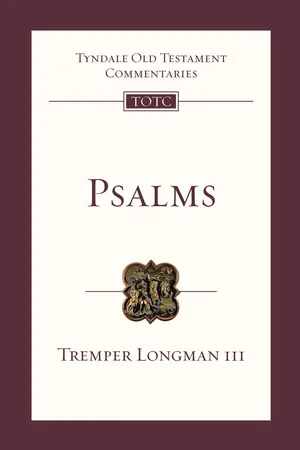
eBook - ePub
Psalms
Information
Topic
Theology & ReligionSubtopic
ChristianityCOMMENTARY BOOK 1: PSALMS 1 – 41
Psalm 1. The way of the righteous
Context
Psalm 1 serves, along with Psalm 2, as the first part of a two-part introduction to the Psalter. Its placement is intentional on the part of the editors responsible for the final form of the book. Its focus is Torah obedience, and it differentiates those who delight in the law and those who are wicked. The reader naturally identifies with one or the other, with the subtle message that those who are wicked should go no further into the literary sanctuary of the Psalms. After all, like the physical sanctuary, the literary sanctuary presumes an intimacy with God that only the righteous can experience. Psalm 1 stands like a Levitical gatekeeper, warning the wicked to proceed no further.10 Brueggemann is correct when he points out that Psalm 1’s initial position demonstrates that ‘the prayers of the Psalter are grounded in and depend upon torah piety and obedience’ (Brueggemann 1995: 63).
The psalm employs the concepts, themes and terminology of wisdom literature and thus is rightly understood as a wisdom poem. Most notably, like the book of Proverbs, it makes a strict delineation between the righteous and the wicked, connecting the former with great blessings and the latter with dire consequences. For more on the significance of Psalm 1 as the introductory psalm of the collection, see Introduction: Organization, p. 35.
The psalm has three stanzas. The first describes the blessings that come on those who are righteous (vv. 1–3), while the second presents the contrasting destiny of the wicked (vv. 4–7). The final stanza provides a summary statement concerning both the righteous and the wicked (v. 6).
Comment
1:1–3. Blessing on the righteous
The psalm opens with a tricolon that pronounces blessing on people who distance themselves from evil. As is typical of parallelism, each colon adds to the thought of the first colon (A, what’s more, B, what’s more, C; see Introduction: Parallelism). The first colon describes one who does not walk in step with the wicked. To walk with someone is to be associated with them, but not as deeply as to stand with them (colon 2) or sit with them (colon 3). Each colon intensifies the relationship with evil and also uses more forceful terms for evil (wicked, sinners, mockers). Mockers are the most egregiously evil people, since they not only sin, but they also turn around and mock the innocent.11
The psalmist pronounces those who avoid such evil associations as blessed. The Hebrew term used by the psalmist (’šr) ‘stesses a state of happiness’ and is not to be treated as a strict synonym for another word often translated ‘blessed’ (brk), which ‘speaks more of being empowered or favored as the recipient of blessing from the Lord’ (NIDOTTE 2: 763). That said, the two words might overlap, in that one who is blessed (brk) may respond by being happy (’šr). In Psalm 1, the one who obeys God’s covenantal law is happy; in Deuteronomy 28, covenant obedience leads to blessing (habbĕrākôt; 28:2).
God created Adam and Eve in a blessed condition (Gen. 1:28), which they forfeited in their rebellion. It is God’s intention to redeem his human creatures and to return them to a condition of blessing (Gen 12:1–3). To understand what it means to be blessed, we can turn to a passage like Deuteronomy 27 – 28, which describes the blessings that will come on an obedient Israel. The assumption is a harmonious relationship between those who are blessed and God that presupposes obedience to God’s commands (see Deut. 28:1–2). The ramification of a healthy restored relationship with God will be good relationships with other human beings as well as with creation itself. In other words, it will be a return to Eden-like conditions.
While verse 1 states the negative requirements for righteousness and its resultant blessing (avoidance of evil), verse 2 gives the positive description. The righteous who are blessed delight...in the law of the LORD. There is some ambiguity as to what is meant by law (torah) here. It could be the Ten Commandments and the 613 laws12 that follow them. It could be the first five books of the Hebrew Bible. It could be the book of Deuteronomy (Block, 2011). Based on Deuteronomy 27 – 28 where blessing is contingent on following the covenant law, it seems best to understand that the reference is to delight in obedience to divine requirements.
Verse 3 then metaphorically depicts the vibrant condition of the person who avoids evil and embraces righteous obedience. They will be like a tree planted by streams of water. To unpack this figure (technically a simile), the picture suggests life, productivity, fruitfulness, health. The final colon (whatever they do prospers) breaks out of the image and states that just as a well-watered tree produces fruit, so will the righteous person. One thinks of Joseph, whose very presence in the household of Potiphar or later in the Egyptian prison caused those places to be fruitful, because God was with him (Gen. 39:2–3, 21–23).
1:4–5. Punishment on the wicked
Verse 4 abruptly turns from the rewards of righteousness to the punishment on the wicked (Not so the wicked!). While the righteous are a well-watered tree, the wicked are like chaff. Chaff is the opposite of a tree. While a tree has an abundance of life-giving water, chaff is dry. The tree is deep-rooted and productive; chaff has no connection to the earth, but rolls as the wind blows it, and is useless.
As a result, the wicked will not survive God’s judgment. It is unclear precisely what is meant by judgment here. In its Old Testament context, it may simply refer to the moment in this life when God brings consequences on people for their wicked actions. After all, the full-blown teaching on the afterlife comes only with clarity in the New Testament.13 However, it may be that Psalm 1 was not only placed in its initial position in the Psalter during the post-exilic period, but was written at that time as well. If so, late Old Testament as well as some Second Temple Jews did have a more sophisticated understanding of the afterlife. The second colon (nor sinners in the assembly of the righteous) does not settle this question, but does make clear that God will not confuse the righteous with the wicked and that each will eventually receive their proper due. It also indicates that the wicked will not stand in the congregation, which is the setting for the use of the Psalms in worship.
1:7–8. The two ways
Wisdom literature recognizes that everyone is walking on a path or way. That way is either the way of wisdom and righteousness that is straight, well lit, smooth and leads to life, or it is crooked and filled with obstacles and leads to death. The positive side of the psalmist’s statement here is similar to the idea of Proverbs 3:5–6:
Trust in Yahweh with all your heart,and don’t depend on your own understanding.In all your paths, know himand he will keep your paths straight.14
The fact that the Lord watches over the righteous means that they will be safe, while the psalmist concludes with the warning that the way of the wicked ends in destruction.
Meaning
Psalm 1 introduces the Psalter by contrasting the righteous and the wicked. The righteous are those who delight in God’s law and thus spend considerable time studying it. The righteous will prosper, while the wicked will perish. Jeremiah 17:5–8 utilizes the same imagery of the flourishing tree to describe the person who trusts in God.
Brueggemann highlights the significance of Psalm 1 as the opening poem when he observes, ‘Standing at the beginning of the Psalter, this psalm intends that all the psalms should be read through the prism of torah obedience’ (Brueggemann 1995: 190). The psalm calls the faithful to obedience.
New Testament readers recognize Jesus as the only righteous person without exception. He follows his Father’s will perfectly, even though ultimately it takes him to the cross.
Psalm 2. The Lord and his anointed
Context
Psalm 2, along with Psalm 1, serves as an introduction to the book of Psalms as a whole. Psalm 1 cites Torah obedience as a prerequisite to entry into the literary sanctuary of the book. Psalm 2 presents the entrant with a powerful depiction of God and his anointed’s strength over against the plotting of the earth’s powerful leaders.
The psalm is obviously a kingship psalm, speaking of the divine King as well as his anointed, the designated human king. In its Old Testament context, Psalm 2 likely functioned as a psalm that accompanied the inauguration of the divinely appointed Davidic heir who occupied the throne in Jerusalem. As part of the ceremony, he was anointed, that is, the priest would pour oil on his head in a ceremony that symbolized his divine authorization and empowerment for his office. While it is true that the majority of Davidic rulers did not live up to the standard that God had set for them (see Deut. 17:14–20), they all would have relished the idea that they ruled with the Lord’s imprimatur and would have encouraged the use of this psalm during their inauguration, no matter how hypocritical it might have been in terms of their own hearts and actions. After all, God promised his beloved servant David, ‘Your house and your kingdom shall endure for ever before me; your throne shall be established for ever’ (2 Sam. 7:16). This Davidic covenant provides the theological background to Psalm 2.
The faithful would probably have seen through the hypocrisy during the monarchical period. But it would have been particularly in the post-exilic period, when the book of Psalms reached its final form, that the eschatological significance of Psalm 2 would have come to the fore. Once the monarchy had ended with Zedekiah and the destruction of Jerusalem and the temple at the hands of the Babylonians in 586 BC, then questions would have arisen in regard to the promise of the Davidic covenant in 2 Samuel 7. The faithful came to believe that there was a deeper meaning to the promise than having a king sitting on the throne in Jerusalem. They began to expect a future Messiah (from the Hebrew word for anointed). The New Testament, of course, recognizes that Jesus is that expected Messiah and affirms that belief every time he is called Christ (the Greek equivalent to Messiah; see also Rom. 1:3–4). For this reason, Psalm 2 is frequently cited in the New Testament (see Meaning for specific citations).
Psalm 2 does not name an author, but the New Testament associates the psalm with David (Acts 4:25), in line with the general tendency during this time to associate more and more psalms with David.
The psalm may be divided into four three-verse stanzas. The first (vv. 1–3) describes the revolt of the kings of the earth. The second (vv. 4–6) describes God’s response to their foolish actions. The third announces God’s decree concerning his appointed king, while the fourth (vv. 10–12) returns attention to the rebellious kings of the earth, by admonishing them to submit and be obedient to the Lord and his chosen king.
Comment
2:1–3. Human rebellion
The psalmist uses three tightly constructed parallel lines15 to describe the rebellion of the peoples of the earth, led by their kings. They direct their rebellion against the LORD and his anointed king (or messiah). A king was anointed with oil, probably by the high priest (2 Kgs 11:12). In their relationship with God and the king, the people view themselves as prisoners or slaves (bound by shackles). They resist their authority and lead the nations of the world in rebellion against this supposed bondage. The opening parallel line already strongly hints at the futility of their actions when it questions the purpose of their evil plotting and in the second colon reveals that it is in vain. Right from the start, we learn that they will not succeed, in spite of all their noisy turmoil.
2:4–6. Divine ridicule
God responds by ridiculing their futile actions. They may be human kings and powerful in their own way, but they are nothing to the divine King who is enthroned in heaven. His ridicule leads to angry rebuke. Interestingly, God’s rebuke takes the form of announcing the installation of the human king on the throne in Jerusalem. As mentioned in the Introduction, this psalm almost certainly was used during the monarchical period as a song that accompanied the installation ceremony of the son of David who assumed the throne after the death of his father. Perhaps Zion is mentioned because it was the actual physical location of the ceremony. The psalm asserts that the mere existence of this Davidic king would bring terror to the raving human kings of the nations and thus reassert order.
2:7–9. You are my son
The third stanza develops God’s relationship with his appointed human king who rules from Zion. Verse 7a assumes that the psalm’s composer is none other than the king himself, who announces that he will pronounce the decree which God addressed to him. Although the psalm does not have a title, as we saw in the Introduction, by the time of the New Testament it was attributed to David, probably on the logic of this verse.
The decree begins with an allusion to 2 Samuel 7:14, the heart of the Davidic covenant, wherein God announces a special relationship with David and his descendants. He there establishes the Davidic dynasty and a special relationship between himself and the king as a father to a son. In 2 Samuel 7, that father-son relationship is described as one that would punish infractions of the father’s rules (2 Sam. 7:14b), but also refers to the fact that he would never remove his kingly son’s special relationship (2 Sam. 7:15).
A father grants the requests of his son, and here God invites his kingly son to ask him for dominance over the nations of the world. God signifies that he would bring the nations into submission through the agency of his warrior king.
2:10–12. Kiss his son
The fourth stanza again focuses on the kings of the earth. From heaven, God warns them to serve him and to submit to his divinely appointed human king. Not only should Israel and its rulers pay homage to the Lord, but all the kings of the earth should do so. The claim of the psalmist is that the Lord is not a mere local deity, but the God of the whole earth. They should approach God with fear, the attitude that the wisdom literature urges on all of God’s people (see especially Prov. 1:7). Fear implies that God is the centre of all existence and power, and that human beings, even kings who are powerful on a human level, are not. Rather, they are dependent on God for everything.
God rules all (v. 11), but he has also established his human representa...
Table of contents
- Tyndale Old Testament Commentaries
- Psalms
- CONTENTS
- GENERAL PREFACE
- AUTHOR’S PREFACE
- CHIEF ABBREVIATIONS
- SELECT BIBLIOGRAPHY
- Introduction
- COMMENTARY BOOK 1: PSALMS 1 – 41
- BOOK 2: PSALMS 42 – 72
- BOOK 3: PSALMS 73 – 89
- BOOK 4: PSALMS 90 – 106
- BOOK 5: PSALMS 107 – 150
Trusted by 375,005 students
Access to over 1.5 million titles for a fair monthly price.
Study more efficiently using our study tools.
Frequently asked questions
Yes, you can cancel anytime from the Subscription tab in your account settings on the Perlego website. Your subscription will stay active until the end of your current billing period. Learn how to cancel your subscription
No, books cannot be downloaded as external files, such as PDFs, for use outside of Perlego. However, you can download books within the Perlego app for offline reading on mobile or tablet. Learn how to download books offline
Perlego offers two plans: Essential and Complete
- Essential is ideal for learners and professionals who enjoy exploring a wide range of subjects. Access the Essential Library with 800,000+ trusted titles and best-sellers across business, personal growth, and the humanities. Includes unlimited reading time and Standard Read Aloud voice.
- Complete: Perfect for advanced learners and researchers needing full, unrestricted access. Unlock 1.5M+ books across hundreds of subjects, including academic and specialized titles. The Complete Plan also includes advanced features like Premium Read Aloud and Research Assistant.
We are an online textbook subscription service, where you can get access to an entire online library for less than the price of a single book per month. With over 1.5 million books across 990+ topics, we’ve got you covered! Learn about our mission
Look out for the read-aloud symbol on your next book to see if you can listen to it. The read-aloud tool reads text aloud for you, highlighting the text as it is being read. You can pause it, speed it up and slow it down. Learn more about Read Aloud
Yes! You can use the Perlego app on both iOS and Android devices to read anytime, anywhere — even offline. Perfect for commutes or when you’re on the go.
Please note we cannot support devices running on iOS 13 and Android 7 or earlier. Learn more about using the app
Please note we cannot support devices running on iOS 13 and Android 7 or earlier. Learn more about using the app
Yes, you can access Psalms by Tremper Longman in PDF and/or ePUB format, as well as other popular books in Theology & Religion & Christianity. We have over 1.5 million books available in our catalogue for you to explore.