- 575 pages
- English
- ePUB (mobile friendly)
- Available on iOS & Android
eBook - ePub
About this book
The Handbook is composed of two parts, the first volume covering supplements for human usewhile the second volume is devoted to agriculture supplements. This volume, relating to food supplements for human use, is organized on the basis of raw materials utilized in their production, as well as on the basis of target groups for which they are intended.
Tools to learn more effectively

Saving Books

Keyword Search

Annotating Text

Listen to it instead
Information
Nutritional Sources
Oilseed and Nut Proteins
M. Swaminathan
Introduction
Protein deficiency, particularly in the diets of young children and other vulnerable groups, is one of the major nutritional problems facing the developing countries. The nature and magnitude of the “protein gap” has been discussed by the Food and Agricultural Organization (FAO) and other United Nations (UN) Agencies.1 The most promising additional protein sources remain to be used for human consumption are the edible oilseeds, nuts, and their meals.2,3 Nuts and oilseeds provide about 5 to 15 g of additional proteins per capita in many developing countries, where milk production and consumption are low (less than 150 g/capita/day) and milk provides less than 5 g protein per day per head.4 A considerable amount of work has been carried out during recent years on the utilization of edible nuts and oilseeds and their meals in the preparation of supplementary foods for infants and children.5,6 This chapter gives a summary of the available data on the chemical composition and nutritive value and the proteins of nuts and oilseeds and results of studies on the processed supplementary foods based on them.
Production
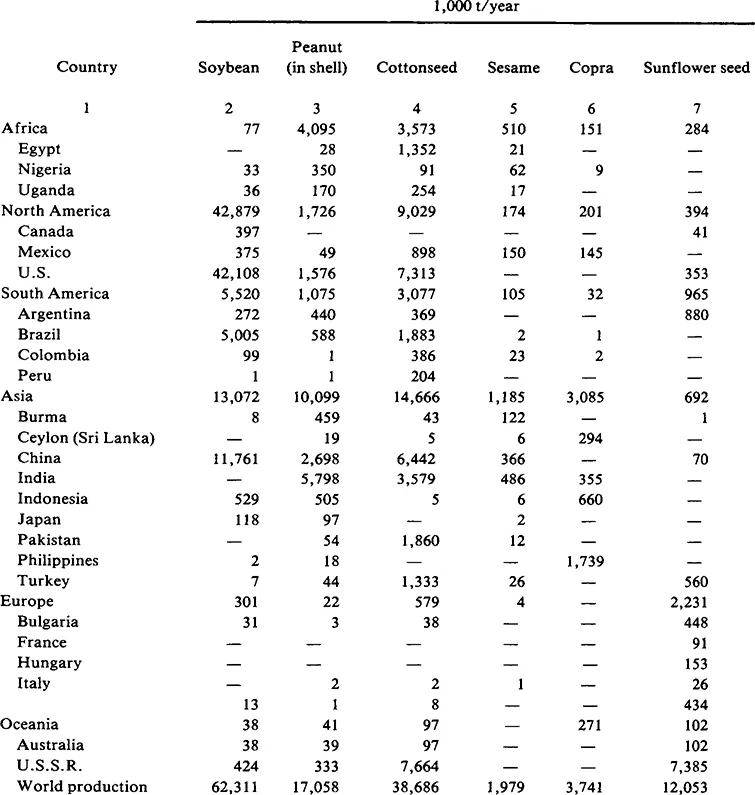
Data7 regarding the production of certain oilseeds and nuts in some countries are given in Table 1. Only about 10 to 20% of the production is consumed as such in human diets, and the major portion is used for the extraction of oil. The residual oilseed meals which are rich sources of proteins, are at present, used mainly as a concentrate for cattle, swine, and poultry.
Soybeans — The present annual world production is over 62 million tons. Appreciable amounts are grown in some developing countries, viz., Brazil and Indonesia; the U.S. is the largest producer.
Peanuts — The present annual world production (peanut in shell) is over 17 million tons. Large amounts are grown in several developing countries, viz., India, Argentina, Brazil, Indonesia, and Nigeria, India being the largest producer.
Cottonseed — The present annual world production is over 38 million tons. Large quantities are grown in several developing countries, viz., Brazil, Burma, Mexico, India, Pakistan, U.A.R., and Sudan. The U.S. is the largest producer.
Sesame seed — The present annual world production is over 1.9 million tons. Appreciable quantities of sesame seed are being produced in some developing countries, viz., Mexico, India, Burma, and Sudan.
Copra — The present annual world production of copra is about 3.7 million tons. Copra is produced in large quantities in some developing countries, viz., Ceylon, India, Indonesia, the Philippines, and Mexico. The Philippines is the largest producer.
Sunflower seed — Annual world production exceeds 12 million tons. It is grown in appreciable quantities in some developing countries, viz., Argentina and Turkey. The U.S.S.R. is the largest producer.
The Chemical Composition and Nutritive Value of the Proteins of Certain Oilseeds and Nuts
The available data regarding the chemical composition and nutritive value of the proteins of certain oilseeds and nuts are summarized according to chemical composition and amino acid composition and nutritive value of the proteins.
Table 1
PRODUCTION OF MAJOR OILSEEDS AND NUTS IN SOME COUNTRIES7
PRODUCTION OF MAJOR OILSEEDS AND NUTS IN SOME COUNTRIES7
Chemical Composition
Proteins — Data given in Table 2 show that protein contents of different oilseeds and nuts are as follows: soybean 34.1%; peanut, 26.3%; sunflower seed, 24.0%; sesame seed, 18.6%; almond, 18.6%; cashewnut, 17.2%; and coconut (dried), 7.2%. It is evident that coconut is a poor source of protein.
Fat — The fat content of soybean is about 17.7% and that of other oilseeds range from 35 to 54%. Sunflower seed, soybean, safflower, and sesame seed oils are rich sources and peanut and almond oils are moderate sources, while cashewnut and coconut oils are poor sources (Table 3) of polyunsaturated fatty acids (linoleic, linolenic, and arachidonic acids).
Carbohydrates — Oilseeds and nuts contain varying amounts of starch, sugars, and unavailable carbohydrates such as cellulose, hemicelluloses, galactans, pentosans, etc.
Table 2
THE CHEMICAL COMPOSITION OF CERTAIN OILSEEDS AND NUTS8
THE CHEMICAL COMPOSITION OF CERTAIN OILSEEDS AND NUTS8

Table 3
THE POLYUNSATURATED AND SATURATED FATTY ACID CONTENTS AND THE P/S RATIO OF CERTAIN COMMON OILSEED AND NUT FATS9
THE POLYUNSATURATED AND SATURATED FATTY ACID CONTENTS AND THE P/S RATIO OF CERTAIN COMMON OILSEED AND NUT FATS9
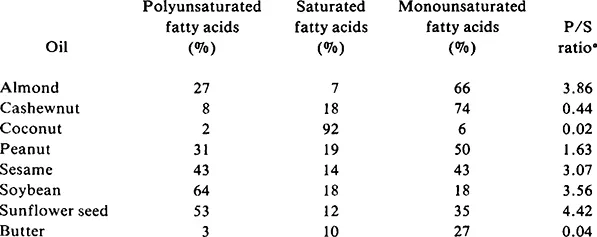
a Ratio between polyunsaturated fatty acids and saturated fatty acids.
Table 4
ESSENTIAL AMINO ACID CONTENTS OF THE PROTEINS OF CERTAIN OILSEEDS AND NUTS COMPARED WITH MILK PROTEINS10
ESSENTIAL AMINO ACID CONTENTS OF THE PROTEINS OF CERTAIN OILSEEDS AND NUTS COMPARED WITH MILK PROTEINS10
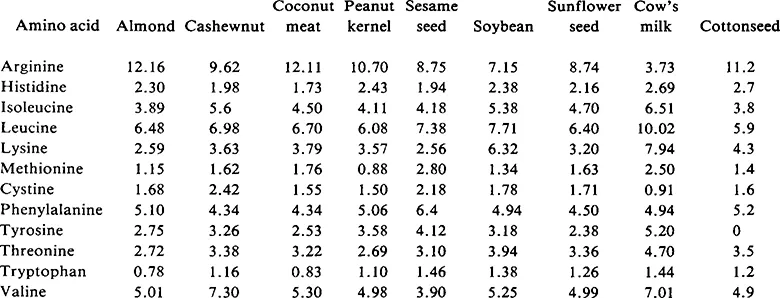
Note: Expressed in g/16 g N.
Minerals — Oilseeds and nuts are, in general, good sources of all minerals except calcium and sodium. Phosphorus is present in them mainly as phytates. As compared with whole milk powder, they are deficient in calcium. Hence, supplementary foods based on oilseeds and nuts will have to be fortified adequately with calcium salts.
Vitamins — Data given in Table 2 show that, as compared with whole milk powder, oilseeds and nuts are good sources of all B-group vitamins, except riboflavin and folic acid. They do not contain vitamins A, D, C, and B12. Hence, supplementary foods based on oilseeds and nuts will have to be fortified with these vitamins.
Essential Amino Acid Composition and Nutritive Value of Proteins
Data regarding the essential amino acid composition of the proteins of certain oilseeds and nuts as compared with milk proteins are given in Table 4. Soy proteins are good sources of all essential amino acids except methionine. Peanut, safflower seed, and almond proteins are deficient in lysine, methionine, and threonine, while sesame and sunflower seed proteins are deficient in lysine. Cashew proteins are good sources of all essential amino acids, while coconut proteins are slightly deficient in lysine and methionine.10 The protein efficiency ratios of nuts and oilseeds range from 1.5 to 2.3, depending on the material (Table 5).
Table 5
EFFECT OF SUPPLEMENTATION WITH LIMITING AMINO ACIDS ON THE NUTRITIVE VALUE OF OILSEED PROTEIN
EFFECT OF SUPPLEMENTATION WITH LIMITING AMINO ACIDS ON THE NUTRITIVE VALUE OF OILSEED PROTEIN
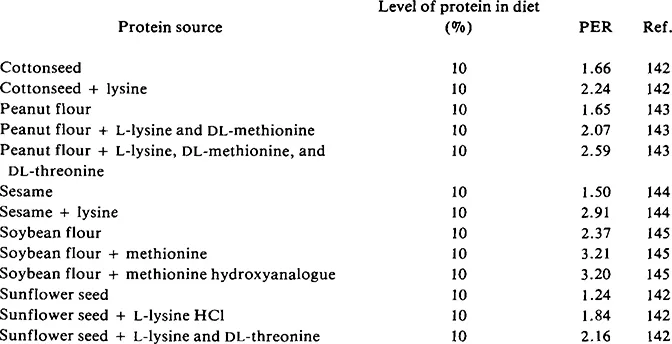
Amino Acid Supplementation of the Proteins of Oilseeds and Nuts
Supplementation with methionine increases markedly the protein efficiency ratio (PER) of both raw and processed soybean. The PER of methionine-fortified processed soybean is nearly equal to that of milk proteins. Highly significant increases in the PER of sesame proteins as a result of fortification with lysine have been reported.12 Fortification of cottonseed meal with lysine increased the PER to a significant extent. Supplementation of peanut proteins with lysine, methionine and threonine increased the PER to a marked extent.11,12
Deleterious Constituents Present in Oilseeds and Legumes
Several deleterious constituents (Table 6) have been reported to occur in some oilseeds and these can be removed by suitable processing. Trypsin inhibitors and hemagglutinins are present in soybean and retard growth in rats. These can be inactivated by optimal heat treatment.13 A heat-labile goitrogenic factor has been reported to be present in soybean. The goitrogenic factor of peanut is present in the red skin.13 The pigment gossypol present in cottonseed has been found to retard the growth of rats and chicks. It is, however, not toxic to ruminants. Gossypol is inactivated when cottonseed flour is subjected to optimal heat treatment.13 The toxic factor aflatoxin is produced by a fungus Aspergillus flavus growing mostly on peanut and occasionally on other oilseeds. Sreenivasa Murthy et al.14 have developed a process for eliminating this toxin.
Selenium has been found to occur in sesame seeds grown on seleniferous soils in some countries. If selenium is present at a level higher than 300 ppb, it is toxic to mammals. No simple process for the elimination of selenium from sesame is known. A maximum level of 300 μg/kg (300 ppb) has been suggested as the safe limit in the Latin American Food Code.15
Table 6
DELETERIOUS CONSTITUENTS IN SOME OIL SEEDS AND NUTS
DELETERIOUS CONSTITUENTS IN SOME OIL SEEDS AND NUTS
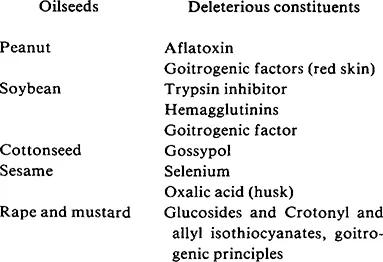
Oxalic acid is present in the form of calcium oxalate in the husk of sesame seeds. This can be eliminated by dehusking, and the dehusked sesame seed is almost free of oxalic acid.
Effect of Processing on the Nutritive Value
Heat processing produces both beneficial and deleterious effects on the nutritive value of proteins, ...
Table of contents
- Cover
- Series Page
- Title Page
- Copyright Page
- Preface Crc Series in Nutrition and Food
- Preface Handbook of Nutritional Supplements
- The Editor
- Advisory Board Members
- Contributors
- Table of Contents
- Nutritional Sources
- Foods for Special Uses
- Enriched and Fortified Foods
- Index
Frequently asked questions
Yes, you can cancel anytime from the Subscription tab in your account settings on the Perlego website. Your subscription will stay active until the end of your current billing period. Learn how to cancel your subscription
No, books cannot be downloaded as external files, such as PDFs, for use outside of Perlego. However, you can download books within the Perlego app for offline reading on mobile or tablet. Learn how to download books offline
Perlego offers two plans: Essential and Complete
- Essential is ideal for learners and professionals who enjoy exploring a wide range of subjects. Access the Essential Library with 800,000+ trusted titles and best-sellers across business, personal growth, and the humanities. Includes unlimited reading time and Standard Read Aloud voice.
- Complete: Perfect for advanced learners and researchers needing full, unrestricted access. Unlock 1.4M+ books across hundreds of subjects, including academic and specialized titles. The Complete Plan also includes advanced features like Premium Read Aloud and Research Assistant.
We are an online textbook subscription service, where you can get access to an entire online library for less than the price of a single book per month. With over 1 million books across 990+ topics, we’ve got you covered! Learn about our mission
Look out for the read-aloud symbol on your next book to see if you can listen to it. The read-aloud tool reads text aloud for you, highlighting the text as it is being read. You can pause it, speed it up and slow it down. Learn more about Read Aloud
Yes! You can use the Perlego app on both iOS and Android devices to read anytime, anywhere — even offline. Perfect for commutes or when you’re on the go.
Please note we cannot support devices running on iOS 13 and Android 7 or earlier. Learn more about using the app
Please note we cannot support devices running on iOS 13 and Android 7 or earlier. Learn more about using the app
Yes, you can access Handbook of Nutritional Supplements by Miloslav Rechcigl in PDF and/or ePUB format, as well as other popular books in Medicine & Nutrition, Dietics & Bariatrics. We have over one million books available in our catalogue for you to explore.