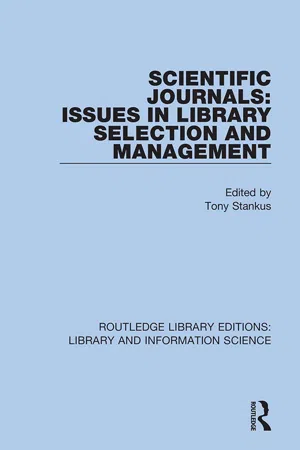
This book, first published in 1987, brings together from a variety of sources analysis on the major issues involved in the collection of scientific journals. Working from the premise that scientists tend to know much more about their subject than about their journals, it examines the rationale for journal choices, journals and tenure, journals and budgeting, and the elements of a good journal. It shows librarians how to penetrate the internal structure of some imposing technical literatures in a way that can help them make responsible collection management decisions that even their science clientele will respect.
- 228 pages
- English
- ePUB (mobile friendly)
- Available on iOS & Android
eBook - ePub
Scientific Journals: Issues in Library Selection and Management
About this book
Information
THEME THREE
What Journals Tell Us About the Fields They Cover
As a practical matter I know very little biochemistry, anatomy or mathematics, yet I am able to put together without too much difficulty some comments on the journals of these disciplines. I have learned to ask questions of both faculty scientists and the journals themselves, and surprisingly enough, answers are forthcoming. The technique comes from Garfield. He asked questions and got answers in the form of citation data. I get a few more from abstracts, indexing codes and author’s affiliations, most of which can be interpreted with a little help from others and from histories of the disciplines.
Collection Development: Journals for Biochemists
ABSTRACT. The types of serials of interest to biochemists are reviewed, as are the schools of science journal collection development. Results of pilot studies are presented: where American biochemists publish; authorship of articles in selected journals; publication patterns of authors in for-profit firms and in small liberal art colleges; journals most frequently cited in widely used biochemistry texts. A list of journals discussed is included.
INTRODUCTION
In addition to the intellectual curiosity involved, the study of serial collection development for biochemists worthwhile because of the cost and complexity of the materials involved. The decision to add or cancel a single subscription may involve several hundred dollars and comparison of numerous titles. To compound the problem, publication in biochemistry is growing at a rapid rate. Garfield (1979) reports three journals which published more than a thousand papers in 1977 (one of them exceeded two thousand papers) and estimates the total production of papers in that year as 20–25,000. Virtually every library with a substantive collection in the life sciences will have biochemistry serials and should have a policy for their selection.
HISTORICAL BACKGROUND
The development of the serial literature in biochemistry has been discussed by Sengupta (1973). Between the late 1800s and the First World War, the French, Germans, Americans, and British established scientific societies devoted to better understanding the relationship between chemistry and living organisms, these national societies sponsored journals to publish in their native languages the results of specifically biochemical work. These include, respectively, Biochimie, Hoppe-Seylers Zeitschrift fuer Physiologische Chemie, the Journal of Biological Chemistry, and the Biochemical Journal. These journals gave increased visibility and respectability to the field and, gradually at first, drew biochemically oriented manuscripts away from the neighboring disciplines of general and organic chemistry, microbiology, and physiology. After the Second World War, the science publishing world exploded with many new biochemistry journals, some no longer directly sponsored by a scientific society and most dominated by English-language articles. Some of the more alert journals of neighboring disciplines sought to hold on to their biochemically concerned readers and have increasingly featured papers using biochemical methods. This time of rising status for biochemistry also saw increased acceptance of biochemistry papers in the prestigious multiscience journals. As a consequence of these trends, Sengupta too sees more and more biochemistry papers in more and more kinds of journals, although he sees the more specifically biochemical journals as most important.
Types of Serials for Biochemists
Serials for biochemists may be classified in at least two ways: (1) by the function and/or length of the papers ordinarily published and (2) by the subject orientation of the papers ordinarily published.
In the function/length category, several subclasses of journals are found.
- A journal that publishes primarily the result of original research in longer articles with structural elements such as abstracts, introductions, experimental details, results, and discussions may be referred to as a FULL-LENGTH ORIGINAL REPORTS JOURNAL. Examples include the Journal of Biological Chemistry and Biochemistry. Publishing in one of these journals is prestigious, in part because of the very rigorous examination of a given paper’s worth by a somewhat lengthier refereeing process.
- The delay between submission and appearance of articles in Full- Length Original Reports Journals (due to the lengthier refereeing procedures and the large numbers of papers, chronically backlogged) and the fact that not all studies lend themselves to this format have led to the development of the RAPID, PRELIMINARY COMMUNICATIONS (or “LETTERS”) JOURNAL. The studies reported in these journals are in the form of shorter papers, often reporting preliminary results. Newsworthiness is stressed; the format is not as structured. Referees are instructed to quickly assess submitted papers and to make reasonable allowance for very new or speculative interpretation in the interests of rapid dissemination. Biochemical and Biophysical Research Communications is an example of all of these characteristics, while FEBS Letters stresses a more conclusive finding equally with brevity and speed of processing.
- The desire for speed and priority of announcement, especially of reports presented at meetings, has resulted in appearance of the MEETING ABSTRACTS JOURNAL or the MEETING ABSTRACTS SPECIAL ISSUES (of either a full-length or rapid preliminary communications journal). In these journals, presenters scheduled for meetings publish paragraph-sized summaries of their presentations. The journals usually appear in print well before the conference. Examples of these journals are found in the special issues of the Biophysical Journal and the Journal of Supramolecular Structure.
- Biochemists have felt a necessity to grasp the central themes and generalizing theories of their profession. They have recognized that one is in danger of seeing only the thousands of trees (full- length articles; rapid, preliminary communications; meetings abstracts) and failing to comprehend the totality of the forest. For this reason, the REVIEW SERIAL was born. In Review Serials, authors present long essays which summarize and classify the main channels of work in a given specialty by discussing a great many papers written over a given time span. The physical appearance of the type of review serial defined here is usually hardbound, and issuance is often irregular A well-known hardbound series is the Annual Review of Biochemistry; a familiar softbound is the CRC Critical Reviews in Biochemistry.
In the subject-orientation category, six subclasses are also present, divided into two classes of specialty journals in biochemistry and four classes of more general journals or...
Table of contents
- Cover
- Half Title
- Title Page
- Copyright Page
- Original Title Page
- Original Copyright Page
- Dedication
- Contents
- Acknowledgements
- Introduction
- Theme One
- Theme Two
- Theme Three
- Theme Four
- Index
Trusted by 375,005 students
Access to over 1.5 million titles for a fair monthly price.
Study more efficiently using our study tools.
Frequently asked questions
Yes, you can cancel anytime from the Subscription tab in your account settings on the Perlego website. Your subscription will stay active until the end of your current billing period. Learn how to cancel your subscription
No, books cannot be downloaded as external files, such as PDFs, for use outside of Perlego. However, you can download books within the Perlego app for offline reading on mobile or tablet. Learn how to download books offline
Perlego offers two plans: Essential and Complete
- Essential is ideal for learners and professionals who enjoy exploring a wide range of subjects. Access the Essential Library with 800,000+ trusted titles and best-sellers across business, personal growth, and the humanities. Includes unlimited reading time and Standard Read Aloud voice.
- Complete: Perfect for advanced learners and researchers needing full, unrestricted access. Unlock 1.5M+ books across hundreds of subjects, including academic and specialized titles. The Complete Plan also includes advanced features like Premium Read Aloud and Research Assistant.
We are an online textbook subscription service, where you can get access to an entire online library for less than the price of a single book per month. With over 1.5 million books across 990+ topics, we’ve got you covered! Learn about our mission
Look out for the read-aloud symbol on your next book to see if you can listen to it. The read-aloud tool reads text aloud for you, highlighting the text as it is being read. You can pause it, speed it up and slow it down. Learn more about Read Aloud
Yes! You can use the Perlego app on both iOS and Android devices to read anytime, anywhere — even offline. Perfect for commutes or when you’re on the go.
Please note we cannot support devices running on iOS 13 and Android 7 or earlier. Learn more about using the app
Please note we cannot support devices running on iOS 13 and Android 7 or earlier. Learn more about using the app
Yes, you can access Scientific Journals: Issues in Library Selection and Management by Tony Stankus in PDF and/or ePUB format, as well as other popular books in Languages & Linguistics & Library & Information Science. We have over 1.5 million books available in our catalogue for you to explore.