eBook - ePub
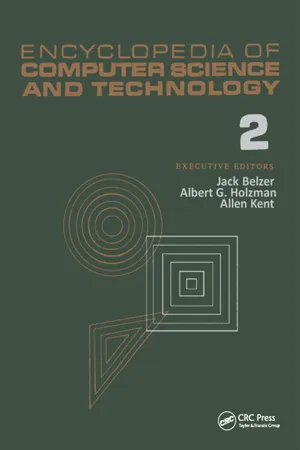
Encyclopedia of Computer Science and Technology
Volume 2 - AN/FSQ-7 Computer to Bivalent Programming by Implicit Enumeration
- 494 pages
- English
- ePUB (mobile friendly)
- Available on iOS & Android
eBook - ePub
Encyclopedia of Computer Science and Technology
Volume 2 - AN/FSQ-7 Computer to Bivalent Programming by Implicit Enumeration
About this book
"This comprehensive reference work provides immediate, fingertip access to state-of-the-art technology in nearly 700 self-contained articles written by over 900 international authorities. Each article in the Encyclopedia features current developments and trends in computers, software, vendors, and applications...extensive bibliographies of leading figures in the field, such as Samuel Alexander, John von Neumann, and Norbert Wiener...and in-depth analysis of future directions."
Information
APL TERMINAL SYSTEM
OVERVIEW OF THE APL SYSTEM
One of the most popular concepts in the short history of computer and information technology is the APL terminal system—commonly referred to as APL and frequently pronounced “apple.” APL, which is an acronym based on the title of the book, A Programming Language, authored by the distinguished computer scientist K. E. Iverson, combines two advanced technological concepts: (1) an advanced programming language, and (2) the time-sharing mode of system operation. Time sharing is useful without the APL language and the APL language would be useful without time sharing. In combination, however, the two concepts provide the user with an extremely powerful computational facility. The APL system combines the simplicity of a desk calculator with the power of an automatic computer. APL is most useful for computer applications, large or small, to which a relatively fast response from the computer is needed.
APL and Time Sharing
APL combines a recent technique called time sharing with Iverson’s programming language to provide an interactive system that is appropriate for large and small problems and convenient for human use. Time sharing is a technique that allows several users at remote locations to concurrently use a computer via communications facilities. The system is accessed with a keyboard-type remote terminal device that is used for both input and output. The user types the information he wants sent to the computer and the computer responds, normally within seconds, with appropriate results. The discourse between the user and the computer is termed “interactive computing.”
Clearly, the computer can only execute one program at a time. Thus, to provide the above service concurrently to several users, the computer is programmed to operate in a time-sharing mode. When time sharing, the central computer gives each user a short b...
Table of contents
- Cover
- Half Title
- Title Page
- Copyright Page
- Table of Contents
- Contributors to Volume 2
- AN/FSQ-7 Computer
- Analog-Digital Conversion
- Analog Signals and Analog Data Processing
- Analysis of Variance
- And-or-Not-Nand-Nor Logic
- APL Terminal System
- Approximation Methods
- Argonne National Laboratory
- Arithmetic Operations
- ARPA Network
- Arrays
- Artificial Intelligence
- Artificial Languages
- ASCII Code
- Association for Computing Machinery (ACM)
- Associative Memories and Processors: A Description and Appraisal
- Astronomy
- Atomic Energy Commission (Energy Research and Development Administration)
- Audition
- Auerbach Corporations
- Autocorrelation
- Automata Theory
- Automatic Indexing: Progress and Prospects
- Automatically Programmed Tools—Numerically Controlled Machine Tools
- Automation
- Babbage, Charles
- Bivalent Programming by Implicit Enumeration
Trusted by 375,005 students
Access to over 1.5 million titles for a fair monthly price.
Study more efficiently using our study tools.
Frequently asked questions
Yes, you can cancel anytime from the Subscription tab in your account settings on the Perlego website. Your subscription will stay active until the end of your current billing period. Learn how to cancel your subscription
No, books cannot be downloaded as external files, such as PDFs, for use outside of Perlego. However, you can download books within the Perlego app for offline reading on mobile or tablet. Learn how to download books offline
Perlego offers two plans: Essential and Complete
- Essential is ideal for learners and professionals who enjoy exploring a wide range of subjects. Access the Essential Library with 800,000+ trusted titles and best-sellers across business, personal growth, and the humanities. Includes unlimited reading time and Standard Read Aloud voice.
- Complete: Perfect for advanced learners and researchers needing full, unrestricted access. Unlock 1.5M+ books across hundreds of subjects, including academic and specialized titles. The Complete Plan also includes advanced features like Premium Read Aloud and Research Assistant.
We are an online textbook subscription service, where you can get access to an entire online library for less than the price of a single book per month. With over 1.5 million books across 990+ topics, we’ve got you covered! Learn about our mission
Look out for the read-aloud symbol on your next book to see if you can listen to it. The read-aloud tool reads text aloud for you, highlighting the text as it is being read. You can pause it, speed it up and slow it down. Learn more about Read Aloud
Yes! You can use the Perlego app on both iOS and Android devices to read anytime, anywhere — even offline. Perfect for commutes or when you’re on the go.
Please note we cannot support devices running on iOS 13 and Android 7 or earlier. Learn more about using the app
Please note we cannot support devices running on iOS 13 and Android 7 or earlier. Learn more about using the app
Yes, you can access Encyclopedia of Computer Science and Technology by Jack Belzer in PDF and/or ePUB format, as well as other popular books in Computer Science & Computer Science General. We have over 1.5 million books available in our catalogue for you to explore.