eBook - ePub
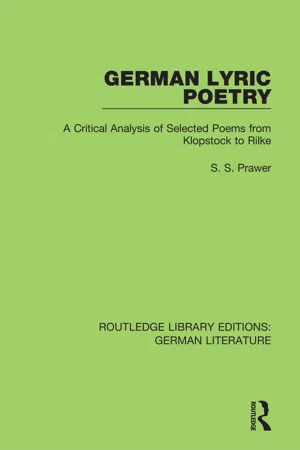
German Lyric Poetry
A Critical Analysis of Selected Poems from Klopstock to Rilke
- 272 pages
- English
- ePUB (mobile friendly)
- Available on iOS & Android
eBook - ePub
German Lyric Poetry
A Critical Analysis of Selected Poems from Klopstock to Rilke
About this book
Originally published in 1952, this book provides a detailed critical analysis of 40 German lyrics. All the poems analysed are reprinted in full, so that criticism may be checked by reference to the original text. The book therefore provides a unique introduction to German poetry from the Age of Enlightenment to that of Rilke, without burdening the reader with too much details about minor figures.
Tools to learn more effectively

Saving Books

Keyword Search

Annotating Text

Listen to it instead
Information
CHAPTER ONE
Approaching the German Lyric
‘No, it is impossible’, says Marlow in Conrad’s Heart of Darkness; ‘it is impossible to convey the life-sensation of any given epoch of one’s existence—that which makes its truth, its meaning —its subtle and penetrating essence. It is impossible. We live as we dream—alone.’ But it is just this ‘impossible’ which the lyric poet in our period at least sets out to accomplish. He does not seek to tell a story, or present conflict of character and opinion: he seeks, within short compass, to annihilate the distance between himself and his reader, to make the reader experience directly the poet’s ‘life-sensation at a given period of his existence—that which makes its truth, its meaning’.
‘The miracle of lyric poetry is this: that individuality, in its essence as individuality, has become experience generally accessible.’1
The poet may express his ‘life-sensation’, his experience, directly, may speak in the first person of his thoughts and aspirations and fears, as does Novalis, for instance, in Sehnsucht nach dem Tode (see Chapter Seven, below); or he may express himself through symbols, through objective correlatives, as do—in different ways —Matthias Claudius in Der Tod und das Mädchen, Mörike in Um Mitternacht, and Platen in the Venedig sonnets.
But whether direct or metaphorical, the lyrical poem makes some of its most important effects through its rhythms: through the tension between metrical and syntactical stress. As we read a lyric, we become aware of a pattern, of the metre (however free) in which the work is written. Certain stresses recur at certain intervals; certain breaks (the end of lines, of stanzas) become noticeable at more or less equal distance from one another; certain sounds (especially end-rhymes) are heard more than once. All this imposes a pattern: and this pattern is significantly varied when natural speech-rhythms conflict or coincide with the hypothetical ‘regula’ metre. Through such tensions as these, through pauses and stresses, the poet is able to convert his experience into generally accessible physical sensation.
1 Das Wunder lyrischei Dichtung besteht... darin, dass Individualität in ihrer Individualität allgemein erlebbar geworden ist. (Joh. Pfeiffer, Das lyrische Gedicht als ästhetisches Gebilde, Halle, 1931.)
A simple example—perhaps excessively simple, for the poem is certainly not a great one—of such tension, such significant variation, is furnished by one of the best known of Heine’s ‘Lieder’:
IM WUNDERSCHÖNEN MONAT MAIIm wunderschönen Monat Mai,Als alle Knospen sprangen,Da ist in meinem HerzenDie Liebe aufgegangen.
Im wunderschönen Monat Mai,Als alle Vögel sangen,Da hab’ ich ihr gestandenMein Sehnen und Verlangen.
Heine here confronts us with four statements. Buds open up—like them, love blossoms in the poet’s heart. Birds (begin to) sing —like them, the poet confesses his love. There is obviously progression in this poem (everything leads up to the last, crowning line, the actual confession of a love we have seen blossoming out) : but the four elements of comparison have one common factor. Each one denotes something which, hitherto hidden, now bursts forth.
And now we may set ourselves to notice how Heine, by playing natural speech-rhythms across the regular pattern of his stanza, makes his words do what they say.
At first the movement of the stanza (and the second repeats exactly the first) is comparatively slow and endstopped.

We notice at the same time that the grammatical construction does not allow us to let our voice sink at the end of the second line1: and this combines with the hesitant movement to induce in the reader a feeling of expectancy. Something has yet to come before our voice may come to rest.
The pattern established by the first two lines of each stanza is broken in two significant respects in the last two. Line 3 begins in each case with a heavy stress; and lines 3 and 4 run on, enjambed:

At the word ‘Da’ we feel the expectancy to be over: what we have been waiting for has come, bringing with it a great sense of release. ‘Da’, there it is, the heavy stress at the beginning of the line seems to tell us. And with this release, all hesitancy of movement disappears. The last lines flow unimpeded one into the other.
First expectancy, then fulfilment. Something which has been hidden, bursts forth. The poem does, through its movements through significant variation of a regular pattern, what a prose-summary of it would only say.2
But metre, metrical variation, must not operate in a vacuum. As far as metre acts in and for itself, Coleridge tells us, it tends to ‘increase the vivacity and susceptibility both of the general feelings and of the attention’; it acts powerfully, though itself unnoticed, ‘as a medicated atmosphere, or as wine during animated conversation’:
‘Where therefore correspondent food and appropriate matter are not provided for the attention and feelings thus aroused, there must needs be disappointment felt, like that of leaping in the dark from the last step of a staircase, when we had prepared our muscles for a leap of three or four.’
1 To realize the force of this, we need only imagine Heine to have written:
Im wunderschönen Monat MaiAlle Knospen sprangen.
2 An analysis of this poem makes the desired point well enough: but it must be pointed out that the sudden ‘Da’, the onrush of the last two lines after the hesitancy of the first two, misrepresents the rhythm of the natural phenomenon invoked: the coming of spring. Heine is (as so often) forcing the rhythms of his own experience onto nature.
Metre, like any technical device in poetry, is only an empty shell if the artist has nothing to communicate. Poetic devices are only means to an end.
To see how a great poet uses his medium to communicate an experience, we need only glance at the lyric with which Eduard Mörike ends his Novelle Mozart auf der Reise nach Prag.
Ein Tännlein grünet wo,Wer weiss, im Walde,Ein Rosenstrauch, wer sagt,In welchem Garten?Sie sind erlesen schon,Denk es, o Seele,Auf deinem Grab zu wurzelnUnd zu wachsen.
Zwei schwarze Rösslein weidenAuf der Wiese,Sie kehren heim zur StadtIn muntern Sprüngen.Sie werden schrittweis gehnMit deiner Leiche;Vielleicht, vielleicht noch ehAn ihren HufenDas Eisen los wird,Das ich blitzen sehe.
The poem begins with slow, groping lines, made all the more portentous by t...
Table of contents
- Cover
- Half Title
- Title Page
- Copyright Page
- Original Title Page
- Original Copyright Page
- Dedication
- Epigraph
- Acknowledgements
- INTRODUCTION
- 1. APPROACHING THE GERMAN LYRIC
- 2. THE LYRIC POETRY OF THE AUFKLÄRUNG
- 3. KLOPSTOCK AND THE ‘GÖTTINGER HAIN’
- 4. GOETHE
- 5. SCHILLER
- 6. HÖLDERLIN
- 7. THE ROMANTICS
- 8. HEINE AND PLATEN
- 9. POETIC REALISM
- 10. MUNICH INTERLUDE AND NATURALIST REACTION
- 11. CHAOS AND CONTROL
- 12. RILKE
- CONCLUSION
- BIOGRAPHICAL NOTES
- SELECT BIBLIOGRAPHY
- GENERAL INDEX
- INDEX FIRST LINES
Frequently asked questions
Yes, you can cancel anytime from the Subscription tab in your account settings on the Perlego website. Your subscription will stay active until the end of your current billing period. Learn how to cancel your subscription
No, books cannot be downloaded as external files, such as PDFs, for use outside of Perlego. However, you can download books within the Perlego app for offline reading on mobile or tablet. Learn how to download books offline
Perlego offers two plans: Essential and Complete
- Essential is ideal for learners and professionals who enjoy exploring a wide range of subjects. Access the Essential Library with 800,000+ trusted titles and best-sellers across business, personal growth, and the humanities. Includes unlimited reading time and Standard Read Aloud voice.
- Complete: Perfect for advanced learners and researchers needing full, unrestricted access. Unlock 1.4M+ books across hundreds of subjects, including academic and specialized titles. The Complete Plan also includes advanced features like Premium Read Aloud and Research Assistant.
We are an online textbook subscription service, where you can get access to an entire online library for less than the price of a single book per month. With over 1 million books across 990+ topics, we’ve got you covered! Learn about our mission
Look out for the read-aloud symbol on your next book to see if you can listen to it. The read-aloud tool reads text aloud for you, highlighting the text as it is being read. You can pause it, speed it up and slow it down. Learn more about Read Aloud
Yes! You can use the Perlego app on both iOS and Android devices to read anytime, anywhere — even offline. Perfect for commutes or when you’re on the go.
Please note we cannot support devices running on iOS 13 and Android 7 or earlier. Learn more about using the app
Please note we cannot support devices running on iOS 13 and Android 7 or earlier. Learn more about using the app
Yes, you can access German Lyric Poetry by Siegbert Prawer,S. S. Prawer in PDF and/or ePUB format, as well as other popular books in Literatur & Deutsche Literaturkritik. We have over one million books available in our catalogue for you to explore.