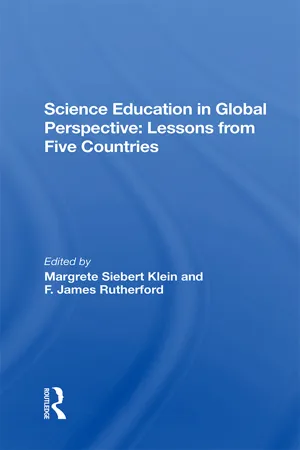
eBook - ePub
Science Education In Global Perspective
Lessons From Five Countries
- 254 pages
- English
- ePUB (mobile friendly)
- Available on iOS & Android
eBook - ePub
Science Education In Global Perspective
Lessons From Five Countries
About this book
The decline in the quality of American public school instruction, particularly in science and mathematics, is a well-documented subject of concern for our nation. This book examines the educational systems in Japan, the People's Republic of China, East and West Germany, and the Soviet Union, countries that have developed particularly innovative app
Trusted by 375,005 students
Access to over 1 million titles for a fair monthly price.
Study more efficiently using our study tools.
Information
Topic
EducationSubtopic
Education General1. Science Education in Contemporary Japan
Kay Michael Troost
Introduction
Japanese science education is more successful than its American counterpart in terms of both quantity and quality of science education for all students. More students take advanced science courses; the average level of cognitive achievement attained by Japanese students is higher, and so is the level of scientific literacy of the Japanese population as a whole. Some of this success is due to the overall effectiveness of Japanese precollege education, and part is a result of specific features of its science education. In this chapter, I will examine general educational practices, describe the science curriculum at both the elementary and secondary levels, and then conclude by evaluating the strengths and weaknesses of the Japanese educational system.
An interesting irony in the comparison of Japanese and American science education is that since World War II, Japanese education has been based upon the American model. The American Occupation forces attempted to "democratize" Japanese education, and the continuing domestic effort has made it more egalitarian than its American counterpart. In addition, the process of cyclic revision of the curriculum and the ongoing dialogue between the teachers' union (Nikkyōso) and the Ministry of Education, Science, and Culture (Mombushō) has in many instances substantially altered the original curriculum.
An overview of the Japanese educational system is provided in Figure 1.1, and numbers of students, teachers, and institutions are shown in Table 1.1. Due to the reforms of the Occupation, the Japanese replaced their European--and particularly German-influenced--system with a 6-3-3-4 year system which directly parallels that of the United States. Virtually all students (99.9 percent) complete the compulsory first nine grades, and 94 percent attend high school. The percentage attending a junior college or university (37 percent) is second only to the United States. Almost 70 percent of high school students are in college-and university-oriented curricula; the remainder are in one of six vocational courses: agriculture (3.8 percent), industry and engineering (10.3 percent), commerce (12.5 percent), fisheries (0.4 percent), home

Figure 1.1 Organization of the Japanese school system
Source: Mombushō, Education in Japan (1978), p. 13.
Source: Mombushō, Education in Japan (1978), p. 13.

TABLE 1.1 Level by gender for Japanese students, teachers, and institutionsa
Source; Mombushō, Mombushō (1981), pp. 13, 15, 17, 18; see also National Institute for Educational Research, Basic Facts and Figures about the Educational System in Japan (Tokyo, March 1982). aData are for May 1980 unless otherwise noted.
Source; Mombushō, Mombushō (1981), pp. 13, 15, 17, 18; see also National Institute for Educational Research, Basic Facts and Figures about the Educational System in Japan (Tokyo, March 1982). aData are for May 1980 unless otherwise noted.
bData from Foreign Press Center of Japan, Education in Japan (1978), p. 30.
cData for graduate students from Mombushō, Mobutōkeiyōran (1979).
dMale.
eFemale.
economics (3.5 percent), and nursing (0.6 percent).
The junior college and technical college systems are much smaller than the university system, with 371,125; 46,348; and 1,835,304 students, respectively,1 and are more sex segregated. Junior colleges are predominantly female (89 percent), while technical colleges are overwhelmingly male (98 percent).2 The course of study also varies: the technical colleges are oriented toward the training of technicians, while junior college students are much more likely than their university counterparts to major in home economics or pedagogy (24.4 percent versus 7.9 percent) and, to a lesser degree, humanities. By contrast, university students are apt to major in natural science (3.1 percent versus zero), social science, and engineering (19.4 percent versus 5.9 percent).3
The Japanese educational system is highly centralized through the Ministry of Education, Science, and Culture (Mombushō), which controls textbook approval, school accreditation, teachers' salaries, educational subsidies, and the all-important course of study. The minimum course content is specified in considerable detail all the way through high school. Because of the national uniformity, considerable economies of scale in textbooks, curriculum planning, and curriculum-based research are achieved.
The Mombushō bureaucrats in Tokyo also set the requirements for university majors, for postgraduate education, and for the minimum qualifications for faculty members at all levels of school, from day care to postgraduate education. One of the battles which the U.S. Occupation did not win in its reform of Japanese education was an attempt to decentralize the system. Today, Japanese education owes its many strengths and assorted deficiencies to the heavy involvement of the Mombushō in educational affairs at all levels.
The course of study specifies a large quantity and a high level of cognitive content, although many schools supplement it. The course of study sets the minimum--and it is a very high minimum, internationally speaking--and is met virtually everywhere. The Mombushō's influence is pervasive: if the classroom is second grade science and it is spring, then the students will be studying sunflowers; if the topic is morning glories, then the class must be first grade. The minimums are met not only due to the vigilance of the central bureaucrats with their financial power, but also due to the professionalism of local school authorities and the demands of parents anxious that their children not be at a disadvantage in the national exams. The Mombushō finances all of compulsory education, including free textbooks which become the property of the student;4 there are no supplementary fees. Thus, the Mombushō achieves a considerable degree of planned uniformity through the compulsory first nine grades of school.
The financing of education is an important part of national and local budgets. In 1976. for example, 12.3 percent of national expenditures and 27.3 percent of local expenditures were for education.5 Since then, there has been continued growth in the Mombushō budget. In 1980, the budget for education was 4.267 trillion yen; in 1981, the budget was 4.854 trillion yen.6 Dr. S. Okuda estimated the 1982 Mombushō budget at 5.022 trillion yen.7
Personnel and capital costs of education differ between Japan and the United States. Cummings cites Mombushō data indicating that Japan spends a larger fraction on capital expenses than the United States, the United Kingdom, or France.8 While personnel costs in Japan were but 46.5 percent of total educational expenses (compared to 58.6 percent in the United States), capital investment was 28.7 percent (compared to 12.1 percent in the United States).
One reason why personnel costs are low is that student-teacher ratios are high (Japan, 27; U.S., 22). More importan...
Table of contents
- Cover
- Title
- Copyright
- About the Book
- About the Series
- Contents
- List of Tables and Figures
- About the Editors and Authors
- Acknowledgments
- Preface
- Introduction: Science Education in Other Countries -- Issues and Questions, Kathleen M. Fisher and Joseph I. Lipson
- 1 Science Education in Contemporary Japan
- 2 Precollege Science Education in the People's Republic of China
- 3 Two Worlds of Science Learning: A Look at the Germanies
- 4 Science Education in the USSR
- 5 The Soviet Challenge in Science, Mathematics, and Technology Education
- 6 Lessons from Five Countries
Frequently asked questions
Yes, you can cancel anytime from the Subscription tab in your account settings on the Perlego website. Your subscription will stay active until the end of your current billing period. Learn how to cancel your subscription
No, books cannot be downloaded as external files, such as PDFs, for use outside of Perlego. However, you can download books within the Perlego app for offline reading on mobile or tablet. Learn how to download books offline
Perlego offers two plans: Essential and Complete
- Essential is ideal for learners and professionals who enjoy exploring a wide range of subjects. Access the Essential Library with 800,000+ trusted titles and best-sellers across business, personal growth, and the humanities. Includes unlimited reading time and Standard Read Aloud voice.
- Complete: Perfect for advanced learners and researchers needing full, unrestricted access. Unlock 1.4M+ books across hundreds of subjects, including academic and specialized titles. The Complete Plan also includes advanced features like Premium Read Aloud and Research Assistant.
We are an online textbook subscription service, where you can get access to an entire online library for less than the price of a single book per month. With over 1 million books across 990+ topics, we’ve got you covered! Learn about our mission
Look out for the read-aloud symbol on your next book to see if you can listen to it. The read-aloud tool reads text aloud for you, highlighting the text as it is being read. You can pause it, speed it up and slow it down. Learn more about Read Aloud
Yes! You can use the Perlego app on both iOS and Android devices to read anytime, anywhere — even offline. Perfect for commutes or when you’re on the go.
Please note we cannot support devices running on iOS 13 and Android 7 or earlier. Learn more about using the app
Please note we cannot support devices running on iOS 13 and Android 7 or earlier. Learn more about using the app
Yes, you can access Science Education In Global Perspective by Margrete Siebert Klein,F. James Rutherford,F James Rutherford,Margrete S. Klein in PDF and/or ePUB format, as well as other popular books in Education & Education General. We have over one million books available in our catalogue for you to explore.