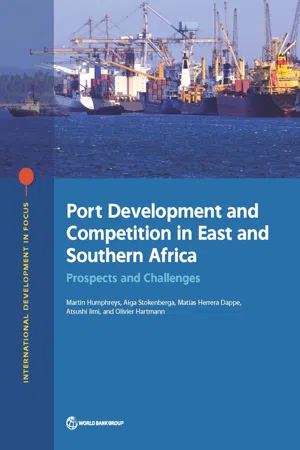
Port Development and Competition in East and Southern Africa analyzes the 15 main ports in East and Southern Africa (ESA) to assess whether their proposed capacity enhancements are justified by current and projected demand; whether the current port management approaches sufficiently address not only the maritime capacity needs but also other impediments to port efficiency; and what the expected hierarchy of ports in the region will be in the future. The analysis confirms the need to increase maritime capacity, as the overall container demand in the ports in scope is predicted to begin exceeding total current capacity by between 2025 and 2030, while gaps in terms of dry and liquid bulk handling are expected even sooner. However, in the case of many of the ports, the issue of landside access—the ports' intermodal connectivity, the ease of international border crossing, and the port-city interface—is more important than the need to improve maritime access and capacity. The analysis finds that there is a need to improve the operating efficiency in all of the ESA ports, as they are currently less than half as productive as the most efficient ports in the matched data set of similar ports across the world, in terms of efficiency in container-handling operations. Similarly, there is a need to improve and formalize stakeholder engagement in many of the ports, to introduce modern management systems, and to strengthen the institutional framework to ensure the most efficient use of the infrastructure and to be able to attract private capital and specialist terminal operators. Finally, given the ports' geographic location and proximity to main shipping routes, available draft, and the ongoing port-and-hinterland development, the book concludes that Durban and Djibouti are the most likely to emerge as the regional hubs in ESA's future hub-and-spoke system.
eBook - PDF
Port Development and Competition in East and Southern Africa
Prospects and Challenges
- 185 pages
- English
- PDF
- Available on iOS & Android
eBook - PDF
Port Development and Competition in East and Southern Africa
Prospects and Challenges
About this book
Information
Subtopic
InfrastructureIndex
BusinessTable of contents
- Front Cover
- Contents
- Foreword
- Foreword
- Acknowledgments
- About the Authors
- Abbreviations
- Overview
- Chapter 1: Introduction
- Chapter 2: The Role of the Port in International Trade
- Chapter 3: The Port Sector in East and Southern Africa
- Chapter 4: The Performance of the Individual Ports
- Chapter 5: The Challenges Facing the Ports in ESA
- Chapter 6: The Prospects for the ESA Ports
- Chapter 7: Conclusions and Recommendations
- Appendix A: The Review of the Institutional Framework
- Boxes
- Figures
- Maps
- Photo
- Tables
Trusted by 375,005 students
Access to over 1.5 million titles for a fair monthly price.
Study more efficiently using our study tools.
Frequently asked questions
Yes, you can cancel anytime from the Subscription tab in your account settings on the Perlego website. Your subscription will stay active until the end of your current billing period. Learn how to cancel your subscription
No, books cannot be downloaded as external files, such as PDFs, for use outside of Perlego. However, you can download books within the Perlego app for offline reading on mobile or tablet. Learn how to download books offline
Perlego offers two plans: Essential and Complete
- Essential is ideal for learners and professionals who enjoy exploring a wide range of subjects. Access the Essential Library with 800,000+ trusted titles and best-sellers across business, personal growth, and the humanities. Includes unlimited reading time and Standard Read Aloud voice.
- Complete: Perfect for advanced learners and researchers needing full, unrestricted access. Unlock 1.5M+ books across hundreds of subjects, including academic and specialized titles. The Complete Plan also includes advanced features like Premium Read Aloud and Research Assistant.
We are an online textbook subscription service, where you can get access to an entire online library for less than the price of a single book per month. With over 1.5 million books across 990+ topics, we’ve got you covered! Learn about our mission
Look out for the read-aloud symbol on your next book to see if you can listen to it. The read-aloud tool reads text aloud for you, highlighting the text as it is being read. You can pause it, speed it up and slow it down. Learn more about Read Aloud
Yes! You can use the Perlego app on both iOS and Android devices to read anytime, anywhere — even offline. Perfect for commutes or when you’re on the go.
Please note we cannot support devices running on iOS 13 and Android 7 or earlier. Learn more about using the app
Please note we cannot support devices running on iOS 13 and Android 7 or earlier. Learn more about using the app
Yes, you can access Port Development and Competition in East and Southern Africa by Martin Humphreys, Aiga Stokenberga, Matias Herrera Dappe, Atsushi Iimi, Olivier Hartmann in PDF and/or ePUB format, as well as other popular books in Business & Infrastructure. We have over 1.5 million books available in our catalogue for you to explore.