eBook - ePub
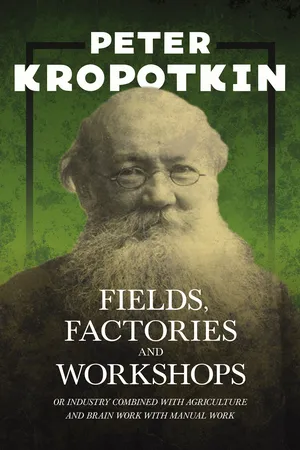
Fields, Factories, and Workshops - Or Industry Combined with Agriculture and Brain Work with Manual Work
With an Excerpt from Comrade Kropotkin by Victor Robinson
- 328 pages
- English
- ePUB (mobile friendly)
- Available on iOS & Android
eBook - ePub
Fields, Factories, and Workshops - Or Industry Combined with Agriculture and Brain Work with Manual Work
With an Excerpt from Comrade Kropotkin by Victor Robinson
About this book
This book comprises a fascinating discussion of the future of agriculture as conceived at the start of the twentieth century. It explores the advantages which societies could derive from a combination of industrial pursuits with intensive agriculture, and 'brain work' with manual work. This is a book that is sure to appeal to those with a keen interest in the history of agriculture, and is a text not to be missed by the discerning collector of vintage farming literature. Chapters include: 'The Decentralisation of Industries', 'The Possibilities of Agriculture', 'Small Industries and Industrial Villages', 'Brain Work and Manual Work', and more. Pyotr Alexeyevich Kropotkin (1842–1921) was a Russian writer, activist, revolutionary, economist, scientist, sociologist, essayist, historian, researcher, political scientist, geographer, geographer, biologist, philosopher and advocate of anarcho-communism. He was a prolific writer, producing a large number of pamphlets and articles, the most notable being "The Conquest of Bread and Fields, Factories and Workshops" and "Mutual Aid: A Factor of Evolution". This classic work is being republished now in a new edition complete with an excerpt from "Comrade Kropotkin" by Victor Robinson.
Trusted by 375,005 students
Access to over 1.5 million titles for a fair monthly price.
Study more efficiently using our study tools.
Information
CHAPTER I
THE DECENTRALISATION OF INDUSTRIES
Who does not remember the remarkable chapter by which Adam Smith opens his inquiry into the nature and causes of the wealth of nations? Even those of our contemporary economists who seldom revert to the works of the father of political economy, and often forget the ideas which inspired them, know that chapter almost by heart, so often has it been copied and recopied since. It has become an article of faith; and the economical history of the century which has elapsed since Adam Smith wrote has been, so to speak, an actual commentary upon it.
“Division of labour” was its watchword. And the division and subdivision — the permanent subdivision — of functions has been pushed so far as to divide humanity into castes which are almost as firmly established as those of old India. We have, first, the broad division into producers and consumers: little-consuming producers on the one hand, little-producing consumers on the other hand. Then, amidst the former, a series of further subdivisions: the manual worker and the intellectual worker, sharply separated from one another to the detriment of both; the agricultural labourers and the workers in the manufacture; and, amidst the mass of the latter, numberless subdivisions again — so minute, indeed, that the modern ideal of a workman seems to be a man or a woman, or even a girl or a boy, without the knowledge of any handicraft, without any conception whatever of the industry he or she is employed in, who is only capable of making all day long and for a whole life the same infinitesimal part of something: who from the age of thirteen to that of sixty pushes the coal cart at a given spot of the mine or makes the spring of a penknife, or “the eighteenth part of a pin.” Mere servants to some machine of a given description; mere flesh-and-bone parts of some immense machinery; having no idea how and why the machinery performs its rhythmical movements.
Skilled artisanship is being swept away as a survival of a past condemned to disappear. The artist who formerly found aesthetic enjoyment in the work of his hands is substituted by the human slave of an iron slave. Nay, even the agricultural labourer, who formerly used to find a relief from the hardships of his life in the home of his ancestors — the future home of his children — in his love of the field and in a keen intercourse with nature, even he has been doomed to disappear for the sake of division of labour. He is an anachronism, we are told; he must be substituted, in a Bonanza farm, by an occasional servant hired for the summer, and discharged as the autumn comes: a tramp who will never again see the field he has harvested once in his life. “An affair of a few years,” the economists say, “to reform agriculture in accordance with the true principles of division of labour and modern industrial organisation.”
Dazzled with the results obtained by a century of marvellous inventions, especially in England, our economists and political men went still farther in their dreams of division of labour. They proclaimed the necessity of dividing the whole of humanity into national workshops having each of them its own speciality. We were taught, for instance, that Hungary and Russia are predestined by nature to grow corn in order to feed the manufacturing countries; that Britain had to provide the worldmarket with cottons, iron goods, and coal; Belgium with woollen cloth; and so on. Nay, within each nation, each region had to have its own speciality. So it has been for some time since; so it ought to remain. Fortunes have been made in this way, and will continue to be made in the same way. It being proclaimed that the wealth of nations is measured by the amount of profits made by the few, and that the largest profits are made by means of a specialisation of labour, the question was not conceived to exist as to whether human beings would always submit to such a specialisation; whether nations could be specialised like isolated workmen. The theory was good for today — why should we care for tomorrow. Tomorrow might bring its own theory!
And so it did. The narrow conception of life which consisted in thinking that profits are the only leading motive of human society, and the stubborn view which supposes that what has existed yesterday would last for ever, proved in disaccordance with the tendencies of human life; and life took another direction. Nobody will deny the high pitch of production which may be attained by specialisation. But, precisely in proportion as the work required from the individual in modern production becomes simpler and easier to be learned, and, therefore, also more monotonous and wearisome — the requirements of the individual for varying his work, for exercising all his capacities, become more and more prominent. Humanity perceives that there is no advantage for the community in riveting a human being for all his life to a given spot, in a workshop or a mine; no gain in depriving him of such work as would bring him into free intercourse with nature, make of him a conscious part of the grand whole, a partner in the highest enjoyments of science and art, of free work and creation.
Nations, too, refuse to be specialised. Each nation is a compound aggregate of tastes and inclinations, of wants and resources, of capacities and inventive powers. The territory occupied by each nation is in its turn a most varied texture of soils and climates, of hills and valleys, of slopes leading to a still greater variety of territories and races. Variety is the distinctive feature, both of the territory and its inhabitants; and that variety implies a variety of occupations. Agriculture calls manufactures into existence, and manufactures support agriculture. Both are inseparable: and the combination, the integration of both brings about the grandest results. In proportion as technical knowledge becomes everybody’s virtual domain, in proportion as it becomes international, and can be concealed no longer, each nation acquires the possibility of applying the whole variety of her energies to the whole variety of industrial and agricultural pursuits. Knowledge ignores artificial political boundaries. So also do the industries; and the present tendency of humanity is to have the greatest possible variety of industries gathered in each country, in each separate region, side by side with agriculture. The needs of human agglomerations correspond thus to the needs of the individual; and while a temporary division of functions remains the surest guarantee of success in each separate undertaking, the permanent division is doomed to disappear, and to be substituted by a variety of pursuits — intellectual, industrial, and agricultural — corresponding to the different capacities of the individual, as well as to the variety of capacities within every human aggregate.
When we thus revert from the scholastics of our textbooks, and examine human life as a whole, we soon discover that, while all the benefits of a temporary division of labour must be maintained, it is high time to claim those of the integration of labour. Political economy has hitherto insisted chiefly upon division. We proclaim integration; and we maintain that the ideal of society — that is, the state towards which society is already marching — is a society of integrated, combined labour. A society where each individual is a producer of both manual and intellectual work; where each able-bodied human being is a worker, and where each worker works both in the field and the industrial workshop; where every aggregation of individuals, large enough to dispose of a certain variety of natural resources — it may be a nation, or rather a region — produces and itself consumes most of its own agricultural and manufactured produce.
Of course, as long as society remains organised so as to permit the owners of the land and capital to appropriate for themselves, under the protection of the State and historical rights, the yearly surplus of human production, no such change can be thoroughly accomplished. But the present industrial system, based upon a permanent specialisation of functions, already bears in itself the germs of its proper ruin. The industrial crises, which grow more acute and protracted, and are rendered still worse and still more acute by the armaments and wars implied by the present system, are rendering its maintenance more and more difficult. Moreover, the workers plainly manifest their intention to support no longer patiently the misery occasioned by each crisis. And each crisis accelerates the day when the present institutions of individual property and production will be shaken to their foundations with such internal struggles as will depend upon the more or less good sense of the now privileged classes.
But we maintain also that any socialist attempt at remodeling the present relations between Capital and Labour will be a failure, if it does not take into account the above tendencies towards integration. These tendencies have not yet received, in our opinion, due attention from the different socialist schools — but they must. A reorganised society will have to abandon the fallacy of nations specialized for the production of either agricultural or manufactured produce. It will have to rely on itself for the production of food and many, if not most, of the raw materials; it must find the best means of combining agriculture with manufacture — the work in the field with a decentralised industry; and it will have to provide for “integrated education,” which education alone, by teaching both science and handicraft from earliest childhood, can give to society the men and women it really needs.
Each nation — her own agriculturist and manufacturer; each individual working in the field and in some industrial art; each individual combining scientific knowledge with the knowledge of a handicraft — such is, we affirm, the present tendency of civilised nations.
The prodigious growth of industries in Great Britain, and the simultaneous development of the international traffic which now permits the transport of raw materials and articles of food on a gigantic scale, have created the impression that a few nations of West Europe were destined to become the manufacturers of the world. They need only — it was argued — to supply the market with manufactured goods, and they will draw from all over the surface of the earth the food they cannot grow themselves, as well as the raw materials they need for their manufactures. The steadily increasing speed of trans-oceanic communications and the steadily increasing facilities of shipping have contributed to enforce the above impression. If we take the enthusiastic pictures of international traffic, drawn in such a masterly way by Neumann Spallart — the statistician and almost the poet of the world-trade — we are inclined indeed to fall into ecstasy before the results achieved. “Why shall we grow corn, rear oxen and sheep, and cultivate orchards, go through the painful work of the labourer and the farmer, and anxiously watch the sky in fear of a bad crop, when we can get, with much less pain, mountains of corn from India, America, Hungary, or Russia, meat from New Zealand, vegetables from the Azores, apples from Canada, grapes from Malaga, and so on?” exclaim the West Europeans. “Already now,” they say, “our food consists, even in modest households, of produce gathered from all over the globe. Our cloth is made out of fibres grown and wool sheared in all parts of the world. The prairies of America and Australia; the mountains and steppes of Asia; the frozen wildernesses of the Arctic regions; the deserts of Africa and the depths of the oceans; the tropics and the lands of the midnight sun are our tributaries. All races of men contribute their share in supplying us with our staple food and luxuries, with plain clothing and fancy dress, while we are sending them in exchange the produce of our higher intelligence, our technical knowledge, our powerful industrial and commercial organising capacities! Is it not a grand sight, this busy and intricate exchange of produce all over the earth which has suddenly grown up within a few years?”
Grand it may be, but is it not a mere nightmare? Is it necessary? At what cost has it been obtained, and how long will it last?
Let us turn a hundred years back. France lay bleeding at the end of the Napoleonic wars. Her young industry, which had begun to grow by the end of the 18th century, was crushed down. Germany, Italy were powerless in the industrial field. The armies of the great Republic had struck a mortal blow to serfdom on the Continent; but with the return of reaction efforts were made to revive the decaying institution, and serfdom meant no industry worth speaking of. The terrible wars between France and England, which wars are often explained by merely political causes, had a much deeper meaning — an economical meaning. They were wars for the supremacy on the world market, wars against French industry and commerce, supported by a strong navy which France had begun to build — and Britain won the battle. She became supreme on the seas. Bordeaux was no more a rival to London; as to the French industries, they seemed to be killed in the bud. And, aided by the powerful impulse given to natural sciences and technology by a great era of inventions, finding no serious competitors in Europe, Britain began to develop her manufactures. To produce on a large scale in immense quantities became the watchword. The necessary human forces were at hand in the peasantry, partly driven by force from the land, partly attracted to the cities by high wages. The necessary machinery was created, and the British production of manufactured goods went on at a gigantic pace. In the course of less than seventy years — from 1810 to 1878 — the output of coal grew from 10 to 133,000,000 tons; the imports of raw materials rose from 30 to 380,000,000 tons; and the exports of manufactured goods from 46 to 200,000,000 pounds. The tonnage of the commercial fleet was nearly trebled. Fifteen thousand miles of railways were built.
It is useless to repeat now at what a cost the above results were achieved. The terrible revelations of the parliamentary commissions of 1840–1842 as to the atrocious condition of the manufacturing classes, the tales of “cleared estates,” and kidnapped children are still fresh in the memory. They will remain standing monuments for showing by what means the great industry was implanted in this country. But the accumulation of wealth in the hands of the privileged classes was going on at a speed never dreamed of before. The incredible riches which now astonish the foreigner in the private houses of England were accumulated during that period; the exceedingly expensive standard of life which makes a person considered rich on the Continent appear as only of modest means in Britain was introduced during that time. The taxed property alone doubled during the last thirty years of the above period, while, during the same years (1810 to 1878) no less than £1,112,000,000 — nearly £2,000,000,000 by this time — was invested by English capitalists either in foreign industries or in foreign loans.[1]
But the monopoly of industrial production could not remain with England for ever. Neither industrial knowledge nor enterprise could be kept for ever as a privilege of these islands. Necessarily, fatally, they began to cross the Channel and...
Table of contents
- IN LATER LIFE
- PREFACE TO THE SECOND EDITION
- PREFACE TO THE FIRST EDITION
- CHAPTER I
- CHAPTER II
- CHAPTER III
- CHAPTER IV
- CHAPTER V
- APPENDIX
- TABLES
Frequently asked questions
Yes, you can cancel anytime from the Subscription tab in your account settings on the Perlego website. Your subscription will stay active until the end of your current billing period. Learn how to cancel your subscription
No, books cannot be downloaded as external files, such as PDFs, for use outside of Perlego. However, you can download books within the Perlego app for offline reading on mobile or tablet. Learn how to download books offline
Perlego offers two plans: Essential and Complete
- Essential is ideal for learners and professionals who enjoy exploring a wide range of subjects. Access the Essential Library with 800,000+ trusted titles and best-sellers across business, personal growth, and the humanities. Includes unlimited reading time and Standard Read Aloud voice.
- Complete: Perfect for advanced learners and researchers needing full, unrestricted access. Unlock 1.5M+ books across hundreds of subjects, including academic and specialized titles. The Complete Plan also includes advanced features like Premium Read Aloud and Research Assistant.
We are an online textbook subscription service, where you can get access to an entire online library for less than the price of a single book per month. With over 1.5 million books across 990+ topics, we’ve got you covered! Learn about our mission
Look out for the read-aloud symbol on your next book to see if you can listen to it. The read-aloud tool reads text aloud for you, highlighting the text as it is being read. You can pause it, speed it up and slow it down. Learn more about Read Aloud
Yes! You can use the Perlego app on both iOS and Android devices to read anytime, anywhere — even offline. Perfect for commutes or when you’re on the go.
Please note we cannot support devices running on iOS 13 and Android 7 or earlier. Learn more about using the app
Please note we cannot support devices running on iOS 13 and Android 7 or earlier. Learn more about using the app
Yes, you can access Fields, Factories, and Workshops - Or Industry Combined with Agriculture and Brain Work with Manual Work by Peter Kropotkin,Victor Robinson in PDF and/or ePUB format, as well as other popular books in Politics & International Relations & Philosophers. We have over 1.5 million books available in our catalogue for you to explore.