eBook - ePub
Viral Nanoparticles
Tools for Material Science and Biomedicine
- 284 pages
- English
- ePUB (mobile friendly)
- Available on iOS & Android
eBook - ePub
Viral Nanoparticles
Tools for Material Science and Biomedicine
About this book
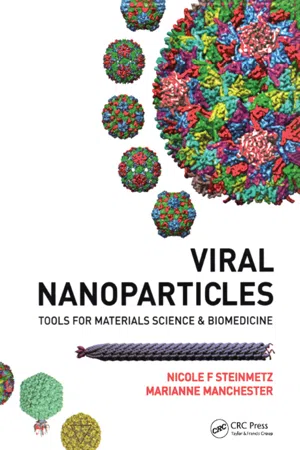
This book overviews the applications of viral nanoparticles (VNPs) in areas ranging from materials science to biomedicine. It summarizes the many different VNP building blocks and describes chemistries that allow one to attach, entrap, or display functionalities on VNPs. The book outlines the strategies for the construction of 1-, 2-, and 3-D arrays, highlights the achievements in utilizing VNPs as tools for novel biosensors and nanoelectronic devices, and describes efforts in designing VNPs for biomedical applications, including their use as gene delivery vectors, novel vaccines, imaging modalities, and applications in targeted therapeutics.
Tools to learn more effectively

Saving Books

Keyword Search

Annotating Text

Listen to it instead
Information
Chapter 1
AN INTRODUCTION TO VNPs AND NANOTECHNOLOGY
Viruses have long been studied as pathogens, with the goal of understanding viral infection and disease. More recently viruses have begun to be regarded as building blocks and tools for nanotechnology. Viruses are exploited as platforms; that is, they are used as templates or scaffolds for the design of novel nanomaterials. A wide variety of viral platforms have been studied and utilized for applications ranging from materials to medicine. This chapter will provide an introduction to the role of viral nanoparticles (VNPs) in nanotechnology.
1.1 WHAT IS NANO?
Nanotechnology is a highly interdisciplinary field that brings together researchers from different scientific backgrounds and has created a novel common language. It is a collective term for a broad range of novel topics concerned with matter on the nanometer scale. Nanotechnology sits at the interface of biology, chemistry, physics, material science, and medicine. Nanotechnology is found and applied in nearly every scientific area.
Nano is a somewhat fashionable term; in common speech, it is used as a prefix to denote something that is smaller than usual. As of this writing, the term “Apple iPod nano” is the first hit on a Google search of the term “nano”. The word nano is derived from the ancient Greek word for dwarf. In a scientific context the prefix nano is used to describe “a billionth of something”. A nanometer is a billionth of a meter (10−9 m = 1 nm), and a nanosecond is a billionth of a second (10−9s = 1 ns).
Figure 1.1 illustrates how tiny nano is. An aphid insect (Fig. 1.1, panel A) is about 1 mm in size. The aphid is about 1,000,000 times bigger than a nanometer. Human hairs (Fig. 1.1, panel B) have an average diameter of 100 pm and are thus 10 times smaller than the aphid and still 100,000 times bigger than a nanoparticle. Panel C shows a plant cell, which is about 10 pm in size and thus 10,000 bigger than a nanometer. Particles formed by the plant virus Cowpea mosaic virus (CPMV; Fig. 1.1, panel D) are about 30 nm in diameter and thus nanoparticles. One would need around 50,000,000 VNPs to fill up the interior of a cell.
A single atom is a fraction of a nanometer in size; molecules, including biological molecules, are typically nanometers in size and can thus be regarded as nanoobjects. In recent years a range of biological molecules have been exploited for nanosciences and nanotechnology. Nucleic acids, for example, are used as construction materials to generate highly ordered 2D and 3D structures and assemblies such as nanotubes and nanocages. A main theme in nanotechnology is controlled self-assembly, with the goal being to generate functional materials with a high degree of precision. Nanotechnology, then, requires chemical and physical control at the molecular level. Nucleic acids, proteins, and viruses are essentially naturally occurring nanomaterials capable of self-assembly with a high degree of precision. This property, coupled to the relative ease of experimentally controlling and producing biological nanomaterials, has led to tremendous interest in their nanotechnology applications. Viruses, and VNPs in particular, possess a number of traits that make them exceptionally outstanding candidates.

1.2 WHERE DID IT ALL BEGIN? A HISTORY OF VNPs: FROM PATHOGENS TO BUILDING BLOCKS
The word virus is Latin and means “poison”. Viruses are infectious agents, and generally pathogens. It was not, however, until the end of the 19th century that viruses were discovered as infectious agents. The first virus to be recognized as an infectious agent distinct from bacteria was the plant pathogen Tobacco mosaic virus (TMV) (Zaitlin, 1898). Today more than 5,000 viruses have been discovered and described, although this likely represents a fraction of those found in nature. Viruses cause many human diseases, from the common cold and chicken pox to more serious infections such as AIDS (acquired immune deficiency syndrome, which is caused by the Human immunodeficiency virus [HIV]) and SARS (severe acute respiratory syndrome, which is caused by SARS coronavirus). Virology — the science of studying viruses — is thus a highly important discipline in regard to human health.
Viruses infect all forms of life. Generally, animal viruses infect animals, including humans; plant viruses infect plants; and bacteriophages infect bacteria. Archaeal viruses are those that infect Archaea. Archaea show similarities with bacteria as well as with eukaryotes, and although they are prokaryotes, it has been suggested that they are more closely related to the eukaryotes (Woese & Fox, 1977).
In their simplest form, viral particles consist of a nucleic acid genome and a protective protein coat termed the capsid. Some viruses have additional structural features such as a lipid envelope, or they may consist of separate head and tail structures (discussed in Chapter 2). In brief, the nucleic acid genome encodes the genetic information that is needed to produce viral progeny. In addition to cellular attachment, an important function of the capsid of non-enveloped viruses is the protection of the nucleic acid genome. This tends to make non-enveloped viral particles extremely robust. With a few exceptions, nearly all viruses utilized in nanotechnology are non-enveloped particles. The envelope for enveloped viruses also plays a role in the initial stages of the infection process, including binding to surface receptors and internalization into the host cell.
Viruses have now been studied for more than 100 years, and detailed knowledge about the structure and function of many viruses has been gathered. For many years the emphasis has been on the understanding of viral infection and disease, and it still is. Being able to control or treat viral infections is an important goal in human medicine (as well as veterinary medicine and agriculture). Every year novel viruses or virus strains evolve with the potential to cause disease and death worldwide. For instance, at the time of writing this book, the Influenza virus strain H1N1 (also referred to as “swine flu”) has emerged and quickly spread all over the world. The science of fundamental virology will always play an important role in medicine.
By the 1950s, researchers had begun thinking of viruses as tools in addition to pathogens. Bacteriophages, for example, played a key role in the development of molecular biotechnology. Bacteriophage genomes and components of the protein expression machinery have been widely utilized as tools for understanding fundamental cellular processes such as nucleic acid replication, transcription, and translation. Virus genomes are small and the genetic elements that control expression of the genome are highly efficient and multifunctional. On the basis of these properties, several viruses have been exploited as expression systems in biotechnology. Several cloning vectors are derivatives of bacteriophages, and typical examples include the Escherichia coli phages λ and M13. Various phage-encoded promoters (DNA sequences that facilitate transcription of DNA into RNA) have been utilized to regulate gene expression. An overview of tools used for molecular biology can be found in Molecular Cloning: A Laboratory Manual, by Sambrook and Russell (2001). The use of viruses as cloning and expression vectors is not restricted to phages; plant viruses, insect viruses, and mammalian systems have also been engineered for these purposes. Some of these systems are discussed in Chapter 3.
Another early application evaluated was bacteriophage therapy, the use of bacteriophages to combat bacterial infections. With the development of antibiotics (compounds that kill bacteria), which have proven to be more efficient and comprehensive compared with bacteriophage therapy, few efforts were made toward its further development. Other applications include bacteriophage-mediated microbial control (applied in the food industry) and phage display technologies that allow screening for biological protein-binding partners. More recent developments include the use of bacteriophages for vaccine production and gene delivery approaches. Developments in using bacteriophages for biotechnological applications were reviewed by Clark and March (2006) and Marks and Sharp (2000).
In the 1970s many efforts focused on the production of virus-like particles (VLPs) for use in anti-viral vaccines (reviewed in Garcea & Gissmann, 2004; Grgacic & Anderson, 2006; Ludwig & Wagner, 2007). A VLP is a particle consisting of the capsid but lacking the genome. A VLP is the replication-deficient and thus non-infectious counterpart of a VNP. Chimeric VLPs and VNPs have also been designed. A chimera is a genetically modified version of a naturally occurring particle or cell. In vaccine development, chimeras are used as carriers or platforms for the presentation of antigenic sequences (sequences that induce an immune response) of other pathogens (reviewed in Garcea & Gissmann, 2004; Grgacic & Anderson, 2006; Ludwig & Wagner, 2007]. More details and insights on the use of viruses in vaccine development are given in Chapter 8.
In the 1980s researchers began exploiting plant viruses as expression vectors (a DNA-based plasmid that promotes the expression of foreign genes] to produce pharmaceutical proteins in plants. Advantages of protein production in plants are the absence of contamination with animal products, low production costs, and — when using viral expression vectors — achievement of high expression levels. A range of pharmaceutically relevant proteins including therapeutic antibodies have been successfully produced using viral vectors such as TMV, CPMV, and Potato virus X (PVX) (Awram et al., 2002; Canizares et al., 2005; Johnson et al., 1997; Porta & Lomonossoff, 1998; Scholthof et al., 1996).
Viruses Became VNPs. Beginning about 20 years ago, the focus on exploiting viruses and their capsids for biotechnology began to shift toward using them for nanotechnology applications. Douglas and Young (Montana State University, Bozeman, MT, USA) were the first to consider the utility of a virus capsid as a nanomaterial (Douglas & Young, 1998). The virus of interest in their studies was the plant virus Cowpea chlorotic mottle virus (CCMV). CCMV is a highly dynamic platform with pH- and metal ion-dependent structural transitions (see Section 2.2.2). Douglas and Young made use of these capsid dynamics and exchanged the natural cargo (nucleic acid) with a synthetic material, in this case encapsulating the organic polymer polyanetholesulfonic acid. Since then many materials have been encapsulated into CCMV and other VNPs (discussed in detail in Chapter 5). The system was further engineered to allow not only the entrapment of materials but also the size-constrained and spatially controlled synthesis of materials within both the capsid and other protein cages (discussed in Chapters 5 and 6). A protein cage is a hollow, generally spherical protein structure that is typically assembled by multiple copies of protein monomers and thus has similarities to a viral capsid.
At about the same time, the research team led by Mann (University of Bristol, UK) pioneered a new area using the rod-shaped particles of TMV. The particles were used as templates for the fabrication of a range of metallized nanotube structures using mineralization techniques (Shenton et al., 1999). These techniques have received great attention during recent years. In particular the contributions of Belcher and colleagues at the Massachusetts Institute of Technology (MIT, Cambridge, MA, USA) led to the development of a new technology that allowed for the generation of a large range of mineralized nanotubes and nanowires for use in batteries and data storage devices (Lee et al., 2009; Nam et al., 2006; Nam et al., 2008). Mineralization and metal deposition techniques as well as their potential applications are discussed in Chapters 6 and 7.
A third direction began a few years later. In 2002, the first study was reported in which bioconjug...
Table of contents
- Cover
- Half Title
- Title Page
- Copyright Page
- Table of Contents
- Preface
- Chapter 1 An Introduction to VNPs and Nanotechnology
- Chapter 2 Overview of the Manifold VNPs Used in Nanotechnology
- Chapter 3 Production of VNPs, VLPs, and Chimeras
- Chapter 4 The Art of Bioconjugation: Functionalization of VNPs
- Chapter 5 Encapsulating Materials within VNPs
- Chapter 6 VNPs as Templates for Materials Synthesis
- Chapter 7 Playing “Nano-Lego”: VNPs as Building Blocks for the Construction of Multi-Dimensional Arrays
- Chapter 8 VNPs as Tools for Nanomedicine
- Chapter 9 Summary and Outlook
- Appendix A
- Appendix B
- Appendix C
- Appendix D
- Appendix E
- Index
Frequently asked questions
Yes, you can cancel anytime from the Subscription tab in your account settings on the Perlego website. Your subscription will stay active until the end of your current billing period. Learn how to cancel your subscription
No, books cannot be downloaded as external files, such as PDFs, for use outside of Perlego. However, you can download books within the Perlego app for offline reading on mobile or tablet. Learn how to download books offline
Perlego offers two plans: Essential and Complete
- Essential is ideal for learners and professionals who enjoy exploring a wide range of subjects. Access the Essential Library with 800,000+ trusted titles and best-sellers across business, personal growth, and the humanities. Includes unlimited reading time and Standard Read Aloud voice.
- Complete: Perfect for advanced learners and researchers needing full, unrestricted access. Unlock 1.4M+ books across hundreds of subjects, including academic and specialized titles. The Complete Plan also includes advanced features like Premium Read Aloud and Research Assistant.
We are an online textbook subscription service, where you can get access to an entire online library for less than the price of a single book per month. With over 1 million books across 990+ topics, we’ve got you covered! Learn about our mission
Look out for the read-aloud symbol on your next book to see if you can listen to it. The read-aloud tool reads text aloud for you, highlighting the text as it is being read. You can pause it, speed it up and slow it down. Learn more about Read Aloud
Yes! You can use the Perlego app on both iOS and Android devices to read anytime, anywhere — even offline. Perfect for commutes or when you’re on the go.
Please note we cannot support devices running on iOS 13 and Android 7 or earlier. Learn more about using the app
Please note we cannot support devices running on iOS 13 and Android 7 or earlier. Learn more about using the app
Yes, you can access Viral Nanoparticles by Nicole F. Steinmetz, Marianne Manchester, Nicole F. Steinmetz,Marianne Manchester in PDF and/or ePUB format, as well as other popular books in Technology & Engineering & Biotechnology in Medicine. We have over one million books available in our catalogue for you to explore.