- 244 pages
- English
- ePUB (mobile friendly)
- Available on iOS & Android
eBook - ePub
Chekhov & His Russia Ils 267
About this book
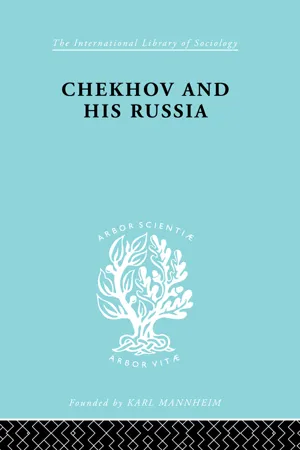
This is Volume I of eight in a series on the Sociology of the Soviet Union. Originally published in 1948, the aim from the outset was to throw light both on Chekhov and on Russia, by trying to see Russia through Chekhov's eyes and to see Chekhov as the product of a particular age and country.
Trusted by 375,005 students
Access to over 1.5 million titles for a fair monthly price.
Study more efficiently using our study tools.
Information
CHAPTER I
CHEKHOV’S AIMS AND OPPORTUNITIES AS A REALIST
When Chekhov published his first work in 1880 in Moscow comic papers like the Dragon Fly and the Alarm Clock, he was a first year medical student of twenty, desperately in need of money, both for his own maintenance and that of his family. He had supported himself by coaching ever since his bankrupt father had left his grocer’s shop in Taganrog for Moscow in 1876, but now the literary gift he had discovered in himself at school, where he had written stories for a school magazine, as well as a farce and a play, offered a more promising and congenial means of making money. Even three years later, when, mainly through his work, his home circumstances were easier, and he had been writing for a year for a rather more literary St. Petersburg weekly called Oskolki (Chips!), we find him complaining to its editor of the overcrowded noisy surroundings in which he is forced to write, and of ‘the non-literary work in front of him that is mercilessly whipping his conscience’. He felt that week’s story to be particularly slight and unpolished, and his ‘Moscow notes’ to be flat, and it was probably this he had in mind in the sentence quoted, but medicine was on his conscience too, for he was beginning his final year, and his friends and relations were always urging him not to give up ‘real work’ for scribbling. It was not until 1886, two years after he had taken his degree, that encouragement from the editor of the Novoe Vremya, Suvorin, and the respected writer Grigorovich, led him to think of himself as an artist. He did not at that time remember a single story over which he had spent more than twenty-four hours.
Yet Chekhov did not consider these years lost which he had given to medical studies and literary hack-work. In them he had qualified as a doctor and practised a little, he had found his feet unaided in the literary world and relieved his family from penury, and above all, perhaps, he had achieved a certain personal culture and freedom of mind. His high conception of personal culture is evident from the remarkable letter to his artist-brother Nicolai, which will be quoted later. The moral and intellectual effort that was necessary for the grandson of a serf to make of himself a spiritual aristocrat on the level of a Tolstoy can be divined from a letter to Suvorin, after Ivanov (711/1889) in which Chekhov says, feeling Ivanov to be still immature: ‘I am glad that I did not listen to Grigorovitch two or three years ago and write a novel! I can imagine what a lot of good material I should have spoilt if I had. According to him “freshness and talent overcome all difficulties”. It is truer to say that freshness and talent can spoil a great deal. In addition to abundance of material and talent, something else, no less important, is necessary. One needs to be mature in the first place, and further, it is essential to have the feeling of personal freedom, a feeling that has only recently begun to spring up in me. What I had earlier in its place was my light-heartedness, carelessness and lack of respect for my, vork. What writers belonging to the gentry received from nature for nothing, we others (raznochintsy) have to purchase at the cost of our youth. Write a story of how a young man, the son of a serf, who has served in a shop, sung in a choir, and had a secondary school and university education, who has been brought up to respect rank and office, to kiss priests’ hands, to bow to other people’s ideas, to say thank you for every piece of bread, who has often been whipped, who has trudged from one pupil to another without galoshes, who has been used to fighting, and tormenting animals, who has been glad to be asked to dinner by rich relations and been hypocritical before God and men without any necessity, simply from the consciousness of his own in-significance—write how this young man squeezes the slave out of himself drop by drop until, waking one fine morning, he feels that he has no longer slave’s blood flowing in his veins, but a real man’s.’
This letter is purely autobiographical, though it gives a less favourable picture of Chekhov’s youth than that drawn by his brother Michael in his biographical sketch. It shows in particular how Chekhov had set himself from early manhood to realize in his own life that ideal of a free personality, avoiding any encroachment on the personal life of others and permitting none on his own, which the great Russian authors, following in part the liberal tradition of the West, had by now established. His gentleness, his habit of self-depreciation and of self-sacrifice for others were, as Chukovsky 1 convincingly proves, the result of sustained moral effort, not of indifference and inertia.
Anton Chekhov’s father Paul had been brought up as a serf in a village in the province of Voronezh, until in 1841, twenty years before the general Emancipation, his own father, an able and energetic peasant who had been able to save, bought freedom for his whole family at 70o roubles a head, a small daughter being thrown in for nothing. Later, Chekhov’s grandfather became steward to Count Platov, a hero of the war of 1812, on his estates not far from Taganrog on the sea of Azov. On his visits as a boy to his grandfather, Anton saw something of the life on a big estate, sometimes sitting by the great steam threshing machine checking the corn sacks from dawn till dusk, and hearing tales of peasant life of that day and the preceding age. Paul Chekhov worked as a clerk in Taganrog, until in 1857 he had saved up enough money to open a grocer’s shop. He belonged now to the second gild of merchants of Taganrog and had recently married the daughter of a cloth merchant, a man of some education, whose affairs had taken him all over Russia. From his earliest days Paul Chekhov had had a passion for church music and choral singing. He had learnt to sing from music and to play the violin even as a serf boy. In Taganrog he gave rather too much time to town affairs and to music, conducting a church choir, playing the violin and, as his family grew up, teaching them to sing too. Church on Saturday evening and Sunday morning was always followed by hymns sung in parts at home, and sometimes the Chekhov boys would sing trios in church. Everyone envied their parents then, Chekhov said later, but the boys themselves felt like little convicts. An overdose of compulsory religion in youth probably helped to turn them against it later, especially as they associated it with their father’s general ‘despotism’, scenes at table because the soup was oversalted, free use of the rod and the like (cf. Difficult People). Meanwhile business in Taganrog was not too bad, until most of the trade of the port was attracted to Rostov-on-Don through railway developments in the ‘seventies, and in 1876 Paul Chekhov became bankrupt.
At this time Anton was a healthy and remarkably cheerful schoolboy of sixteen, attending the town grammar school. He had been brought up rather strictly but with real affection in a large family, in which there were two brothers older and two brothers and a sister younger than himself. The patriarchal family life and the example of a stern father and devoted mother had not only helped to form his character—he was unselfish and attached to his family in a rare degree—but he had also unconsciously learnt from them a good deal about life in serf days and about other regions of Russia beside the south where they lived. He was soaked in the music and liturgy of the Orthodox Church, he knew something about merchants and shopkeepers and the life of a port, and he had worked and played and caught fish with peasant boys on a great country estate. After the family’s departure for Moscow he lived on in the old house, now taken over by one of the creditors, and gave lessons to the Cossack nephew of the new owner. On holiday visits to this boy’s home in the steppe he got to know the Cossack country and the life of its landowners, and learned from his companions to ride and shoot, while in town, in spite of his poverty, he worked and played with the best, flirted with the high school girls, frequented the local theatre and read everything he could lay his hands on. It was not a bad foundation of experience for a future writer.
In Moscow he had not only to maintain himself as a student; he had already serious family responsibilities. His two older brothers had already left home. Alexander, after studying at Moscow, became first a customs official in Taganrog, writing stories in his spare time, and then a journalist in Moscow. Nicolai studied art; he had talent but insufficient strength of character and constitution, and died at an early age of consumption. Anton had their artistic gifts in a much higher degree, together with a moral integrity and buoyancy which they lacked. As their father, when he at last found employment as a poorly-paid clerk in a warehouse, was obliged to live in, like the assistants in Three years, the mother and younger children turned to Anton in all their difficulties as the virtual head of the family. He had brought a couple of school-friends to Moscow with him as boarders, and in one way or another the family contrived to live, and to live quite cheerfully, if not in ideal surroundings at first, in the succession of old houses where they found quarters (cf. The old house). Anton was extremely gay and sociable. He soon had friends not only in the university, but among the intelligentsia of Moscow, and, soon after graduation, in St. Petersburg as well. In the intervals of writing, and finding a market for, two or three comic stories or feuilletons a week, he worked hard at medicine, which interested him deeply and influenced from an early date both his attitude to life and art, and his subjects.
Before Anton graduated his younger brother Ivan had become the schoolmaster of a parish school at Voskresensk, a sleepy little town in fine country in the Moscow province, and there any of the family who were free joined him in the summer months. Anton went there after graduation in 1884. He was soon on friendly terms with the officers of the battery stationed there and their families (cf. Three Sisters), he visited the New Jerusalem monastery near the town, and he acquired some clinical experience under the capable head of the Zemstvo hospital at Chikino, a few miles away, sometimes helping his feldscher assistants with their peasant patients. In the same summer he took the place for a month or two of the Zemstvo doctor at Zvenigorod, about twelve miles away, received thirty to forty patients every morning, accompanied the examining magistrate to a post-mortem or two, attended various zemstvo meetings and gained some knowledge of the life and the administration of the whole region. In a single letter (27 June 1884, to Leikin) we have glimpses of the real experience behind at least three of his early stories, when he tells of his journey with an old examining magistrate to hold a post-mortem on a stranger found dead in a field. Two muzhiks, sitting beside a little fire, have been watching the body since it was found, as they were bound to do until the authorities arrived (cf. A dead body). The villagers beg them not to bring it into the village, or ‘the women and children won’t sleep for fright’ (cf. On official duty), so the post-mortem is held under an oak tree. Chekhov sees that many ribs are broken, but is not surprised when he learns that on finding the body the peasants had tossed it twice in a mat by way of first aid (cf. Speedy help*). Amongst other stories that go back to the experiences of that time are Surgery,* The run-away, Sorrow, etc.
In the same eventful summer he first became intimately acquainted with the country-house life of a cultivated family, at Babkino, the estate of the Kiselyovs, three miles from Voskresensk. For the next three years the Chekhovs had the use of a bungalow on this estate for the summer, and became close personal friends of a well-connected family who had great charm, good taste in music and literature, and a host of friends in artistic circles. The father of Mme. Kiselyov, who lived with her and her husband in retirement, was a much-travelled man who had been director of the imperial theatres in Moscow. She herself was a writer and she shared Chekhov’s passion for fishing. His letters to her and her family are amongst the best even of Chekhov’s letters. They include amusing stories with his own illustrations for the children.
In April and May of 1887 Chekhov found a flood of new impressions on the journey which he made, mainly for reasons of health (he had been spitting blood since 1885, though he would not yet believe that he was consumptive) to the south of Russia. He went by rail through Tula, Orel, Kursk, Byelgorod, Kharkov, Slavyansk to his old home Taganrog, where he stayed with his uncle and renewed old acquaintances. After a fortnight there he went as best man to a Cossack wedding at Novocherkask in the Don valley, east of Rostov, and from there north to a remote Cossack farm on the Donetz road beyond Zvyerevo, where one had to drive fifteen miles for letters to the nearest post-office. He was living, he told Leikin, in the heart of the Donetz hills, amongst ‘mountains, ravines, little woods, little streams, and steppe, steppe, steppe’, with a retired Cossack cornet. In the thatched farm-house of three rooms, with clay floors, he was wakened in the morning by shots—that was their way of killing the hens and geese which were his main diet—and the chief occupation was rational farming on the basis of wholesale slaughter. ‘They kill sparrows, bumble-bees, ants, magpies, crows, so that they won’t eat the bees; to prevent bees from. spoiling the flowers on the fruit-trees, they kill the bees, and to prevent the trees from exhausting the soil, they uproot them. This highly original cycle is founded on the latest discoveries of science.’ This part of his journey clearly gave him ideas for The Steppe, The Pechenyeg, Happiness, etc. Chekhov returned to Taganrog by way of Slavyansk and the Holy Mountains monastery, where he spent two nights in the guesthouse. Slavyansk was a quiet little provincial town, like Gogol’s south Russian town Mirgorod, he said. ‘In its dusty and grass-grown streets, pigs, cows and other domestic animals wander about. The houses have an inviting and kindly air, like benign grandmothers, the pavements are soft to walk on, the streets wide, the air is scented with lilac and acacia; in the distance you hear nightingales singing, frogs croaking, dogs barking, the notes of an accordion, and a woman’s high-pitched voice.’ The Svyatogorsky (Holy Mountains) monastery on the Donets, at the foot of steep pine-clad hills, he described at length in Uprooted. After a few more days in Taganrog he returned to Moscow.
In the autumn of this year Chekhov wrote in a fortnight his first big play, Ivanov, for a Moscow theatre, where a rather indifferent performance aroused the liveliest interest among the public. It was much discussed even in St. Petersburg because of its striking presentation of contemporary types of character. After this production and the publication of his first long story, The Steppe, in the leading monthly magazine, the Severny Vyestnik, Chekhov considered himself a professional writer, and though he was still frequently in temporary difficulties, his financial position was much easier. The Novoe Vremya and the monthlies could afford to pay him well, his older stories were appearing in book form and Ivanov and one or two one-act plays helped to keep the pot boiling. The following summer (1888) he spent chiefly in the Ukraine, at Luka on the Psyol, in the province of Kharkov. His parents were longing for the south after so many years in Moscow, and an acquaintance recommended to them as a ‘dacha’ a lodge on the old and neglected estate of the Lintvaryovs. Here they found beautiful country, excellent fishing, congenial company at the manor-house, and round about ‘sad and poetical estates shut up and deserted where live the souls of beautiful women; old footmen, relics of serfdom, with one foot in the grave; young ladies, longing for the most conventional love’. From there he visited the neighbouring province of Poltava, staying with the Smagins on another old estate, where the doors would not shut, and suckers from the roots of cherry and plum trees came up through cracks in the floor. Here were some more models for his numerous pictures of the country gentry. The old poet Pleshcheyev, the novelist Barantsevich, and Suvorin visited him at Luka. In July he went, through Kiev and down the Dnieper, to Feodosia in the Crimea, to spend a fortnight with the Suvorins. He saw Sevastopol with its sea ‘like blue copperas’, Yalta, where he was to settle in his later years, ‘a mixture of something European that reminds one of views of Nice, with something plebeian, something of the country fair’. From Feodosia he started off with one of Suvorin’s sons on what was intended to be a journey through the Caucasus to Persia. They went from Kerch by small steamers to the monastery New Athos, Sukhum and Poti, and then by the Georgian military road through Tiflis to Batum, but here they received news of the death of the younger brother of Chekhov’s companion, and had to return.
Next year (1889) Chekhov did not see much new country. He was so tired of Moscow now and his new fame—in the autumn of 1888 he had been awarded the Pushkin prize—that he was looking out for a small farm in the south where he could live permanently. He went back to Luka for the summer, but after the death of his brother Nicolai there he felt so depressed and incapable of work that he determined to go abroad. Suvorin was in the Tyrol, and he went as far as Odessa intending to join him there, but lost touch with him through some misunderstanding and went to the Crimea again instead, to Yalta. A busy winter in Moscow followed, and from January 1890 he was planning the most surprising and adventurous journey of his life, right across Siberia to the penal settlement on the island of Sakhalin. It was through his brother Michael, who was studying law, that he suddenly became intensely interested from the human angle in prison management. His reasons for undertaking the journey, and the objections raised by his friends, are to be found in his long letter to Suvorin of 9th March 1890. It seemed to them a sudden craze, which would make great inroads on his time, his money and his health, and would only lead to a book of no interest to anyone, but though Chekhov did not expect to make any contribution to science or literature through his visit, it is clear that he was bent on discharging a debt of conscience. He had come to realise that the famous reforms of the ‘sixties had done nothing for the sick and nothing for those in prison. The first omission was to some extent being made good in his own time, and as doctor-author he had long been concerned with it. But the second still remained, and the first step towards reform was knowledge of the facts. His aim was to get to know all he could about this new Australia, this colony of convicts, ‘a place of unbearable suffering, such as only man, free and unfree, was capable of experiencing’. The administration of it was a fearful responsibility, one which, like the responsibility for the fate of those millions who had in the past been sent to rot in Russian prisons, did not fall simply on the shoulders of ‘gaolers and red-nosed superintendents’, but on them all.
Nothing could show more clearly than this journey, and the book Sakhalin Island which resulted from it, that Chekhov was not an artist in an ivory tower, or a mere observer, indifferent to the sufferings of Russia. His social conscience is evident in all his later work, but it is only in Sakhalin Island that he is purely the sociologist. This work took the place of the medical thesis that he had always intended to write, proving how much his mind was drawn towards the study of everything that had some bearing on man’s happiness in society. It was a straightforward account, in over 4.00 pages, of his investigations at the penal settlement, containing many striking details, but anything but sensational in tone. It was based on house to house visits and the methodical filling in, at every house in the island, of a questionnaire with twelve headings (age, status, confession, birthplace, date of arrival, occupation, etc.). The analysis of this information was supplemented by a general description of the island and the approach to it, of the daily life, houses, food and clothing of the settlers, their churches and schools, the state of morality, social statistics, and medical services. Chekhov often found whole villages where no one was legally married, irregular unions being the rule everywhere rather than the exception. Venereal disease was exceedingly common, and the principal hospital was far below even Russian standards. There were a few fairly prosperous free men and ‘settlers’ (who had served their time), but in the usual izba he found just the barest necessities and listless, unhealthy people. Chekhov found the authorities on the island on the whole friendly and helpful; the articles he wrote for Russkaya Myssl on his return and the subsequent book were well received in official circles, and may have had some influence on the reforms which followed in the ‘nineties, though to judge by Tolstoy’s Resurrection much still remained to be done in 1899.
Apart from its main purpose, this journey greatly increased Chekhov’s knowledge of the Russian Empire and gave him some acquaintance with many other lands. Its effect is to be seen not only in the few stories which it directly inspired, such as Gusev and In Exile, but in the general broadening of his horizon. No wonder that on his return, his Moscow life seemed to him ‘petty, bourgeois and dull’. It put western Europe too in a different perspective. ‘After being in India and China,’ he wrote, ‘I did not see a great difference between Russia and other European countries.’ To cross Siberia before the railway was built was a really formidable undertaking, especially for one in his already rather uncertain state of health. He took leave o...
Table of contents
- Cover
- Half Title
- Title Page
- Copyright Page
- Table of Contents
- Preface
- Chapter I Chekhov’s Aims and Opportunities as A Realist
- Chapter II Chekhov’s Russia—The Land and the People—The Scope of His Picture
- Chapter III The Peasant
- Chapter IV The Landowner
- Chapter V The Official Class; Administration, Justice, Police
- Chapter VI The Church
- Chapter VII The Intelligentsia, Education and the Liberal Professions
- Chapter VIII Industry and Commerce and Town Life
- Chapter IX Chekhov’s Values
- Bibliography
- Index of References to Chekhov’s Works
- General Index
Frequently asked questions
Yes, you can cancel anytime from the Subscription tab in your account settings on the Perlego website. Your subscription will stay active until the end of your current billing period. Learn how to cancel your subscription
No, books cannot be downloaded as external files, such as PDFs, for use outside of Perlego. However, you can download books within the Perlego app for offline reading on mobile or tablet. Learn how to download books offline
Perlego offers two plans: Essential and Complete
- Essential is ideal for learners and professionals who enjoy exploring a wide range of subjects. Access the Essential Library with 800,000+ trusted titles and best-sellers across business, personal growth, and the humanities. Includes unlimited reading time and Standard Read Aloud voice.
- Complete: Perfect for advanced learners and researchers needing full, unrestricted access. Unlock 1.5M+ books across hundreds of subjects, including academic and specialized titles. The Complete Plan also includes advanced features like Premium Read Aloud and Research Assistant.
We are an online textbook subscription service, where you can get access to an entire online library for less than the price of a single book per month. With over 1.5 million books across 990+ topics, we’ve got you covered! Learn about our mission
Look out for the read-aloud symbol on your next book to see if you can listen to it. The read-aloud tool reads text aloud for you, highlighting the text as it is being read. You can pause it, speed it up and slow it down. Learn more about Read Aloud
Yes! You can use the Perlego app on both iOS and Android devices to read anytime, anywhere — even offline. Perfect for commutes or when you’re on the go.
Please note we cannot support devices running on iOS 13 and Android 7 or earlier. Learn more about using the app
Please note we cannot support devices running on iOS 13 and Android 7 or earlier. Learn more about using the app
Yes, you can access Chekhov & His Russia Ils 267 by W.H. Bruford in PDF and/or ePUB format, as well as other popular books in Politique et relations internationales & Relations internationales. We have over 1.5 million books available in our catalogue for you to explore.