eBook - ePub
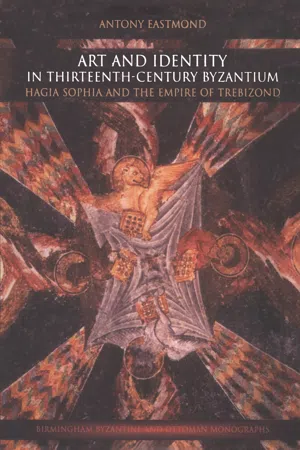
Art and Identity in Thirteenth-Century Byzantium
Hagia Sophia and the Empire of Trebizond
- 246 pages
- English
- ePUB (mobile friendly)
- Available on iOS & Android
eBook - ePub
Art and Identity in Thirteenth-Century Byzantium
Hagia Sophia and the Empire of Trebizond
About this book
The church of Hagia Sophia in Trebizond, built by the emperor Manuel I Grand Komnenos (1238-63) in the aftermath of the fall of Constantinople to the Fourth Crusade, is the finest surviving Byzantine imperial monument of its period. Art and Identity in Thirteenth-Century Byzantium is the first investigation of the church in more than thirty years, and is extensively illustrated in colour and black-and-white, with many images that have never previously been published. Antony Eastmond examines the architectural, sculptural and painted decorations of the church, placing them in the context of contemporary developments elsewhere in the Byzantine world, in Seljuq Anatolia and among the Caucasian neighbours of Trebizond. Knowledge of this area has been transformed in the last twenty years, following the collapse of the Soviet Union. The new evidence that has emerged enables a radically different interpretation of the church to be reached, and raises questions of cultural interchange on the borders of the Christian and Muslim worlds of eastern Anatolia, the Caucasus and Persia. This study uses the church and its decoration to examine questions of Byzantine identity and imperial ideology in the thirteenth century. This is central to any understanding of the period, as the fall of Constantinople in 1204 divided the Byzantine empire and forced the successor states in Nicaea, Epiros and Trebizond to redefine their concepts of empire in exile. Art is here exploited as significant historical evidence for the nature of imperial power in a contested empire. It is suggested that imperial identity was determined as much by craftsmen and expectations of imperial power as by the emperor's decree; and that this was a credible alternative Byzantine identity to that developed in the empire of Nicaea.
Tools to learn more effectively

Saving Books

Keyword Search

Annotating Text

Listen to it instead
Information
Chapter 1
Hagia Sophia and its contexts
The church of Hagia Sophia stands on an isolated spur of rock just above the Black Sea some two kilometres to the west of the citadel of Trebizond, the heart of the medieval city (Fig. 2). The church is now engulfed by a suburb of the city, enclosed by high-rise buildings and cut off from the sea by the coastal highway, but originally it stood on the edge of the water, well outside the medieval city. Photographs taken before it was surrounded by housing show the magnificent location of the church and how it dominated the fields around (plate II). It was a striking statement to mark the western approach to the imperial city of the Grand Komnenoi.
Every aspect of the external design and decoration of the church is unusual and stands outside the norms of Byzantine art and architecture. It is built of ashlar and its external form is dominated by three huge porches which precede the south, north, and west entrances to the church (plate I). The surface of the church is decorated with a range of sculptures and reliefs, including geometric and floral interlace plaques, and a long frieze depicting the story of the creation and fall of Man on the south porch, none of which find easy parallels in Byzantine art. Inside the church, extensive sections of the original wall paintings survive, but some aspects of the iconography are unique to this site. It has long been recognised that the unusual architectural form of the church, its diverse range of figurai and decorative sculpture and wall paintings and their apparently eclectic combination, defy any simple categorisation: the 1968 publication of the church linked these various elements with Georgian, Armenian, Seljuq, Syrian as well as with Byzantine models and influences. The presence in one building of elements, motifs and styles associated with Constantinople, the Caucasus, and Anatolia, drawn from both Christian and Islamic artistic traditions, demands explanation. Trying to locate Trebizond within a notional mainstream of Byzantine art, Cyril Mango concluded that: ‘The frescoes at St. Sophia are purely Byzantine; the architecture contaminated; the sculpture entirely alien’.1 The image of the church that emerges from these accounts is of an essentially confused and eclectic building with mutually incompatible elements, which has little underlying rationale and the appearance of which was determined as much by accident as by design.

2 The city of Trebizond in the mid-thirteenth century. Hagia Sophia was located well to the west of the inhabited areas of the city
In this book, the ways in which both Talbot Rice and Mango characterised the church are challenged. Their interests in the extent of regional influence on the church, and the varying resilience of Byzantine style in the different arts of painting, sculpture and architecture remain a major concern, but different interpretations are offered. Rather than see the divergent nature of the many influences in purely artistic terms, I use them as evidence of the development of the empire of Trebizond under Manuel I Grand Komnenos and its ideology. This chapter outlines the various regional and international contexts into which all explanations and interpretations of the different elements of the church must be placed. With these contexts as a background, it is possible to establish a new and more nuanced gauge against which to judge the church.
By the time that the building and decoration of Hagia Sophia were completed, probably in the mid 1250s, the empire of Trebizond had undergone many changes since its foundation. Its status as independent state had been lost and regained on more than one occasion, and the ambitions of its emperors had altered accordingly. Over the decades between 1204 and C.1250, the political and social contexts of the empire of Trebizond shifted constantly; all had an impact on the makeup of the empire, its ideology, ambitions and potential. The various overlapping geopolitical and cultural contexts within which the creation and functions of Hagia Sophia were determined are essential to its understanding. I have chosen here to emphasise questions about the cultural orientation of the empire of Trebizond and the relationship between political ambition and geopolitical reality, although I recognise that the selection of contexts necessarily limits the frames of interpretation that are applied to the church.2
Establishing a series of political and cultural contexts within which to examine the church and its decoration also raises questions about the relationship between art and political or cultural change. As an approach, such a structure contains within it an implicit presumption that the church is merely created in response to external forces. One of the key features of the church is the number of elements of its design and decoration that can be associated with the art of its neighbouring cultures, in addition to those that relate to elements within Byzantine and Constantinopolitan art. To what extent should we expect to see in the architecture and decoration of Hagia Sophia a reflection of the political realities of any particular time and to what extent is art an agent and creator of ideologies?
This question must be examined on many levels. First, all evidence of artistic interchange requires a model for interpretation. This can best be expressed in terms of a dichotomy between imitation and appropriation: does evidence of imitation of architectural forms, sculptural motifs or iconography and painting styles tell us about the influences that were brought to bear on the empire or about the ways in which its emperors appropriated what they found around them? Either approach makes assumptions about conscious decisions made by artists and patrons. The idea of influence, prevalent in Talbot Rice’s interpretation of the church, establishes a model of passivity and inferiority, in which ideas and motifs are consumed either with little thought about or with little control over their appearance. Through this interpretative model, the decoration of Hagia Sophia emerges as just the imprint of the serial subjugations to which the empire was subjected. The alternative model, that of ideas being appropriated by artists and patrons, suggests a more self-conscious and carefully determined desire to bring diverse elements together to create a new vision of power or piety in Trebizond.3 As each element of the church is studied in the following chapters, the evidence in favour of each view can be assessed.
The model of appropriation, however, still implies an intentionalist reading of the church: it sees the agglomeration of forms as the specific result of predetermined aims. Undoubtedly some elements of the church must have been carefully thought through and self-consciously fashioned. This is certainly the case with the donor portrait of Manuel I Grand Komnenos, the most explicit projection of power in the church, which is examined in chapter 8; but it may also be true of aspects of the architecture and decoration. It is harder to accept that all elements in the church were subject to the same level of scrutiny or programmatic order. Many of the minor, decorative elements in the church, such as the painted borders between scenes, mouldings or some of the sculptural roundels, must have been determined by less deliberative processes, which are not adequately described by the paradigms of passive influence or more active appropriation. The form and appearance of these features can be ascribed to the requirements of functionality and necessity, and can be seen as responses to unavoidable limitations. Restrictions on the availability of materials and craftsmen and on access to knowledge of artistic developments elsewhere, and demands imposed by location and climate also play their part in the organisation and appearance of the church, as does the degree of freedom granted to artists to execute elements outside direct patronal control. Whilst none of these aspects, which lie outside the normal ‘programmatic’ elements, can be used to build up a picture of a conscious expression of imperial ideology, they are nevertheless valuable evidence for perceptions of empire within Trebizond and the ways in which it adapted to local circumstances. They provide implicit evidence about the backgrounds and expectations of the artists involved in the church and consequently of the audience that they considered themselves to be addressing. Such a picture cannot be built up by seeking to locate the exact ‘source’ of any motif, or by identifying the geographic, ethnic or religious origins of the anonymous artists involved, and using these to quantify the impact of the cultures that impinged on Trebizond. The portability and circulation of ideas and the level of interchange are more important than their classification.4 Rather, they can be used to build up a picture of the nature of the empire, its cultural orientation and homogeneity, and its frames of reference by exploring the range of motifs and their cultural associations.
Questions about imperial and cultural identity, then, are built up through the layering of two different forms of evidence, explicit records of conscious ideology and implicit evidence of non-programmatic production. By placing these in the various geopolitical and cultural contexts that enveloped the empire of Trebizond, it is possible to see the extent to which the imperial buildings reflect existing political realities and the degree to which they actively create and encapsulate a new ideology of empire. It is important to consider not just questions of what ideas and ideologies are built into the church and its decoration, but how those ideas were determined, and by whom.
Consideration of contexts provides a framework for an analysis of the relationship between patron, artists and audiences. Paramount in this is a consideration of the role of the monument as an encapsulation of social memory.5 This moves discussion away from the church as a simple vehicle of imperial propaganda to a more complex and dynamic negotiation between competing ideas and audiences about the nature of power and piety in Trebizond in this period. The church can be interpreted as a collective embodiment of ideas about empire in which the design of the church is seen not as a scheme imposed from above by patron or designer, but rather as a project which seeks to match wider expectations of empire. This approach suits the diverse nature of the decoration of the church, and allows non-self-conscious elements to be fully exploited as evidence of the external pressures that were brought to bear on imperial aspirations.
This requires us to challenge the normal, simple models of patronal control and influence, in which, in the case of medieval art, the patron takes over from the [anonymous] artist as the creator of the work, whose intentions can be used to explain the monument. It is important to question the degree of imperial control over the design of Hagia Sophia. The combination of explicit and implicit forms of evidence reveals as much about non-imperial expectations as about centralised propaganda. The self-consciously fashioned elements clearly present an official view of the emperor and his vision of empire. The less formal elements portray a more complicated picture, in which the visual languages employed by artists can be seen to represent non-imperial perceptions of how power and piety should be represented. The concept of empire expressed in these elements is one that possibly constrained and directed the ways in which Manuel I ultimately had to portray his power. According to this model, the church can be seen as much as a manifestation of the long history of Pontic independence and local autonomy as of Manuel’s own imperial claims. It can be argued that the Grand Komnenoi were accepted as emperors in Trebizond and survived in power because their presence acted to legitimise existing local autonomous power structures. Manuel provided a fig-leaf of Byzantine imperialism to cover this regional independence, but the presentation of his rule had to adapt to accommodate it. Hagia Sophia provides the evidence of the results of this negotiation.
The imperial ideology that can be read into the church cannot exist in isolation, whether from the craftsmen that built Hagia Sophia, the people that proclaimed it, or from those that viewed it. The degree to which local factors, including the ethnicity of artists and subjects, and the local traditions for the depiction and expression of power, helped to determine the appearance of Hagia Sophia is central to our understanding of it. The weight given to the various overlapping audiences of the church – the emperor and court, the clergy, the citizens of Trebizond, Manuel’s other subjects outside his capital, as well as its different foreign audiences, whether diplomats or traders, Christians or Muslims – must also be taken into consideration. This has an effect on the ways in which the various elements of the church are interpreted. Emphasis placed on those aspects of the church that are usually ascribed to Constantinople or the mainstream of Byzantine culture, notably the wall paintings, must be balanced against evidence about who had the knowledge to produce them, and who, in thirteenth-century Trebizond, would have understood or recognised them. In contrast, emphasis placed on elements of local origin must be considered against Manuel’s imperial proclamations.
In order to study all these questions, the succeeding chapters look at different aspects of the church: its architecture, its role in the city of Trebizond, its sculptural decoration and its wall paintings. This chapter outlines the principal contexts within which all these are set.
Trebizond and Constantinople
Manuel’s self-proclaimed title in his donor portrait in the church, ‘faithful emperor and autocrat of the Romans’ establishes the prime context for the analysis of Hagia Sophia: Constantinople, and the revival of the Byzantine empire. One of the premises of this book is that the emperors of Trebizond sought to display themselves as Byzantine emperors, and that all the art and buildings in the city served to help achieve this. The issue that remains is the way in which they perceived that such an ideology of Byzantine imperial power should be manifested in Trebizond.
The early history of the empire suggests that the relationship of Trebizond and its emperors to Constantinople was an ambivalent one. The creation of an empire in Trebizond was a haphazard, evolutionary affair.6 When Alexios I Grand Komnenos and his brother David, the grandsons of emperor Andronikos I Komnenos (1183–85), first arrived in the city in April 1204, imperial designs were unlikely. They came to Trebizond from the east, from Georgia, where they had been brought up at the court of its formidable ruler, queen Tamar (1184–1210)7 The Life of Jamar, king of kings, the principal Georgian history of this period, records that the aim of their military expedition was not to establish an empi...
Table of contents
- Cover Page
- Art and Identity in Thirteenth-Century Byzantium
- Copyright Page
- Contents
- List of Abbreviations
- List of Illustrations
- Acknowledgements
- Preface
- Introduction: The Byzantine empires in the thirteenth century
- 1. Hagia Sophia and its contexts
- 2. Hagia Sophia: architecture and the construction of identity
- 3. Trebizond as imperial capital: ceremonial and processions
- 4. Adam, exile and ‘Byzantine’ sculpture
- 5. Ornamental sculpture and cultural orientation: Hagia Sophia, the Seljuqs and the Caucasus
- 6. Wall paintings and politics: rebuilding empire?
- 7. Hagia Sophia: art, the liturgy and modernity
- 8. Manuel I Grand Komnenos: the embodiment of empire
- Conclusion
- Appendix of rulers
- Notes
- Select Bibliography
- Index
Frequently asked questions
Yes, you can cancel anytime from the Subscription tab in your account settings on the Perlego website. Your subscription will stay active until the end of your current billing period. Learn how to cancel your subscription
No, books cannot be downloaded as external files, such as PDFs, for use outside of Perlego. However, you can download books within the Perlego app for offline reading on mobile or tablet. Learn how to download books offline
Perlego offers two plans: Essential and Complete
- Essential is ideal for learners and professionals who enjoy exploring a wide range of subjects. Access the Essential Library with 800,000+ trusted titles and best-sellers across business, personal growth, and the humanities. Includes unlimited reading time and Standard Read Aloud voice.
- Complete: Perfect for advanced learners and researchers needing full, unrestricted access. Unlock 1.4M+ books across hundreds of subjects, including academic and specialized titles. The Complete Plan also includes advanced features like Premium Read Aloud and Research Assistant.
We are an online textbook subscription service, where you can get access to an entire online library for less than the price of a single book per month. With over 1 million books across 990+ topics, we’ve got you covered! Learn about our mission
Look out for the read-aloud symbol on your next book to see if you can listen to it. The read-aloud tool reads text aloud for you, highlighting the text as it is being read. You can pause it, speed it up and slow it down. Learn more about Read Aloud
Yes! You can use the Perlego app on both iOS and Android devices to read anytime, anywhere — even offline. Perfect for commutes or when you’re on the go.
Please note we cannot support devices running on iOS 13 and Android 7 or earlier. Learn more about using the app
Please note we cannot support devices running on iOS 13 and Android 7 or earlier. Learn more about using the app
Yes, you can access Art and Identity in Thirteenth-Century Byzantium by Antony Eastmond in PDF and/or ePUB format, as well as other popular books in History & World History. We have over one million books available in our catalogue for you to explore.