The Ecology of the New Economy
Sustainable Transformation of Global Information, Communications and Electronics Industries
- 283 pages
- English
- ePUB (mobile friendly)
- Available on iOS & Android
The Ecology of the New Economy
Sustainable Transformation of Global Information, Communications and Electronics Industries
About this book
A "revolution" is taking place in the development of global information and communications technologies. In slightly more than a decade, the World Wide Web has gone from the idea of an obscure English scientist to a consumer-oriented technology system with an expected one billion users by 2005. The technologies that enable this to happen are advancing rapidly, which is leading to both an unprecedented number of start-up companies and a host of innovative new alliances between companies.
The growth has been so rapid and unexpected that little research and analysis has yet been done on what impact this transformation has had or will have on the ability of companies to meet the global sustainability challenge.
As environmental strategy has traditionally been portrayed in terms of risk cutting and resource efficiency, there is a danger that critical business issues such as information technology, R&D and e-commerce development are examined in isolation from the wider sustainable business perspective.
An important objective of the book is to explore, document and raise awareness of sustainability concerns arising from the emerging global information economy. The information economy is defined in the broadest sense possible, including software, hardware, telecommunication – traditional and wireless – and advanced communication technologies.
Some of the key issues and questions that are examined include:Case studies on how and to what degree sustainability concerns are being integrated into the business model of electronic, telecommunication and dot.com firms.
The relationship between the diffusion of information and communication technologies and the energy and resource intensity of companies.
The role of information and communication technologies in the shaping of policies for sustainability, its impacts on sustainable or unsustainable lifestyles and its implications for the interaction between companies and other actors.
Corporations and the global digital divide.
The Ecology of the New Economy will be of interest to academics, governments, businesses, and non-governmental groups who are trying to understand the linkages and relationship between the two of our greatest global challenges: the information revolution and environmental sustainability.
Tools to learn more effectively

Saving Books

Keyword Search

Annotating Text

Listen to it instead
Information
Part 1
Sustainability Challenges and Implications of a Global Information Economy
1
Sustainable Business Strategies in the Internet Economy
1.1 From atoms to bits?
1.2 Environmental effects of e-commerce and Internet use
- ∎ There is no general answer to the question of whether the use of new media will lead to increased or decreased environmental impacts.
- ∎ New and classic media each have their specific environmental advantages: so, for instance, with regard to selective searching for information, electronic media are usually more efficient and more environmentally friendly (time-saving search functions; energy use and environmental exploitation are crucially dependent on use). With regard to entertainment and unspecific background input, conventional media are often more environmentally advantageous.
- ∎ Electronic media are often not so much a substitute for but a rather a supplement to printed or other media, thus tending to increase environmental impacts. There is a risk of summation effects and incomplete substitution.
- ∎ Digitisation of products and media (music, news, e-mails, etc.) does not automatically lead to dematerialisation but often rather entails subsequent effects. So, for instance, digitised music files downloaded from the Web (e.g. via Napster) are often stored on CDs; received e-mails are printed out on paper, etc. These are rematerialisation effects.
- ∎ Side-effects of digitised media, such as packaging of CDs, or printed user manuals, considerably influence the eco-balance.
- ∎ The environmental friendliness of Internet use and electronic media depends heavily on electricity production, and the contribution made by the technol-ogies used for power generation. For printed media, the paper recycling aspect strongly influences environmental effects.
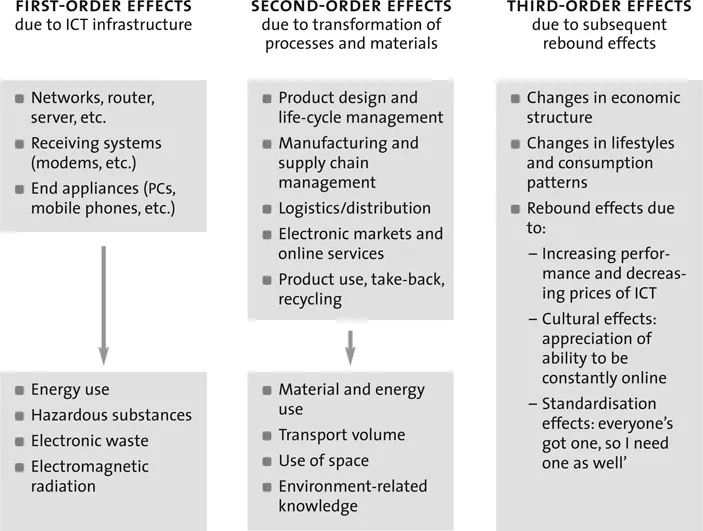
- ∎ The network infrastructure (server, router, etc.), as distinct from terminals, has considerable relevance for energy consumption and environmental effects.
- ∎ Potentials for increasing resource productivity are presumed mainly to lie in the B2B area. US studies (e.g. Romm et al. 1999; Cohen 2000) indicate considerable potential in the areas of reducing stocks of flawed products, energy consumption and floor space used for retail and office businesses.
- ∎ Any assessment of the environmental effects of e-commerce on traffic and the environment is linked to multiple assumptions and requires complex modelling. The results of the analyses of environmental effects are thus extremely dependent on the underlying assumptions.
- ∎ Online orders tend to accelerate the delivery of goods and to change the structure of shipped freight towards smaller units; this results in an increase in courier, express and parcel deliveries.
- ∎ On the other hand, Swedish studies show that e-commerce does not necessarily entail more traffic (Jönson and Johnsson 2000). Under certain conditions,online shopping has the potential to reduce the volume of traffic. The realisation of that potential depends crucially on the population density of the home delivery service area, the share of e-commerce users, the delivery distances travelled, and the type of transportation used in the respective region.
- ∎ Only a very few existing studies take rebound effects into account (Romm et al. 1999; Laitner and Koomey 2000). Most empirical studies reflect only the effects at a certain point in time.
| Subject of the study | Positive environmental effects | Negative environmental effects |
| Eco-balance: reading an article in an online newspaper as compared to a conventional newspaper (Plätzer and Göttsching 1998) | An online newspaper uses ten times the energy of a conventional newspaper (with respect to consumption of fossil primary energy) and produces about twice as much waste. | |
| Swedish study: comparing online shopping and traditional shopping for food and goods for daily needs (Jönson and Johnsson 2000) | Dependent on circumstances: the energy consumption for transport of goods is 5%–7% lower with online shopping if the delivery route amounts to a distance of 50–90 km and about 25 families are supplied. | |
| Eco-balance for desktop personal computers: comparing ‘traditional’ life-cycle and life-cycle with use of e-commerce (Caudill et al. 2000) | If possibilities of e-commerce are used to their full extent in production (B2B, reduction of stocks, etc.), sales (B2C) and in take-back, energy use and environmental impact can be reduced by about 10%. | If possibilities of e-commerce are used in the sales area only (B2C), the energy use surpasses that of traditional distribution channels by about 10%.This is above all due to accelerated shipment by air cargo. |
| Comparing printed and online catalogues of a mailorder firm (energetic balance of the complete life-cycle) (Greusing and Zangl 2000) | The primary energy consumption of an online catalogue is about 24 times that of a printed catalogue. The main ‘energy consumer’ is the personal computer needed to read the online catalogue. |
1.3 Business strategies: why take environmental aspects into account?
- ∎ Costs can be lowered or avoided.
- ∎ A firm can differentiate itself from competitors and thus increase its sales.
- ∎ New business areas and markets can be opened up.
- ∎ Risks (liability, brand image) can be reduced.
- ∎ Markets can be secured through compliance with regulations and resulting acceptance on the part of stakeholders (‘licence to operate’).

1.4 Approaches for sustainable business strategies
Table of contents
- Cover
- Half Title
- Title
- Copyright
- CONTENTS
- Foreword
- Introduction. Atom to bits: e-sustainability in the global economy
- PART 1: Sustainability challenges and implications of a global information economy
- PART 2: E-business strategies for a sustainable world
- PART 3: Old-economy concerns in a new-economy world
- Bibliography
- List of abbreviations
- Author biographies
- Index
Frequently asked questions
- Essential is ideal for learners and professionals who enjoy exploring a wide range of subjects. Access the Essential Library with 800,000+ trusted titles and best-sellers across business, personal growth, and the humanities. Includes unlimited reading time and Standard Read Aloud voice.
- Complete: Perfect for advanced learners and researchers needing full, unrestricted access. Unlock 1.4M+ books across hundreds of subjects, including academic and specialized titles. The Complete Plan also includes advanced features like Premium Read Aloud and Research Assistant.
Please note we cannot support devices running on iOS 13 and Android 7 or earlier. Learn more about using the app