Understanding the characteristics of material contact and lubrication at tribological interfaces is of great importance to engineering researchers and machine designers. Traditionally, contact and lubrication are separately studied due to technical difficulties, although they often coexist in reality and they are actually on the same physical ground. Fast research advancements in recent years have enabled the development and application of unified models and numerical approaches to simulate contact and lubrication, merging their studies into the domain of Interfacial Mechanics.
This book provides updated information based on recent research progresses in related areas, which includes new concepts, theories, methods, and results for contact and lubrication problems involving elastic or inelastic materials, homogeneous or inhomogeneous contacting bodies, using stochastic or deterministic models for dealing with rough surfaces. It also contains unified models and numerical methods for mixed lubrication studies, analyses of interfacial frictional and thermal behaviors, as well as theories for studying the effects of multiple fields on interfacial characteristics. The book intends to reflect the recent trends of research by focusing on numerical simulation and problem solving techniques for practical interfaces of engineered surfaces and materials.
This book is written primarily for graduate and senior undergraduate students, engineers, and researchers in the fields of tribology, lubrication, surface engineering, materials science and engineering, and mechanical engineering.
Trusted by 375,005 students
Access to over 1.5 million titles for a fair monthly price.
“Interface” is a general term that concerns a boundary between two different materials, which can possibly be in any combination of solid(s), liquid(s), and gas(es). Interfacial phenomena are complex in nature. Relevant studies on interfacial behaviors have been in a wide range from different aspects, often multi-scale and interdisciplinary that may involve many branches of science and engineering. Great efforts have been made in order to understand interfacial mechanics, physics, and chemistry in different fields. However, so far, there has not been a well-developed branch of science that covers all the different types of interfacial phenomena in a general sense. Interfacial mechanics, in fact, is still an evolving field of study generally in its infancy.
In this book, our discussion will focus on a special type of interface system, called “tribological interface”, or “interface” in short, that consists of two solid body surfaces in contact and possible relative motion with or without fluid(s) in between. This specific type of interface system is widely seen in reality and extremely important in science and engineering practice. Figure 1.1 gives a sketch showing two solid surfaces in contact and relative motion, but, in reality, fluid(s) (often acts as lubricant), boundary films and a small quantity of debris/particles may also be observed in this interface system. For commonly used metallic materials, thin oxide films, as well as some other surface layers and coatings, may often exist in engineering reality. Because the boundary and oxide films are usually extremely thin, and the size and quantity of possible debris very small, they are often ignored in most interfacial analyses. Therefore, a basic model used in this book is constructed with two solid bodies having smooth or rough surfaces in contact and possible relative motion with or without fluid lubricant in between.
FIGURE 1.1 Schematic of a tribological interface system.
Power and motion are transmitted through interfaces, which are often lubricated in one way or another, at surface contact locations of various components that are basic elements of all kinds of vehicles, industrial machineries, engineering equipment, and scientific devices. As is well known, a large portion of energy produced globally is dissipated through frictional loss that occurs mainly due to the interaction of surfaces of machine components. Also, it has been found that, today, roughly more than 70%–80% of mechanical component failures take place or originate at surfaces due to severe contact, rubbing, and insufficient lubrication. Machine performance, loading capacity, efficiency, durability, and reliability appear to be macro-scale events that always need to be well controlled and optimized in engineering practice. However, they are dependent strongly upon micro- and nano-scale interfacial characteristics. A deep understanding of the nature of such interfacial mechanisms, therefore, is vital to components design and product development. In the 21st century, critical issues associated with energy shortage, environmental pollution, and global warming, as well as their impact to economic growth and stability, impose increasingly strong challenges to researchers and engineers, thus striving for better efficiency and reliability becomes more urgent than ever before.
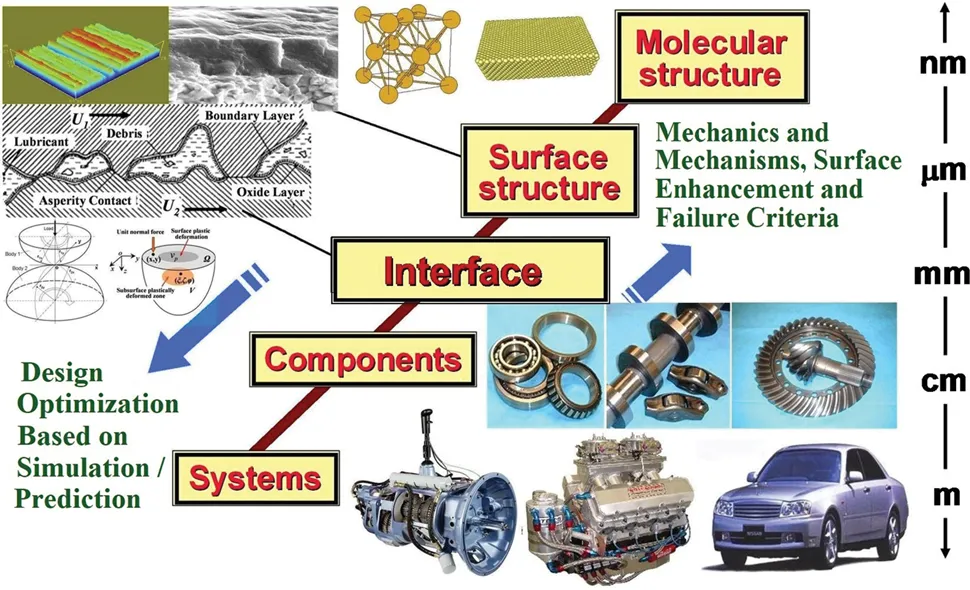
In reality, solving interfacial problems may involve multi-scale multidisciplinary science and engineering, including continuum mechanics, rheology, mechanical design theory, materials science, thermal dynamics, physics, chemistry, and others. Associated studies may span from macro- to micro- all the way down to nano- and subnano-scales, as depicted in Figure 1.2.
For such complicated multi-scale problems, however, continuum mechanics-based contact and lubrication analyses are fundamental, providing basic information, such as interfacial pressure due to solid contact and/or hydrodynamics, lubricant film thickness or gap, surface deformation, friction/traction, temperature, and subsurface strain, and stress distributions, which are necessary for performance, efficiency, and failure predictions. Also, it serves as a foundation of further in-depth investigations in the areas of interfacial physics, chemistry, and materials failure mechanisms.
FIGURE 1.2 Multi-scale system problems.
It is well known that material failures found in mechanical components can generally be categorized into two types: structure (or bulk) failures and surface failures. For structure failures, predicting and preventing technologies have been much better developed. For example, not long ago, people still relied on photoelasticity, strain gauge experiments, and destructive tests to evaluate structure strengths. In the last few decades, as the FEM/CAD technologies have been well developed with commercial software packages readily available, system and component structure strength can now be quickly and accurately predicted by using computers. Product development cycles have been greatly shortened, and photoelasticity and destructive tests can be avoided in most cases. Today structure failures have been significantly reduced in engineering reality.
On the other hand, however, the majority of component failures fall in the surface failure category. These include sliding and fretting wear, scuffing, pitting due to contact fatigue, and others. Unfortunately, so far, interfacial sciences and problem-solving technologies are still mostly premature, and few commercial software packages are conveniently available for engineers to accurately evaluate surface strength of various components.
In fact, today modeling and analyzing contact and lubrication problems, predicting interface performance, and evaluating surface strength and life often appear to be a bottleneck in advanced product design and development. Moreover, critical problems found during laboratory and field tests, machine operations, and customer warranty services are usually associated with malfunction and failure of interface systems, statistically much more than any other problems. There are great challenges, together with vast opportunities, for further development in the field of interfacial sciences, and the importance of understanding these interfaces can never be overestimated.
1.2 Tribological Interface Systems
The interface in contact with relative motion is often referred to as a tribological interface. The word “tribology” originated from the Greek word, tribos, which means rubbing between two surfaces or simply refers to a science about “rubbing” (Halling, 1971). Tribology, in other words, is a branch of science that develops theories and technologies for improving functionality, efficiency, and durability of the surfaces in contact and relative motion.
It is important to note that a tribological interface usually involves two solid surfaces in contact with or without lubricating media in between that can possibly be liquid(s), solid(s), gas(es) or their combination(s). Also, the two solid bodies may have surface oxide layers, adsorbed layers, boundary layers, non-uniform layers due to various fabrication processes and surface treatments. Within the solid bodies, there may be impurities, particles, fibers, inclusions, defects, voids, and other types of inhomogeneity. Typically, ultrathin oxide and bou...
Table of contents
Cover
Half Title
Title Page
Copyright Page
Table of Contents
Preface
Acknowledgments
Authors
Nomenclature
Chapter 1 Introduction
Chapter 2 Properties of Engineering Materials and Surfaces
Chapter 3 Fundamentals of Contact Mechanics
Chapter 4 Numerical Methods for Solving Contact Problems
Chapter 5 Fundamentals of Hydrodynamic Lubrication
Chapter 6 Numerical Methods for Hydrodynamic Lubrication
Chapter 7 Lubrication in Counterformal Contacts—Elastohydrodynamic Lubrication (EHL)
Chapter 8 Mixed Lubrication with Rough Surfaces
Chapter 9 Thermal Behaviors at Counterformal Contact Interfaces
Chapter 10 Behaviors of Interfacial Friction
Chapter 11 Contact of Elastoplastic and Inhomogeneous Materials
Chapter 15 Multifield Interfacial Issues and Generalized Contact Modeling
Appendix A: Basic Expressions in Linear Elasticity
Appendix B: Fourier Series, Fourier Transform, Convolution, and Correlation
Appendix C: Solutions of the FRFs for Multilayered Materials Under Normal and Shear Loadings
Appendix D: Reference Source Code in FORTRAN for Discrete Convolution and Fast Fourier Transform (DC-FFT)
Appendix E: Basic Equations and Their Discretization Schemes for Numerical Solution of Mixed EHL
Appendix F: Potential Functions, Derivatives, and Equations Used in Chapter 11
Appendix G: Stresses and Surface Displacement Caused by a Cuboidal Inclusion with Uniformly Distributed Eigenstrain
Appendix H: Material Property Parameters and Coefficients for the MEMCT Theory
Appendix I: Frequency Response Functions for Surface-Source Induced Temperature and Thermal Elasticity
References
Index
Frequently asked questions
Yes, you can cancel anytime from the Subscription tab in your account settings on the Perlego website. Your subscription will stay active until the end of your current billing period. Learn how to cancel your subscription
No, books cannot be downloaded as external files, such as PDFs, for use outside of Perlego. However, you can download books within the Perlego app for offline reading on mobile or tablet. Learn how to download books offline
Perlego offers two plans: Essential and Complete
Essential is ideal for learners and professionals who enjoy exploring a wide range of subjects. Access the Essential Library with 800,000+ trusted titles and best-sellers across business, personal growth, and the humanities. Includes unlimited reading time and Standard Read Aloud voice.
Complete: Perfect for advanced learners and researchers needing full, unrestricted access. Unlock 1.5M+ books across hundreds of subjects, including academic and specialized titles. The Complete Plan also includes advanced features like Premium Read Aloud and Research Assistant.
Both plans are available with monthly, semester, or annual billing cycles.
We are an online textbook subscription service, where you can get access to an entire online library for less than the price of a single book per month. With over 1.5 million books across 990+ topics, we’ve got you covered! Learn about our mission
Look out for the read-aloud symbol on your next book to see if you can listen to it. The read-aloud tool reads text aloud for you, highlighting the text as it is being read. You can pause it, speed it up and slow it down. Learn more about Read Aloud
Yes! You can use the Perlego app on both iOS and Android devices to read anytime, anywhere — even offline. Perfect for commutes or when you’re on the go. Please note we cannot support devices running on iOS 13 and Android 7 or earlier. Learn more about using the app
Yes, you can access Interfacial Mechanics by Jane Wang,Dong Zhu in PDF and/or ePUB format, as well as other popular books in Technology & Engineering & Mechanics. We have over 1.5 million books available in our catalogue for you to explore.