- 224 pages
- English
- ePUB (mobile friendly)
- Available on iOS & Android
eBook - ePub
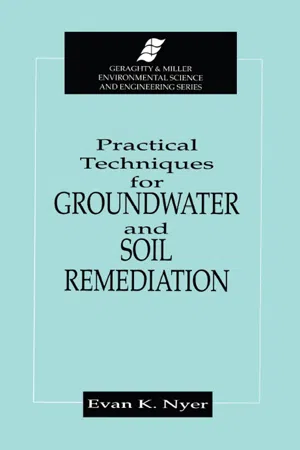
Practical Techniques for Groundwater & Soil Remediation
About this book
Practical Techniques for Groundwater and Soil Remediation is a compilation of articles by the author that were printed in the National Ground Water Association (NGWA) magazine Groundwater Monitoring Review. The book provides valuable data, emphasizes the practical aspects of remediation, presents results from actual remediation programs, and helps readers prepare remediation strategies. The book also includes detailed technical data on treatment equipment performance and the costs associated with their design and operation. A unique feature of the book is that it also contains data from treatment systems that did not work.
Practical Techniques for Groundwater and Soil Remediation is a "must have" source of invaluable data and tips that will be useful for all groundwater and soil remediation professionals.
Trusted by 375,005 students
Access to over 1 million titles for a fair monthly price.
Study more efficiently using our study tools.
Information
Subtopic
Environmental ScienceIndex
Biological SciencesSECTION II
Properties of the Contaminants
There are two important uses for the chemical properties of organic compounds at a remediation site. The first use is as part of the investigation. The properties of the compounds show the interaction of the organics with the environment around the organics. In fact, the only way that we understand what the data means is by interpreting the concentration of a compound in relation to the properties of that compound.
The best example of this use is retardation factors. We know that organic compounds do not migrate at the same rate as the free water in the aquifier. The chemical interaction of the organic compounds with the soil particles of the aquifer cause the organics to be retarded as they move through the aquifer. Retardation is a fundamental factor of contaminant treatment design. All remediations consider this chemical property when dealing with plume movement or recovery.
Other examples of the use of the chemical properties in investigations include the adsorption of compounds on soil and the volatility of compounds in the vadose zone. Adsorption can be used to determine the amount of material that is retained by the soil in the vadose zone and never reaches the aquifer. Volatility can be used to explain contaminant concentration measured in the vadose zone gas phase in relation to groundwater and soil concentrations.
A second important use of the chemical properties is in the design of the treatment systems that are used to remove the compounds from ground water and soils. Specific data is readily available on the treatability properties of each compound. This data can be used to prepare a preliminary analysis, preliminary designs, and cost estimates on a treatment method for a site.
An example of this use is the Henry’s Law constant for the design of air strippers. This section lists the Henry’s Law constant for fifty organic compounds. Based upon this data, the designer can estimate the removal efficiency that an air stripper will have on a particular compound. Using this chemical property, the designer can determine whether an air stripper should be studied further or eliminated as a possible treatment method. Carbon adsorption and biological treatment can be evaluated by the same method. This is a very cost effective method to evaluate treatment systems. Based upon chemical properties, most treatment methods can be selectively eliminated before significant amounts of money have been spent on the feasibility study.
This section provides the information necessary for these evaluations. The properties of most of the organic compounds that will be found at contaminated sites are included in these chapters. The first discusses chemical mixtures like gasoline. An important point to remember when dealing with a spill of a material like gasoline is that it is made up of several compounds. Each compound has its own properties. Any remediation design has to encompass all of the compounds (and their properties) if it is to be successful. The remaining chapters give the detailed information on the chemical properties and discusses how to utilize them in a project.
CHAPTER 2
Relating the Physical and Chemical Properties of Petroleum Hydrocarbons to Soil and Aquifer Remediation
Evan K. Nyer and George J. Skladany
This chapter is devot...
Table of contents
- Cover
- Title Page
- Copyright Page
- Preface
- Author
- Dedication
- Table of Contents
- Introduction
- Section I Starting the Project
- Section II Properties of the Contaminants
- Section III Developing Treatability Data
- Section IV Developing Detailed Designs
- Section V Unit Operations
- Section VI Selection of Treatment Alternatives
- Section VII Practical Problems
- Section VIII In Situ and Natural Biochemical Remediations
- Contributors
- Index
Frequently asked questions
Yes, you can cancel anytime from the Subscription tab in your account settings on the Perlego website. Your subscription will stay active until the end of your current billing period. Learn how to cancel your subscription
No, books cannot be downloaded as external files, such as PDFs, for use outside of Perlego. However, you can download books within the Perlego app for offline reading on mobile or tablet. Learn how to download books offline
Perlego offers two plans: Essential and Complete
- Essential is ideal for learners and professionals who enjoy exploring a wide range of subjects. Access the Essential Library with 800,000+ trusted titles and best-sellers across business, personal growth, and the humanities. Includes unlimited reading time and Standard Read Aloud voice.
- Complete: Perfect for advanced learners and researchers needing full, unrestricted access. Unlock 1.4M+ books across hundreds of subjects, including academic and specialized titles. The Complete Plan also includes advanced features like Premium Read Aloud and Research Assistant.
We are an online textbook subscription service, where you can get access to an entire online library for less than the price of a single book per month. With over 1 million books across 990+ topics, we’ve got you covered! Learn about our mission
Look out for the read-aloud symbol on your next book to see if you can listen to it. The read-aloud tool reads text aloud for you, highlighting the text as it is being read. You can pause it, speed it up and slow it down. Learn more about Read Aloud
Yes! You can use the Perlego app on both iOS and Android devices to read anytime, anywhere — even offline. Perfect for commutes or when you’re on the go.
Please note we cannot support devices running on iOS 13 and Android 7 or earlier. Learn more about using the app
Please note we cannot support devices running on iOS 13 and Android 7 or earlier. Learn more about using the app
Yes, you can access Practical Techniques for Groundwater & Soil Remediation by Evan K. Nyer in PDF and/or ePUB format, as well as other popular books in Biological Sciences & Environmental Science. We have over one million books available in our catalogue for you to explore.