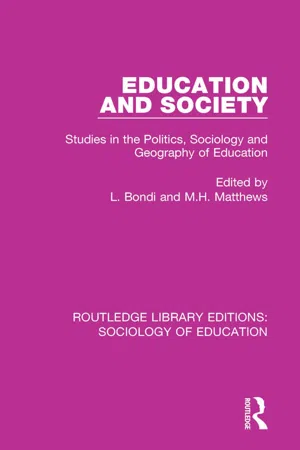
This book, first published in 1988, examines the most contentious issues in contemporary education. The political, social, educational and geographical impact of changes in the provision of educational services are discussed and illustrated through a wide range of case studies. Issues are examined from a number of different perspectives, amongst them those of the parent, the educational administrator and the organisational theorist, with the result that eh book is able to evaluate which changes are most consistent with the requirements of each group. This book will be of interest to students of sociology and education.
eBook - ePub
Education and Society
Studies in the Politics, Sociology and Geography of Education
- 332 pages
- English
- ePUB (mobile friendly)
- Available on iOS & Android
eBook - ePub
Education and Society
Studies in the Politics, Sociology and Geography of Education
About this book
Trusted by 375,005 students
Access to over 1.5 million titles for a fair monthly price.
Study more efficiently using our study tools.
Information
Topic
EducationSubtopic
Education GeneralPart One
THE POLITICS OF EDUCATIONAL PROVIS1ON
Chapter One
CONSULTING FOR CHANGE: THE POLITICAL GEOGRAPHY OF SCHOOL REORGANISATION IN PORTSMOUTH
Alan Burnett
INTRODUCTION
Perspectives on school reorganisation
Schools are being reorganised and closed in many British cities but there are relatively few studies of either the mechanics or political processes by which these changes are (or are not) being accomplished, (but see Brown and Ferguson, 1977, 1982; Bailey, 1982; Thomas and Robson, 1984; Bondi, 1987; and Adler and Bondi in this volume).
During 1981 and 1982 parents in Portsmouth were consulted over the future shape of sixth-form education. The local education authority (Hampshire County Council), faced with falling school rolls, declining numbers in sixth forms of several secondary schools, and the need to make savings, proposed that changes be made to sixth-form provision in the city. The local Area Office was charged with investigating the problem and, having consulted those potentially affected, recommending changes. Figure 1.1 shows the numerous organisations involved in making decisions or influencing them. The education committee of Hampshire County Council was the locus of municipal responsibility, with its decentralised Portsmouth Area Office officials and their advisory committee playing a key role. Governing bodies of schools and parents were consulted through official channels and other organisations and groups made their views known in other ways.
Figure 1.1: Official and Unofficial Organisations Involved in Decision-making over Sixth- form Provision in Portsmouth

Discussions on the issue took place over a period of 18 months and a two-stage consultation exercise was mounted over (1) what form future sixth-form provision should take, and (2) which existing secondary school should be closed to make way for a sixth-form college. Parents of all schoolchildren in the city were consulted as well as school governors, teachers and the public. The involvement of parents and the public over this issue provided an opportunity to explore the extent and efficacy of public involvement in an aspect of educational policy-making in one British city. As Boaden, Goldsmith, Hampton and Stringer (1982) have noted, it is over such administrative questions in education that public involvement is frequently encouraged.
Although there is one parent-representative on the governing body of every school in the city, parents are heavily outnumbered by political appointees, including the nominees of the majority Conservative Party. Governing bodies have been characterised by Packwood (1984, p. 271) ‘as something of a catspaw; convenient at different times for promoting different purposes’. He argues that they are merely ‘talking shops’, with ambiguous objectives, uncertain authority and only indirect accountability. In Portsmouth, as elsewhere, political decisions of the authority (Hampshire) affecting the size of the education budget, the pattern of schooling, the pupil/teacher ratio, and curriculum planning, are beyond their scope. Although many schools have thriving parent-teacher associations, parents are rarely given any real authority on decision-making bodies and spend much of their time fund-raising and organising social events. Thus, opportunities for parents to be directly or even indirectly involved in major educational decisions affecting their children are limited.
This chapter focuses on the role of parents in this particular aspect of educational policy-making. Initially, Portsmouth’s secondary school system is described, and the ‘problem’ of sixth forms, as defined and presented by officials, is noted. The main part of the chapter consists of a detailed analysis of the form, functions and outcome of the consultation process that was undertaken. The extent and pattern of involvement on the part of parents is noted, as are the roles of county councillors and officers who were centrally involved in the consultation process and its outcome.
As Honey and Sorenson (1984) have noted, closing schools is often very traumatic, not only for those whose school is in jeopardy but also for those making the decisions. Such proposals arise out of population loss or shifts, a decline in the birthrate, obsolete buildings, a prevailing attitude among educational administrators that learning is enhanced in schools large enough to provide curricular and staff flexibility, and fiscal retrenchment. School reorganisation and, in particular, school closure is an acute spatial political problem because benefits and costs that are not geographically uniform, are altered; for example, proximity to a school means a quick and safe journey for pupils and quiet weekends for neighbours. Thus ‘(c)losing schools destroys benefits while imposing additional costs on children and their parents when children are reassigned to more distant schools’ (Honey and Sorenson, p. 119). The potential for conflict is therefore high.
The procedures for making school reorganisation and closure decisions are likely to be crucial. In Britain, central government legislation and guidelines (particularly the Education Act 1980 and subsequent Circulars) have ensured that parents are informed and consulted and have the right of appeal to the Secretary of State. One strategy employed by officials to reduce conflict is to present the causes as technical rather than political, thereby increasing the role of experts. But even the expert assessment of buildings, costs and pupil re-assignment, and the preparation of an array of alternatives with supporting background data, does not result in what Honey and Sorenson (p. 123) call ‘a politically antiseptic result’.
A case study of this sort can, of course, be interpreted from one or more of the numerous theoretical approaches currently employed by social scientists and human geographers. In this study, locational conflict and managerialist perspectives are favoured. Thus, for example, there are reasons for anticipating that education officers will manage any public consultation in the interests of gaining acceptance for policies they believe in and (coincidentally) are in the interests of organisations to which they belong. It is also likely that participation by parents will revolve around individual schools that are threatened, and will only occur if parents see their children being adversely affected. Members of the public who live close to schools may also protest if a change in the status of a school is thought to adversely affect the amenity value of their neighbourhood.
CASE STUDY - PARENTS IN SCHOOL REORGANISATION
Secondary education in Portsmouth
Following major reorganisation in 1975, nine maintained comprehensive secondary schools were established in the city. In 1981, a total of 10,439 pupils were being taught in the secondary sector, of which only 750 were in sixth forms. While the two denominational and two single-sex schools drew their intake from broader areas of the city, entry to the remaining five mixed comprehensives was primarily from neighbourhood, feeder, middle schools. The city operated a ‘designated area’ system whereby parents were permitted to send their children to a school other than the one designated, only if there were ‘extra’ places available. Details of non-denominational secondary schools in the city are presented in Table 1.1 and the location of schools and their catchment areas is shown in Figure 1.2. Clearly, schools in Portsmouth vary in previous status, total enrolment, sixth-form enrolment, and (in so far as the number of ‘enforced’ pupils is a measure of unpopularity and the percentage of pupils from outside the catchment area is a measure of their popularity) the esteem in which they are held. Priory and Mayfield each had sixth forms of over 100, while there were between 50 and 100 sixth formers at Springfield, City Boys and City Girls, and Great Salterns.
It was estimated by local officials that all schools would have spare capacity by the end of the decade. Two (King Richard and City Girls) would, if parents continued to select schools for their children as they had in the past, be left with tiny intakes. Whereas in January 1981 the 15+ age-group in the city totalled 2,513, by 1993 it was estimated that it would decline to 1,470. Given a 20 per cent staying-on rate, it was feared that most, if not all, sixth forms could not be sustained.
Figure 1.2 shows that all but the two single-sex schools had catchment areas based largely on a neighbourhood principle. In the north-west of the city, King Richard serves the predominantly local authority housing estates of Paulsgrove and Wymering; to the east of the A3, Springfield’s catchment area covers Cosham, Farlington and Drayton as well as Highbury (where the city’s largest further education college is situated). Great Salterns caters for children in the east of Portsea Island, and Priory is the only non-denominational state secondary school in the south of the city. The catchment areas of Mayfield and the two single-sex schools (all more ‘centrally’ placed in the city) are more complex. Pupils are allocated to these schools by sex and by where they live. Thus, in Hilsea girls went to Mayfield and boys to City Boys, whereas Copnor boys were allocated to Mayfield and girls to the City Girls School.
Table 1.1 Neighbourhood comparison


Source: Area Education Office
Figure 1.2: Secondary Schools and Catchment Areas in Portsmouth

This, then, was the spatial structure of secondary education in the city in 1981. Turning to the sixth-form curriculum, schools offered a varying range of both ‘A’ and ‘O’ level and less academic courses. In addition, many 16- year-olds attended courses at Highbury College of Technology, and the College of Art, Design and Further Education. Some travelled outside the city: substantial numbers living in the north-east of the city, attended Havant Sixth-Form College.
Official definition of the problem
There is no evidence that any concern regarding the quality of sixth-form provision in Portsmouth was articulated by either parents or teachers in the city. Nor, indeed, was it county councillors or school governors who put the issue on the agenda. Rather, it was education officials at Winchester and in the local Area Office, prompted by the Department of Education and Science (DES), who began to look critically at the size of some school sixth forms in the early 1980s. A policy to cope with future falling school rolls was required. County officials had already confronted the problem elsewhere in Hampshire, for example, in the Gosport area. Once officials had raised the issue, elected members began to voice their concern. Thus, in 1981, the chairman of Hampshire Education Committee was quoted as saying that
while comprehensive schools in Portsmouth had done an excellent job and the results in sixth forms are very creditable indeed … nonetheless it is easy (but undesirable) to shut one’s eyes to the impending storm and let matters drift on in cost complacency. (Portsmouth News, 12 December 1981)
The projected falling school rolls, the small size of several existing sixth forms and the limited range of ‘A’ level courses being offered, the apparent success of sixth-form colleges and tertiary colleges elsewhere in Hampshire, combined to convince officials and councillors that structural changes in the school system were necessary. The possibility of a solution involving ad hoc arrangements whereby sixth-form pupils could transfer on a full-time or shared basis between schools, was rejected at the outset. Officials argued that there was no way of achieving an acceptable level of sixth-form provision, and making the necessary economies, if they retained the existing pattern of secondary schools.
Whilst clearly impressed by the need to take action, councillors evidently viewed the prospect with some trepidation. In Gosport, the loss of the sixth form of certain schools had been vigorously and successfully opposed and county councillors feared that the public might not readily accept the need for yet another major alteration in the school system, especially if it involved the closure of any schools. The chairman of the County’s education committee was at pains to point out that
these predictions (of falling rolls) were not the work of bureaucrats playing with theoretical calculations but were based on actual births and children in schools. (Portsmouth News, 12 December 1981)
Thus, the question of sixth-form reorganisation was initiated, highlighted and framed by of...
Table of contents
- Cover
- Half Title
- Title Page
- Copyright Page
- Table of Contents
- List of Figures
- List of Tables
- Preface
- Introduction: Liz Bondi
- Part One: The Politics of Educational Provision
- Part Two: Social Issues in Education
- Conclusion: Liz Bondi
- References
- Index
Frequently asked questions
Yes, you can cancel anytime from the Subscription tab in your account settings on the Perlego website. Your subscription will stay active until the end of your current billing period. Learn how to cancel your subscription
No, books cannot be downloaded as external files, such as PDFs, for use outside of Perlego. However, you can download books within the Perlego app for offline reading on mobile or tablet. Learn how to download books offline
Perlego offers two plans: Essential and Complete
- Essential is ideal for learners and professionals who enjoy exploring a wide range of subjects. Access the Essential Library with 800,000+ trusted titles and best-sellers across business, personal growth, and the humanities. Includes unlimited reading time and Standard Read Aloud voice.
- Complete: Perfect for advanced learners and researchers needing full, unrestricted access. Unlock 1.5M+ books across hundreds of subjects, including academic and specialized titles. The Complete Plan also includes advanced features like Premium Read Aloud and Research Assistant.
We are an online textbook subscription service, where you can get access to an entire online library for less than the price of a single book per month. With over 1.5 million books across 990+ topics, we’ve got you covered! Learn about our mission
Look out for the read-aloud symbol on your next book to see if you can listen to it. The read-aloud tool reads text aloud for you, highlighting the text as it is being read. You can pause it, speed it up and slow it down. Learn more about Read Aloud
Yes! You can use the Perlego app on both iOS and Android devices to read anytime, anywhere — even offline. Perfect for commutes or when you’re on the go.
Please note we cannot support devices running on iOS 13 and Android 7 or earlier. Learn more about using the app
Please note we cannot support devices running on iOS 13 and Android 7 or earlier. Learn more about using the app
Yes, you can access Education and Society by L. Bondi,M. H. Matthews in PDF and/or ePUB format, as well as other popular books in Education & Education General. We have over 1.5 million books available in our catalogue for you to explore.