- 178 pages
- English
- ePUB (mobile friendly)
- Available on iOS & Android
eBook - ePub
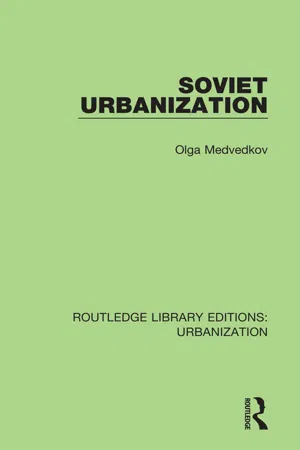
Soviet Urbanization
About this book
Originally published in 1990, Soviet Urbanization provides an assessment of Soviet urban systems. Drawing on her personal experiences at the Soviet Academy of Sciences and bringing with her much material otherwise unavailable in the West, the author analyses the structure of the Soviet urban network and its future development under the constraints of central planning. The author concludes that the danger to Soviet urbanization programme lies in the gap between central planning on the one hand and actual spatial change on the other. This book will appeal to students and academics working in the disciplines of geography, urban studies and planning.
Tools to learn more effectively

Saving Books

Keyword Search

Annotating Text

Listen to it instead
Information
Chapter one
Hierarchy of cities: how it changes and why
The concept of hierarchy
When Geography takes part in Urban Studies it operates with messages coded as maps. It creates maps of deceptively plain appearance. They simplify land patterns of real life to keep facts at a minimum. Their purpose is like that of hieroglyphic symbols. Both emphasize the ideas communicated by images. Both try to bring concepts in a distilled form, without specific details. Which is justified, because one encounters enough headaches with mastering ideas behind images.
Mapped networks of cities are a case in point. Geography treats them with the concept of hierarchy. It is a tool to uncover reasons for the networks being what they are. A hierarchy, as dictionaries define it, is an arrangement of things (or persons) in a graded series; and it has lots of intricacy.
Examine any reference map of a nation, and make sure that it does portray a hierarchy of urban settlements. The map stresses various sizes and centralities for cities, which is a message about their grading in importance (Figure 1.1).
Maps show the scattering of cities of different rank and one may notice some regularity in it. Around any given city its nearest neighbours are mostly small in size. Big cities tend to be more widely spaced than small settlements. It happens because small places are numerous. The explanations may go deeper, and it leads to the treatment of urban hierarchies in Central Place Theories (Dacey, 1965).
There are two Central Place Theories, both started in Germany, before the Second World War. The origin was in a book by Walter Christaller (1933, 1956) and in another one, by August Loesch (1940, 1954). Both deal with emphatically distinct steps of ranking for cities.

Figure 1.1 Soviet urban population, 1987, located in 250 main cities.
Walter Christaller predicts a geometric progression in sizes of urban centres (Christaller, 1962). August Loesch admits also other levels of hierarchy. The disagreement is minor, if one compares it with significance of a common starting principle in two theories. Both Christaller and Loesch accept the making of urban hierarchies only by service functions of cities: by those addressed to rural areas and to vassal settlements. If a city succeeds in clustering such functions it grows in size. The clustering, in its turn, depends on the clientèle mass of serviced territories.
There are alternative explanations for urban hierarchies, with roots not just in urban services (Berry, 1961, Medvedkov, Y., 1966; Tinbergen, 1968; Vapnarskiy, 1969; Matlin, 1974). One of the explanations, the earliest of this kind, belongs to Auerbach (1913); it was rediscovered a generation later and very eloquently popularized by George K. Zipf (1941, 1949). It has potentialities which I am going to use in this chapter for clarifying features of the Soviet urban networks.
Zipf’s approach to urban hierarchies is associated with a so called ‘Rank-Size Rule’. It predicts city sizes in a nation without rigid and distinct steps in grading. The reasoning suggested by Zipf is free from postulating any unique privileges for services in cities. If one sets aside numerous (and ingenious) attempts to portray the Rule as a clone, a derivative from Central Place Theories (Beckmann, 1958) or from trends observed for population density gradients (Okabe, 1979, 1987) the post-Zipf theory in Geography for the Rank-Size Rule is regretfully thin. It is unfair to the originality of Zip’s ideas, and there is more in the Rule than only an empirical and descriptive device for compressing data arrays.
In this chapter a view is presented that independence of Zip’s tradition is a virtue. I am introducing a train of reasoning for strengthening the Rank-Size model in its sovereignty. One may find appealing its freedom from rigid assumptions. It permits more room for experiments in analysing why real-life data fit so well the Rank-Size model, the fact well testified by many authors (Alperovich, 1984; Assamy, 1986; Boventer, 1973; Cassetti et al., 1971; Medvedkov, Y., 1964; Models, 1970; Rashevsky, 1943, 1951; Richardson, 1978; Rosen and Resnik, 1980). Such features are just right for the job in mind.
Consequently, there will be opportunities to return later, within this chapter, to the Rank-Size Rule.
Why knowledge of urban hierarchy is important
The material so far discussed, in this chapter, presents evidence that Geography pays much attention to urban hierarchy. One may legitimately ask, if a justification exists for bringing the same approach into this book.
Why invest more into the same? What urgency is in learning the Soviet reality under the angle of urban hierarchy? Why may it benefit readers and give them a better understanding of social, cultural, economic and political problems in the Soviet Union?
One answer to this is in indicating that knowledge comes with structuring data into information. A process of learning has steps to replace vague opinions by solid findings. For that purpose there are specialized tools of research. They rely on concepts (like that of hierarchy). It means acceptance of traditions in studies; one benefits from their potential.
There is a certain urgency now in bringing the Soviet urban hierarchy into the limelight. Detailed arguments for that are in the next two sections. Here it may be sufficient to mention the present period of disarray in internal Soviet life. The nation is at a point of unpleasant discoveries about itself, and developments are worth watching closely. In any case, this nation is a nuclear superpower and an unexpected course of events within the Soviet Union may bring instability elsewhere.
One may specifically question the usefulness of the hierarchy concept. Why become preoccupied with it? What may it promise of inherent interest? Why does it fit the type of concerns about developments in the Soviet Union?
The answer to these questions is in expounding the meaning of hierarchy. The entire chapter deals with it. At the introductory level it is best, perhaps, to have help from relevant ‘key words’. They are instruments of information retrieval. They are like coordinates for navigating among library shelves or in database browsing with a personal computer. It is easy to make a trial. It will uncover key words with close association to hierarchy.
There are pepper-and-salt relations for hierarchy. It goes together with systems, With flowcharts of authority in organizations. One examines hierarchy for learning who is the boss of whom. Other key words link hierarchy to functioning of systems. They also lead to ways of handling a system, to keeping it under control. This sounds like a journey deep inside the nature of the Soviets, into their rigid, military-like structures.
In examining the hierarchy of cities one may get closer to such key notions as ‘societal system’, ‘national unity’, ‘poles of political power’. Let us remember that one of earlier books on urban hierarchy has the title National Unity and Disunity (Zipf, 1941). It is an acute angle for viewing the Soviet Union, where ethnic groups of Transcaucasia have been involved since the spring of 1988 in a noisy dispute over the territory of Nagorny Karabakh. While this event escalates to the level of a major constitutional crisis one may observe how it triggers many other peripheral regions to voice a spirit of dissatisfaction with the imperial order imposed by Moscow.
The regional structure of the Soviet Union has also economic contradictions and imbalances which may endanger the imperial dominance of Moscow. Central Asia dominates regarding the number of additions to the labour force, whereas Siberia has a monopoly on the main mineral resources. With their resources being clearly complementary the two macro-regions will gain most from establishing direct co-operation. But Moscow is more interested in the underdeveloped Central Asia to keep it in obedience.
One way of getting the answer is in examining the hierarchy of cities. The hierarchy develops from long-term favours in channelling national investments. Each urban centre functions as an accumulation of fixed assets, and in this sense an inquiry into the hierarchy permits one to assess the inertia of the existing economy, i.e. the subject of actual importance for the Soviet Union in its present phase of attempted, but slow going, changes.
Hierarchy of cities belongs to key Soviet structures. The Soviets are an urban empire. The Marxist ideology advocates urban growth. Ambitions to have industrial and military strength have been invested into cities. Much of the success or failure in these ambitions depends on the health of proportions among cities, how well they function in concert. It is acutely intriguing right now, because rapid growth of the Soviet economy is a matter of the past. During the 1980s it came to a grinding halt.
Now, the Soviets are debating reforms and blaming the former leader, Leonid, Brezhnev, for short-sighted investments, and there are voices about ‘paralysis of transport’. Disease of that sort is more complex than shortages of food. ‘Transport product cannot be replaced by another and cannot be bought for currency’ write Vasiliy Selynin and Grigoriy Khanin in Moscow, Novyy Mir (No 2, Feb 1987: 186).
There are other non-replaceable structures in society, like urban systems with a substantial distinction. However, urban systems are harder to modernize, it takes generations to build them.
Economist Abel G. Aganbegyan, a top advisor for the Kremlin, tells in a Soviet weekly how much more damaging is poor quality of manufactured goods. He admits that 1,500 factories are being penalized by the State: their goods of bad quality are not counted towards production goals (AP, July 21; Aganbegyan 1988). It represents a manifest decrease in industrial functions of cities. But what about tracing it in deeper roots?
This book has a chapter on economic functions of Soviet cities. It displays what is wrong at that level. Equally or even more, it is important to have the same for the roots, for the irreplaceable structure of the national urban network. It requires a process of visualization at the root level. The concept of urban hierarchy is a key participant in it.
Models and real-life experiences
This chapter (and others) combine two different types of reasoning. The first is a style with formal constructs of science, including mental models, like that of hierarchy or other mathematical models used for statistical data analysis. The second type of reasoning consists of informal and explanatory arguments, the more difficult of the two, because explanatory reasoning must interpret formal models, and derive conclusions from them or declare them invalid.
One enjoys objectivity and exactness in conducting experiments with formal numerical models. The results come as if automatically, and they are the same with any qualified operator of a computer. Broader life experiences of the analyst are practically irrelevant to the quality of formalized results. Explanatory reasoning is different. The background of an expert manifests itself very strongly in the quality of interpretations, which depend on who does the interpreting, what direct knowledge of the realities is involved, and how intimate was prior access to key structures. Here interpretations must compensate for weaknesses of the formal models. Such models bring results that remain rather indirect probes into major Soviet riddles and mysteries, and the output remains a method of remote sensing. These models need help from explanatory-interpretive reasoning, and conclusions are indirect.
The two styles of reasoning are familiar in many intellectual professions. For example, daily events in a modern medical clinic implement both types of reasoning. Patients are examined by laboratory tests, and a patient may be given laboratory results....
Table of contents
- Cover
- Half Title
- Title Page
- Copyright Page
- Table of Contents
- List of figures
- List of plates
- List of tables
- Introduction
- 1 Hierarchy of cities: how it changes and why
- 2 Soviet cities and their functional typology
- 3 The interaction between industrial and social content of cities
- 4 What kind of solutions are in stock?
- Personal epilogue
- References
- Index
Frequently asked questions
Yes, you can cancel anytime from the Subscription tab in your account settings on the Perlego website. Your subscription will stay active until the end of your current billing period. Learn how to cancel your subscription
No, books cannot be downloaded as external files, such as PDFs, for use outside of Perlego. However, you can download books within the Perlego app for offline reading on mobile or tablet. Learn how to download books offline
Perlego offers two plans: Essential and Complete
- Essential is ideal for learners and professionals who enjoy exploring a wide range of subjects. Access the Essential Library with 800,000+ trusted titles and best-sellers across business, personal growth, and the humanities. Includes unlimited reading time and Standard Read Aloud voice.
- Complete: Perfect for advanced learners and researchers needing full, unrestricted access. Unlock 1.4M+ books across hundreds of subjects, including academic and specialized titles. The Complete Plan also includes advanced features like Premium Read Aloud and Research Assistant.
We are an online textbook subscription service, where you can get access to an entire online library for less than the price of a single book per month. With over 1 million books across 990+ topics, we’ve got you covered! Learn about our mission
Look out for the read-aloud symbol on your next book to see if you can listen to it. The read-aloud tool reads text aloud for you, highlighting the text as it is being read. You can pause it, speed it up and slow it down. Learn more about Read Aloud
Yes! You can use the Perlego app on both iOS and Android devices to read anytime, anywhere — even offline. Perfect for commutes or when you’re on the go.
Please note we cannot support devices running on iOS 13 and Android 7 or earlier. Learn more about using the app
Please note we cannot support devices running on iOS 13 and Android 7 or earlier. Learn more about using the app
Yes, you can access Soviet Urbanization by Olga Medvedkov in PDF and/or ePUB format, as well as other popular books in Physical Sciences & Geography. We have over one million books available in our catalogue for you to explore.