- 200 pages
- English
- ePUB (mobile friendly)
- Available on iOS & Android
eBook - ePub
About this book
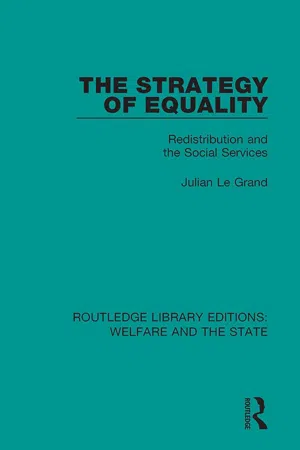
Originally published in 1982 The Strategy of Equality examines public expenditure on the social services as a strategy for promoting social equality. Today there is a widespread belief that the strategy has worked and that public spending on the social services primarily benefits those less well off. However, there have been few attempts to examine whether this belief is founded in reality. This book attempts to rectify this. Examining four areas of social policy: health care, education, housing, and transport, the book looks at the distribution of public expenditure and the 'outcome' of that expenditure, as well as the implications for various conceptions of equality.
Tools to learn more effectively

Saving Books

Keyword Search

Annotating Text

Listen to it instead
Information
PART ONE
The Dream
CHAPTER 1
Introduction
The aim of this book is to examine a key element of what R. H. Tawney has termed the Strategy of Equality. This is the attempt to achieve social and economic equality through public spending on what are commonly termed the ‘social services’: health, education, housing and transport. Under this strategy the revenues raised through general taxation are used to fund the provision of these services free or at subsidised prices to some or all of those using them. By these means, it is believed the domain of inequality is severely restricted and its unfortunate social consequences eliminated.
This strategy has played a dominating role in the growth of public expenditure in Britain, and indeed throughout the world. Wholly or partially in the name of equality, most governments subsidise in some way the provision of medical care, education, housing and transport. Many also subsidise a wide variety of other goods and services for basically similar reasons. Yet there has been little analysis of these policies from an egalitarian point of view. Precisely what kind of equality is being aimed at? Does public expenditure on these goods and services actually achieve equality in any sense of the term? And what effect is there on the overall pattern of social and economic inequality? Despite the importance of such questions, few have tried to address them in any detail. Accordingly, this book is an attempt to rectify this omission.
Its conclusions are not comforting for those who subscribe to the strategy, or indeed for anyone who believes that public expenditure is broadly egalitarian in its effects. For the evidence reviewed suggests that:
• Almost all public expenditure on the social services in Britain benefits the better off to a greater extent than the poor. This is not only true for services such as roads where, due to the insignificant role played by a concern for equality in determining policy, such an outcome might be expected; it is also true for services whose aims are at least in part egalitarian, such as the National Health Service, higher education, public transport and the aggregate complex of housing policies.
• As a result equality, in any sense of the term, has not been achieved. In all the relevant areas, there persist substantial inequalities in public expenditure, in use, in opportunity, in access and in outcomes. Moreover, in some areas (though by no means all) there is evidence to suggest that the policies concerned have failed even to reduce inequality significantly.
The book’s structure is straightforward. The next chapter outlines the Strategy of Equality, as expressed by its adherents, and endeavours to formalise it in as specific a fashion as possible. The next four chapters examine the distributional impact of public expenditure on health care, education, housing and transport: the key components of the ‘social services’ and essential elements of the Strategy of Equality. All these chapters have the same format. They begin with an investigation of the distribution of public expenditure in the area concerned, reviewing the available evidence, and, where relevant, discussing possible explanations for the distributional pattern that emerges. They continue with a brief consideration of the distribution of what might loosely be termed the ‘outcome’ of that expenditure: health standards, educational outcomes, housing conditions and travel. Where possible, the links between these distributions and the distribution of public expenditure in the area concerned are also examined. The final sections of each of these four chapters, entitled ‘Equality and Policy’, may be read independently of the other sections. They consist of a brief description of the various ways in which the objective of equality has been interpreted in the area concerned, an assessment as to whether equality, in any of its possible interpretations, has actually been achieved, and a discussion of the prospects for policy reform.
Chapter 7 draws on the material of the preceding four chapters to provide an overall assessment of this particular strategy of equality. Chapter 8 discusses an alternative strategy: the redistribution of money income. Finally, there are three appendices: Appendix A, which discusses studies of the distribution of public expenditure in general and some of the methodological difficulties they encounter; Appendix B, presenting some additional tables; and Appendix C, which describes the principal income and occupational classifications used in the main text.
The book may be read in a number of different ways, depending on the purpose of the reader. Those who want to know simply the main thrust of the argument should read Chapters 2, 7 and 8. Those interested in the individual services, but who are prepared to take the details of the statistics on trust, should look at the same three chapters, plus the sections on Equality and Policy in Chapters 3, 4, 5 and 6. And those whose concern is only with the facts concerning the distribution of public expenditure should read the first sections of Chapters 3, 4, 5 and 6, and Appendix A.
With the exception of Appendix A, technical terminology – whether of economists, sociologists or statisticians – has been avoided as far as possible, in order to make the book accessible to a wide audience. Those few technicalities that have crept into the main text are explained in notes at the end of each chapter. With the exception of certain government publications, which are referred to by their title, references to other work are signalled in the text by the name of the author followed by the date of publication: the full reference can be found in the Bibliography at the end of the book.
A final word. In some of what follows, extensive use is made of statistics. These are inhabitants of a cold realm; they lack the warmth of personal experience or the flow of bar-room anecdotes. Yet the facts they contain are essential; for no one individual’s personal experience, however diverse, can equip him or her adequately to pass judgement on the consequences of a particular policy or set of policies. Every attempt has been made to make the numerical material as readable as possible; it is hoped that no one will find it too unpalatable.
CHAPTER 2
The Dreamers
If every individual were reared in conditions as favourable to health as science can make them, received an equally thorough and stimulating education up to sixteen and knew on reaching manhood that ... he and his family could face the risks of life without being crushed by them, the most shocking of existing inequalities would be on the way to disappear ... Even inequalities in income ... would not continue in such conditions to be, either in magnitude or kind, what they are at present ... As ... the surplus elements in incomes were increasingly devoted to public purposes, while the means of health and education were equally diffused throughout the whole community, ‘the career open to talent’, which today is only a sham, would become a reality. R. H. Tawney
Large scale public spending is a relatively new phenomenon. In the Middle Ages, virtually the only form of state expenditure was military: the king funding his armies for the defence of the realm. Even as late as 1890, total government expenditure comprised less than a tenth of the Gross National Product (GNP) and nearly half of that was on military and war-related items. But since that time, public spending has increased dramatically. By 1900, it had risen to 14 per cent of GNP; by 1920 it was over 25 per cent, and by 1950 over 40 per cent. By 1978–9 total public expenditure was over £70,000 million or 44 per cent of the national product.1
A large part of this growth was due to increased public expenditure on what are generally described as the ‘social services’. In 1920 (the earliest date for which reliable data are available) public expenditure on health care, education and housing was less than 3 per cent of GNP: the proportion for 197 8–9 was 15 per cent. If personal social services and transport are included,2 then total public expenditure on the social services in 1978–9 was £26,000 million or 18 per cent of GNP.
The importance of the social services relative to other areas of government expenditure can be gauged from Figure 2.1. This shows the relative sizes of different categories in 1978–9. After social security (which constituted a quarter of public expenditure in Great Britain in that year), education and health care were the biggest items in the government budget, taking up 13 and 11 per cent of public expenditure, respectively. After defence, housing was the next largest, with 8 per cent: transport and personal social services together took up 6 per cent. In total, expenditure on the social services comprised nearly 40 per cent of all government expenditure in Great Britain, and well over half of the expenditure on goods and services (public expenditure excluding transfer payments, such as social security or debt interest).

Figure 2.1 Public expenditure on selected services, Great Britain 1978–9.
Source:. Appendix B, Table B. 1.
A major justification for such a massive expansion of government activity has been the pursuit of equality. As will be illustrated in the first section of this chapter, the belief that some kind of equality can be achieved through public expenditure on the social services has long been an essential part of what R. H. Tawney called the Strategy of Equality. As will become apparent, it is widely believed that this strategy has actually been largely successful: that public expenditure in the relevant areas has indeed achieved a substantial measure of equality in some sense of the term. However, neither those who advocated the strategy nor those who believe it has worked have been very specific about the kind of equality they had (or have) in mind. Accordingly, the remainder of the chapter is an attempt to specify in as precise a fashion as possible the various ways in which the objective of equality can be interpreted, an essential preliminary to the analysis of the strategy’s efficacy to be undertaken in subsequent chapters.
The Strategy of Equality
As the coiner of the phrase, Tawney should have the first word. An essential element of any strategy for reducing inequality, he argued, was (Tawney, 1964, p. 122):
the pooling of [the nation’s] resources by means of taxation, and the use of the funds thus obtained to make accessible to all, irrespective of their income, occupation, or social position, the conditions of civilization which, in the absence of such measures, can be enjoyed only by the rich.
By these means, he went on:
It is possible for a society ... thus ... to abolish, if it pleases, the most crushing of the disabilities, and the most odious of the privileges which drive a chasm across it. It can secure that, in addition to the payments made to them for their labour, its citizens enjoy a social income ... [which] ... is available on equal terms for all its members.
The other major supporter of the strategy was Anthony Crosland. In the conclusion to his seminal work on egalitarian socialism (Crosland, 1956, p. 519) he emphasised that he laid:
great stress on the relation, a direct and intimate one, between social expenditure and social equality. The former can promote the latter in two ways: first, by removing the greater handicap which poorer families suffer as compared with richer, during sickness, old age and the period of heaviest family responsibility, and secondly by creating standards of public health, education and housing which are comparable in scope and quality with the best available for private purchase.
The belief that public expenditure on the social services can promote social equality has not been confined to Tawney and Crosland. It has played a crucial role in the development of the welfare state in Britain (see, for example, Marshall, 1970, Ch. 12; Robson, 1976, Ch. II),3 and it is now widely accepted that the aims of the social services include ‘especially social equality’ (Townsend, 1975, p. 28). It has had great influence on the Labour Party; for instance, the February 1974 manifesto included as one of its objectives: ‘Increase social equality by giving far greater importance to full employment, housing, education and social benefits’ (Craig, 1975, p. 405, emphasis added). In the United States it has become part of a philosophy, called variously ‘specific egalitarianism’ (Tobin, 1970) and ‘categorical equity’ (Feldstein, 1975), arguing that certain commodities should be distributed equally, or at least not according to individuals’ ability to pay.
Nor does it lack support today. Dr David Owen, in his recent tract on social democracy, while also advocating the redistribution of private income and wealth, emphasises the importance of the ‘social wage’ as a means of attaining greater equality, and devotes much space to the ways in which policy in the relevant areas (housing, education and health care) can be reformed better to achieve that end (1981, pp. 97–110). Colin Crouch, in one of a recent collection of essays assembled as a tribute to Crosland, claims that ‘it is impossible to envisage an egalitarian politics ... which will not need to divert resources from the unequal individualised market process so that they can be put to communal use by popularly responsive public agencies’ (1981, p. 185). Nick Bosanquet, in the Fabian assessment of the 1974–9 Labour government’s record in promoting equality, claims that ‘it is hard to see how we can move towards a fairer society – a more even distribution of income and life chances – unless this core of the public sector [social security, education, the NHS, social services and housing] has an expanding share of GDP’ (1980b, p. 40); although he goes on to add, in a significant caveat, that success would depend on how the money was used. And even such a fervent critic of egalitarianism as Sir Keith Joseph, in his polemic against equality written with Jonathan Sumption, has asserted that, if a society is unwise enough to attempt to promote equality, ‘the only practical means of doing so’ is via public spending on goods and services (Joseph and Sumption, 1979, p. 111).
The hope that equality of some kind can be attained through public expenditure on the social services can also be found in statements, both official and unofficial, concerning the objectives of public policy towards specific se...
Table of contents
- Cover
- Half Title
- Title Page
- Copyright Page
- Table of Contents
- Acknowledgements
- PART ONE: THE DREAM
- PART TWO: THE REALITY
- PART THREE: THE STRATEGY
- APPENDICES
- Bibliography
- Index
Frequently asked questions
Yes, you can cancel anytime from the Subscription tab in your account settings on the Perlego website. Your subscription will stay active until the end of your current billing period. Learn how to cancel your subscription
No, books cannot be downloaded as external files, such as PDFs, for use outside of Perlego. However, you can download books within the Perlego app for offline reading on mobile or tablet. Learn how to download books offline
Perlego offers two plans: Essential and Complete
- Essential is ideal for learners and professionals who enjoy exploring a wide range of subjects. Access the Essential Library with 800,000+ trusted titles and best-sellers across business, personal growth, and the humanities. Includes unlimited reading time and Standard Read Aloud voice.
- Complete: Perfect for advanced learners and researchers needing full, unrestricted access. Unlock 1.4M+ books across hundreds of subjects, including academic and specialized titles. The Complete Plan also includes advanced features like Premium Read Aloud and Research Assistant.
We are an online textbook subscription service, where you can get access to an entire online library for less than the price of a single book per month. With over 1 million books across 990+ topics, we’ve got you covered! Learn about our mission
Look out for the read-aloud symbol on your next book to see if you can listen to it. The read-aloud tool reads text aloud for you, highlighting the text as it is being read. You can pause it, speed it up and slow it down. Learn more about Read Aloud
Yes! You can use the Perlego app on both iOS and Android devices to read anytime, anywhere — even offline. Perfect for commutes or when you’re on the go.
Please note we cannot support devices running on iOS 13 and Android 7 or earlier. Learn more about using the app
Please note we cannot support devices running on iOS 13 and Android 7 or earlier. Learn more about using the app
Yes, you can access The Strategy of Equality by Julian Le Grand in PDF and/or ePUB format, as well as other popular books in Social Sciences & Sociology. We have over one million books available in our catalogue for you to explore.