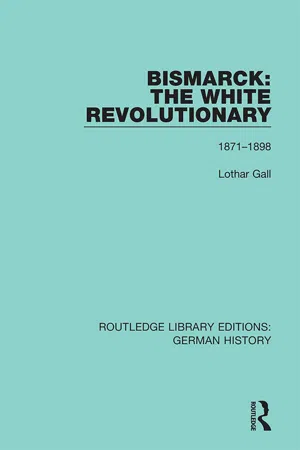
Originally published in English in 1986, these volumes are far more than the story of the life of a powerful statesman. The name Bismarck sums up the entire political, social, economic and intellectual development of central Europe in the second half of the 19th Century and the internal and external shape that Germany then assumed. This book analyses how much of this was Bismarck's personal achievement or whether he was the man who put the nation on the disastrously wrong course that reached its fateful culmination in 1933? It examines whether Bismarck's success was precisely because he implemented policies for which the time was ripe and did so in ways that were in harmony with the historical evolution of central Europe.
- 280 pages
- English
- ePUB (mobile friendly)
- Available on iOS & Android
eBook - ePub
About this book
Trusted by 375,005 students
Access to over 1.5 million titles for a fair monthly price.
Study more efficiently using our study tools.
Information
Topic
GeschichteSubtopic
Business allgemeinPART THREE
The Sorcerer’s Apprentice
[10]
New Constellations, New Conflicts
‘I am weary, and while still bound up with the life of this world I begin to appreciate the attractions of peaceful repose. What I should like most is to leave the stage for a seat in one of the boxes.’1 This was not the Bismarck of the late 1880s writing, a septuagenarian at the end of a long career. The words were penned by the newly appointed Chancellor of the recently founded German Reich, a man universally regarded as having reached the very climax of a political career that might last no one knew how long. For nine years now he had led the state of Prussia, a state that had steadily expanded under his leadership and enormously increased its influence and its importance in terms of European power politics. He had gone on to become chief minister first of the North German Confederation and then of the Reich, for the internal and external policy of which he was now as directly responsible as he was for those of Prussia. As head of the nascent imperial executive, as Minister-President and Foreign Minister of Prussia, as the effective voice of Prussia as chief power in the Federal Council, as chairman of the latter, and not least as ‘founder of the Empire’ (‘Reichsgründer’), with all the prestige that that conferred, he held in his hands such a wealth of power as at his age, and given his character, suggested anything but retirement, renunciation and self-effacing resignation. And he did indeed remain in office for a further eighteen years, with this concentration of power combined with the great weight of his increasingly inflexible personality constituting an ever more oppressive burden on the nation and on the forces within it that were striving to unfold and to shape circumstances in their own way and on their own responsibility.
Yet it was no mere coquettish whim of the moment that was expressed in those lines written to Catherine Orlov on Christmas Day 1871, as in many others written around that time. Granted, there were various external reasons for his feeling that way: a protracted and at one point seemingly dangerous illness suffered by his wife, his own susceptibility to ill health, early signs of advancing age, even a certain weariness of success. But there was something else hidden behind all this, something of which much of it was merely symptomatic.
From his early years he had lived in a state of protest, as it were, against the regimentation and discipline of the life of modern man and against the resultant ossification and impoverishment of human existence. Over and over again he had broken out in order to escape such constraints and not be a slave to the world purely in terms of a job, office, or profession. Freedom, independence, individuality – everything the writers of his youth, Shakespeare, Byron, Heine, the young Goethe, had invoked – remained a fundamental need for him, one that kept coming demandingly to the fore. It was also a crucial element in his religious life and in his belief in a personal God who ruled men in freedom.
In the life of a diplomat who had risen to high office by an unusual route he had enjoyed what he had at first regarded as a scarcely conceivable degree of freedom. He had further been able constantly to remind himself that the whole thing was on a temporary basis, that it might be exchanged at any time for the independent existence of the country squire, but that the way upwards, as it were, was also permanently open, the post of Foreign Minister having been mentioned as a possibility from the outset. Subsequently, however, he had come increasingly ‘under the yoke’, as he called it. At first he had still had to reckon with his days as chief minister in Prussia being very probably numbered. Again this had enabled him to see everything in terms of an experiment, a momentary harnessing of forces in a specific direction, a purely temporary one-sidedness, as it were. Who knew how soon he would be ‘turning [his] back on this unremitting river of ink and living quietly in the country’, he kept asking. Without such a prospect the ‘bustle of life’ was downright ‘unbearable’.2 Then, however, with success and the consequent strengthening of his position it became ever clearer that, as happens to everyone in such a situation, he had in a way become a slave to that success and to that position. During those years the individual, the private person, was increasingly obscured by the politician, the diplomat, the minister, by the problems that preoccupied him and the manifold tasks with which he was confronted in ever-changing forms.
Bismarck’s whole make-up was such that he always retained a keen awareness of the process whereby private gradually became dissipated in public life. ‘One has simply to renounce one’s private life when one becomes a public personage’, he summed up resignedly on one occasion in the 1880s.3 Unlike many, he found this a very high price to have to pay for success – even at times of the most intense involvement and concentration, when he was almost wholly taken up with the tasks of office. Politics, he complained repeatedly, was ‘dessicating’ everything in him; ‘neither hunting, nor music, nor company gave him pleasure any more’.4
The idea of freeing himself from all this, of living his own life once again, kept its power of attraction over the years, and not just in periods of illness, despondency, or aversion to work. It constituted a kind of counterpoint to his public life. It enabled him, for all his ambition, all his passionate commitment and all his highly developed taste for power, to maintain a certain detachment, a sense of never being inextricably involved – and to do so even and indeed especially at moments of crucial importance as far as his political existence was concerned. This in turn enabled him to stake his all each time, including his whole political position. His many offers to resign, though for the most part purely tactical in intention, in essence embodied a readiness, indeed almost a secret inclination to send himself qua public being into retirement. For him this was the expression and confirmation of that ‘autonomy of private life’ of which he had dreamt as a young man that he would be able to carry it over ‘into the public sphere’.5
The ‘autonomy of private life’ was an ideal. But in Bismarck’s level-headed pragmatism it meant at the same time securing the material foundations of a private livelihood. Since learning what it meant to live by politics and be dependent on career and success he had striven continually to broaden the narrow base that his paternal inheritance provided for him outside his official position.
He had done so, moreover, with extraordinary success. The fact that a heavily indebted country squire owning two relatively small estates became in the space of a few decades a man of means who left his children assets running into millions of marks already provoked speculation among Bismarck’s contemporaries. Such speculation has never entirely ceased to this day. However, a meticulous, expert and wholly unprejudiced examination of Bismarck’s fortune has meanwhile come up with what is probably definitive proof that there can be no question of any irregularities here, not even in the indirect sense of taking advantage of official information.6
Bismarck’s prosperity rested on two things, and there was nothing secretive or dubious about either of them. One was the fact that in an age of sustained boom conditions and rapid economic growth he found in the Frankfurt-based Meyer Carl von Rothschild, and later and more particularly in Gerson Bleichröder, bankers who administered his revenues and property with the utmost skill. The other was the fact that the state of Prussia manifested extreme generosity towards its first citizen. In February 1867 he received an endowment of 400,000 taler in cash, a sum amounting to several million marks in today’s currency. Shortly afterwards, in April 1867, he used it to purchase from Count Blumenthal the domain of Varzin, between Köslin and Stolp in East Pomerania (Koszalin and Sfupsk in what is now Poland), an estate of more than 14,000 acres that comprised seven villages. And in 1871 a further endowment brought him the Sachsenwald in the duchy of Lauenburg, just east of Hamburg, a forest of almost 16,000 acres. This, together with a further 1,250 acres of land and a hunting lodge, albeit a derelict one, constituted an asset that was likewise worth many millions of marks in present-day currency. Recently created a hereditary prince, Bismarck was now one of the biggest landowners in Germany. Moreover, he contrived to increase his holdings systematically, manifesting an insatiable appetite for land despite Bleichröder’s demonstrating to him on numerous occasions that the yield from such acquisitions, even given improved administration, was far inferior to what could be obtained in other sectors of the economy. In Bismarck’s eyes, the only man who was beholden to nobody was the man who owned land.
Only the fact that he owned land allowed him to lead the one kind of life he considered worthwhile. Before 1871 he had tried in vain to combine the life-style of an estate-owner and country squire with the demands and commitments arising out of his various offices. But Schönhausen had become too small for him and Varzin was too far away and above all too difficult of access. The Sachsenwald, however, had the Berlin-Hamburg railway running right through it, with a stop at Friedrichsruh, a tiny place consisting in the main of a hotel-restaurant for excursionists, the Specht, which Bismarck purchased in 1879 as his future residence.
So from 1871 on the Sachsenwald and Friedrichsruh formed the true centre of his life, the ‘refuge’, as he wrote, that he was unfortunately ‘condemned’ far too often ‘to contemplate with the eyes of Tantalus’.7 This was where, realizing the aspirations of his youth, he felt his earthly life to be firmly rooted, as it were, far from the city and its sea of houses, that architectural symbol of the regimentation of all life, that ‘stony ice’ that ‘will not melt’, as he once wrote to his wife from St Petersburg,8 far too from an ever more prevalent bourgeois life-style from which he was able to gain nothing either in a positive or in a negative sense – if we except his furniture, which, suggesting a total lack of interest in this regard, was that of a wealthy bourgeois with no taste. Here he could spend hours in the saddle or on foot in the midst of nature, following its growth, observing the cycle of the seasons and reflecting on the ways in which man depends on change and harmony, on the ordinary and on the extraordinary aspects of his natural surroundings. He often found it more important to jot such things down in his devotional and commonplace books than to record what the day had brought in the way of politics and human intercourse. Here he could organize his day as he liked and as he had been in the habit of doing from an early age, sleeping late, obeying sudden whims, but also sitting down to a particular problem for hours on end without being disturbed, burying himself in the writing of a memorandum or the drafting of a Bill. Here, even more than in Berlin, everything was arranged to suit his desires and preferences, including the remarkable eating habits that never failed to astonish guests at the Chancellery, the tendency to stuff himself indiscriminately with herrings and sweetmeats, roasts and nuts, sausages and pickles, and then wash it all down with two or three bottles of red wine, champagne, or even beer. People spoke of whole turkeys being consumed at a sitting by this gigantic but also increasingly corpulent man – until in the early 1880s Dr Schweninger put a partial stop to such excesses by prescribing a strict diet.
Friedrichsruh brought to an end twenty years of a nomadic existence in which Bismarck had always seen an element of the artificial, an element that at the very deepest level ran counter to his true nature. Granted, since his tour in St Petersburg he had lived all the time with one foot on his estates, as it were; only to a limited extent had he settled into his official residence at Wilhelmstrasse 76 – with good reason, as many people believed, in view of his initially precarious political position. Nevertheless, even outwardly he had led the life of the modern breed of mobile civil servant tied to no particular place other than capital and court, a life he had been inclined to mistrust so deeply, not least on account of this peculiar lack of ties. His three children, Marie, Herbert and Wilhelm, had grown up in the city. They were children of a top civil servant, a minister of the Crown, not primarily children of a Prussian nobleman; their conscious minds but also their whole lives were, like his own, more bound up with the city than with the rural aristocracy, making them more Mencken than Bismarck.
Twenty years earlier this had seemed to him inconceivable. ‘A state that cannot, as a result of a salutary thunderstorm, tear itself free from a bureaucracy such as ours’, he had written to Hermann Wagener in June 1850, ‘is and remains doomed to extinction.’ He had added: ‘Bureaucracy is cancerous in head and limbs; only its belly is sound, and the laws it excretes are the most straightforward shit in the world.’9 He himself, he had been convinced, would never become the kind of bureaucrat he so loathed, the man who at every stage of his career tended to see everything in accordance with the files and with ‘general principles’ and usually even rearrange it to fit. Nor did he ever become one in that sense; all the same, his attitude and ideas had changed a great deal in this respect as well.
At one time he had included the Prussian reformers among bureaucrats of this stamp and fulminated against them for having, in the name of an abstract idea of reason and of the state, done violence to tradition and to the social order as an organic growth. Now he had in many ways become an advocate of that kind of development himself. The state as intervening in and altering ever broader areas of social life and organization had not been pushed back at all during his period of office hitherto; it had been enormously strengthened.
Much of this, of course, particularly in the economic sphere, came under the heading of removing a wide variety of constraints, releasing individual forces and promoting the free development of society and the various groups within it. But that disguised and concealed what was really going on, namely the step-by-step construction of the modern interventionist state. This made its greatest steps forward precisely in the guise of the liberalizing, reforming state. That was true of the era of ‘enlightened despotism’, it was true of the revolution of 1789 and it was true of the Prussian reforms of the post-1806 period. The process continued all over Europe throughout the nineteenth century. After eight years of collaborating with liberalism and liberal reformist policies in broad areas of the economy and society, the Prussian Minister-President soberly remarked on one occasion in 1874 that the Prussian bureaucracy was spreading ‘after the fashion of groundwater, everywhere finding the same level’.10
From his arch-conservative viewpoint Bismark had once had far too sharp an eye for this aspect of developments not to have been aware of the extent to which he had himself meanwhile become a protagonist of this very process of an increasing bureaucratization and nationalization of broad areas of existence. When he occasionally remarked that the growing opposition of a large number of his fellow aristocrats and former political friends to himself and to his policy ultimately reflected only their envy at his success, at his meteoric rise up the social ladder to the rank of prince, that kind of reduction of profounder issues to purely human considerations shows one thing above all else: it shows that, convinced though he was of the inevitability of the process, he had what one might almost call instinctive misgivings about the whole thing; he knew exactly what his fellow aristocrats, his ‘quarrelsome cousins’, as he bitterly dubbed them on one occasion in 1873,11 reproached him with.
Not that he seriously disturbed the supremacy enjoyed by the nobility in the diplomatic and officer corps and in the higher ranks of the civil service. The trend was towards increasing middle-class influence in all these spheres, but it was one he consistently opposed, even during the period of close collaboration with the National Liberals, and in the 1880s, in the so-called ‘Puttkamer Era’, named after the famous/notorious Prussian Minister of the Interior who took office in 1881, he fought systematically against it. At the same time his own policy was in fact further undermining the position of the nobility as a class, and he made a crucial contribution towards strengthening and extending the foundations of modern economic society with its levelling effect.
The process that he helped along with the policy for which he was responsible seems in retrospect to have been so ineluctable and so inevitable that attention tends in fact to become concentrated solely on the obstacles that Bismarck himself increasingly placed in its path. Yet many contemporaries still saw things in a very different light. This applies primarily to those areas and those strata of society, particularly east of the River Elbe, among which the forms and customs of economic life were still in many instances bound up with the forms and customs of the traditional social order and where the latter still largely determined the way people thought. Here the apparent arbitrariness of the laws passed and the measures taken by the state, the element that allegedly served a particular political line and its social objectives, stood out very clearly with either a positive or a negative connotation. It often obscured the element of simple reaction to the pressure of circumstances; this can be deduced from the impassioned debates about local government reform as much as from many other political disputes of the period. The upshot, however, was that those who felt ‘got at’ saw Bismarck, to a very much greater extent than is often appreciated today, as a kind of traitor – a traitor to his class, to the party to which he owed his career and his political position, and even to his own convictions.
To start with, in the period immediately after 1866, this had been the opinion of only a few. But since then it had been steadily gaining ground. For all the glamour conferred by his success, Bismarck found himself more and more isolated: the loneliness of the powerful was aggravated by the loneliness of the man who appears to adopt a position outside his social group, outside his class. To that extent there was something very artificial about his life on his Sachsenwald estate: it was a private invocation of a form of existence in which in reality he no longer had any part – not only because of his position but also, and above all,...
Table of contents
- Cover
- Half Title
- Title Page
- Copyright Page
- Original Title Page
- Original Copyright Page
- Dedication
- Epigraph
- Contents
- Part Three: The Sorcerer’s Apprentice
- Notes
- Sources and Literature
- Index of Names
Frequently asked questions
Yes, you can cancel anytime from the Subscription tab in your account settings on the Perlego website. Your subscription will stay active until the end of your current billing period. Learn how to cancel your subscription
No, books cannot be downloaded as external files, such as PDFs, for use outside of Perlego. However, you can download books within the Perlego app for offline reading on mobile or tablet. Learn how to download books offline
Perlego offers two plans: Essential and Complete
- Essential is ideal for learners and professionals who enjoy exploring a wide range of subjects. Access the Essential Library with 800,000+ trusted titles and best-sellers across business, personal growth, and the humanities. Includes unlimited reading time and Standard Read Aloud voice.
- Complete: Perfect for advanced learners and researchers needing full, unrestricted access. Unlock 1.5M+ books across hundreds of subjects, including academic and specialized titles. The Complete Plan also includes advanced features like Premium Read Aloud and Research Assistant.
We are an online textbook subscription service, where you can get access to an entire online library for less than the price of a single book per month. With over 1.5 million books across 990+ topics, we’ve got you covered! Learn about our mission
Look out for the read-aloud symbol on your next book to see if you can listen to it. The read-aloud tool reads text aloud for you, highlighting the text as it is being read. You can pause it, speed it up and slow it down. Learn more about Read Aloud
Yes! You can use the Perlego app on both iOS and Android devices to read anytime, anywhere — even offline. Perfect for commutes or when you’re on the go.
Please note we cannot support devices running on iOS 13 and Android 7 or earlier. Learn more about using the app
Please note we cannot support devices running on iOS 13 and Android 7 or earlier. Learn more about using the app
Yes, you can access Bismarck: The White Revolutionary by Lothar Gall, J. A. Underwood in PDF and/or ePUB format, as well as other popular books in Geschichte & Business allgemein. We have over 1.5 million books available in our catalogue for you to explore.