Originally published in 1945, at a time when feelings against the German people were running high, this book is as much a revealing insight into the psyche of the Germans as it is a history of Germany from the late 18th century to the end of WWII. The author firmly believed that a path of reconciliation and a peaceful future for relations with Germany could only be achieved by understanding key episodes from the country's past.
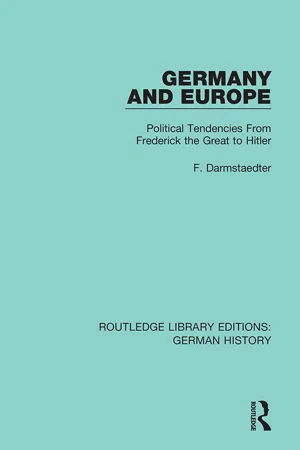
eBook - ePub
Germany and Europe
Political Tendencies From Frederick the Great to Hitler
- 230 pages
- English
- ePUB (mobile friendly)
- Available on iOS & Android
eBook - ePub
LIST OF PERSONS AND DATES
ALGAROTTI, FRANCESCO CONTE, 1712–1764: distinguished Venetian writer and connoisseur; 1740 joined the court of Frederick the Great.
ARGENS, JEAN BAPTISTE MARQUIS D’, 1704–1771: illustrious French litterateur; 1744 joined the court of Frederick the Great.
ARISTOGEITON: a young Athenian who together with his friend Harmodius, about 514 B.C. attacked the Athenian tyrants Hippias and Hipparchus and therefore was put to death.
ARNDT, ERNST MORITZ, 1769–1860: German poet and political writer; 1806 invoked German national spirit against Napoleon; 1819 insisted on constitutional reforms and therefore lost his university chair; 1848 member of Frankfurt National Assembly.
AUGUSTINE (AURELIUS AUGUSTINUS), 354–430: from 396 Bishop of Hippo; the most illustrious Latin Father of the Church; his greatest work is De Civitate Dei.
BACH, JOHANN SEBASTIAN, 1685–1750: famous German composer and organist; his musical production embraces almost every variety of sacred and secular music.
BAUR, FERDINAND CHRISTIAN, 1792–1860: Protestant theologian of far-reaching influence; founder of the Tübingen School of Theology.
BEETHOVEN, LUDWIG VAN, 1770–1827: great German composer of Dutch extraction; works: nine symphonies, the opera ‘Fidelio’, many other musical pieces.
BERNHARDI, FRIEDRICH VON, 1849–1930: Prussian officer and writer; head of the military history department of the General Staff in Berlin; his chief book, Deutschland und der nächste Krieg, 1912.
BETHMANN-HOLLWEG, THEOBALD VON, 1856–1921: German Riechskanzler 1909–1917; published Betrachtungen über den Weltkrieg, 1919.
BEUTH, PETER CHRISTIAN WILHELM, 1781–1853: Prussian state official; from 1818 member of the Prussian Council of State; mainly responsible for the development of Prussian manufacture after the Wars of Liberation.
BISMARCK, PRINCE OTTO EDUARD LEOPOLD VON, 1815–1898: 1862 Prussian Prime Minister; politically prepared the Prussian conquest of Schleswig and Holstein, 1864; the war against Austria, 1866; and the war against France, 1870; was responsible for the organization of the North-German Confederacy, 1867; and of the German Reich, 1871, whose first Reichskanzler he was from 1871–1890.
BISSCHOP, WILLEMROOSEGAARDE, 1866–1944: a Dutchman; from 1897 living in England; a famous jurist in international law.
BLUCHER, PRINCE GERHARD LEBRECHT VON, 1742–1819: Prussian field-marshal; 1813 C-in-C of the allied Russian and Prussian armies against Napoleon; 1815 of the Prussian army against the same.
BLUM, ROBERT, 1807–1848: German democratic politician; 1848 member of the Frankfurt National Assembly, as such sent to Vienna in order to instigate the revolutionary movement; arrested and court-martialled.
BODIN, JEAN, 1530–1596: celebrated French political writer; published 1576 the work De republica in which he defended the idea of sovereignty.
BÖHMER, JOHANNES FRIEDRICH, 1795–1865: German historian; editor of Fontes Rerum Germanicarum, 1843–1853.
BÖRNE, LUDWIG, 1786–1837: famous German journalist, critic, and politician, especially noted for his Briefe aus Paris.
BOULANGER, GEORGES ERNEST JEAN MARIE, 1837–1891: French general; 1886–1887 minister of war; champion of the idea of revenge for 1870; dismissed from the army; became parliamentarian; persecuted, fled the country and shot himself.
BRENTANO, LUJO, 1844–1931: German economist; from 1891 professor in Munich; authority on modern Workmen’s Association, received the Nobel Prize 1927.
BUNSEN, ROBERT WILHELM EBERHARD VON, 1811–1899: distinguished German chemist; most notable are his studies on electrolysis and on the solar spectrum in company with Kirchhoff.
CALVIN, JEAN, 1509–1564: illustrious Swiss divine and church reformer, who ruled Genevese church and government alike.
CATILINA, LUCIUS SERGIUS, 108–62 B.C.: Roman demagogue and conspirator. Attacked by the orator Cicero, then defeated by Antonius, fell in the battle against the latter.
CAVOUR, CAMILLO BENSO CONTE, 1810–1861: Italian statesman who is mainly responsible for the liberation and unification of modern Italy.
CHAMBERLIAN, HOUSTON STEWART, 1855–1926: English born German writer; strongly anti-British and anti-Semite; extolled German institutions.
CLASS, HEINRICH, 1866– : German lawyer, writer, and reactionary politician; his Deutsche Geschichte appeared 1908.
CLAUSEWITZ, KARL VON, 1780–1831: Prussian general and military writer; in Vom Kriege, 1832, he gave a renowned exposition of the philosophy of war.
CLOOTS, JEAN BAPTISTE BARON VON, 1755–1794: a Prussian of Dutch origin, became a resident of Paris and a fanatical partisan of the French Revolution.
CONSALVI, ERCOLE, 1757–1824: Cardinal and an eminent Italian statesman in the service of the Pope; defending an enlightened and humane policy.
COTTA, JOHANN FRIEDRICH BARON VON, 1764–1832: publisher of Goethe and Schiller, founded the Allgemeine Zeitung at Tübingen in 1793.
CREUZER, (GEORG) FRIEDRICH, 1771–1858: learned and ingenious German philologist and antiquary; from 1804 professor at Heidelberg.
DIEHL, KARL, 1864– : important German economist; from 1908 professor at Freiburg i.B.
DIETZGEN, JOSEF, 1828–1888: autodidact in philosophy; published several philosophical works.
DILTHEY, WILHELM, 1833–1911: German philosopher and historian; from 1882 professor in Berlin; a supporter of positive Idealism.
DROSTE-VISCHERING, CLEMENS AUGUST BARON VON, 1773–1845: German Roman Catholic divine; from 1835 Archbishop of Cologne.
DROYSEN, JOHANN GUSTAV, 1808–1884: German historian; from 1851 professor at Jena; his most important work Geschichte der Preussischen Politik appeared 1855–1876.
DUBOIS-RAYMOND, EMIL HEINRICH, 1818–1896: from 1858 professor of physiology in Berlin.
DÜHRING, EUGEN KARL, 1833–1901: German philosopher and political eco...
Table of contents
- Cover
- Half Title
- Title Page
- Copyright Page
- Original Title Page
- Original Copyright Page
- Preface
- Contents
- Introduction: Parliamentary State and Power State
- I. Germany’s Entry into World Politics: 1750–1914
- II. Absolutism and Democracy: 1750–1790
- III. Humanity and Nationalism: 1790–1820
- IV. Legitimacy and Liberty: 1820–1850
- V. Military Obedience and Civic Courage: 1850–1875
- VI. Love of Peace and Preparation for War: 1875–1914
- VII. A Man and a Book: 1848–1878
- VIII. Revolutionaries and Social Pensioners: 1868–1914
- IX. The Will to Education and the Class Struggle: 1800–1918
- X. Politics and History: 1750–1914
- XI. State and Church: 1815–1880
- XII. Right and Might
- XIII. The Sovereignty of the People and the Unity of the State: 1918–1920
- XIV. A Glance Behind and a Glance Forward
- List of Persons and Dates
Trusted by 375,005 students
Access to over 1.5 million titles for a fair monthly price.
Study more efficiently using our study tools.
Frequently asked questions
Yes, you can cancel anytime from the Subscription tab in your account settings on the Perlego website. Your subscription will stay active until the end of your current billing period. Learn how to cancel your subscription
No, books cannot be downloaded as external files, such as PDFs, for use outside of Perlego. However, you can download books within the Perlego app for offline reading on mobile or tablet. Learn how to download books offline
Perlego offers two plans: Essential and Complete
- Essential is ideal for learners and professionals who enjoy exploring a wide range of subjects. Access the Essential Library with 800,000+ trusted titles and best-sellers across business, personal growth, and the humanities. Includes unlimited reading time and Standard Read Aloud voice.
- Complete: Perfect for advanced learners and researchers needing full, unrestricted access. Unlock 1.5M+ books across hundreds of subjects, including academic and specialized titles. The Complete Plan also includes advanced features like Premium Read Aloud and Research Assistant.
We are an online textbook subscription service, where you can get access to an entire online library for less than the price of a single book per month. With over 1.5 million books across 990+ topics, we’ve got you covered! Learn about our mission
Look out for the read-aloud symbol on your next book to see if you can listen to it. The read-aloud tool reads text aloud for you, highlighting the text as it is being read. You can pause it, speed it up and slow it down. Learn more about Read Aloud
Yes! You can use the Perlego app on both iOS and Android devices to read anytime, anywhere — even offline. Perfect for commutes or when you’re on the go.
Please note we cannot support devices running on iOS 13 and Android 7 or earlier. Learn more about using the app
Please note we cannot support devices running on iOS 13 and Android 7 or earlier. Learn more about using the app
Yes, you can access Germany and Europe by F. Darmstaedter in PDF and/or ePUB format, as well as other popular books in History & Business General. We have over 1.5 million books available in our catalogue for you to explore.