This book interrogates contemporary processes of neoliberal urban renewal in the Global South by studying the model of chawl redevelopment in Mumbai, India.
The model of chawl redevelopment is used to address questions surrounding contemporary urban renewal. Focusing on attempts to redevelop Mumbai´s central middle-class neighbourhoods, popularly known as Girgaum, into a modern downtown of a global metropolis, the author sheds light on the impact this development model has on the everyday lives of people inhabiting transformed urban environments. He examines, from an ethnographic perspective, apparently contradictory intentions of planners, investors, residents, activists and politicians. A combination of detailed and vivid ethnographic accounts and incisive theoretical arguments, the book shows that the highly contested and controversial approach of chawl redevelopment serves as an example of the manifold ideological tendencies in India today, and how they combine, clash and continuously shape each other in surprising and unpredictable ways.
Offering new insights in the topics of class dynamics in the era of globalization and neoliberalism, urban gating, sense studies, and urban politics in South Asia, this book will be of interest to academics working on South Asian Studies, Anthropology, Sociology, as well as Urban and Global Studies.
Batatyachi chawl still stands. Withstanding heat and rain, it stands facing the newly constructed buildings. The hinges of the wooden windows and the gallery railing are mostly worn out and the staircase is old. […] The outer layers of the walls are coming off. The colour has faded away many years back. It has been a long time. The colour you see today is not the colour you can find in any paint bucket. This colour has been created over the years by many who have rubbed their fingers, touched their forehead and by the smoke coming from the chawl.
(Deshpande 2012 [1958], 164; translation by author)
This quote is taken from Purushottam Laxman Deshpande’s collection of short stories about life in a residential community in the southern Bombay neighbourhood called Girgaum during the 1950s entitled Batatyachi chaal (Potato chawl). Widely regarded a classic of Marathi literature, the book depicts everyday life in a chawl, a usually two- to three-storeyed type of residential building constructed for the indigenous population during the era of British colonial rule at the end of the late nineteenth century that is mostly found in the city’s centre. Deshpande, who himself was born into a lower middle-class Brahmin family that resided in a chawl near Girgaum (Chaudhari 1986, 340), offers a tongue-in-cheek depiction of chawl residents’ typical idiosyncrasies. He describes the residents in an ironic, yet sympathetic, tone, poking fun at their religious beliefs and practices, cultural institutions and moderate living standards, as well as their need to get along with each other in the face of crammed living conditions. Batatyachi chaal is inhabited by schoolteachers, clerks and administrative employees, an agglomeration of the educated middle class in Jawaharlal Nehru’s India, whose lives mingle by default in the densely populated residential complex. They mock each other’s religious beliefs, give advice on lifestyle questions and discuss political issues while dealing with changing living conditions in post-Independence India.
While for the most part the book paints a humorous picture of chawl life, it is the last chapter titled Ek chintan (A reflection) that strikes a more serious, even mournful, note. In this gloomy, nostalgic piece, Deshpande warns of the impending demise of ‘chawl culture’. Applying a nostalgic look at chawls, he describes the changes that have occurred in Batatyachi chaal over the years as an indicator of a threat to this way of life. Within a city starting to be dominated by high-rise apartment buildings, chawl residents would begin to feel ashamed for their comparatively moderate lifestyle. Many would move out of chawls and into more modern apartment complexes. Moreover, life in the chawl itself would slowly change and resemble apartment life, imagined as more segregated and anonymous than in the chawl. Social cohesion among residents would wane and demands for more privacy would increase. Growing income disparities between residents would give rise to mistrust and envy and increase the necessity for rule-based institutions (mandals) and account books. Common festival celebrations would disappear, tenement doors that were usually left open would habitually be closed and interaction between residents would generally decrease. All in all, Deshpande concluded that the chawl had already been ‘urbanized’ (‘chaal sheherli’) (Deshpande 2012 [1958], 168) and lost its ‘original character’ in this process. The piece reads like a requiem for a way of life that would not have a place in the rapidly modernizing metropolis that was on the verge of becoming the centre for India’s major financial institutions, the hub of the country’s booming film industry and the destination of a vast number of migrants looking for employment and a better life in the city.
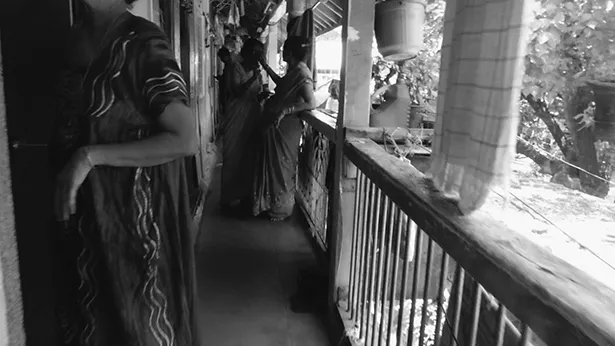
Cut to March 2013. I am getting off a local train at Charni Road station located in the centre of Girgaum (see Map 1.1). I am headed for a chawl complex – usually referred to as wadi1 – to meet one of the residents. The wadi is located just about a short walk away from the train station and lies on a major road that crosses through the neighbourhood. While entering the complex, one has the impression that not much has changed since Deshpande’s account from the 1950s. As I pass the archway bearing the name of the complex, it seems that his lament over the early demise of Girgaum’s chawls was rather premature. The buildings look old and worn out by the years, but most of them appear rather sturdy. Children play cricket in the small lane that stretches out into the complex and leads to a central courtyard. The noise of some labourer hammering on metalwork resounds between the buildings. Passing the open entrance doors of tenements on the ground floor of a chawl, one cannot help but catch glimpses of what is happening inside. A man sits on a bed watching TV; a woman cooks food in the kitchen that is usually located at the back of the tenement. Other residents stand on the common gallery that connects single tenements of a chawl (see Figure 1.1) or sit at a small temple on one end of the courtyard, read newspapers and chat. At first glance, this place could easily pass as the setting of Deshpande’s Batatyachi chaal from 1950s Bombay, rather than what one would expect as a residential complex in the centre of India’s most populated metropolis in 2013.
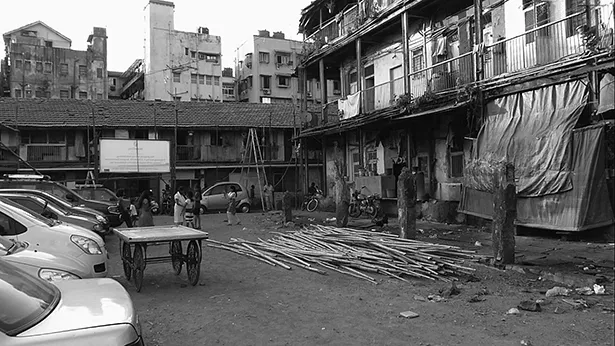
However, while walking further into the wadi, the feeling of being caught in a time capsule suddenly disappears. As I pass another chawl, I spot some large open ground to my left. Such an amount of open space is an unusual sight amidst the number of chawls built right next to each other, often leaving hardly enough space for a single person to pass through between the buildings. The open ground is covered in rubble and marked by a huge signboard that reads “This property now belongs to Shanti Builders and is being redeveloped under DCR 33 (7)”.2 Not long ago, this was the location of another chawl within the wadi. It had recently entered the process of redevelopment, being demolished to make place for a newly constructed high-rise building. The former residents have moved to a transit home in another neighbourhood and are currently waiting for the new building to be constructed, so they can move back into new apartments in the same space. In this process, they would turn from tenants who inhabit a comparatively small amount of space in a more than 100-year-old building into owners of apartment homes in a newly constructed high-rise building, as dictated by the legal framework of chawl redevelopment. Right now, however, there are no signs of any new homes, except for the announcement on the builder’s signboard, and the only remains of the former chawl are some partly visible pillars rising into the air on the side of the ground (see Figure 1.2).
Map 1.1 Map of D-Ward. On this map of Mumbai’s Ward D, the location of Charni Road Station is marked. The Municipal Corporation of Greater Mumbai has divided the city into separate wards and the neighbourhood popularly known as Girgaum stretches out over parts of Wards C and D (Municipal Corporation of Greater Mumbai 2018).
Figure 1.1 Chawl residents chatting on the gallery.
Source: Photo by author.
While the former residents of the demolished chawl wait for their new homes, the residents of the neighbouring chawls have made good use of the newly available open space: Many cars are parked on the ground, children chase each other between the vehicles and some torn up decorations made up of coloured paper adorn one end of the ground, indicating that the space has recently been used for some festive occasion. Especially the number of cars are testament to the comparatively good economic position of Girgaum’s residents and stand in stark contrast to the rather shabby facades of the surrounding buildings. Watching chickens and stray dogs chase each other between fancy cars and the remains of historical buildings, it becomes quite obvious that chawl redevelopment in Girgaum unfolds in a rather paradoxical manner which calls into question standard assumptions about urban renewal in India.
Figure 1.2 Site of a demolished chawl in a wadi in Girgaum.
Source: Photo by author.
This setting encapsulates the various puzzles of chawl redevelopment in Girgaum that I aim to unpack in this book. On the one hand, chawl redevelopment is an ideological hybrid, a development model that resembles attempts at urban renewal informed by neoliberal ideas in many metropolises all over the world, but also includes elements of older socialist ideologies with notable state interventions that aim at inhibiting former chawl residents to be displaced from their area of residence. On the other hand, the way this model is realized on the ground is shaped by various appropriations by different stakeholders that often lead to surprising uses and interpretations. In this regard, it is the conception as well as the implementation of chawl redevelopment in Girgaum that sits uneasily with dominant narratives of neoliberal urban renewal.
The next sections of this introductory chapter will serve to situate the topic of the book in the literature, summarize the core arguments that are developed and outline the structure of the book. I will explain how my analysis of chawl redevelopment contributes to debates about urban renewal in India, anthropological concepts of neoliberalism, the heterogeneity of the Indian middle classes and the relation between ideology and everyday life. Lastly, I will present the methodological apparatus with which I approached my study and outline the chapter structure of the book.
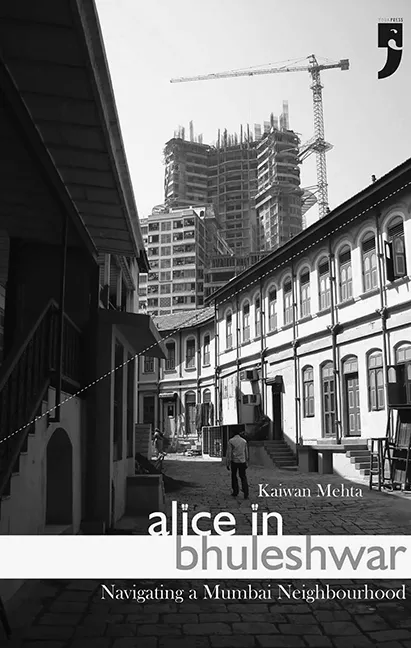
Figure 1.3 Cover of Kaiwan Mehta’s book Alice in Bhuleshwar. The book deals with Girgaum’s chawls, depicting the iconic image of chawls in the front and high-rises in the back of the picture.
Source: Mehta 2009.
Resettlement policies in post-liberalization India
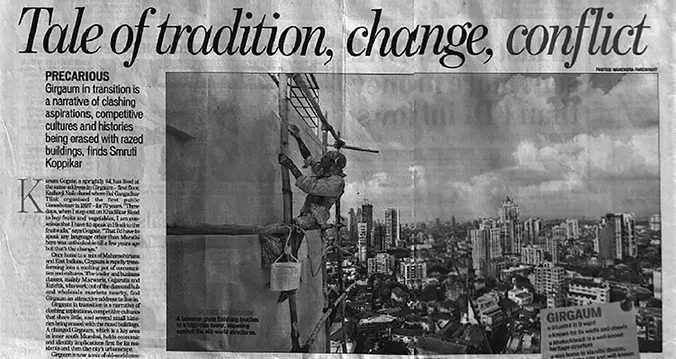
Behind nearly every chawl complex in Girgaum, one can spot several high-rise towers that have come to adorn the skyline of the neighbourhood and silently foretell the possible future of Girgaum’s chawls. Many chawls have been redeveloped into high-rises during the last years, a process that has significantly changed the appearance of the neighbourhood. In fact, it is nowadays nearly impossible to take a photo of a chawl in Girgaum without catching the silhouette of a high-rise tower in the background of the picture. This image has been used numerous times in books and newspaper reports to illustrate the story of spatial and socio-economic transformations that have occurred in the neighbourhood over the last decades (see Figures 1.3 and 1.4). Part of a particular mode of representing contemporary Girgaum, this way of depicting the neighbourhood shapes its public perception and inserts it into a larger narrative about the transition of Indian society from a quasi-socialist past to a modern, consumption-centred future based on a liberalized economy.
Among many scholars, the late 1980s and early 1990s are considered as an era of epochal changes in India’s history. Many studies have argued that the deregulation of markets during this period signified a paradigmatic shift away from an inward-oriented economic strategy devised during the rule of Jawaharlal Nehru in the 1950s and 1960s towards a more substantial involvement in the global economy (Chandrasekhar 2010; Mukherji 2014; Nayar 2001). These economic interventions enabled an unprecedented influx of foreign capital, which led to the emergence of a vibrant consumer culture, new middle-class subjectivities and a restructuring of urban space in the wake of these developments. Along with these shifts in policy, a new image of India as an emerging global power was fashioned and touted by the media. India appeared to have finally been transformed from a Third World country into a competitive global player. Seen from this perspective, replacing Mumbai’s shabby chawls with modern high-rise towers seemed like a crucial element of India’s evolution out of decades of state-sanctioned austerity into a more salubrious age of economic prosperity and global visibility. This aim was to be achieved by the chawl redevelopment scheme.
The chawl redevelopment scheme was introduced by the Indian government during the early 1990s as an extension of the similarly conceptualized slum redevelopment scheme (Mukhija 2006). The main aim of both these schemes was to ensure that chawl and slum residents would be rehoused in new high-rise buildings at the site of their old homes free of cost, while simultaneously enabling private builders to sell additional apartment spaces to new residents at market rates to make redevelopment projects profitable. This type of public–private partnership between residents, landlords, municipal bodies and private builders was expected to solve the problem of lower standard and often unsafe housing and propel the city into a league of other globalizing Asian metropolises with shiny, modern architecture like Shanghai, Singapore or Hong Kong (Ong 2011, 14ff.). Loaded with such expectations and promises, chawl redevelopment was considered to be a win-win situation for residents, builders and politicians alike. However, implementation of the scheme has proven extremely tedious and time-consuming, with redevelopment projects often facing delays of many years due to builders flouting rules, residents protesting and fighting over the most promising redevelopment proposal and landlords being unsure about whom to trust with the development of their property. These problems demand a close look at the conception and implementation of the chawl redevelopment scheme, especially in comparison to other examples of neoliberal urbanism in India.
Figure 1.4 Newspaper article about Girgaum.
Housing policy and processes of urban renewal have been considered as the prime indicator of the Indian state’s shift to a neoliberal political agenda. Numerous analyses of the slum redevelopment scheme support this position. Nijman (2008), for example, has argued that the slum redevelopment scheme is an expression of a global neoliberal ideology that has taken hold over policy programs in India. He asserts that redevelopment schemes are conducted under “conditions of neoliberalization” that de-emphasize central state control and shift responsibilities to local, i.e. urban governments (Nijman 2008, 73f.). In a similar vein, Doshi (2012) identified three key features of slum redevelopment that constitute the neoliberal character of the scheme. These include the impact of India’s market reforms on the dramatic increases of Mumbai’s real estate values, which led to increased interests in slum clearances, the creation of incentives for private builders through market-oriented policies and a heightened role of NGOs who increasingly act as intermediaries between slum dwellers and the state (Doshi 2012, 84). These authors stress the fact that the slum redevelopment scheme is built on the premise that state regulation of housing markets is the main obstacle to the performance of development programmes and that private enterprises unrestrained by regulations are generally more effective in improving substandard housing conditions than the state. The retreat of the state from housing renewal schemes thus constitutes the main neoliberal attribute of India’s post-1990 housing policy.
This shift in policy has fostered contradictory results and received numerous criticisms. One point of critique concerns the scheme’s basic performance. Of around 75,000 households that had been registered for slum redevelopment in 1998, only about 2200 had been completed (Mukhija 2003, 3). In his study of a case of slum rehabilitation in a Mumbai neighbourhood, Nijman pessimistically concludes that “in current slum rehabilitation schemes, too much is expected of the market” (Nijman 2008, 84), echoing a central critique mounted against neoliberal thinking as either naively assuming that markets would regulate themselves or wilfully creating opportunities for mass dispossession of the poor to enable new routes of capital accumulation (Harvey 2008). Similar critiques of the slum redevelopment scheme attest that the state acts merely as a market facilitator with a primary interest in...
Table of contents
Cover
Half Title
Series Page
Title Page
Copyright Page
Table of Contents
List of illustrations
Acknowledgements
1 Introduction
2 The monumental everyday
3 The promise and the burden of the law
4 Living in a climate of suspicion
5 Stacking classes I
6 Stacking classes II
7 Strange food, strange smells, strange people?
8 Epilogue
Index
Frequently asked questions
Yes, you can cancel anytime from the Subscription tab in your account settings on the Perlego website. Your subscription will stay active until the end of your current billing period. Learn how to cancel your subscription
No, books cannot be downloaded as external files, such as PDFs, for use outside of Perlego. However, you can download books within the Perlego app for offline reading on mobile or tablet. Learn how to download books offline
Perlego offers two plans: Essential and Complete
Essential is ideal for learners and professionals who enjoy exploring a wide range of subjects. Access the Essential Library with 800,000+ trusted titles and best-sellers across business, personal growth, and the humanities. Includes unlimited reading time and Standard Read Aloud voice.
Complete: Perfect for advanced learners and researchers needing full, unrestricted access. Unlock 1.4M+ books across hundreds of subjects, including academic and specialized titles. The Complete Plan also includes advanced features like Premium Read Aloud and Research Assistant.
Both plans are available with monthly, semester, or annual billing cycles.
We are an online textbook subscription service, where you can get access to an entire online library for less than the price of a single book per month. With over 1 million books across 990+ topics, we’ve got you covered! Learn about our mission
Look out for the read-aloud symbol on your next book to see if you can listen to it. The read-aloud tool reads text aloud for you, highlighting the text as it is being read. You can pause it, speed it up and slow it down. Learn more about Read Aloud
Yes! You can use the Perlego app on both iOS and Android devices to read anytime, anywhere — even offline. Perfect for commutes or when you’re on the go. Please note we cannot support devices running on iOS 13 and Android 7 or earlier. Learn more about using the app
Yes, you can access Urban Renewal in India by Pablo Holwitt in PDF and/or ePUB format, as well as other popular books in Education & Inclusive Education. We have over one million books available in our catalogue for you to explore.