eBook - ePub
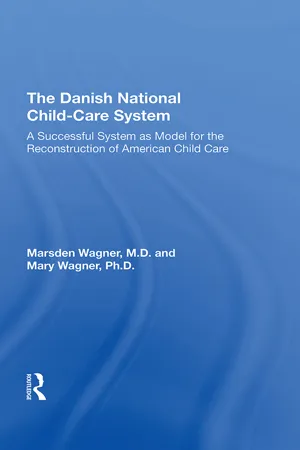
Danish National Child-Care System
A Successful System as Model for the Reconstruction of American Child Care
- 192 pages
- English
- ePUB (mobile friendly)
- Available on iOS & Android
eBook - ePub
Danish National Child-Care System
A Successful System as Model for the Reconstruction of American Child Care
About this book
This book is for all those concerned Americans and parents who are looking for ways to give children better education and care. The authors have shown areas where Denmark is strong and America is weak and have tried to give Americans hope and enthusiasm for changing things for their children.
Tools to learn more effectively

Saving Books

Keyword Search

Annotating Text

Listen to it instead
Information
Chapter
1
Who Speaks for the Children?
On March 2, 1972, in Istanbul, a fourteen-year-old schoolboy was sentenced to six years and three months in jail and ordered to pay a fine of 151,000 Turkish lira ($10,500) by a Turkish court for selling and conspiring to sell 26 kilos of hashish. The defense counsel argued that the child had agreed to sell the hashish because his family was in distress. The boy testified during the trial that his family had no money and that he had trusted “Footsey,” an otherwise unidentified American, who, he said, arranged the sale. During the trial a report from the boy’s school was read describing him as “a good influence on his schoolmates.”1
Some might say this is just another case of a “bad” boy: “Little kids are born and they’re nasty little bastards,” declares John Wayne, “but we used to realize it and straightened them out early.”2 Others would say this boy (and his family) were in dire need of an advocate, or intercessor, both before the boy got into trouble and afterward. Basic to the idea of child advocacy is the proposition that children are, from several points of view, helpless.
Young children cannot be expected to know what their needs are and how these needs might best be served. They live in a society that tends to suppress criticism or demands for attention and help. And children have no effective voice in a highly verbal society; they do not vote and have no economic or political power. It follows that an effective child advocate would be able to intercede for the child in these areas of dependency and represent him and his needs and rights in the society at large.
Perhaps our tradition of rugged individualism partly explains the question that immediately occurs to some Americans: “Why aren’t parents qualified to be the natural advocates of their children?” The answer might be that under favorable circumstances and other things being equal, they usually are. What happens, however, when parents fail to meet a child’s needs because of their own mental, physical, or economic limitations or social and cultural isolation? What if the parents lack the ability to understand, organize, and provide for all that modern society requires for this future adult, their child? Does the child get a fair deal from parents who lack the economic or political power necessary to represent him in the fierce competition for society’s limited resources? And what if parents and child have a conflict of interest that automatically disqualifies these adults as advocates for their child?
What actually does happen when parents lack the resources and society fails to represent the child’s interests is all too apparent from a review of some well-known facts. Despite America’s advanced technology, there are more than 15 countries with lower infant death rates than ours. We ensure (that is, submit to government regulation) quality day care for fewer than 10 percent of the preschool children of working mothers. About a third of the youngsters from poverty areas are two years or more behind grade level at the end of elementary school, and—most shocking of all, perhaps—homicide and suicide are the second leading cause of death among our adolescent population.3
It is not our intention to add to the already oppressive burden of guilt that most of us carry these days with regard to the less privileged of our society, in this case children. The fact is, however, that despite a growing awareness of the importance of children to the progress of our society, results fall far short of initial measures taken to deal with this reality. Thus, while the federal government has 61 different programs for various kinds of child care, many have budgets far below the congressional authorization, and others are in a state of flux and chaos. Some examples follow.
In 1971 Head Start had an authorization of $578 million and an appropriation of $360 million; the Elementary and Secondary Education program had an authorization of $41.5 billion and an appropriation of $1.9 billion; juvenile-delinquency programs had an authorization of $75 million and an appropriation of $15 million. In one recent year, the federal government spent approximately $1,750 a year for each citizen aged sixty-five and over. By contrast, for each child under twenty-one it spent $190 a year. It is as though our fiscal priorities have not yet caught up with our moral awareness.
“Surely nothing ought to interest our people more than the care of children who are destitute and neglected,” said Theodore Roosevelt, who, on December 25, 1908, issued the call for the first White House Conference on Children. This also was the first official government conference to raise the issue of child advocacy. One outcome was the formation of a Children’s Bureau at the federal level, taking its cue from the constitutional guarantee that “Congress will provide for the general welfare of the people.”
On April 9, 1912, a federal law established the Children’s Bureau, charging it to investigate and report “upon all matters pertaining to the welfare of children and child life among all classes of our people.” For a half-century, the bureau did this effectively, and as a result, many new laws were passed of benefit to children. During the same period, a number of private, mostly voluntary, organizations also served as child advocates. Their efforts, however, were largely at the local level and directed toward only one disease or condition of childhood.
During the past decade there has been an increasing awareness that the present advocacy programs are grossly inadequate. The Children’s Bureau, empowered only to investigate and report, lacked the economic and political power to push through its recommendations. The private organizations were in general neither strong enough nor mutually cooperative enough to be really effective on a national scale. As a result, a three-year study on the critical problems of children culminated in 1969 with the recommendation by the Federal Commission on the Mental Health of Children that federal funding be provided for the establishment of a child-advocacy system at every level of society.4 The 1970 White House Conference on Children recommended that a national system of child advocacy be implemented under the auspices of a designated, concerned federal agency which would supply financial support to neighborhood child-advocacy councils and their programs.
One hallmark of the scientific age is the notion that all the facts must be in before action is taken. Consequently, new ideas such as child advocacy are often submitted to much “research.” At the time of writing, there were 12 federally funded research projects on child advocacy—11 of them experiments with a new child-advocacy system and only one an evaluation of existing knowledge or programs. Such experiments will provide valuable data on the advantages and disadvantages of different systems of advocacy, but they will take years to conduct.
In a few scattered areas in the United States, limited advocacy programs have been codified into law. One example is the mental-retardation program in California. The state has been divided into districts and each district has a council appointed by elected officials; the council serves as advocate for the retarded in its district by gathering information and making recommendations for programs. Significantly, the California program is for persons obviously helpless and unable to advocate for themselves.
Program planners in the United States have another alternative besides conducting research that takes years to yield results or instituting untested programs. They can learn from other nations’ experience. Denmark has had a nationwide, multilevel child-advocacy system since the turn of the century. This system has evolved over the decades through trial and error into a program for the support of children which has much to offer the rest of the world. In view of the urgency of the need, not to mention the expense of error, we might do well to examine in detail Denmark’s experience.
Child Advocacy in Denmark
At the end of the last century there was great concern all over the world about the common practice of placing illegitimate, abandoned, or orphaned children with private families, where they were often overworked, mistreated, sold, and frequently died. The United States responded in part by passing child labor laws which were extremely hard to enforce. Although enforcement in industry was difficult, at least it was feasible at times, but not so in private families.
Denmark’s answer was a nationwide network of local lay citizens whose job it was to serve as watchdogs (advocates) for children in the individual communities. Thus its present highly developed child-advocacy system was born. The responsibilities and powers, checks and balances of the local citizen groups (now called Child and Youth Committees) have been gradually modified as revisions based on hard-won experience were made in the law (the last major one in 1964). The case of Lise* reveals the system in action:
Lise is the sixteen-year-old daughter of an unwed mother who is highly educated, a teacher, and well known for her left-wing political views. When Lise became pregnant, she was sent by her mother to live with a physician’s family in a small rural town until she gave birth. Lise did very poorly in this setting, since it was a small conservative community and the girl’s social behavior and political leanings were widely at odds with the physician’s and the rest of the community’s. For this, and perhaps other reasons, Lise became quite disturbed and was admitted to a local mental hospital, where she gave birth to her child.
What will happen to this child? Can Lise in her present mental state and at her immature age take the full responsibility for the child or for a decision to adopt? Does the physician with whom Lise has been living have any say? Does Lise’s mother? Do the doctors in the mental hospital have the right to rule on the matter? Everyone has a stake in the problem but who can be trusted to be an impartial advisor? Who will be certain to consider the interests of the newborn child as well as those of his child-mother? Because Lise lives in Denmark, the case was automatically referred to the local Child and Youth Committee, for it is the kind of case routinely taken up by these child-advocacy groups.
Organization of the Child and Youth Committees
The complexity of the problems handled by the Child and Youth Committees (CYC) is, unfortunately, matched by its organizational complexity, as seen in Figure 1. Denmark is divided into 250 local districts or townships, the closest U.S. equivalent being the municipality or township. Every four years each township elects a council in a general election. This council has a number of standing committees, one of which is the CYC—the backbone, if not the entire skeleton, of the child-advocacy system.
The CYC is formed like this: one of the council members who has a special interest in children becomes the chairman; then two or three more council members volunteer for the committee and are joined by two or three more committee members chosen by the council from local citizens to form a committee of five (or seven) members. Several important

Figure 1. Organization of Children and Youth Committees.
features of this committee should be noted: a majority (three of five or four of seven) are elected council members; all are lay people with an interest but no special training for this work; there must be both men and women on the committee; there is no pay for the work, just expenses, and all are volunteering their time; the committee may likely be reconstituted every four years.
Each CYC is served by a staff of full-time employees, hired and fired by the township council. The committee meets perhaps two or three times a month for a few hours, and it is the staff that carries out the ongoing responsibilities under the committee’s direction. The staff includes, if possible, social workers or, if these are not available, “family helpers” (see Chapter 2). Secretarial assistance and the size of the staff depend on the size of the township.
The population served by each CYC varies widely. The 250 townships range from small rural areas of 10,000 people to the Copenhagen Township with about 1.3 million inhabitants. Although the same operating principles hold nationwide, the mechanisms differ. It is important to note that the CYCs in Copenhagen, with its heavy population density (similar in most respects to any of the large U.S. urban areas), work quite differently from those in the rest of Denmark.
Functions of the Child and Youth Committees
The three key words to the ways in which the CYC serves as an advocate for the children of any community are protection, promotion, and prevention. Protection is essentially the responsibility the local citizens’ groups were given at the turn of the century: to serve as watchdogs for the welfare of each and every child in the community, no matter where he might be or what he might be doing. The basic notion here is that the child’s right to function in conditions conducive to sound development should be protected, whether he is at home, at school, or anywhere else in the community.
Protection at Home
How can the CYC watch over the well-being of a child in his own home? It is considered the duty of every citizen in the community—parent, neighbor, family doctor, schoolteacher, public-health nurse, policeman, or whatever—to report to the CYC any child who he suspects may be living under “bad conditions” or behaving in a way that might indicate “bad conditions.” Consider Marianne:
Marianne, ten years old, attends an elementary school in one of the oldest and poorest sections of Copenhagen. The schoolteacher noticed an increasing tardiness, with Marianne coming to school one, two, or three hours late. She seldom brought a lunch or had any lunch money, seemed tired all the time, and was not interested in her school work. The teacher discussed her concerns with the school counselor, and they decided to ask the school doctor to see the child. The doctor’s examination showed no signs of physical illness, but there was a slowing of growth on her growth chart and the child appeared undernourished and tired. The teacher, counselor, school doctor, and school nurse discussed the findings and decided their concerns and findings needed to be reported to the CYC. A staff member visited Marianne’s home and found the following.
Marianne’s mother had been divorced from her father and was living in a one-room apartment with Marianne and a young American man. The mother and her boyfriend were making ends meet by selling second-hand articles in a small storefront. It appeared possible, however, that drug traffic was also involved. When the staff worker arrived at 11:30 a.m., the mother and boyfriend were still in bed, the apartment was dirty and unkempt, and there was no food in the house. It was clear that Marianne was essentially fending for herself at home while the mother and her boyfriend were otherwise occupied.
Is the CYC legally permitted to intervene at this point? The law lists, in general, the conditions under which the CYC may take action:
- 1. The child has no one to provide for him—death, desertion, etc.
- 2. The breadwinner is otherwise permanently incapable of providing for the child—illness, retardation, etc.
- 3. The breadwinner is temporarily unable to provide for the child—divorce, imprisonment, mental illness, etc.
- 4. The child is not properly brought up—home environment lacking in material or educational aspects, parental lack of interest, child abuse, etc.
- 5. The child has difficulty adjusting to his daily environment, his school or community.
- 6. The child does not live under satisfactory conditions—financial conditions bad, disorderly life of parents, etc.5
Since Marianne’s problem clearly fell into several of the above categories, the CYC could act. Although in some cases it is possible for the CYC staff member to solve a problem quickly and directly, perhaps by providing emergency financial aid, in this case the problem was more complex. The CYC staff member assigned a “family helper” to follow Marianne’s case.
The family helper worked with Marianne’s mother not only to try to solve the immediate problem in the home affecting the child but also to provide the child with a good environment during the rest of her childhood. Unfortunately, after some months, the family helper concluded that, at least for the present, t...
Table of contents
- Cover
- Half Title
- Title
- Copyright
- Dedication
- Contents
- Introduction
- 1 Who Speaks for the Children?
- 2 Who Helps the Family?
- 3 A Solution for Children of Working Parents: A Nationwide Network of Day-Care Centers
- 4 Family-To-Family Day Care
- 5 Visiting Health Care for Infants
- 6 A Support System: Services for Mothers During Pregnancy and After
- 7 Training Child-Care Workers
- Conclusion
Frequently asked questions
Yes, you can cancel anytime from the Subscription tab in your account settings on the Perlego website. Your subscription will stay active until the end of your current billing period. Learn how to cancel your subscription
No, books cannot be downloaded as external files, such as PDFs, for use outside of Perlego. However, you can download books within the Perlego app for offline reading on mobile or tablet. Learn how to download books offline
Perlego offers two plans: Essential and Complete
- Essential is ideal for learners and professionals who enjoy exploring a wide range of subjects. Access the Essential Library with 800,000+ trusted titles and best-sellers across business, personal growth, and the humanities. Includes unlimited reading time and Standard Read Aloud voice.
- Complete: Perfect for advanced learners and researchers needing full, unrestricted access. Unlock 1.4M+ books across hundreds of subjects, including academic and specialized titles. The Complete Plan also includes advanced features like Premium Read Aloud and Research Assistant.
We are an online textbook subscription service, where you can get access to an entire online library for less than the price of a single book per month. With over 1 million books across 990+ topics, we’ve got you covered! Learn about our mission
Look out for the read-aloud symbol on your next book to see if you can listen to it. The read-aloud tool reads text aloud for you, highlighting the text as it is being read. You can pause it, speed it up and slow it down. Learn more about Read Aloud
Yes! You can use the Perlego app on both iOS and Android devices to read anytime, anywhere — even offline. Perfect for commutes or when you’re on the go.
Please note we cannot support devices running on iOS 13 and Android 7 or earlier. Learn more about using the app
Please note we cannot support devices running on iOS 13 and Android 7 or earlier. Learn more about using the app
Yes, you can access Danish National Child-Care System by Marsden Wagner in PDF and/or ePUB format, as well as other popular books in Politics & International Relations & Politics. We have over one million books available in our catalogue for you to explore.