- 252 pages
- English
- ePUB (mobile friendly)
- Available on iOS & Android
eBook - ePub
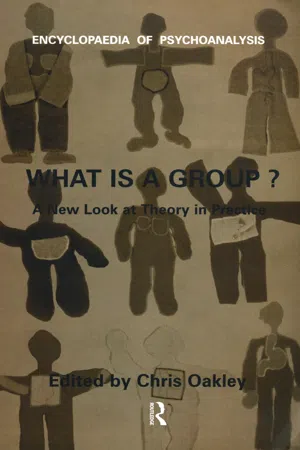
About this book
This volume on groups emphasises the importance of a psychoanalytic analysis, as opposed to a behaviourist account. Work by Foulkes and Bion is reconsidered in the light of current clinical practice by Robin Cooper and Michael Halton, and the American scene is represented through an essay by Otto Kernberg, using Freud's work on group psychology.
Information
Introduction
Any anthology or collection of papers is—potentially—something of a compromise. But it clings to a vague and insistent hope that it may transform itself into something more than the sum of its disparate parts.
Indeed, the question arises as to whether there is any inherent common purpose suffusing these chapters, beyond a response to the initial proposal to produce a book on ‘group psychoanalysis’. In the case of this compilation, we decided to tilt in the direction of a pick ‘n’ mix of psychoanalytic notables—some names that might add weight to such a collection—co-joined with some emerging chancers, all struggling for a wee spot in the sun, all with their separate agendas and idiosyn-crasies. The result is this curious manifesto of odd cullings, in which any purported links between the contributors would be more an effect of the contingent than of any meticulous planning.
Possibly the very notion of a text book—for this is, rather, a book of texts—lures the reader into a fantasy of enclosure, into an expectation of an account which covers the whole field, an invitation to ‘come on in and read all about it; we’ve got it all down!’. Indubitably this would be misleading, for there was never any intention to squeeze these random samplings into a package for export, nor to fit them into any particular syllabus.
So much contemporary psychoanalytic writing arrives dead on the page. It merely papers over the fissures that open onto the profoundly alarming abyss of anxious uncertainty, which we encounter as we endeavour to address the hurt of our being and our attempts to understand this. It is with a certain defiance—a brash humility, even—that this slender volume gestures towards something other. Is it possible to surf the Zeitgeist of these troubled psychoanalytic times, and offer up the possibility of access to the marginal, whilst simultaneously leavening this with something bordering on the orthodox? Indeed, it would certainly be implausible to attempt to define what is included in this book by means of a memorable label—for instance: The Independent Tradition, French Freud, etc.—or via the colonisation of a particular geographical location—The Palo Alto Group, The Tavistock School… For this volume is much more in the vein of an album ‘by various artists’. Whilst purposefully shying away from any attempt to chart a general or prevailing group analytic milieu—far less a recording of a history—what we have here is more a celebration of a few elective outsiders. What is valued is often the more remote, the difficult—the ‘fractured’, even—all of which might, hopefully, inaugurate a faint adrenaline rush. Consequently, there has been no attempt to identify ‘the best’ or the ‘most important’ among the contributors or the theorists whose work is addressed, or even to conduct an overarching survey of ‘group psychoanalysis ‘.
Psychoanalytic writers can so often be a quarrelsome crowd. One often anticipates demands of ‘who else is involved?’ and a withholding of work unless the project is underwritten by some suitable co-journeymen. But, for the most part (the odd envies and resentments from the also-rans notwithstanding), this project was uncontaminated by such capers.
I began with a low-key sniffing around: being passed over, passing over, passed on by certain people to others… I found my way by stalking possibilities, lurching into random moments… Philip Boxer—for instance—was picked up over lunch in the bar of London’s Hotel Russell. I just liked the man’s style, and stumbled with him and others via cogent suggestions, eventually arriving at the final compilation. Ultimately, those who are here wanted it the most, for with only a littie guidance people were encouraged to follow their own desire, to articulate particular themes around certain pivotal figures or historical moments—with Kirsty Hall’s deft hand always at my elbow, steering a path through the thickets of inertia. Hopefully what has emerged is something both intelligent and provocative; perhaps Steve Gans and Norman Velia are exemplary contributors in this respect. Michael Halton and Robin Cooper produce some fresh thoughts about two of the original innovators in the field, Bion and Foulkes. Earl Hopper engages in a valorisation of the socio-cultural dimension at play within unconscious process. Otto Kemberg provides us with an individual blend of thoughts around Freud’s classic text, Group Psychology and the Analysis of the Ego, Melanie Klein and Elias Cannetti, before arriving at his own views in connection with the contribution of narcissism to an understanding of group process. Eric Harper and Alan Rowan mount a lucid account of a Lacanian approach to groups, whilst wondering at the same time whether this venture is not lodged in the realms of impotence and impossibility. But if this book produces in its readers even the faintest trace of an invocation to think about group analysis differently, or to disrupt prevailing stagnancies, then it will all have been worthwhile.
* * *
It was Schopenhauer who saw us as entangled in the heart of our being with something incorrigibly alien. He termed it ‘The Will?, and suggested that out of it ‘we’ are formed. ‘The Will’ is, in itself, utterly meaningless and without objective, and insistently indifferent to us, yet it simultaneously sustains in us an illusory veil of purpose. Freud was not unimpressed by this conceptualisation, and installed in his theory the concept of desire which, whatever we might say, will always say what it wants (hence the psychoanalyst’s love of parapraxes), and implicitly cares for nothing but itself. Lacan called it ‘Das Ding’, the Thing, or—as the Slovenian philosopher Slavoj Zizek underscores it in his re-readings of Lacan: The Real. One might equally refer to it as life and life only, as that which makes us what we are and which is, at the same time, impenetrable, unrepresentable and obscenely enjoyable. If such ideas are taken seriously, then what significance do they have for a theory of—or an analysis of—what goes on in groups?
At times, in these chapters, one may note a mild tilt in the direction of a preference for ‘theory’ or textual exegesis, but hopefully not at the expense of the specificities of clinical practice. Inevitably there will be considerable congestion around a number of the customary sites of initiative within the group psychoanalytical field: Foulkes, Klein and Bion, amongst others. But perhaps it is also possible to discern a distillation of something more latent, a potential reversal of the more habitual maxims or aims of psychoanalytic treatment… Rather than a project enmeshed in a concern with conformity, maturity, the ‘authenticated self’—and the like—we might find instead a site within which psychoanalysis itself is entangled, as a co-conspirator in ‘the critique of the subject’.
Partially one of the effects of the Real is that it dismantles any sense that one might rendezvous with the real nature of ourselves. This aspiration is now relegated to the illusory, downgraded locus of a fantasy, a means by which one attempts to fend off the compulsive anxieties that cling to desire. Potentially, however, we come by this route to recognise that man’s habitual state is to be constantly and continuously entangled in a phantasmal mendacity. Fantasy can no longer be taken as a straightforward counterpoint to what we take reality to be; rather, it is the stopper in the hole, the plug in the lack in our being, which is actually the condition upon which the multiplicity of fictions that we call ‘reality’ depends. Following Hegel, for Lacan this ‘spaitung’, this primordial wound inaugurated by the irredeemable rupture from the immediacy of the natural, is the site from which our desire unstaunchably flows. The Real is an indivisible remainder; it is that which cannot be subsumed under any system of representation or model. The consequence of this is that we can never be identical to ourselves. In that case, neither is it be possible for any group process to be rendered totally transparent.
Draped over this only dimly perceived absence is a contagion of possible readings and responses, all vigorously propped up by an insistent demand that herein resides the ‘truth’. Indeed we can never be entirely outside of this. But for both Freud and Lacan—amongst others—at the heart of meaning there will always be a persistent residue of non-sense. This is always something other than the signifiable or representable, in which case the Real does not ‘exist’ as such, but can only be acknowledged via its effects.
Following Zizek, every signifying system, every form of interpretation, will contain that which ultimately stumbles up against a particular threshold, the effect of which is to point out that the system cannot be totalised. The system does not quite hold together, and although we are driven in our myriad and varying ways to continue to try to bring about a complete signification, this honest endeavour inevitably fails. We can recognise this point of view as the classically post-structuralist form of the story: what constitutes any sign is its difference from other signs, therefore it is impossible for any sign or ‘story’—aka theory—to be complete unto itself, precisely because its very identity can only be formed through this aforementioned difference.
However, this is also—potentially—a Hegelian or dialectical narrative, to the extent that truth is viewed not so much as in opposition to error, but rather is the result of it. Our mistakes and oversights, inevitable as we know them to be, have been always already taken into account by truth en route, as part of the very process by which it is approached. Indeed, truth itself is somewhat ‘misleading’, for rather than the objective with which we might rendezvous, truth is that which frames both the possibility, and the process of trial and error, which are all so entangled together in this impossible project. As any psychoanalyst or group analyst will know, it is these crucial misrecognitions that are essential to the enterprise. Woven into the requirement that one undergoes the experience of personal or group analysis in the context of training to be an analyst, is this encounter with the potential rupture of the fantasy—indeed, of any lingering illusion—that we will one day meet some ultimate truth, some transcendental knowledge of which someone (usually in the place of the analyst) will gain possession.
Given these considerations, we should acknowledge the fact that, for the healthy development of any language, incorporation and acceptance of foreign elements is not only likely, but entirely essential. All enduring intercourse with others—for it is from this that everything emerges—will result in the borrowing of words from their language. Indeed, this is indispensable when it comes to the cross-fertilisation of ideas.
Freud anxiously admonished practitioners of ‘wild analysis’, by pointing out that it might do more harm to psychoanalysis itself than to individual patients. However, is there not a very real possibility that its very vitality is dependent upon the potentiality of new forms of thinking? Ultimately, the debate hinges upon what precisely is meant by this term ‘wild’.
There will be countless moments or points of contact which culture sets up between people, leaving indelible traces in their language. New objectives, notions, conceptualisations—ideological, philosophical, psychoanalytical and personal—all leading to new configurations of ideas and word formations… But this is what is so conspicuously lacking in much of the prevailing psychoanalytic literature in this country and beyond. In the fifty years since the publication of Foulkes’ Group Analysis the psychoanalytic establishment has become increasingly eaten up with tension, frustrated at being neither especially talented nor able to partake of very much pleasure. One effect of this has been a congealment into forms of hatred—not appropriate hate, directed at those who abuse or oppress, but rather an irrational and (in many instances) an ignorant hatred, saturated with fear in the face of difference. Given this state of affairs, we should increase the sense of importance we attach to appreciating the significance of alternative forms of cultural production. This should be done without deciding in advance what kinds of relationships can be developed between emerging discourses and practices, and the more classical forms of psychoanalytic legitimisation. By valuing the diversity of contributions to the theoretical culture of psychoanalysis, which take place against the backdrop of an increasingly fragmented milieu, we may come to recognise a curious and unexpected complexity with regard to our sense of unity This might emerge despite an absence of any consensus between the members of the group.
It was Freud, in Group Psychology and the Analysis of the Ego, who emphasised that a bond unites us in group settings, producing an inevitable libidinal resonance within this or that association, society, or school of psychoanalysis. This depends upon a blind fidelity to an all-powerful leader. The social bond is established through the very existence of this beloved chief. It can only be maintained as long as the ‘Führer’ (for this is how Freud translated Le Bon’s ‘meneur’) is himself sustained, through an identificatory love which underwrites the possibility of group cohesion. The assumption is that the disappearance of the tie to the leader will occasion a destruction of these bonds—a form of ‘every man for himself’.
Granted, a disruption of a dominant and habitually idealised fantasy in a community setting provokes a proliferation of fissures across the surface of the social microcosm, accompanied by members of the group turning on one another. In other words, the dislocation of the mutual ties between group members is coterminous with the dismantling of the libidinal tie to the leader—who represents the prevailing fantasy that society is ‘one’, ‘united’, ‘unanimous’, all flying in formation and ultimately undifferentiated.
This is perhaps best exemplified in the use of the term ‘mass’ which, following Arendt, is a fundamental term used in contemporary totalitarianism. It is the work of the French philosophers Lacoue-Labarthe and Nancy which has underlined how there is an relationship between this insistence on the ‘mass’ as ‘an organic unity’, and similar insistences upon the unity of the subject. To put it another way, the mass, the group, the association—and the like—can erect itself as a ‘subject’ only via the introduction of the subject par excellence: the authoritarian Führer. It is the narcissistic ego-ideal and ideal ego upon which both the ‘undivided subject’ and the undivided ‘masses’ depend, in order to shore up this notion of the compact whole.
However, if we are to take Lacan’s thesis seriously—which is so suffused with the ideas that flowed from Kojève’s influential lectures in France in the 1930s—are we not obliged to deconstruct relentlessly any idea of a grounding super-ego, in order to resist the temptation it offers to shore up our faltering and always suspect identity? And does this not apply at the level of the individual, the group or organisation, and the discursive register? For in the analytic encounter, there should be no-one and nothing to mirror or to bolster the subject’s increasingly ruptured, ultimately false and misleading ego. Unless, that is, one is working in the field of psychosis. This is not to prioritise Lacan, but merely to require his thought and writings to go to work. This is always already set in the context of the interweave of one specific psychoanalytic oeuvre working on, joining up with, other bodies of psychoanalytic thought.
Inevitably, however, we must confront the fear of ‘obscurity’, which is one of the motivating forces in the compulsive, totalitarian drive towards conformity and homogeneity. Contemporary psychoanalytic politics is saturated by a dread of an immutable law of that fundamental dynamic of our being—seduction. Here, ‘full signs’ do not operate, but remain obscure and enigmatic. The consequence of this dread is a capitulation in the face of the demand to place everything under the sign of luminous legibility. However, taking up a position on the run from this project of incorrigible transparency does not lead inevitably to a collapse into the dualistic, in that it does not automatically inaugurate the counter-position of revelling in some ‘brute meaninglessness of things’.
Any group or community is inevitably vexed by the problem of our ultimate inability to gain access to the ‘other’. The ‘other’ is always alien, irreducible, and incomplete, and therefore unknowable as a whole. Consequently any introduction to the work, the project of group analysis, lies not in the whole of the project but rather in the hole which informs and sustains it—the gap or yawning abyss wherein is unveiled the truth of ‘the subject supposed to know’.
Perhaps what is communal—the common ground that is to be shared with others—is precisely this recognition that we are never self-transparent, never completed, nor even wholly bound to our own cuitural context, for we are always to some extent out of sync with it. The hollow fictions of mastery, truth, closure, subjectivity—the ‘twilight of the idols’, indeed—and the transference onto fantasised sites of legitimating authority such as Freud and Lacan can be potentially un-handcuffed from the Father-Signified, which is merely the locus of a narcissistically configured ideal. In their place we might pass from an inappropriate certainty of consciousness, towards the unmasterable gap or hole in our ceaselessly spiralling desire. Thus a communality may be built upon realisation that there will always be that which eludes our grasp, and that it is in the overlap of these multiple absences that a possibility of a meeting can arise.
Table of contents
- Cover
- Title
- Copyright
- CONTENTS
- Foreword
- Notes on Contributors
- 1 Introduction
- 2 Freud on Groups
- 3 Foulkes and Group Analysis
- 4 Bion, Foulkes and the Oedipal Situation
- 5 Mass Psychology Through the Analytic Lens
- 6 The Social Unconscious in Clinical Work
- 7 The Dilemmas of Ignorance
- 8 Group Subversion as Subjective Necessity—Towards a Lacanian Orientation to Psychoanalysis in Group Settings
- 9 Levinas and the Question of the Group
- Bibliography
- Index
Trusted by 375,005 students
Access to over 1.5 million titles for a fair monthly price.
Study more efficiently using our study tools.
Frequently asked questions
Yes, you can cancel anytime from the Subscription tab in your account settings on the Perlego website. Your subscription will stay active until the end of your current billing period. Learn how to cancel your subscription
No, books cannot be downloaded as external files, such as PDFs, for use outside of Perlego. However, you can download books within the Perlego app for offline reading on mobile or tablet. Learn how to download books offline
Perlego offers two plans: Essential and Complete
- Essential is ideal for learners and professionals who enjoy exploring a wide range of subjects. Access the Essential Library with 800,000+ trusted titles and best-sellers across business, personal growth, and the humanities. Includes unlimited reading time and Standard Read Aloud voice.
- Complete: Perfect for advanced learners and researchers needing full, unrestricted access. Unlock 1.5M+ books across hundreds of subjects, including academic and specialized titles. The Complete Plan also includes advanced features like Premium Read Aloud and Research Assistant.
We are an online textbook subscription service, where you can get access to an entire online library for less than the price of a single book per month. With over 1.5 million books across 990+ topics, we’ve got you covered! Learn about our mission
Look out for the read-aloud symbol on your next book to see if you can listen to it. The read-aloud tool reads text aloud for you, highlighting the text as it is being read. You can pause it, speed it up and slow it down. Learn more about Read Aloud
Yes! You can use the Perlego app on both iOS and Android devices to read anytime, anywhere — even offline. Perfect for commutes or when you’re on the go.
Please note we cannot support devices running on iOS 13 and Android 7 or earlier. Learn more about using the app
Please note we cannot support devices running on iOS 13 and Android 7 or earlier. Learn more about using the app
Yes, you can access What Is A Group? by Chris Oakley in PDF and/or ePUB format, as well as other popular books in Psychology & Mental Health in Psychology. We have over 1.5 million books available in our catalogue for you to explore.